
Posted inText Meaning
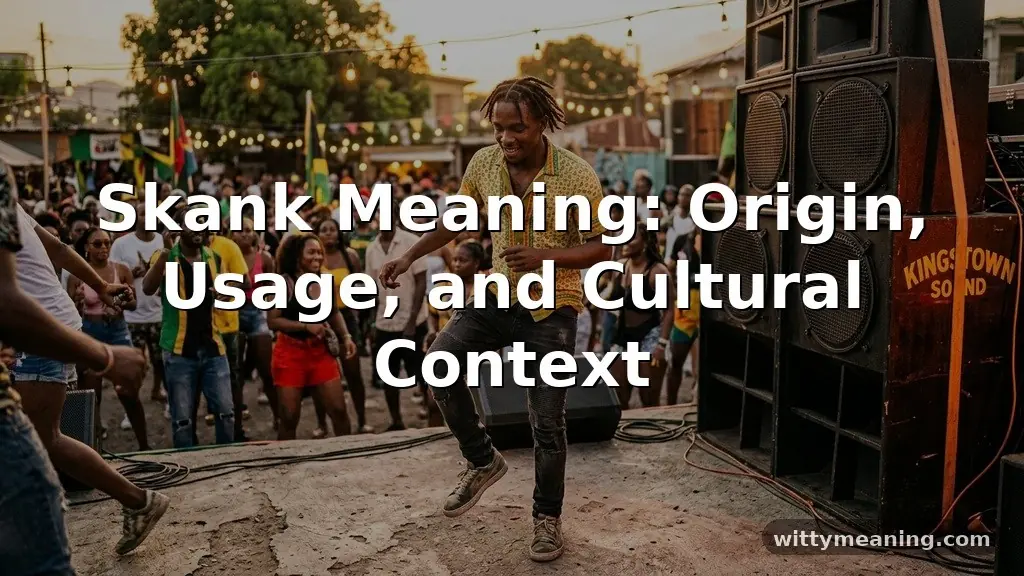
Skank Meaning: Origin, Usage, and Cultural Context
The term "skank" is a complex linguistic artifact that carries drastically different connotations depending on the context in…
















































You’ve probably heard someone described as “witty” and instantly pictured the type. Fast replies. Clever humor. The person who somehow wins the room with one perfectly timed sentence while everyone else is still thinking of a response ten minutes later.
And maybe that’s why you searched for “witty meaning” in the first place.
Not because the word is complicated. It isn’t. The tricky part is understanding how “witty” differs from just being funny, sarcastic, or smart. People use those words interchangeably all the time. They shouldn’t.
A witty person doesn’t simply crack jokes. They combine intelligence, timing, language, and observation in a way that feels effortless. That’s the difference.
Let’s unpack it properly.
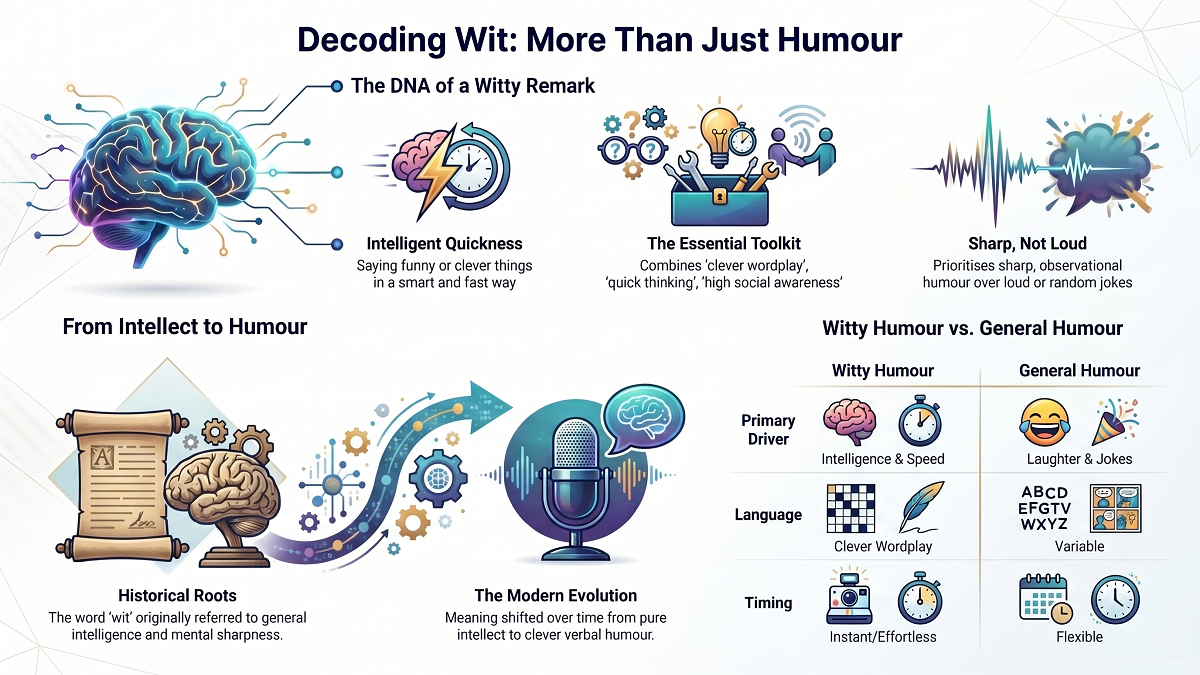
At its core, the word “witty” describes someone who uses clever and amusing language quickly and intelligently.
Not loud humor. Not random jokes.
Sharp humor.
A witty remark usually contains:
Here’s the simplest witty definition:
A witty person says funny or clever things in a smart and fast way.
Short. Clean. Accurate.
Most dictionaries define “witty” as:
The word comes from the older English term “wit,” which historically referred to intelligence and mental sharpness, not humor alone.
That matters.
Originally, wit meant intellect. Over time, the meaning evolved into intelligent humor and clever communication.
“Witty” is pronounced:
WIT-ee
Two syllables. Stress on the first.
Witty banter refers to a playful, fast-paced exchange of clever remarks between two or more people. It usually involves humor, quick thinking, teasing, and smart wordplay without becoming genuinely offensive.
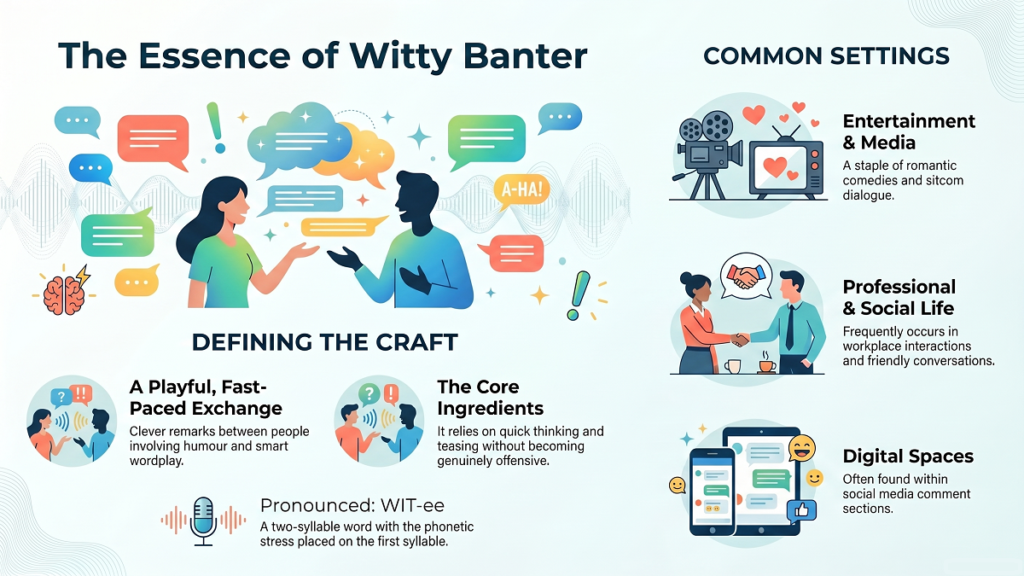
You’ll often hear witty banter in:
The key feature of witty banter is balance. Both people contribute equally to the humor, keeping the conversation energetic and entertaining.
Example:
Person 1: “You’re late.”
Person 2: “I prefer to arrive dramatically.”
That light, clever back-and-forth is witty banter.
People enjoy witty banter because it shows:
Witty humor is a type of intelligent humor that relies on clever ideas, wordplay, irony, or quick observations instead of simple jokes or physical comedy.
Unlike slapstick humor, witty humor makes people laugh because it feels smart and surprising.
It often includes:
Example of witty humor:
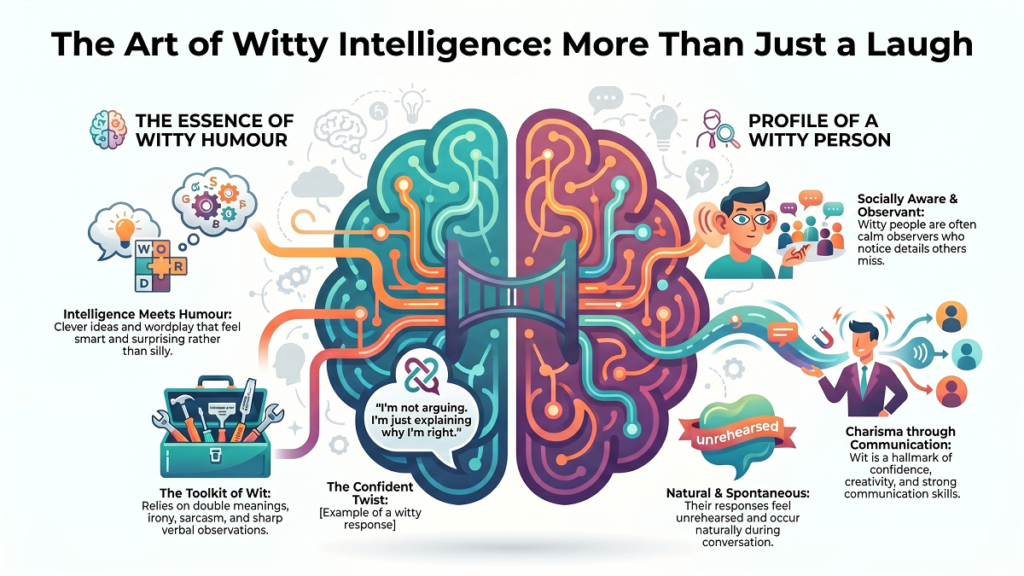
“I’m not arguing. I’m just explaining why I’m right.”
The humor comes from the confident twist in the sentence rather than from silliness alone.
Witty humor appears frequently in:
A witty person is someone who can quickly make clever, amusing, and intelligent comments during conversations. They often use humor naturally and know how to respond in creative ways.
Witty people are usually:
Their humor feels spontaneous rather than rehearsed.
For example:
“Jake is such a witty person. He always has the perfect comeback.”
Being witty does not necessarily mean someone is loud or constantly joking. Many witty people are actually calm observers who notice details others miss.
A witty personality is often associated with:
In English, the word “witty” means cleverly funny or mentally sharp in speech and writing. It describes someone who uses intelligence and humor together to entertain people.
The adjective comes from the noun “wit,” which originally meant intelligence or mental ability.
Modern English uses “witty” to describe:
Example sentences:
The word is commonly used in:
Witty jokes are smart and clever jokes that rely more on intelligence, timing, and wordplay than on exaggerated storytelling or physical comedy.
These jokes are usually:
A witty joke often makes people pause for a second before laughing because the humor comes from understanding the clever twist.
Example:
“I used to play piano by ear. Now I use my hands.”
That joke works because of wordplay and double meaning.
Witty jokes are popular because they feel sophisticated and memorable. They’re commonly used in:
People who enjoy witty jokes often appreciate intelligent humor and quick-thinking conversation.
This is where people get confused.
A person can be funny without being witty. A person can also be intelligent without sounding witty at all.
Wit sits in the overlap between humor and intelligence.
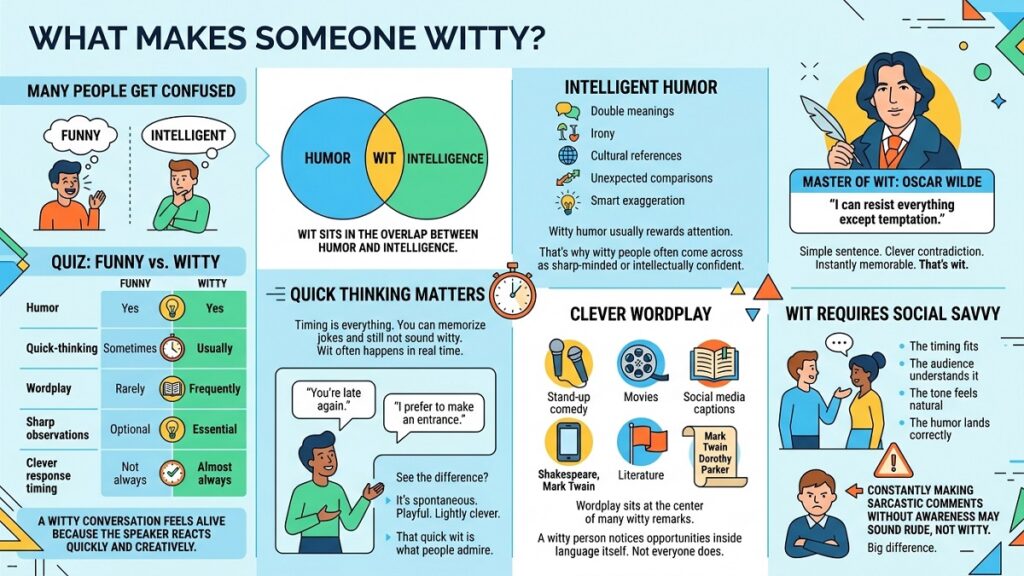
Think of it like this:
| Trait | Funny Person | Witty Person |
|---|---|---|
| Humor | Yes | Yes |
| Quick-thinking | Sometimes | Usually |
| Wordplay | Rarely | Frequently |
| Sharp observations | Optional | Essential |
| Clever response timing | Not always | Almost always |
A witty conversation feels alive because the speaker reacts quickly and creatively.
Timing is everything.
You can memorize jokes and still not sound witty. Wit often happens in real time.
Example:
Someone says:
“You’re late again.”
A witty response might be:
“I prefer to make an entrance.”
See the difference?
It’s spontaneous. Playful. Lightly clever.
That quick wit is what people admire.
Witty humor usually rewards attention.
The joke may involve:
That’s why witty people often come across as sharp-minded or intellectually confident.
Oscar Wilde built an entire literary reputation around this style of communication.
One of his famous lines:
“I can resist everything except temptation.”
Simple sentence. Clever contradiction. Instantly memorable.
That’s wit.
Wordplay sits at the center of many witty remarks.
You’ll see it in:
Shakespeare loved this technique. So did Mark Twain and Dorothy Parker.
A witty person notices opportunities inside language itself.
Not everyone does.
Here’s the part people ignore.
Wit is social.
A witty comment only works if:
Someone constantly making sarcastic comments without awareness may sound rude, not witty.
Big difference.
These three words overlap constantly online. Still, they describe different communication styles.
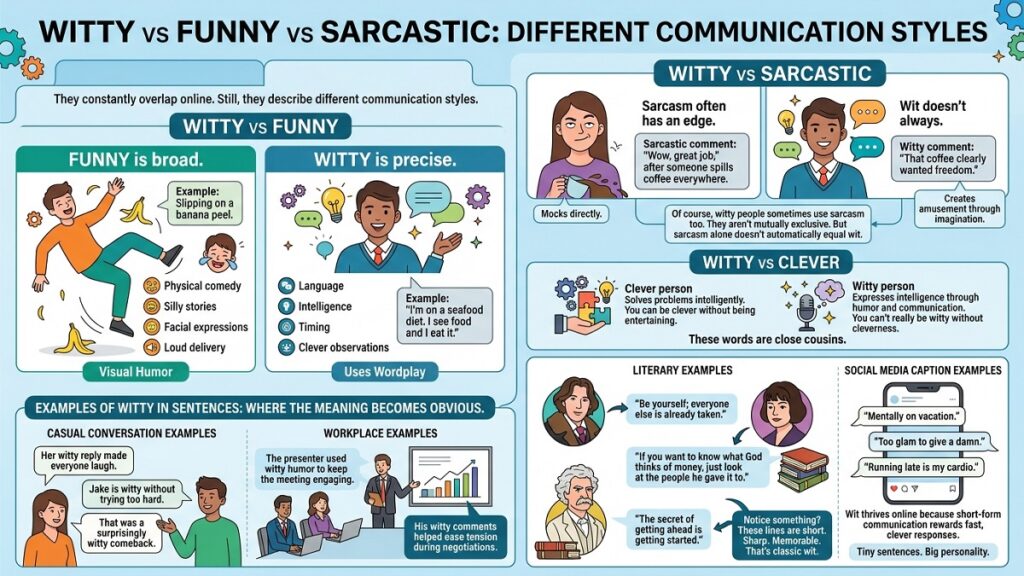
Funny is broad.
Witty is precise.
A funny person may rely on:
A witty person relies more on:
Example of funny:
Slipping on a banana peel.
Example of witty:
“I’m on a seafood diet. I see food and I eat it.”
One is visual humor. The other uses wordplay.
Sarcasm often has an edge.
Wit doesn’t always.
Sarcastic comment:
“Wow, great job,” after someone spills coffee everywhere.
Witty comment:
“That coffee clearly wanted freedom.”
One mocks directly. The other creates amusement through imagination.
Of course, witty people sometimes use sarcasm too. The two aren’t mutually exclusive. But sarcasm alone doesn’t automatically equal wit.
These words are close cousins.
A clever person solves problems intelligently.
A witty person expresses intelligence through humor and communication.
You can be clever without being entertaining.
You can’t really be witty without cleverness.
This is where the meaning becomes obvious.
Many famous authors were known for witty dialogue.
Oscar Wilde:
“Be yourself; everyone else is already taken.”
Dorothy Parker:
“If you want to know what God thinks of money, just look at the people he gave it to.”
Mark Twain:
“The secret of getting ahead is getting started.”
Notice something?
These lines are short. Sharp. Memorable.
That’s classic wit.
Wit thrives online because short-form communication rewards fast, clever responses.
Examples:
Tiny sentences. Big personality.
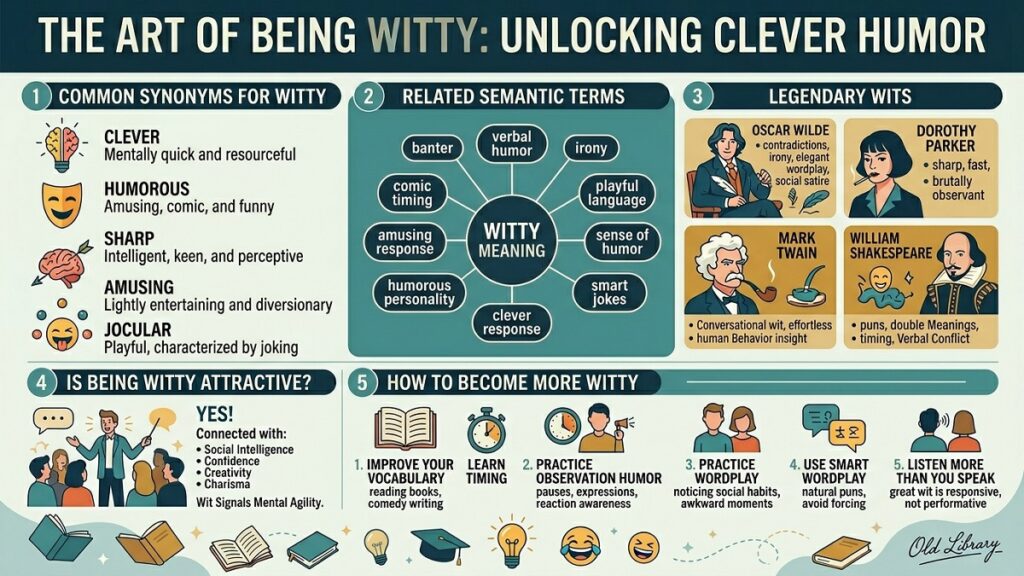
If you’re searching for a witty synonym, context matters. Some alternatives lean playful. Others lean intellectual.
Strong intelligence mixed with creativity.
General amusement or comedy.
Mentally quick and perceptive.
Lightly entertaining.
Playful and joking.
Humorous in a slightly inappropriate or unserious way.
You’ll frequently see these NLP-related terms appear alongside “witty meaning”:
Search engines connect these semantic terms because they help explain the broader topic naturally.
Some people become legendary because of their wit alone.
Not their looks. Not their titles. Their words.
Probably the most quoted witty writer in English literature.
His style relied on:
He could dismantle an idea in one sentence.
Her wit was sharp, fast, and brutally observant.
Many modern social media humor styles actually resemble Parker’s short, biting format.
Twain mastered conversational wit.
His humor sounded effortless because it reflected real human behavior so accurately.
Even centuries later, Shakespeare’s witty dialogue still shapes modern comedy and storytelling.
Much of his humor relied on:
Honestly? For many people, yes.
Studies in psychology and communication consistently connect humor with:
Wit signals mental agility.
That’s why witty people often appear:
There’s also a practical reason.
A witty conversation keeps attention. People enjoy talking to someone who can entertain, respond quickly, and create playful energy without forcing it.
That skill matters socially and professionally.
Good news.
Wit isn’t purely genetic.
You can absolutely improve it.
Witty people tend to have flexible language skills.
More words mean:
Read more. Especially:
A mediocre joke with perfect timing beats a brilliant joke delivered badly.
Watch skilled comedians carefully.
Notice:
Timing creates impact.
Most witty comments come from noticing ordinary things differently.
Train yourself to observe:
That’s the raw material of wit.
Don’t force puns every five seconds.
Natural wordplay works because it surprises people.
Bad wordplay feels rehearsed.
Huge difference.
This sounds backward. It isn’t.
Witty people are often excellent listeners because quick humor depends on reacting accurately to what others say.
Great wit is responsive, not performative.
A witty person uses intelligent humor, quick thinking, and clever language to entertain or communicate effectively.
No. Funny is broader, while witty humor specifically relies on intelligence, timing, and wordplay.
A witty remark is a smart, amusing, and often quick comment designed to entertain or cleverly respond to a situation.
Sometimes. Wit and sarcasm overlap, but wit is usually more playful and intelligent, while sarcasm often carries criticism.
Usually, yes.
Calling someone witty often implies:
It’s generally considered a highly positive personality trait.
The real meaning of “witty” has less to do with telling jokes and more to do with how someone thinks.
Wit is speed. Observation. Precision. Language. Timing.
A witty person notices connections other people miss and expresses them in a way that feels both intelligent and amusing.
That’s why wit stands out.
Anyone can memorize a joke.
Not everyone can create a clever response on the spot and make it sound effortless.