
The concept of being invincible is one that has permeated human culture, literature, and philosophy for millennia. At its core, the invincible meaning denotes a state of being incapable of being conquered, defeated, or overcome. While the term is often used in a literal sense to describe physical dominance or impenetrable defenses, its true weight is frequently found in the realm of the human psyche.
To be truly invincible is to possess an indomitable spirit that remains intact regardless of external circumstances. This article explores the linguistic roots, philosophical implications, and practical applications of this powerful descriptor, revealing why it remains a foundational element of our collective understanding of human potential.
Etymology and Linguistic Roots of Invincibility

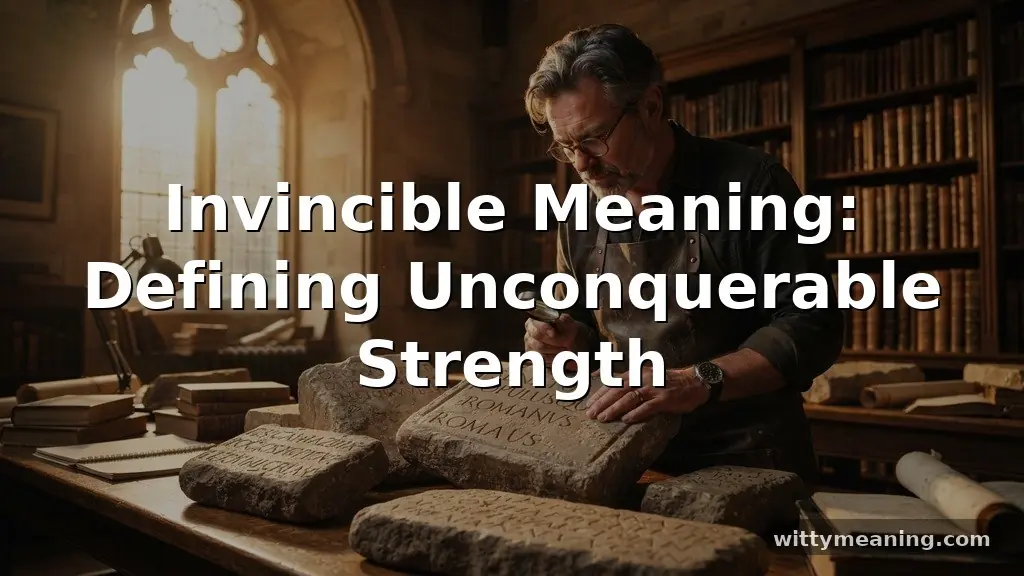
To understand the term fully, one must look at its origins. The invincible definition finds its roots in the Latin root invincibilis, which is derived from the prefix in- (meaning “not”) and vincibilis (meaning “conquerable”). When combined, these elements create a word that literally translates to “that which cannot be conquered.”
This etymological foundation provides a clear picture of the word’s primary function: to describe something or someone that stands beyond the reach of defeat. Throughout history, this term has been applied to everything from military fortifications and divine beings to abstract concepts like truth or justice.
The evolution of the word suggests a transition from purely physical descriptions to more nuanced, metaphorical applications. In classical antiquity, to be invincible was to be a warrior who could not be slain or a fortress that could not be breached. However, as language evolved, the term began to encompass the idea of psychological strength.
Today, when we describe someone as invincible, we are rarely suggesting they are physically immortal. Instead, we are acknowledging their capacity to withstand pressure, remain steadfast in the face of adversity, and maintain their core identity regardless of the challenges they encounter. This linguistic shift reflects our broader understanding that the most significant battles are often fought internally.
The Invincible Mindset and Psychological Fortitude
Developing an invincible mindset is not about arrogance or the denial of reality; rather, it is about cultivating a deep sense of self-efficacy. This psychological framework allows an individual to approach life’s difficulties with the belief that they possess the internal resources necessary to navigate any situation. This is not the same as being invulnerable, which implies an inability to be hurt.
Instead, it is about resilience—the ability to experience a setback and emerge from it with one’s resolve strengthened. The truly invincible person acknowledges the possibility of failure but refuses to let it define their long-term trajectory.
This mental state is closely linked to emotional endurance. Life is inherently unpredictable, and the capacity to regulate one’s emotions during periods of intense stress is the hallmark of an invincible character. By practicing mindfulness and maintaining a clear perspective, individuals can prevent temporary setbacks from turning into permanent defeats.
This form of strength is quiet and consistent, characterized by a refusal to give up when the path forward seems blocked. It is the internal realization that while external conditions may change, one’s agency and core values remain within their own control, providing a stable foundation from which to operate regardless of external volatility.
Mythological Archetypes and the Achilles Heel
Throughout history, mythological archetypes have served as the primary vehicles for exploring the concept of being unbeatable. From the gods of Olympus to the heroes of epic poetry, human culture has long been obsessed with the idea of the invincible warrior. However, these myths almost always contain a crucial caveat: the Achilles heel.
This trope serves as a vital reminder that, in the human experience, total invincibility is a paradox. Even the most powerful mythological figures are defined by their singular point of vulnerability. This narrative device teaches us that perfection is not a prerequisite for greatness.
The existence of a weakness does not negate an individual’s strength; rather, it humanizes it. In modern contexts, we can view our own “Achilles heels”—our personal insecurities, past traumas, or professional blind spots—not as fatal flaws, but as areas requiring heightened self-awareness. When we acknowledge our vulnerabilities, we actually move closer to a state of true invincibility because we are no longer operating under the illusion of perfection.
By protecting our weak points through preparation and support, we become more difficult to defeat than if we pretended those weaknesses did not exist. The mythic hero who knows their flaw is infinitely more dangerous to their enemies than the one who believes they are entirely untouchable.
Stoicism and the Nietzschean Will to Power
The intersection of Stoicism and the Nietzschean will to power offers a compelling philosophical lens through which to view the invincible spirit. Stoicism teaches us that while we cannot control the events of the world, we have absolute dominion over our internal reactions. An invincible person, in the Stoic sense, is someone whose peace of mind cannot be compromised by external chaos.
They are unconquerable because they have detached their sense of self-worth from outcomes they cannot influence. This creates a form of impenetrable serenity that is immune to the ups and downs of fortune.
Conversely, the Nietzschean perspective focuses on the active creation of strength. The “will to power” is the fundamental drive within every individual to expand, achieve, and master their environment. An invincible individual in this context is one who continuously overcomes themselves, refining their capabilities and asserting their values upon the world.
When these two philosophies are combined, they create a powerful blueprint for living: the Stoic’s ability to endure and the Nietzschean drive to overcome. Together, they form a holistic definition of strength that is both defensive and offensive, allowing an individual to maintain their integrity while actively shaping their destiny.
Comparing States of Strength

To better understand the nuances of the term, it is helpful to contrast it with related concepts. While often used interchangeably, these words carry distinct shades of meaning that affect how we perceive the strength of a person or an idea.
| Term | Core Meaning | Primary Context |
|---|---|---|
| Invincible | Cannot be defeated | Strategic, psychological, or physical dominance. |
| Indomitable | Cannot be subdued or discouraged | Spirit, willpower, and moral conviction. |
| Invulnerable | Cannot be wounded or damaged | Physical protection or emotional detachment. |
| Resilient | Able to recover quickly from difficulty | Adaptability and long-term endurance. |
This table highlights that while invincibility is a goal, it is often supported by qualities like resilience and indomitability. A person may be resilient without being invincible, but it is nearly impossible to be truly invincible without a high degree of resilience. Understanding these distinctions allows for more precise communication and a better grasp of the multifaceted nature of human strength.
Practical Applications in Professional and Personal Life
In the modern professional landscape, the invincible meaning is increasingly applied to career longevity and leadership. An invincible professional is someone who possesses high levels of fortitude, allowing them to pivot when industries shift or when projects fail.
They are not defined by a single role or a single success; rather, they are defined by their ability to provide value consistently across varying environments. This professional invincibility is built on a foundation of continuous learning, networking, and the ability to maintain composure during high-stakes negotiations.
In personal life, this concept translates to the ability to maintain one’s values in the face of social pressure. Whether it is resisting negative peer influence or standing firm in one’s ethical convictions, an invincible spirit acts as a compass. It is the quiet confidence that comes from knowing who you are and what you stand for.
When you are rooted in your own principles, you become difficult to manipulate or sway. This does not mean you are closed to new information; rather, it means your core identity is sufficiently robust that it can withstand the scrutiny and criticism of others without crumbling. It is the ultimate form of self-possession.
Overcoming Insurmountable Obstacles
The term insurmountable is often paired with the concept of invincibility, usually to describe the scale of the challenge being faced. When someone is described as having an invincible spirit, it is almost always in the context of them facing an obstacle that everyone else deemed impossible to overcome.
The reality is that “insurmountable” is often a subjective label. History is filled with individuals who looked at seemingly impossible situations—be it in science, civil rights, or exploration—and refused to accept the consensus that defeat was inevitable.
What differentiates these individuals is their refusal to engage with the concept of “impossible.” They break down large, daunting tasks into manageable components and focus on the immediate next step. This granular approach is a practical manifestation of the invincible mindset.
By focusing on what can be done in the present moment, they strip the obstacle of its power to intimidate. They understand that even the most massive mountain can be climbed if one is willing to take enough small, steady steps. This is the essence of true strength: the ability to remain focused and committed when the odds are overwhelmingly stacked against you.
Synonyms, Antonyms, and Linguistic Nuances
Navigating the synonyms and antonyms of this word helps to refine our understanding of its boundaries. Synonyms like “unbeatable,” “unconquerable,” and “unassailable” emphasize the external component of the term—the idea of being immune to outside forces.
However, when we look at the antonyms, such as “vulnerable,” “fragile,” or “defenseless,” we gain insight into what we are actually trying to avoid when we strive for invincibility. It is not necessarily the absence of danger that we fear, but the state of being unprepared for it.
* Synonyms for Invincible: Unbeatable, indomitable, unassailable, unconquerable, bulletproof, and insurmountable.
* Antonyms for Invincible: Vulnerable, fragile, weak, breakable, defenseless, and conquerable.
Using these terms effectively requires an understanding of context. For instance, calling a piece of computer software “invincible” might imply it is secure against hacking, while calling a person “invincible” suggests a depth of character that cannot be broken. Recognizing these nuances prevents the misuse of the term and allows for more impactful communication.
It is also important to note that the pursuit of invincibility can sometimes be a trap; if one becomes too rigid in their “unbeatable” status, they may lose the flexibility required to adapt to a changing world. True strength often requires the wisdom to know when to bend.
Addressing Common Misconceptions and Topical Gaps
One common misconception is that being invincible means one never experiences pain or loss. This is a fundamental misunderstanding of the human condition. Even the most invincible character traits—such as courage, persistence, and moral clarity—are forged in the fires of adversity.
You cannot develop true strength if you have never been tested. Therefore, pain and loss are not the opposites of invincibility; they are the catalysts for it.
Another gap in the general understanding of this topic is the role of community. We often view the invincible person as a “lone wolf,” but in reality, the most formidable individuals are those who have built strong networks of support.
Being invincible does not mean you have to do everything alone. It means you are capable of gathering the necessary resources—whether those are internal mental tools or external social connections—to ensure your survival and success. By framing invincibility as a collaborative and adaptive process rather than a solitary, static state, we make it an attainable goal for everyone.
This perspective shift is crucial for those who feel overwhelmed by the modern world. You do not need to be a mythological hero to possess an invincible spirit; you simply need the willingness to persist, the humility to learn, and the courage to remain true to yourself when the world demands you become something else.
FAQ: Understanding Invincibility
What does it mean if someone is considered invincible?
When someone is considered invincible, it means they possess a level of resolve, strength, or resilience that makes them appear immune to defeat. In a practical sense, this refers to their ability to maintain their integrity and purpose despite facing significant obstacles, criticism, or failure.
Is invincible a positive or negative trait?
Invincibility is generally viewed as a positive trait, as it represents strength and endurance. However, it can have a negative connotation if it leads to arrogance, a refusal to accept help, or a lack of self-awareness. True invincibility is balanced by humility and a willingness to adapt.
What is the difference between being invincible and being invulnerable?
Invincible refers to the inability to be conquered or defeated in a struggle or pursuit. Invulnerable, by contrast, implies an inability to be physically or emotionally wounded. One can be invincible in their goals while still being vulnerable to the emotional pain of human experience.
Can a person truly be invincible in their daily life?
No person is literally invincible, as everyone faces physical and emotional limitations. However, a person can achieve a metaphorical state of invincibility by cultivating an indomitable spirit, strong psychological fortitude, and the ability to recover from setbacks, effectively becoming “unconquerable” in their personal and professional journey.
Conclusion
The invincible meaning transcends the simple definition of being unbeatable. It is a complex, multifaceted concept that bridges the gap between ancient mythology and modern psychological science.
By examining the Latin root invincibilis, we see that the term has always been about the refusal to be conquered. Whether we are discussing the Nietzschean will to power, the Stoic approach to emotional regulation, or the practical development of resilience, the underlying theme remains the same: strength is not the absence of struggle, but the ability to remain steadfast within it.
By acknowledging our own vulnerability, we gain the clarity needed to fortify our weaknesses and leverage our strengths. This process of self-improvement is the true path to an invincible spirit. While we may not achieve the literal immortality of the gods, we can certainly achieve a level of personal mastery that allows us to navigate the complexities of life with grace and determination.
Remember that being unconquerable is not a destination but a practice—a daily commitment to rise, adapt, and continue forward regardless of the obstacles in your path. Embrace your capacity for growth, and you will find that the only thing truly capable of defeating you is the decision to stop trying.