
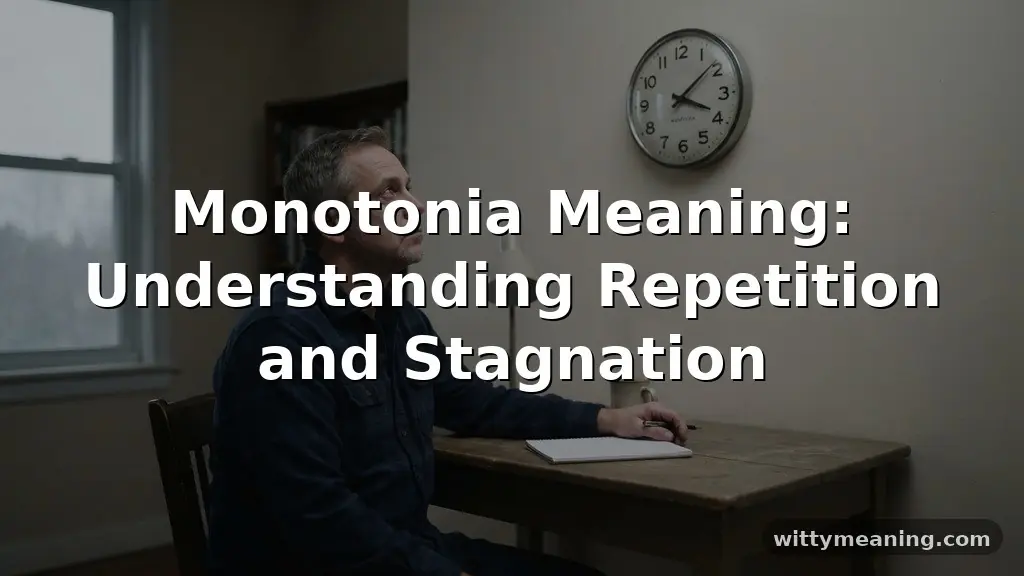

The monotonia meaning centers on the experience of sameness, a lack of variation, or the persistent feeling that life has become a series of identical, uninspired events. Whether derived from the Spanish term monotonía or its English linguistic cousin, monotony, the concept describes a state of being where stimulation is absent and the rhythm of daily existence feels trapped in a loop.
While it is often discussed in the context of boredom, the term carries deeper implications for human psychology, productivity, and emotional well-being. By dissecting the roots of this feeling, we can better navigate the transition from a life defined by stagnant repetition to one enriched by intentional novelty and creative engagement.
Defining the Core Concept of Monotonia
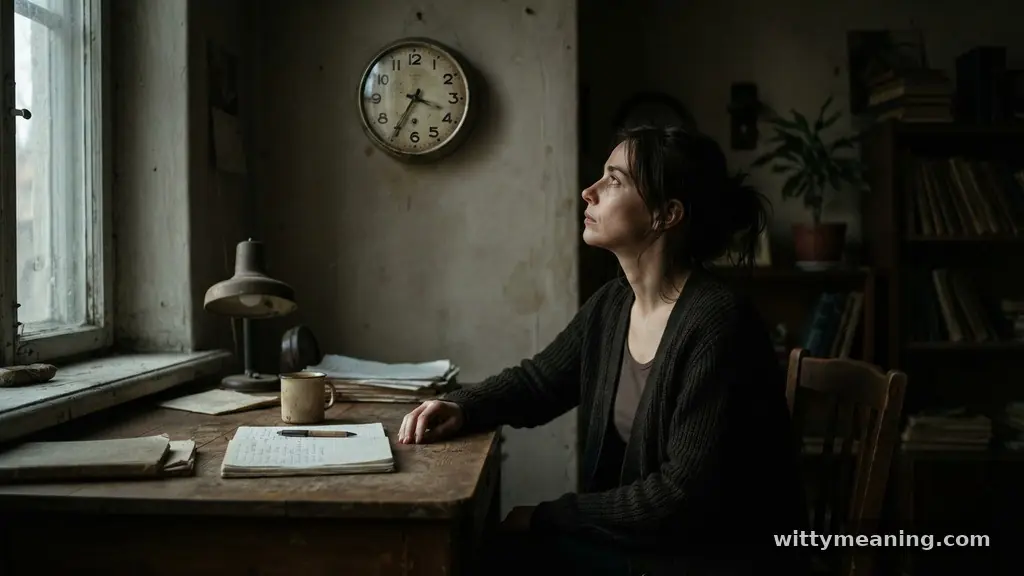
At its most basic level, monotonia is the objective or subjective experience of uniformity. When we speak of a repetitive sound, such as the steady hum of a ventilation fan or the rhythmic ticking of a clock, we are witnessing the physical manifestation of monotony.
However, the term extends far beyond auditory experiences. It describes a quality of existence where the lack of change becomes the defining feature of one’s environment or internal state.
When a person feels they are trapped in a stagnant relationship, they are often grappling with the emotional weight of monotonia. In this context, the interactions between individuals have become predictable to the point of exhaustion, where the spark of spontaneity has been replaced by habitual, mechanical exchanges. It is important to distinguish between “quietude” and “monotonia.”
Quietude can be restorative, providing a necessary pause in a chaotic world. Monotonia, by contrast, is characterized by a lack of growth.
It is the feeling of running on a treadmill: you are putting in the effort, yet you are not moving toward a new destination. This sense of being stuck is precisely what makes the concept so frustrating for those who value progress and intellectual stimulation.
Linguistic Roots and Variations
The term finds its origins in the Greek words monos (single) and tonos (tone or pitch). Historically, this referred to a lack of musical variation, where a single note or pitch was sustained without modulation. Over centuries, the word evolved to encompass a broader spectrum of human experience.
In Spanish, the word monotonía retains the same meaning, though it often carries a more poetic or melancholic weight in literature and song. This linguistic consistency across languages highlights a universal human struggle: the tension between our need for the safety of routine and our innate desire for the thrill of the new.
When analyzing the etymology, we see that the term was never intended to be purely negative. In engineering or design, a “monotone” approach can imply consistency, reliability, and precision. However, when applied to the human condition, the shift from “consistent” to “monotonous” signals a tipping point where efficiency turns into stagnation.
Understanding these roots helps us recognize that the feeling is not a personal failing but a biological response to a lack of sensory or intellectual input. Our brains are wired to prioritize novel stimuli; when that input is missing, the brain signals distress in the form of boredom or apathy.
Psychological and Practical Implications
When individuals experience this state, the impact on cognitive function can be profound. Long-term exposure to environments lacking variety—such as repetitive manual labor or isolated working conditions—can lead to a decline in problem-solving abilities and a decrease in dopamine production. The brain, effectively “bored” by its own lack of challenge, begins to conserve energy, leading to lethargy and a diminished capacity for creative thinking.
Practically, this state often manifests as the “autopilot” mode. You might find yourself driving home from work with no memory of the journey, or performing complex tasks with such mechanical efficiency that you stop paying attention to the details. While efficiency is a virtue in business, the psychological cost is a disconnection from the present moment.
If we spend our days in a blur of sameness, we lose the ability to anchor ourselves in our own lives. This leads to a sense of time “disappearing,” where weeks or months pass by without a single distinct memory to mark their passing. This is the danger of unchecked monotony; it doesn’t just make life boring—it makes life feel shorter.
Cultural Impact and Modern Context
The cultural resonance of this concept is perhaps most visible in contemporary art and media. For instance, the global popularity of the song “Monotonía” by Shakira brought the word into the mainstream conversation, using it to describe the emotional decay of a romantic partnership.
In this cultural context, the monotonia meaning shifts from a general sense of boredom to a specific, painful realization that love has been drained of its vitality by the weight of routine. This highlights how modern society uses the term to describe the “graying” of our most important human connections.
In the digital age, we have created a paradox. We have access to infinite information and entertainment, yet many report feeling more trapped in routine than ever before. Algorithms designed to show us “more of what we like” can create a digital form of monotonia, where we are never challenged by new ideas or perspectives.
This “echo chamber” effect is a modern iteration of the stagnant relationship: it is comfortable, predictable, and ultimately limiting. Recognizing this phenomenon is the first step toward reclaiming our agency in an age of filtered, repetitive content.
Synonyms and Related Nuances

To fully grasp the scope of this concept, it is useful to consider these related terms: boredom, tedium, repetitiveness, and ennui. Each word carries a slightly different shade of meaning, allowing us to pinpoint exactly what we are feeling.
| Term | Primary Nuance | Context of Use |
|---|---|---|
| Monotonia | State of uniformity | General, structural, or emotional stagnation. |
| Tedium | Exhausting repetition | Work-related or task-based frustration. |
| Ennui | Existential listlessness | Deep, philosophical dissatisfaction. |
| Dullness | Lack of sharpness | Refers to sensory or intellectual impact. |
As shown in the table, while these terms are often used interchangeably, their origins and specific applications differ. “Tedium” is often the result of a specific process, whereas “Ennui” is an internal state of being. By expanding our vocabulary, we gain the tools to identify the source of our dissatisfaction.
If you are experiencing dull periods, you might need to change your environment. If you are experiencing ennui, you might need to change your purpose.
Strategies for Overcoming Routine
Breaking free from the cycle of sameness does not require a complete upheaval of your life. In fact, dramatic, sudden changes are often unsustainable. Instead, the most effective approach involves incremental shifts in your daily structure. Strategies for overcoming routine often start with the concept of “micro-variations.”
If you take the same route to work every day, try a different street. If you always eat the same lunch, introduce a new ingredient or flavor profile. These small actions signal to the brain that the environment is changing, which can trigger a release of dopamine and heighten your alertness.
Furthermore, it is vital to audit your “time-sinks.” Many of us unknowingly fall into routines that provide no value, such as mindlessly scrolling through social media feeds for hours. This is a form of passive monotony.
By replacing these passive habits with active ones, you can reclaim your mental bandwidth. The goal is to move from a state of being acted upon by your environment to a state of actively shaping your environment.
Techniques to Introduce Novelty
The most powerful antidote to a stagnant existence is the pursuit of new knowledge or skills. Specifically, learning a new skill—whether it is a language, a musical instrument, or a physical craft—forces the brain to form new neural pathways.
This neuroplasticity is the direct enemy of monotony. When you are a beginner, you are incapable of falling into the “autopilot” mode because the task requires your full, undivided attention.
In addition to skill acquisition, consider the following techniques:
- Environmental Shifting: Rearrange your workspace or living area to change your visual landscape.
- Social Diversification: Engage with communities or interest groups outside of your usual social circle to encounter different viewpoints.
- Sensory Modulation: Experiment with new types of music, lighting, or physical activity to stimulate different parts of your sensory system.
- Structured Spontaneity: Dedicate one hour a week to doing something you have never done before, regardless of how trivial it may seem.
These techniques are not just about “having fun”; they are about maintaining a high level of cognitive flexibility. By regularly introducing novelty, you prevent the brain from settling into the hardened ruts of habitual behavior.
Addressing Topical Gaps: The Role of Rest
One area often overlooked in discussions about monotony is the role of genuine rest. Many people mistake fatigue for monotony. If you are burned out, your brain may be craving stillness rather than “novelty.”
There is a distinction between a stagnant relationship that needs to be revitalized and one that has simply run its course. Sometimes, what we perceive as monotonia is actually a sign that we are overextended and need to disconnect entirely.
To fill the gap in current discussions: it is important to understand that “boredom” is sometimes a necessary precursor to creativity. When we remove the constant stream of stimuli, we allow the mind to wander. This state of “default mode network” activity is where many of our most innovative ideas are born.
Therefore, the goal should not be to eliminate all routine—which provides the scaffolding for a productive life—but to eliminate the compulsive nature of that routine. We need a balance between the comfort of the familiar and the spark of the unknown.
Conclusion and Integration
The monotonia meaning is multifaceted, serving as both a warning sign and an opportunity for growth. While the sensation of being stuck in a repetitive loop can feel demoralizing, it is also a powerful signal from your psyche that you are ready for expansion. By understanding the roots of this feeling, recognizing the difference between helpful consistency and harmful stagnation, and employing deliberate strategies to introduce novelty, you can transform your experience of time.
Whether through learning a new skill, changing your physical environment, or simply choosing to pay closer attention to the world around you, you have the power to break the cycle. Life is not meant to be a flat, single-toned experience; it is a complex composition, and you are the one responsible for adding the variations that make it worth living.
Frequently Asked Questions
What is the difference between monotony and boredom?
Boredom is a subjective emotional state characterized by a lack of interest or stimulation. Monotony refers to the objective quality of a situation or environment that lacks variety. While monotony often causes boredom, one can be bored in a changing environment, or experience monotony without feeling distressed.
Can a routine be healthy even if it feels monotonous?
Yes, routines are essential for mental health and productivity. A “healthy” routine provides a foundation for your goals, while “monotonia” implies that the routine has become a cage that prevents growth. The key is to maintain a stable structure while leaving room for spontaneous, novel experiences.
How does the term monotonia relate to the song by Shakira?
In her song “Monotonía,” Shakira uses the term to describe the erosion of a romantic relationship. It serves as a metaphor for how repetitive, predictable, and cold behavior can eventually destroy an emotional bond, shifting the focus from the individual experience of boredom to a collective experience of loss.
Why do we feel more monotonous in the digital age?
The digital age provides curated, repetitive content through algorithms that limit exposure to new ideas. This creates a digital environment of sameness. Because we spend more time in these digital spaces, we often feel that our lives lack the unpredictable, stimulating friction that leads to growth and discovery.