
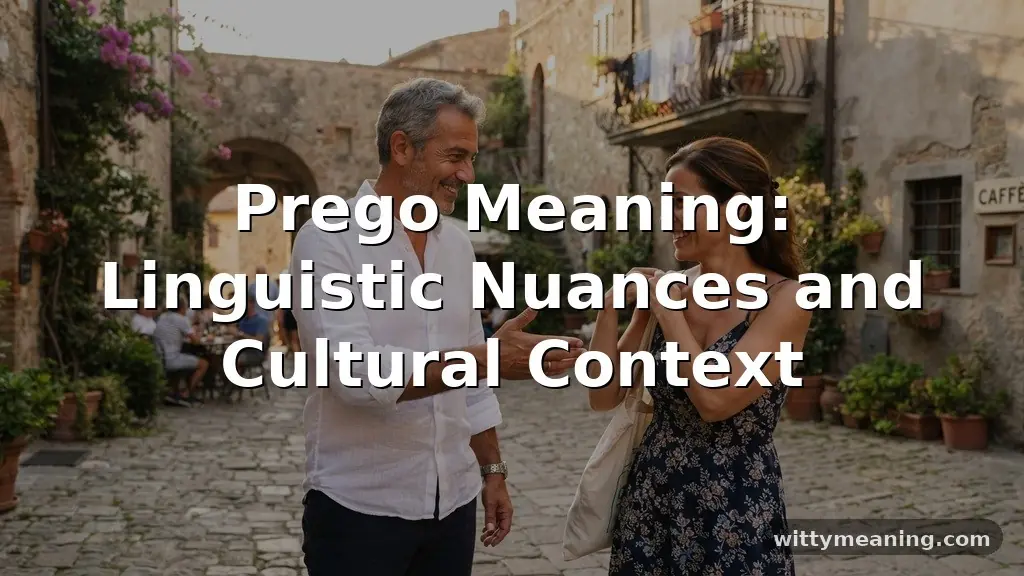

The prego meaning is a fascinating study in linguistic pragmatics, serving as one of the most versatile and essential components of conversational Italian. To the uninitiated, it might appear to be a simple translation of “you are welcome,” but in practice, its usage spans a spectrum that includes invitations, offers, commands, and even expressions of surprise.
Understanding how to deploy this term correctly is a rite of passage for anyone engaging with Italian culture, as it bridges the gap between basic vocabulary and the intuitive flow of native speakers. Whether you are navigating a bustling café in Rome or deciphering the linguistic layers of a formal business dinner, the term functions as a social lubricant that smooths out the edges of social interaction.
Etymology and Core Linguistic Function

At its etymological root, prego is the first-person singular present indicative of the verb pregare, which translates to “to pray” or “to beg.” This historical connection to supplication might seem distant from the modern usage of “you are welcome,” but it provides the necessary context for why it remains such a powerful polite response.
When someone says grazie (thank you), the respondent says prego, essentially signaling “I pray you” or “I beg you [to think nothing of it].” This humble origin reflects the deep-seated Italian etiquette of downplaying one’s own service or kindness, placing the focus instead on the grace of the interaction itself.
In the realm of linguistic pragmatics, prego functions as an interjection that adapts to the environment. It is not merely a static word but a dynamic tool that changes its weight depending on intonation and situational context. Because it is derived from a verb, it carries a sense of action.
When used as a response to gratitude, it is a declarative statement of service rendered happily. When used as an invitation—such as gesturing for someone to enter a room or sit down—it acts as a verbalized gesture of hospitality. This fluidity is precisely why it is often the first word learners master, yet the last word they fully comprehend in all its subtle, shifting manifestations.
Navigating Grazie versus Prego
The interaction between grazie and prego is the bedrock of Italian language nuances. In most Western languages, the response to “thank you” is a relatively fixed phrase. In Italian, however, the exchange is a dance.
While prego is the standard, expected response to grazie, it is not the only option. Depending on the level of intimacy or the specific nature of the favor, Italians may use phrases like di nulla (it was nothing), figurati (don’t worry about it), or non c’è di che (there is no reason to thank me). These variations allow for a range of politeness strategies that prego alone cannot always convey.
When you say grazie, you are acknowledging a service or a gift. When the recipient replies with prego, they are effectively closing the transaction with a seal of modesty. If you fail to say prego after someone thanks you, it can occasionally come across as abrupt, though not necessarily rude.
The key is to match the tone of the grazie. If the thanks are formal and profuse, a simple, slightly bowed-head prego is appropriate.
If the interaction is casual—between friends or colleagues—a more relaxed prego or even a casual figurati is more natural. This reflects the importance of formal versus informal registers in Italian, where the choice of word signals your relationship status with the interlocutor.
Prego Meaning Pregnant: A Common Misconception
A frequent point of confusion for students of the language is the potential for linguistic ambiguity regarding the prego meaning pregnant. Because the Italian word for “pregnant” is incinta, learners often mistakenly assume that prego is related because of the phonetic similarity.
This is a classic case of a false friend or, more accurately, a linguistic red herring. Prego has absolutely no etymological or semantic connection to pregnancy. The confusion likely stems from the fact that the two words share a similar rhythm, but they belong to entirely different conceptual categories.
It is important to clarify this distinction early in the learning process to avoid awkward social gaffes. Using prego in a context where one is attempting to discuss health or biology would be confusing for a native speaker. The term incinta is used exclusively to describe a woman who is expecting.
By keeping these two terms separate, learners can avoid the pitfalls of superficial phonetic patterns and focus on the distinct roles these words play in the language. Understanding that prego is exclusively a social or interactional term—never a biological one—clears up a major hurdle in fluency.
The Culinary Context: The Prego Roll
Beyond the Italian peninsula, the term has migrated into culinary terms and loanwords, most notably in Portuguese cuisine. The prego roll is a staple of Portuguese fast food, consisting of a thin slice of beef, often marinated in garlic and wine, served inside a bread roll.
Here, the prego meaning shifts entirely away from politeness and toward a specific food item. The term prego in Portuguese actually means “nail,” and there is a popular legend that the beef is “nailed” to the bread with garlic cloves to ensure the flavors infuse the meat.
This is an excellent example of a semantic shift where a word loses its original grammatical function and takes on a concrete, physical definition in a different culture. For those traveling in Portugal, ordering a prego will result in a delicious sandwich rather than a polite acknowledgment of a favor.
This linguistic evolution highlights how language adapts to local needs. While the Italian prego remains tied to its verbal roots, the Portuguese prego has been repurposed to describe a beloved national dish, showcasing the versatility of the root word across different Romance languages and regional dialects.
Prego as an Invitation and Command

One of the most useful ways to employ prego is as a polite command or invitation. If you are standing at a doorway and wish to invite someone to enter first, a simple prego accompanied by a hand gesture is the standard way to show respect. In this context, it functions as a “please” or “after you.”
It is an essential component of non-verbal communication, where the word provides the verbal structure while the gesture provides the direction. This usage is so common that it is almost reflexive in Italian society; you will hear it in shops, restaurants, and homes throughout the day.
When used as a command, the intonation is slightly different. It is often sharper or more inviting, depending on the urgency. For instance, a shopkeeper might say prego? with a rising inflection to invite a customer to state their needs.
This demonstrates how the contextual interpretation of the word is driven by the speaker’s intent and the listener’s ability to decode the tone. Mastering this requires more than just vocabulary; it requires an ear for the melody of the language. When you use prego to invite, you are not just saying a word; you are performing an act of service, positioning yourself as the facilitator of the other person’s comfort.
Linguistic Nuances in Regional Dialects
While standard Italian is taught in classrooms, regional dialects and local variations often influence how prego is perceived and used. In the North, the usage might be more clipped and functional, whereas in the South, the word might be paired with more elaborate gestures or additional polite phrases.
This is where the depth of Italian language nuances truly shines. A native speaker in Naples might use prego with a different warmth than a speaker in Milan, reflecting the broader cultural differences in sociability and communication styles.
These regional variations do not change the core meaning, but they do change the social “feel” of the interaction. For a language learner, observing these differences is key to sounding natural. It is not just about the word itself, but how it lands in the specific environment.
In some areas, prego might be used more frequently in professional settings, while in others, it might be reserved for more personal interactions. Understanding these nuances helps a speaker navigate the social landscape with greater confidence, ensuring they are not just speaking the language, but communicating within the cultural framework of the region they are visiting.
Table: Common Uses of Prego in Different Contexts
| Context | Usage | Intonation/Gesture |
|---|---|---|
| Response to Thanks | Acknowledging gratitude | Soft, polite tone, often with a slight nod |
| Invitation | Offering someone to enter or sit | Open hand gesture, inviting tone |
| Service Inquiry | Asking “How can I help you?” | Rising inflection, questioning tone |
| Giving Permission | Allowing someone to proceed | Encouraging, forward-leaning posture |
| Surprise/Shock | Expressing disbelief (informal) | Sharp, shortened, often with eyebrows raised |
Addressing Topical Gaps: Prego in Formal Business
A frequent question that often goes unanswered is how prego fits into high-stakes or formal business environments. Many assume that because it is so common, it might be too casual for a corporate negotiation or a formal meeting. However, prego is perfectly acceptable in professional settings, provided it is used with the correct level of formality.
In a business context, it is often paired with titles or formal address (e.g., Prego, Dottore). This combination of the polite interjection with a formal title creates a bridge between professional respect and the necessary warmth of Italian culture.
The gap often lies in knowing when not to use it. While prego is versatile, it should not be the only tool in your linguistic kit. In extremely formal written communication, for example, one might prefer more elaborate phrases to show deference.
However, in the spoken word of a board meeting or a client lunch, prego remains the gold standard for maintaining a polite, professional atmosphere. It shows that you understand the social norms of the culture, which is often as important as the actual business being discussed. By using it correctly, you signal that you are not just a visitor, but someone who respects the local social architecture.
Politeness Strategies and Cultural Integration
Integrating into a new culture requires more than just memorizing vocabulary; it requires adopting the underlying politeness strategies. Prego is a central pillar of this integration. By using it, you are participating in a system of mutual respect that defines Italian social life. It is not just a filler word; it is a way to acknowledge the presence and the needs of others.
When you say prego to a stranger who has just thanked you for holding a door, you are participating in a small, shared social contract. This is the essence of social interaction—the constant, subtle exchange of acknowledgment.
For those serious about language learning, the goal should be to reach a point where the use of prego becomes intuitive. This happens when you stop translating the word in your head and start feeling the social situation that calls for it.
When you can correctly identify the need for prego—whether it is to invite, to acknowledge, or to facilitate—you have moved beyond the mechanics of the language and into the spirit of it. This is where fluency is truly found: in the ability to navigate the nuances, respect the etiquette, and participate fully in the cultural exchange that makes Italian such a vibrant and expressive language.
FAQ
Is prego the same as saying please?
While prego can be used to invite someone to do something, it is not a direct translation of “please.” The Italian word for “please” is per favore or per cortesia. Prego is primarily used to mean “you are welcome” or as an invitation to proceed.
Can prego be used in a professional meeting?
Yes, prego is perfectly appropriate in professional settings. In an office or business context, it is used to invite someone to sit, to speak, or to enter a room. It is a polite, standard way to facilitate interaction while maintaining a professional level of respect.
How do I know if someone is using prego to be sarcastic?
Like many words, prego can carry sarcasm depending on the tone. If said with a sharp, drawn-out, or overly exaggerated intonation, it may imply impatience or annoyance. Always pay attention to the speaker’s facial expressions and body language, as these are strong indicators of their true intent.
Does prego have any religious connotations?
Because prego comes from the verb pregare (to pray), it does have an etymological link to religious language. However, in modern daily usage, this connection is essentially invisible. It is treated as a secular, functional word for social politeness, with no active religious meaning in contemporary conversation.
Conclusion
The prego meaning is far more than a simple dictionary definition; it is a vital component of Italian culture and social interaction. By understanding its origins, its various roles in conversation, and its nuances across different contexts, you gain a deeper appreciation for the beauty of the Italian language. From its use as a standard polite response to gratitude to its function as a tool for hospitality and invitation, prego is the glue that holds many social exchanges together.
Avoiding the common pitfalls—such as confusing it with terms for pregnancy or failing to recognize its role in Portuguese cuisine—will help you navigate the language with greater precision. As you continue your journey in language learning, let prego be a reminder that communication is as much about the spirit behind the words as it is about the words themselves. By mastering this versatile term, you are not just learning to speak; you are learning to connect with the grace and warmth that define the Italian way of life.