
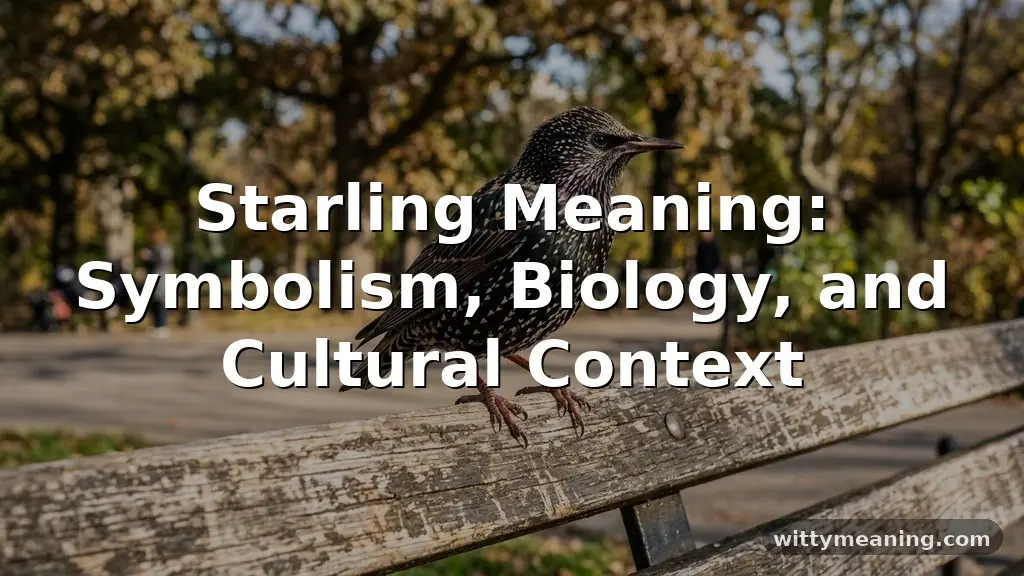

The starling, specifically the Sturnus vulgaris, is a bird that occupies a unique space in human consciousness. While often viewed merely as an invasive pest in regions like North America, the starling meaning transcends its reputation as a common garden visitor.
Across history, these birds have been associated with complex communication, the beauty of synchronized movement, and deep-seated spiritual symbolism. By examining their role in literature, their biological marvels, and even their modern associations with banking and medicine, we can uncover why these birds have captured the human imagination for centuries.
Biological Profile and Characteristics of the European Starling
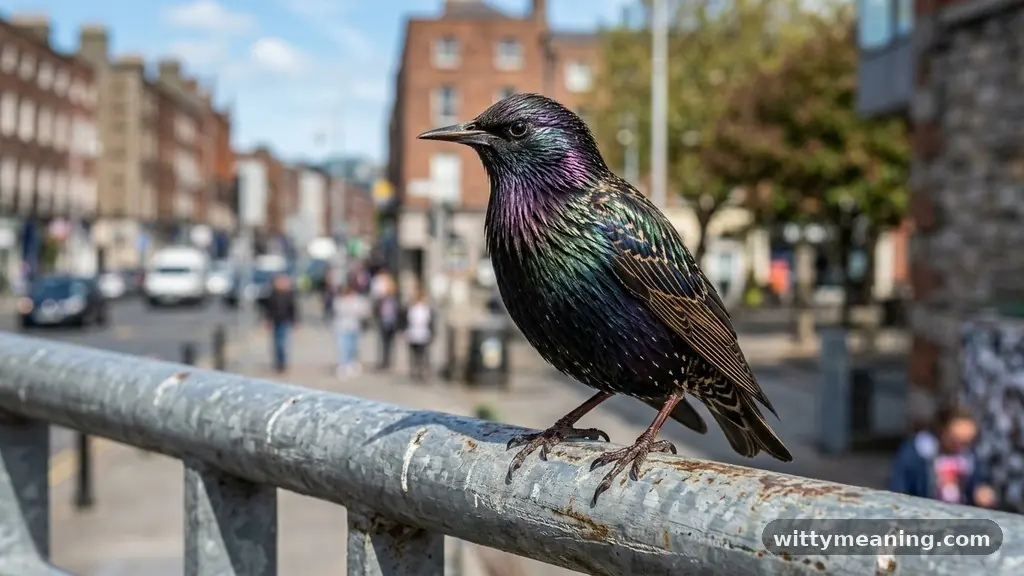
The European starling is one of the most recognizable avian species globally, characterized by its iridescent black plumage, which appears to shimmer with purple and green hues under direct sunlight. In the winter months, their feathers become speckled with white, providing a dramatic contrast to their dark appearance.
Beyond their appearance, they possess a fascinating Biological Profile and Characteristics that distinguish them from including other bird species. Their physical adaptability has allowed them to thrive across diverse climates and urban environments, making them a common sight in both rural fields and bustling city centers.
One of the most striking aspects of the starling is its capability for vocal complexity. These birds are renowned for their incredible avian mimicry. They do not merely tweet; they are capable of integrating human speech and mechanical noises into their repertoire.
A starling might mimic the sound of a car alarm, a ringing telephone, or even the whistles of other bird species with startling accuracy. This vocal range suggests a high level of cognitive function and social intelligence.
By listening closely to a starling, one can often hear a chaotic, beautiful symphony of the sounds that define their immediate environment. Their ability to learn and reproduce such a vast array of sounds serves as a testament to their evolutionary success as a highly adaptable, opportunistic species.
The Marvel of Murmurations
Perhaps the most famous phenomenon associated with the starling is the murmurations. These large, fluid flocks move in unison, creating breathtaking shapes in the sky that seem to defy the laws of physics. Scientists have long studied these formations to understand how thousands of birds can change direction simultaneously without colliding.
The starling meaning in this context is one of profound social harmony and collective intelligence. Each bird reacts to its neighbors, resulting in a system that functions as an interconnected whole rather than a collection of individuals.
When a flock performs a murmuration, they create a visual representation of self-organization. This behavior is not directed by a single leader; instead, it is a decentralized process where each bird tracks the movement of its nearest companions. This creates a ripple effect that spreads through the entire flock in milliseconds.
In nature, this serves as a powerful defense mechanism against predators. A hawk, for instance, finds it nearly impossible to isolate a single target within the swirling, shape-shifting mass. For human observers, witnessing a murmuration often evokes a sense of awe, reinforcing the idea that beauty and survival are often inextricably linked in the natural world.
Symbolism and Cultural Significance
Throughout history, the starling has held varied positions in human culture. In various cultural contexts, the bird is seen as a messenger or a harbinger of change. Because of their tendency to gather in massive numbers, they have been viewed as symbols of community, cooperation, and the strength of the collective.
Unlike solitary predators, which symbolize independence, the starling represents the power of the group. This social nature has made them a frequent subject in art, where they are often depicted as symbols of the bustling, noisy, and energetic nature of life itself.
However, the symbolism is not always positive. In agricultural societies, their massive flocks can be devastating to crops, leading to a reputation as a nuisance. This duality—being both a symbol of natural wonder and a symbol of agricultural strife—is central to the starling meaning.
It forces us to acknowledge that our perception of a species is often tied to its impact on our own survival. Whether viewed as an annoyance or a marvel, the starling remains an inescapable part of the human landscape, constantly reminding us of the interconnectedness of all living things.
Literary References and Historical Context
The starling has a long history of appearing frequently in literature. One of the most famous mentions occurs in William Shakespeare’s Henry IV, Part 1, where the character Hotspur suggests teaching a starling to speak the name of his enemy to torment the King.
This literary moment highlights the bird’s reputation for intelligence and mimicry. Throughout the centuries, writers have used the starling to represent everything from the cacophony of urban life to the bittersweet reality of migration and displacement.
In poetry and prose, the bird’s tendency to flock has been used as a metaphor for human society. Writers have often contrasted the individual with the crowd, using the starling’s behavior to comment on conformity and the loss of individual identity within a larger group. Yet, they also celebrate the bird’s resilience.
By appearing in works ranging from classic plays to contemporary novels, the starling has cemented its status as a literary entity that bridges the gap between the wild world and human storytelling. Their presence in literature often serves to ground a scene, providing a sense of place that feels both authentic and slightly chaotic.
Spiritual and Folklore Meanings
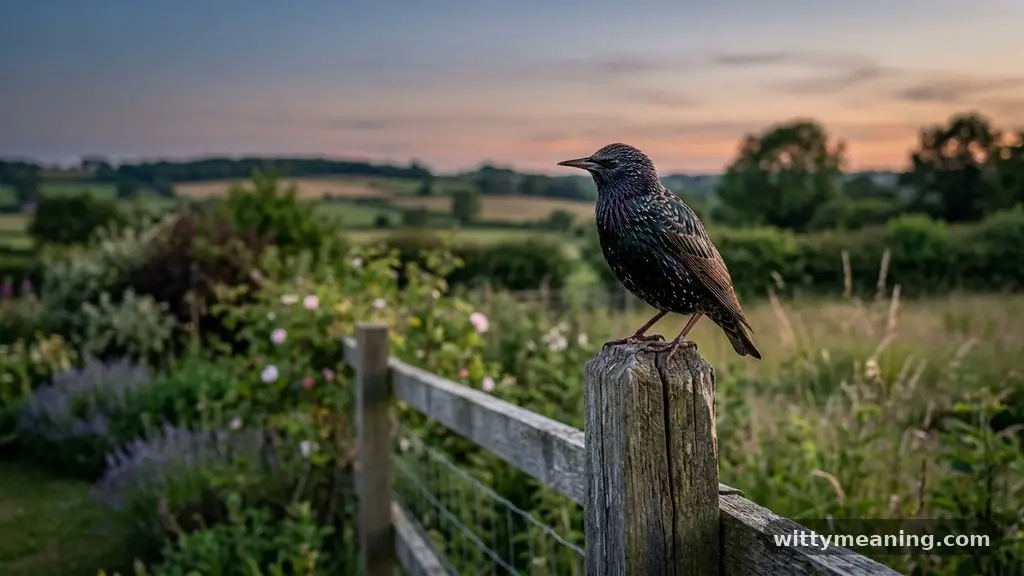
In many spiritual traditions, the starling is seen as a bridge between the physical and spiritual realms. Because of their ability to mimic sounds, they are often associated with the concept of communication from the beyond or the idea that nature is constantly trying to speak to us.
Some folklore traditions suggest that if a starling appears near your home, it is a sign that you should pay closer attention to the messages you are receiving from your surroundings. It is a reminder to listen, not just to the words being spoken, but to the nuances and the “noise” of life.
The concept of the interconnected whole is central to these spiritual interpretations. Just as the birds in a murmuration are linked, so too are our actions linked to the wider world. The starling teaches us that we are part of a larger, complex system.
Their presence can be interpreted as a call to find our own “flock”—the community or group that supports us and allows us to move through life with greater grace and efficiency. In this light, the starling is not just a bird, but a spiritual guide that encourages us to embrace our place within the collective human experience.
Misconceptions and Alternative Meanings
While the bird itself is a fascinating subject, the term “starling” has also been adopted in various professional and technical fields. It is essential to distinguish the biological bird from other entities to avoid confusion.
For instance, in the world of finance, the brand Starling Bank has become a prominent name. This financial institution has no direct biological link to the bird, though the name evokes themes of agility and modern, digital-first efficiency.
Similarly, in the realm of medicine and physiology, we encounter the Frank-Starling law. This is a crucial physiological principle that describes the relationship between the stretch of the heart muscle and the force of its contraction. It is named after Otto Frank and Ernest Starling, two physiologists who independently discovered this mechanism.
Understanding the difference between these terms is vital for anyone researching the starling meaning, as the word carries weight in disciplines as diverse as biology, banking, and cardiology. Clarifying these distinctions helps ensure that the information being sought is accurate and relevant to the user’s intent.
Why Starlings Matter Today
In our modern world, we often lose touch with the natural cycles that sustain us. The starling serves as a persistent reminder of nature’s ability to adapt and thrive, even in human-dominated environments. Why Starlings Matter Today is a question of biodiversity and ecosystem health.
As we face global environmental changes, the starling’s success story—while sometimes problematic due to its invasive status in certain areas—provides a case study in resilience. They are a species that has learned to utilize the resources provided by our cities, parks, and agricultural systems.
Furthermore, the study of their murmurations has provided insights into complex systems, swarm intelligence, and physics. Researchers continue to use data from these birds to improve everything from robotics to traffic management systems.
By observing how these birds navigate their world, scientists are finding new ways to solve human problems related to coordination and efficiency. The starling is therefore not just a bird to be watched in the sky; it is a subject of ongoing scientific inquiry that continues to inform our technological and biological understanding of the world.
Comparison of Interpretations
To better understand the multifaceted nature of the word, the following table summarizes how the “starling” entity is utilized across different contexts and fields.
| Context | Primary Association | Key Characteristic |
|---|---|---|
| Ornithology | Sturnus vulgaris | Avian mimicry and social flocking |
| Finance | Starling Bank | Digital banking and financial services |
| Physiology | Frank-Starling law | Heart muscle contraction mechanics |
| Literature | Metaphorical symbol | Collective movement and communication |
This table highlights that while the bird is the biological root of the term, the starling meaning is heavily influenced by the domain in which it is used. Whether one is discussing the mechanics of a heartbeat or the aesthetic beauty of a sunset murmuration, the term carries a depth that is often overlooked.
Addressing Common Questions
* What does it mean if you see a starling?
Seeing a starling is often interpreted as a call to focus on your communication skills and your connection to your community. In a spiritual sense, it encourages you to pay attention to the “messages” in your environment and to seek harmony within your own social circles.
* Are starlings considered symbols of bad luck?
While some ancient superstitions viewed large flocks of any bird as ominous, starlings are generally not associated with bad luck in modern culture. Instead, they are more often viewed as symbols of resilience, adaptability, and the complex, beautiful nature of social cooperation and collective movement.
* How does the Frank-Starling law relate to the bird?
The Frank-Starling law is named after the physiologist Ernest Starling and has no connection to the bird species.
It is a fundamental principle of cardiac physiology that describes how the heart adjusts its pumping force in response to the volume of blood entering the heart chambers.
* Why are starlings considered invasive?
Starlings are considered invasive in North America because they were introduced by humans in the 19th century and have since outcompeted native bird species for nesting sites and food. Their success is a result of their high adaptability, which often disrupts local ecological balances.
* Can starlings really talk like humans?
Starlings cannot “talk” in the human sense of understanding language, but they are exceptional at mimicry.
They can accurately replicate human words, phrases, and various mechanical sounds. This mimicry is an innate behavior used for social interaction and defense within their complex, noisy environments.
Conclusion
The starling meaning is as diverse as the bird’s own vocalizations. From the iridescent feathers of the Sturnus vulgaris to the complex, mathematical beauty of their murmurations, these birds have cemented their place in our cultural, scientific, and literary landscapes. While they are sometimes misunderstood as mere pests, a deeper look reveals them to be creatures of high intelligence and immense social complexity.
Whether we are discussing the Frank-Starling law in medicine, the digital services of a modern bank, or the poetic imagery of their synchronized flights, the term “starling” serves as a reminder of the layers of meaning that can exist within a single word. By appreciating both the biological reality of the bird and the various ways the term has been adopted by human institutions, we gain a more holistic understanding of the world around us. These birds, in their constant state of movement and communication, continue to challenge us to listen closer, observe more carefully, and find our own place within the interconnected whole of existence.