

So you got a text that just said “PU” and now you’re sitting there like… what does PU mean in text, exactly? You’re not the only one scratching your head over this one. Slang changes so fast these days that even people who text constantly get caught off guard by new abbreviations popping up in their DMs.
Here’s the thing about PU — it’s not some random keyboard mash. It’s an actual texting abbreviation that’s been gaining traction across WhatsApp, Instagram, and Snapchat conversations, and once you know what it means, you’ll probably start seeing it everywhere. Let’s get into it properly, because honestly most articles online just skim the surface and don’t really explain why this term works the way it does.
PU Meaning in Text: The Quick Answer
PU most commonly stands for “Pop Up” in texting slang, and it’s basically someone asking you to message them or start a chat.
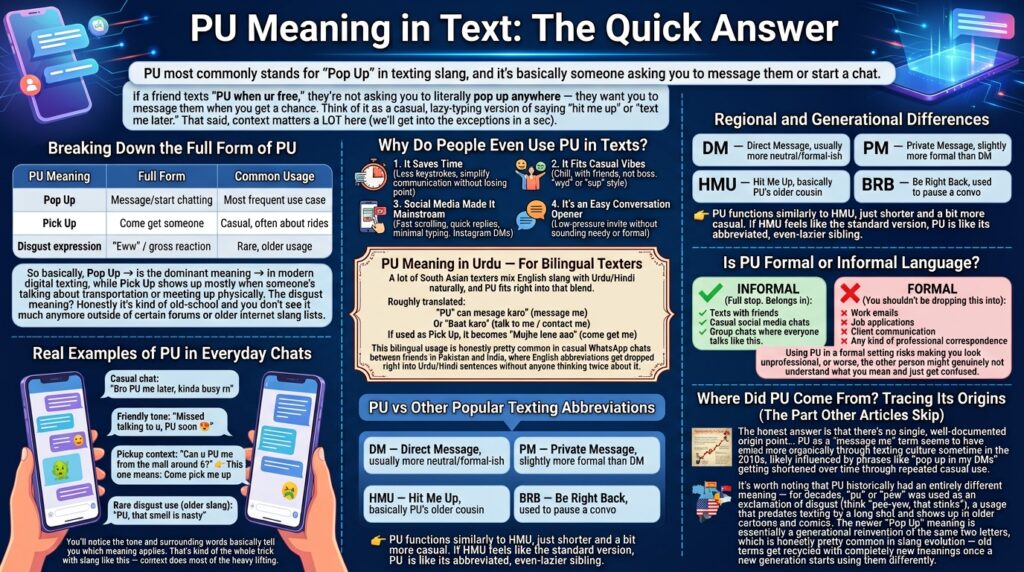
If a friend texts “PU when ur free,” they’re not asking you to literally pop up anywhere — they want you to message them when you get a chance. Think of it as a casual, lazy-typing version of saying “hit me up” or “text me later.” That said, context matters a LOT here (we’ll get into the exceptions in a sec).
Breaking Down the Full Form of PU
Unlike abbreviations like LOL or BRB that have one fixed meaning, PU is a bit of a chameleon. Its full form genuinely depends on who’s texting and what the conversation’s about. Here’s a breakdown that should clear most of the confusion up:
| PU Meaning | Full Form | Common Usage |
|---|---|---|
| Pop Up | Message/start chatting | Most frequent use case |
| Pick Up | Come get someone | Casual, often about rides |
| Disgust expression | “Eww” / gross reaction | Rare, older usage |
So basically, Pop Up → is the dominant meaning → in modern digital texting, while Pick Up shows up mostly when someone’s talking about transportation or meeting up physically. The disgust meaning? Honestly it’s kind of old-school and you don’t see it much anymore outside of certain forums or older internet slang lists.
Why Do People Even Use PU in Texts?
Good question, and the answer comes down to laziness — but like, the productive kind of laziness that actually makes sense once you think about it.
1. It Saves Time
Nobody wants to type out “message me whenever you get a chance” when “PU later” does the exact same job in way less keystrokes. Digital abbreviations like PU simplify communication without losing the actual point of what’s being said.
2. It Fits Casual Vibes
PU just sounds chill. It’s not something you’d use with your boss, but with friends it slides right into the conversation naturally, kind of like how “wyd” or “sup” just feel right in casual chats but weird in formal emails.
3. Social Media Made It Mainstream
Short forms like PU thrive because of how social media platforms operate now — fast scrolling, quick replies, minimal typing. Instagram DMs especially are full of these compressed phrases since nobody’s writing essays in their comments section anymore.
4. It’s an Easy Conversation Opener
“PU” works as a low-pressure way to invite someone into a chat without sounding needy or overly formal. It’s casual enough that it doesn’t feel like a big ask.
PU Meaning in Urdu — For Bilingual Texters
A lot of South Asian texters mix English slang with Urdu/Hindi naturally, and PU fits right into that blend. Roughly translated:
- “PU” can mean “Mujhe message karo” (message me)
- Or “Baat karo” (talk to me / contact me)
- If used as Pick Up, it becomes “Mujhe lene aao” (come get me)
This bilingual usage is honestly pretty common in casual WhatsApp chats between friends in Pakistan and India, where English abbreviations get dropped right into Urdu/Hindi sentences without anyone thinking twice about it.
Real Examples of PU in Everyday Chats
Seeing it in actual context helps way more than just reading definitions, so here’s a few realistic examples:
Casual chat: “Bro PU me later, kinda busy rn”
Friendly tone: “Missed talking to u, PU soon 😍”
Pickup context: “Can u PU me from the mall around 6?” 👉 This one means: Come pick me up
Rare disgust use (older slang): “PU, that smell is nasty”
You’ll notice the tone and surrounding words basically tell you which meaning applies. That’s kind of the whole trick with slang like this — context does most of the heavy lifting.
PU vs Other Popular Texting Abbreviations
To really understand what does PU mean in text, it helps to compare it against similar terms people use interchangeably (even though they’re not technically identical):
- DM — Direct Message, usually more neutral/formal-ish
- PM — Private Message, slightly more formal than DM
- HMU — Hit Me Up, basically PU’s older cousin
- BRB — Be Right Back, used to pause a convo
PU functions similarly to HMU, just shorter and a bit more casual. If HMU feels like the standard version, PU is like its abbreviated, even-lazier sibling.
Is PU Formal or Informal Language?
Straight up — PU is informal, full stop. You shouldn’t be dropping this into:
- Work emails
- Job applications
- Client communication
- Any kind of professional correspondence
It belongs in:
- Texts with friends
- Casual social media chats
- Group chats where everyone already talks like this
Using PU in a formal setting risks making you look unprofessional, or worse, the other person might genuinely not understand what you mean and just get confused.
Where Did PU Come From? Tracing Its Origins (The Part Other Articles Skip)
Here’s something most guides on this topic completely gloss over — where did PU as “Pop Up” actually come from?
The honest answer is that there’s no single, well-documented origin point the way there is for older slang terms. Unlike abbreviations like “LOL” which can be traced back to specific early internet forums in the 1980s-90s, PU as a “message me” term seems to have emerged more organically through texting culture sometime in the 2010s, likely influenced by phrases like “pop up in my DMs” getting shortened over time through repeated casual use.
It’s worth noting that PU historically had an entirely different meaning — for decades, “pu” or “pew” was used as an exclamation of disgust (think “pee-yew, that stinks”), a usage that predates texting by a long shot and shows up in older cartoons and comics. The newer “Pop Up” meaning is essentially a generational reinvention of the same two letters, which is honestly pretty common in slang evolution — old terms get recycled with completely new meanings once a new generation starts using them differently.
Regional and Generational Differences
PU’s meaning isn’t universal across all English-speaking regions either, which is something worth flagging. Gen Z texters in the US tend to lean heavily toward the “Pop Up = message me” interpretation, while older Millennials might still associate “PU” more with the disgust expression if they grew up using it that way. Meanwhile, South Asian and bilingual texting communities (as covered above) have adapted it into their own code-switching style between English and Urdu/Hindi.
This kind of regional drift happens with a LOT of slang — what’s obvious to a 19-year-old in California might mean something totally different (or nothing at all) to someone in their late 30s in another country.
Common Mistakes People Make With PU
A few things to watch out for so you don’t end up looking confused or confusing someone else:
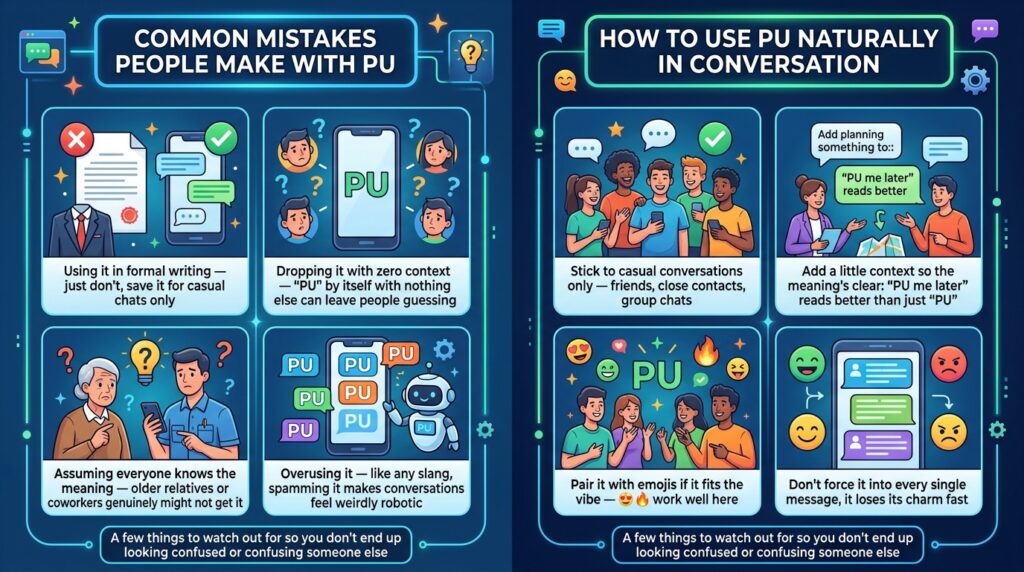
- Using it in formal writing — just don’t, save it for casual chats only
- Dropping it with zero context — “PU” by itself with nothing else can leave people guessing
- Assuming everyone knows the meaning — older relatives or coworkers genuinely might not get it
- Overusing it — like any slang, spamming it makes conversations feel weirdly robotic
How to Use PU Naturally in Conversation
If you want to start using it (or just understand it better when you see it), keep these tips in mind:
- Stick to casual conversations only — friends, close contacts, group chats
- Add a little context so the meaning’s clear: “PU me later” reads better than just “PU”
- Pair it with emojis if it fits the vibe — 😍🔥 work well here
- Don’t force it into every single message, it loses its charm fast
The Psychology Behind Why We Text Like This
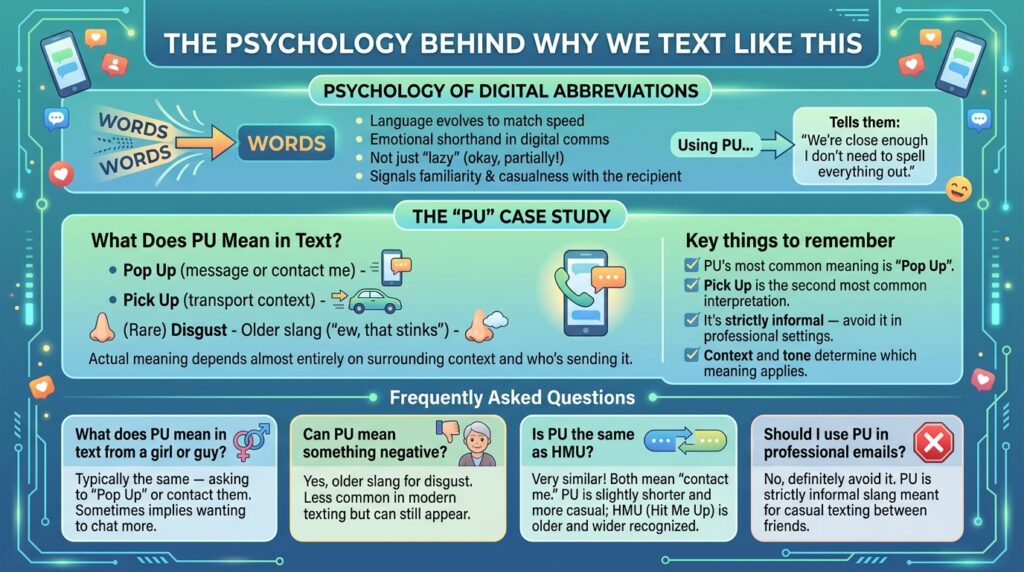
There’s actually something kind of interesting going on linguistically with terms like PU. Modern texting abbreviations reflect how language evolves to match the speed and emotional shorthand that digital communication demands. We’re not just being lazy (okay, partially we are) — we’re also signaling familiarity and casualness with the person we’re texting. Using PU instead of a full sentence tells the other person “we’re close enough that I don’t need to spell everything out.”
This ties back to a broader trend in internet slang and digital abbreviations generally — language compresses when speed and emotional connection matter more than formal correctness, which is basically the entire foundation of how texting culture works.
Quick Recap: What Does PU Mean in Text?
PU = Pop Up, used to ask someone to message or contact you. It can also mean Pick Up in transportation contexts, and rarely, it expresses disgust in older slang usage. The actual meaning depends almost entirely on the surrounding context and who’s sending it.
Key things to remember:
- PU’s most common meaning is “Pop Up” (message me)
- Pick Up is the second most common interpretation
- It’s strictly informal — avoid it in professional settings
- Context and tone determine which meaning applies
Frequently Asked Questions
What does PU mean in text from a girl or guy?
It typically means the same regardless of gender — usually “Pop Up,” asking you to message or contact them. Sometimes it implies wanting to chat more, especially in flirty or friendly contexts. Always read the surrounding message for clearer context clues.
Can PU mean something negative?
Yes, in older slang PU expressed disgust (like “ew, that stinks”). This usage is far less common in modern texting but can still appear, especially among older texters or in specific regional slang communities.
Is PU the same as HMU?
They’re very similar — both essentially mean “contact me” or “message me.” PU is generally shorter and slightly more casual, while HMU (Hit Me Up) is the more widely recognized, older version of the same idea.
Should I use PU in professional emails?
No, definitely avoid it. PU is strictly informal slang meant for casual texting between friends or on social media. Using it professionally risks confusion or making you appear unprofessional to colleagues or clients.