
So you got a text back that just says “MK” and now you’re sitting there wondering if the person is mad at you, busy, or just being lazy with their thumbs. Happens to literally everyone. If you’ve been typing what does MK mean in text into Google at 11pm trying to decode your friend’s one-word reply, you’re definitely not the only one doing that.
Here’s the thing though — MK isn’t some deep mystery. It’s actually one of the simplest abbreviations floating around in texting culture today, but the confusion usually comes from tone, not meaning. In this guide we’re gonna break down everything: what MK actually stands for, where it came from, when its fine to use, when its not, and — importantly — a few things most other guides completely skip over, like what MK means outside of texting (yes, it has other meanings too).
Let’s get into it.
What Does MK Mean in Text? (Quick Answer)
MK = Okay. That’s really the short version.
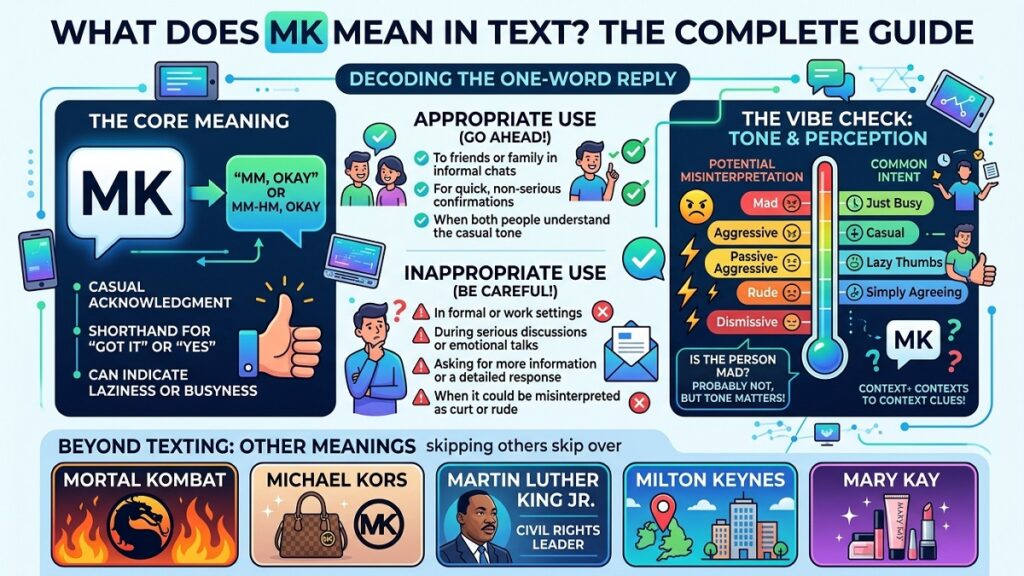
MK functions as a confirmation response, and it’s basically a shortened version of “mmk” or “mkay,” which themselves are casual pronunciations of the word okay. So when your friend texts “MK” back, they are literally just saying “okay, got it” without typing out the whole word.
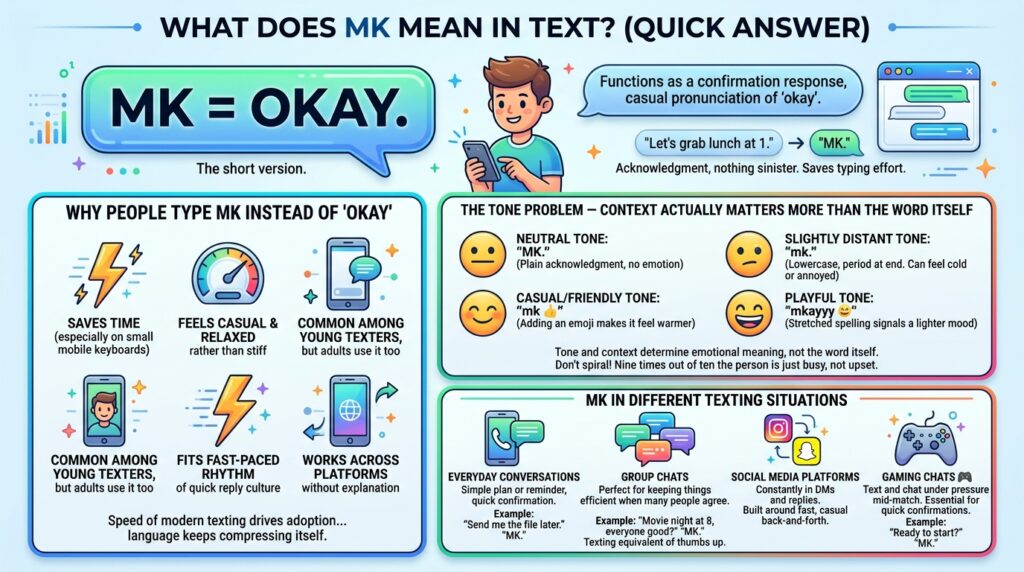
Example: “Let’s grab lunch at 1.” “MK.”
That’s an acknowledgment, nothing more sinister than that. People use it because typing “okay” fully feels like extra effort when three letters does the exact same job.
Why People Type MK Instead of Just Writing “Okay”
Texting culture rewards speed, plain and simple. Nobody wants to type a full sentence when a two-letter reply gets the same message across. This is one of those things that seems small but actually says a lot about how digital communication trends have shifted over the last decade or so.
Some reasons MK has stuck around:
- It saves time typing, especially on small mobile keyboards
- It feels casual and relaxed rather than stiff
- It’s become common among younger texters, though honestly adults use it plenty too
- It fits the fast-paced rhythm of quick reply culture
- It works across almost every messaging platform without needing explanation
Basically, speed of modern texting drives adoption of abbreviations like MK — this isn’t just a texting quirk, its part of a bigger pattern where language keeps compressing itself to match how fast we communicate now.
The Tone Problem — Why Context Actually Matters More Than the Word Itself
Here’s where most confusion happens. MK by itself is neutral. But because text doesn’t carry facial expression or vocal tone, the same three letters can read completely differently depending on situation.
Let’s look at how tone shifts things:
Neutral Tone “MK.” — Plain acknowledgment, no emotion attached either way.
Casual/Friendly Tone “mk 👍” — Adding an emoji instantly makes it feel warmer.
Slightly Distant Tone “mk.” — No emoji, lowercase, period at the end. Can come across a little cold or annoyed even if that’s not the intent.
Playful Tone “mkayyy 😄” — Stretched out spelling signals a lighter, more fun mood.
The core lesson here: tone and context determine the emotional meaning of MK, not the word itself. So if you’re on the receiving end of a blunt “MK.” try not to spiral about it — nine times out of ten the person is just busy, not upset.
MK in Different Texting Situations
MK in Everyday Conversations
This is the most common use case by far. Someone sends a plan or reminder, you reply MK, conversation moves on.
“Send me the file later.” “MK.”
Simple confirmation, nothing complicated.
MK in Group Chats
Group chats move fast, and MK is perfect for keeping things efficient when multiple people are agreeing to plans at once.
“Movie night at 8, everyone good?” “MK.”
It’s basically the texting equivalent of a thumbs up in a meeting.
MK on Social Media Platforms
On apps like Instagram or Snapchat, MK shows up constantly in DMs and replies. Because these platforms are already built around fast, casual back-and-forth, MK fits naturally.
MK in Gaming Chats 🎮
Gamers text and chat under pressure, literally mid-match sometimes, so short confirmations like MK are basically essential.
“Ready to start?” “MK.”
No time for full sentences when the round’s about to begin.
Is MK Rude? Let’s Settle This
Short answer: usually not. MK is a neutral response by default. The rudeness people perceive usually comes from repetition without warmth — if someone sends “mk.” over and over with zero emoji or extra word, it can start to feel dry, even if that wasn’t the intention at all.
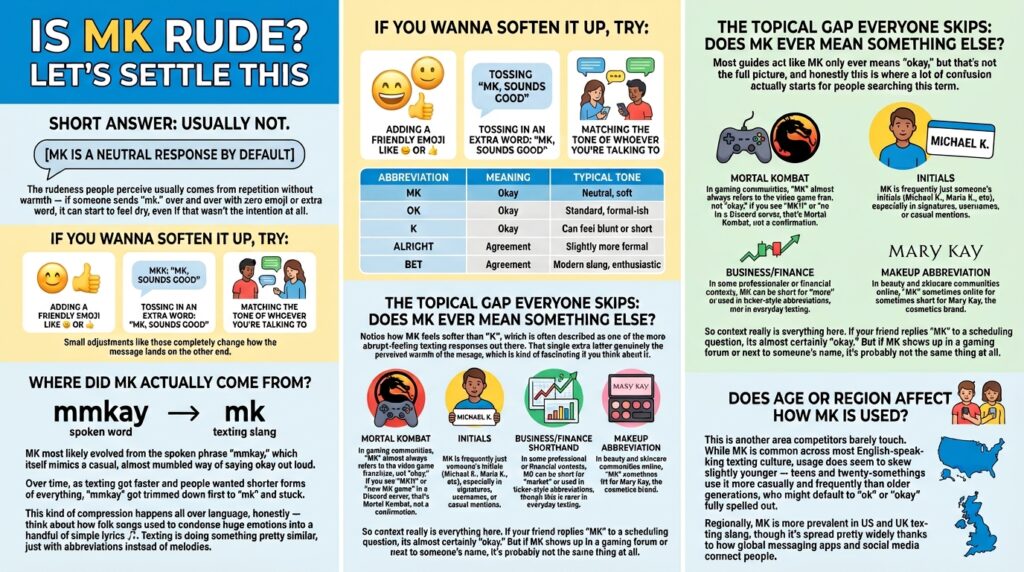
If you wanna soften it up, try:
- Adding a friendly emoji like 😊 or 👍
- Tossing in an extra word: “mk, sounds good”
- Matching the tone of whoever you’re talking to
Small adjustments like these completely change how the message lands on the other end.
MK vs Other Similar Abbreviations
| Abbreviation | Meaning | Typical Tone |
|---|---|---|
| MK | Okay | Neutral, soft |
| OK | Okay | Standard, formal-ish |
| K | Okay | Can feel blunt or short |
| Alright | Agreement | Slightly more formal |
| Bet | Agreement | Modern slang, enthusiastic |
Notice how MK feels softer than “K”, which is often described as one of the more abrupt-feeling texting responses out there. That single extra letter genuinely changes the perceived warmth of the message, which is kind of fascinating if you think about it.
Where Did MK Actually Come From?
MK most likely evolved from the spoken phrase “mmkay,” which itself mimics a casual, almost mumbled way of saying okay out loud. Over time, as texting got faster and people wanted shorter forms of everything, “mmkay” got trimmed down first to “mk” and stuck.
This kind of compression happens all over language, honestly — think about how folk songs used to condense huge emotions into a handful of simple lyrics 🎵. Texting is doing something pretty similar, just with abbreviations instead of melodies.
The Topical Gap Everyone Skips: Does MK Ever Mean Something Else?
Most guides act like MK only ever means “okay,” but that’s not the full picture, and honestly this is where a lot of confusion actually starts for people searching this term.
MK can mean different things depending on context outside of pure texting slang:
- Mortal Kombat — In gaming communities, “MK” almost always refers to the video game franchise, not “okay.” If you see “MK11” or “new MK game” in a Discord server, that’s Mortal Kombat, not a confirmation.
- Initials — MK is frequently just someone’s initials (Michael K., Maria K., etc), especially in signatures, usernames, or casual mentions.
- Business/Finance shorthand — In some professional or financial contexts, MK can be short for “market” or used in ticker-style abbreviations, though this is rarer in everyday texting.
- Makeup abbreviation — In beauty and skincare communities online, “MK” sometimes short for Mary Kay, the cosmetics brand.
So context really is everything here. If your friend replies “MK” to a scheduling question, its almost certainly “okay.” But if MK shows up in a gaming forum or next to someone’s name, it’s probably not the same thing at all.
Does Age or Region Affect How MK Is Used?
This is another area competitors barely touch. While MK is common across most English-speaking texting culture, usage does seem to skew slightly younger — teens and twenty-somethings use it more casually and frequently than older generations, who might default to “ok” or “okay” fully spelled out. Regionally, MK is more prevalent in US and UK texting slang, though it’s spread pretty widely thanks to how global messaging apps and social platforms are now.
Psychological Meaning Behind Short Texting Replies
Short responses like MK aren’t really about carelessness. They reflect how people communicate on devices today:
People are multitasking constantly, conversations happen in bursts rather than long sessions, and most messages get read quickly on a phone screen rather than a full computer. MK signals acknowledgment without slowing the conversation down — it doesn’t mean the person doesn’t care, it usually just means they’re busy or the conversation doesn’t need more than a quick confirmation.
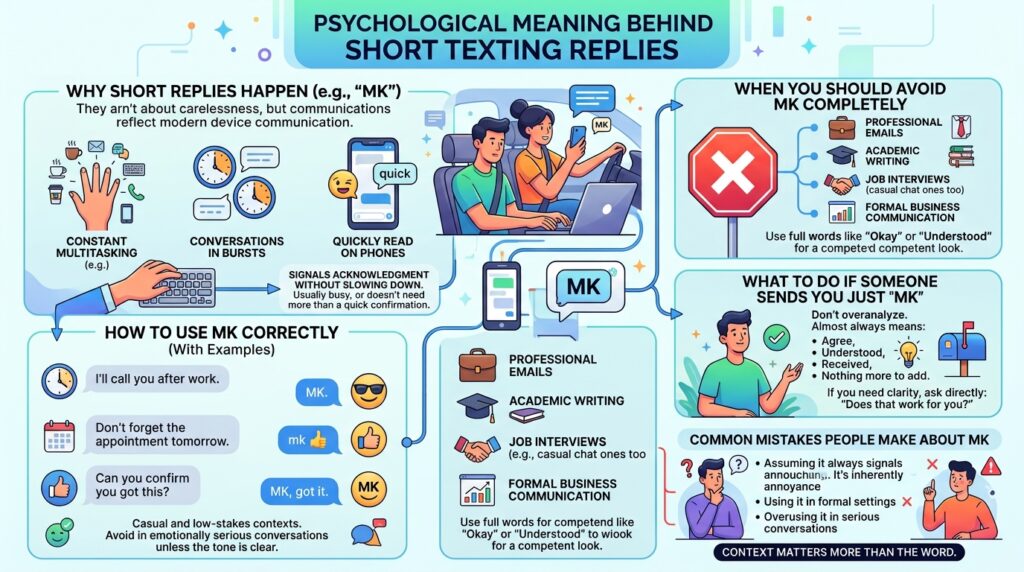
How to Use MK Correctly (With Examples)
Here’s a few natural, everyday examples of MK being used appropriately:
“I’ll call you after work.” “MK.”
“Don’t forget the appointment tomorrow.” “mk 👍”
“Can you confirm you got this?” “MK, got it.”
These all work because the context is casual and low-stakes. Avoid using MK in emotionally serious conversations unless you’re certain the tone reads correctly, because a bare “MK” can feel dismissive when someone’s sharing something that matters to them.
When You Should Avoid MK Completely
There’s definitely settings where MK just doesn’t belong, and using it there can actually hurt how you’re perceived. Steer clear of MK in:
- Professional emails
- Academic writing or school assignments
- Job interviews (even casual chat-based ones)
- Formal business communication of any kind
In these settings, stick with full words like “Okay” or “Understood” — it just reads more competent and put-together.
What To Do If Someone Sends You Just “MK”
Don’t overanalyze it, seriously. In almost all cases it simply means:
They agree, they understood the message, or they received what you sent and there’s nothing more to add.
If you genuinely need more clarity or confirmation, just ask directly: “Does that work for you?” It’s way more effective than trying to read tone into three letters.
Common Mistakes People Make About MK
- Assuming MK always signals annoyance (usually doesn’t)
- Thinking its inherently rude (context matters way more than the word)
- Using MK in formal or professional settings (don’t)
- Overusing it during emotionally serious conversations where more words are needed
Most confusion around MK clears up once you actually pay attention to the surrounding context rather than the word in isolation.
Frequently Asked Questions
What does MK mean in text messages? MK usually means “okay.” It’s a casual abbreviation used to confirm or acknowledge a message, commonly seen in texting, group chats, and social media conversations across most messaging platforms.
Is MK rude to send? Not typically. MK reads as neutral by default, though repeated use without any emoji or warmth can occasionally come across as dry or distant, depending entirely on the context of the conversation.
Is MK the same as K? Not exactly. MK generally feels softer and more casual than a plain “K,” which many people associate with a blunter or more abrupt tone in texting culture.
Can MK mean something other than okay? Yes. Outside texting slang, MK can refer to Mortal Kombat in gaming, someone’s initials, or shorthand used in beauty and business contexts — context always determines the correct meaning.
Conclusion
At the end of the day, MK simply means “okay” in almost every texting scenario you’ll run into — it’s just a faster, more casual way of confirming something without typing the whole word out. Tone and context shape how it feels more than the letters themselves do, and once you understand that, replies like “MK.” stop feeling mysterious or loaded with hidden meaning.
Just remember: keep it casual in friendly chats, skip it entirely in professional settings, and don’t be afraid to add a little warmth with an emoji when it matters. Small adjustments like that make a real difference in how your texts land.