
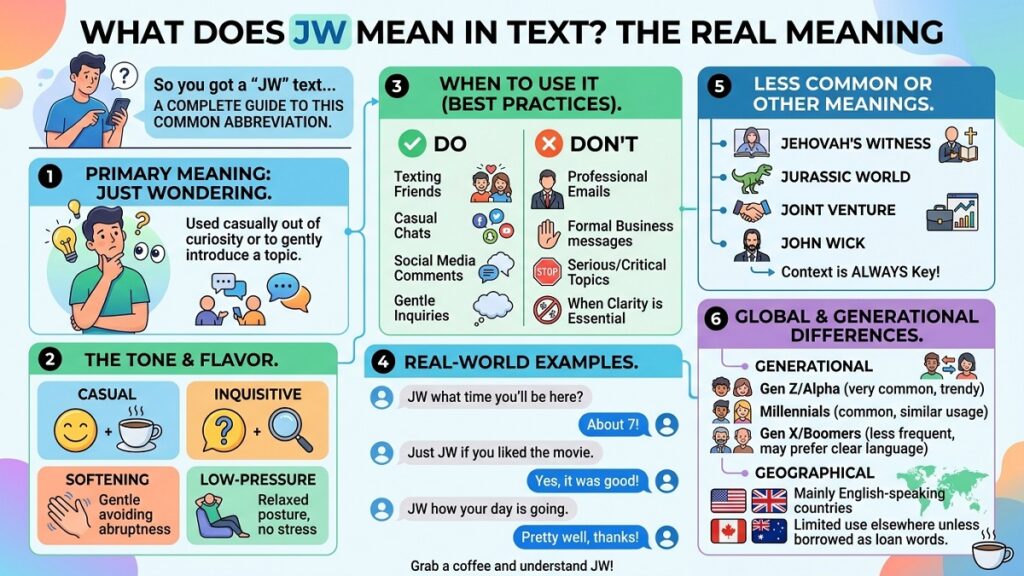

So you got a text that just says “JW” and now you’re sitting there squinting at your phone like it’s a riddle. Yeah, we’ve all been there. If you’re asking what does JW mean in text, the short answer is: it almost always means “Just Wondering.” But honestly, that’s only half the story, because JW changes flavor depending on who’s sending it and where.
This guide breaks down everything — the main meaning, the lesser-known ones, when to use it (and when not to), real examples, and even how JW shows up differently depending on your generation or country. Grab a coffee, this one’s thorough.
The Main Meaning: JW = Just Wondering
When someone drops JW into a text, they’re typically softening a question. It’s their way of saying “I’m curious, no pressure to answer right away.”
JW → expresses → mild curiosity without urgency. That’s the core relationship you need to remember.
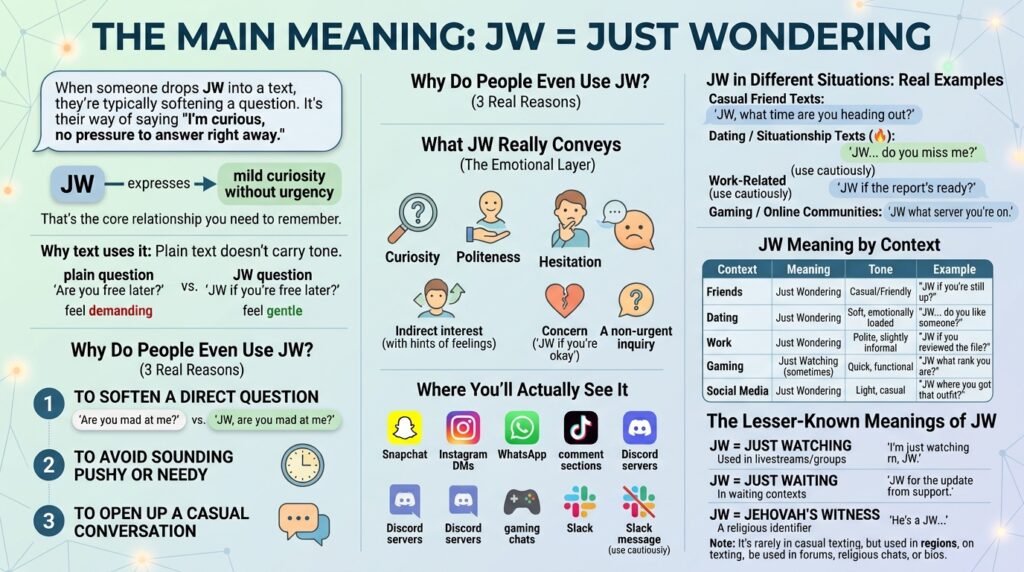
People reach for it because plain text doesn’t carry tone. You can’t hear someone’s voice or see their face, so a flat question like “Are you free later?” can accidentally come off as demanding or even annoyed. Tack a “JW” on the front and suddenly it reads gentle:
- “JW if you’re free later?”
- “JW, did you see my last message?”
- “JW what time the party starts.”
It’s a small linguistic trick, but it does a lot of emotional heavy lifting in texting culture.
Where You’ll Actually See It
JW pops up across basically every messaging platform there is — Snapchat, Instagram DMs, WhatsApp, TikTok comment sections, Discord servers, gaming chats, and yes, even the occasional Slack message (though we’d argue against that one, more on that below). It’s one of those abbreviations that’s so embedded in casual digital communication that most people under 30 don’t even register it as slang anymore — it just is part of how they type.
Why Do People Even Use JW? (3 Real Reasons)
Texting abbreviations exist because typing full sentences takes time and, frankly, sometimes a full sentence feels too intense for a casual question. Here’s the breakdown of why JW specifically gets used so much:
1. To Soften a Direct Question
Compare these two:
“Are you mad at me?” “JW, are you mad at me?”
The second one feels lighter, less confrontational. It signals you’re asking out of curiosity, not accusation, even if deep down you kinda are accusing them lol.
2. To Avoid Sounding Pushy or Needy
Nobody wants to come across as the person who needs an answer immediately. Adding JW basically tells the other person “answer whenever, no rush.” It takes the pressure off both people honestly.
3. To Open Up a Casual Conversation
Sometimes JW isn’t even really a question — it’s a conversation starter in disguise. “JW what you’re up to” is basically just “hey, talk to me” dressed up as curiosity.
What JW Really Conveys (The Emotional Layer)
Here’s the thing most guides skip: JW is rarely just about wondering. The emotional subtext matters way more than the literal definition. Depending on the context, JW can signal:
- Curiosity — the baseline, most common use
- Politeness — trying not to sound demanding
- Hesitation — when someone isn’t sure how to phrase what they actually want to ask
- Indirect interest — especially common in dating or situationships, where JW hints at feelings without saying them outright
- Concern — “JW if you’re okay” leans emotional, not casual
- A non-urgent inquiry — basically the opposite of “911 text me back”
JW in Different Situations: Real Examples
Casual Friend Texts
“JW, what time are you heading out?” “JW, is it raining where you’re at?”
Dating / Situationship Texts (the spicy ones 🔥)
“JW… who were you with today?” “JW, do you miss me?”
These ones hit different because the tone shifts from purely curious to emotionally loaded real quick.
Work-Related (use cautiously)
“JW if the report’s ready?” “JW, is the 4pm meeting still on?”
Gaming / Online Communities
“JW what server you’re on.” “JW which character I should pick.”
JW Meaning by Context (Quick Reference Table)
| Context | Meaning | Tone | Example |
|---|---|---|---|
| Friends | Just Wondering | Casual, friendly | “JW if you’re still up?” |
| Dating | Just Wondering | Soft, emotionally loaded | “JW… do you like someone?” |
| Work | Just Wondering | Polite, slightly informal | “JW if you reviewed the file?” |
| Gaming | Just Watching (sometimes) | Quick, functional | “JW what rank you are?” |
| Social Media | Just Wondering | Light, casual | “JW where you got that outfit” |
The Lesser-Known Meanings of JW
This is where the competitor content usually stops short, so let’s go deeper. JW → can also represent → at least two other distinct meanings, and knowing them keeps you from getting confused.
JW = Just Watching
Used a lot in livestream chats, group chats, or any setting where someone is observing without actively participating.
Example: “I’m just watching rn, JW.”
JW = Just Waiting
Less common, but you’ll see it in waiting-room-type contexts — someone passively hanging around for an update or response.
Example: “JW for the update from support.”
JW = Jehovah’s Witness
This one trips people up because it’s a completely different category — a religious identifier, not a texting abbreviation in the casual sense. It shows up in conversations about religion, community groups, or when someone’s describing their faith.
Example: “He’s a JW, so he doesn’t really celebrate birthdays.”
This meaning is rare in casual texting threads but you’ll definitely run into it in forum discussions, religious group chats, or biography-style content.
How to Figure Out Which JW Someone Means (Filling the Gap)
Here’s something most articles on this topic gloss over: a practical, step-by-step way to actually disambiguate JW when the context isn’t obvious. Because honestly, “just look at context” is vague advice. Let’s make it concrete.
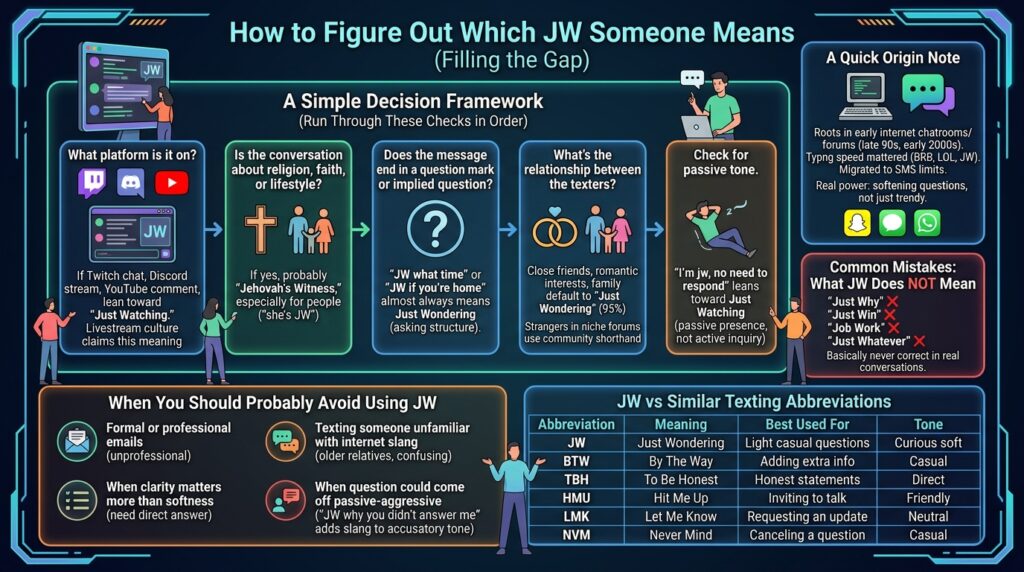
A Simple Decision Framework
When you see a standalone “JW” with no other clues, run through these checks in order:
- What platform is it on? If it’s a Twitch chat, Discord stream channel, or YouTube live comment, lean toward “Just Watching.” Livestream culture has basically claimed this meaning.
- Is the conversation about religion, faith groups, or someone’s lifestyle/beliefs? If yes, it’s probably “Jehovah’s Witness,” especially if it’s describing a person (“she’s JW”) rather than an action.
- Does the message end in a question mark or implied question? “JW what time” or “JW if you’re home” almost always means Just Wondering, since the structure itself is asking something.
- What’s the relationship between the texters? Close friends, romantic interests, and family members default to “Just Wondering” about 95% of the time. Strangers in niche forums are more likely using a community-specific shorthand.
- Check the surrounding sentence for passive tone. “I’m jw, no need to respond” leans toward Just Watching, because it implies passive presence rather than active inquiry.
A Quick Origin Note
For what it’s worth, JW → traces its roots → to early internet chatrooms and forums from the late 1990s and early 2000s, where typing speed mattered and abbreviations like BRB, LOL, and JW became shorthand survival tools. It migrated into texting once SMS character limits made brevity a habit, and then stuck around through every messaging app generation since — Snapchat, iMessage, WhatsApp, you name it. Unlike some slang that fades fast, JW has had real staying power probably because the “softening a question” function it serves is just genuinely useful, not just trendy.
Common Mistakes: What JW Does NOT Mean
People sometimes guess wrong and assume JW stands for things like:
- “Just Why” ❌
- “Just Win” ❌
- “Job Work” ❌
- “Just Whatever” ❌
These interpretations are basically never correct and you’ll almost never see them used this way in real conversations, so don’t stress about them.
When You Should Probably Avoid Using JW
JW is great for casual chats but there’s a handful of situations where it can backfire:
- Formal or professional emails. Abbreviations like this read as unprofessional in serious business correspondence — stick to full sentences.
- When clarity matters more than softness. If you genuinely need a direct answer, don’t bury the question under casual slang.
- Texting someone unfamiliar with internet slang. Older relatives or coworkers who aren’t online-savvy might just be confused, not charmed.
- When your question could come off passive-aggressive. “JW why you didn’t answer me” doesn’t actually soften anything — it just adds slang on top of an accusatory tone.
JW vs Similar Texting Abbreviations
| Abbreviation | Meaning | Best Used For | Tone |
|---|---|---|---|
| JW | Just Wondering | Light, casual questions | Curious, soft |
| BTW | By The Way | Adding extra info | Casual |
| TBH | To Be Honest | Honest statements | Direct |
| HMU | Hit Me Up | Inviting someone to talk | Friendly |
| LMK | Let Me Know | Requesting an update | Neutral |
| NVM | Never Mind | Canceling a question | Casual |
Does JW Mean Something Different Around the World?
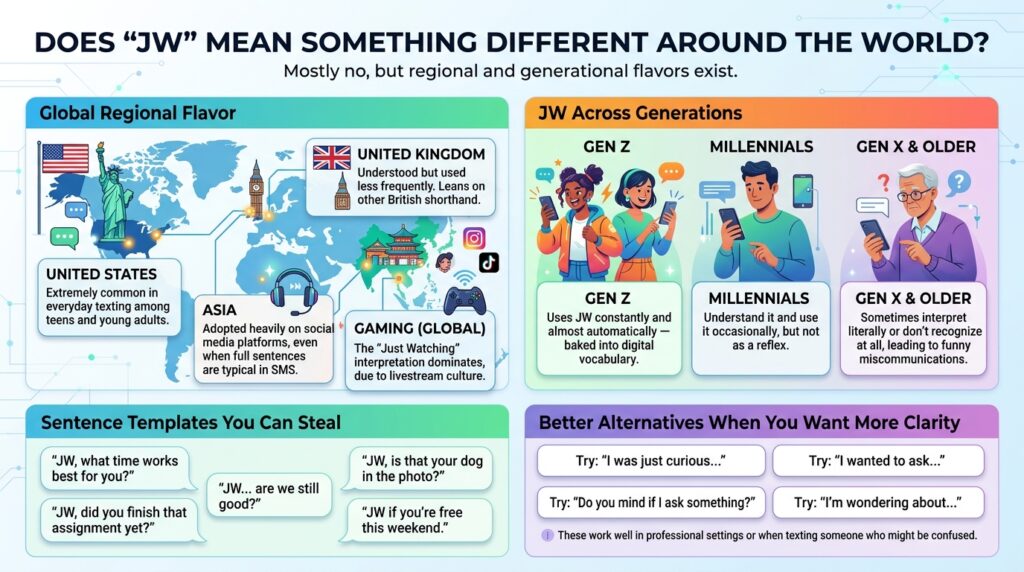
Mostly no, but there’s some regional flavor worth noting. In the US, JW is extremely common in everyday texting among teens and young adults. In the UK, it’s understood but used a bit less frequently — British texting culture tends to lean on other shorthand more. In several Asian countries, younger social media users have adopted JW heavily on platforms like Instagram and TikTok, even when full sentences are more typical in regular SMS. And in gaming communities globally, the “Just Watching” interpretation tends to dominate over “Just Wondering,” just because of how livestream culture works.
JW Across Generations
Not everyone reads JW the same way, and honestly this generational gap causes more confusion than people realize.
- Gen Z uses JW constantly and almost automatically — it’s baked into their everyday digital vocabulary.
- Millennials understand it and use it occasionally, but maybe not as a reflex the way Gen Z does.
- Gen X and older generations sometimes interpret it literally or just don’t recognize it at all, which can lead to some genuinely funny miscommunications.
Sentence Templates You Can Steal
Here’s a handful of plug-and-play examples if you want to use JW naturally:
- “JW, what time works best for you?”
- “JW, did you finish that assignment yet?”
- “JW… are we still good?”
- “JW, is that your dog in the photo?”
- “JW if you’re free this weekend.”
Better Alternatives When You Want More Clarity
If a situation calls for more formality or precision than JW offers, try:
- “I was just curious…”
- “I wanted to ask…”
- “Do you mind if I ask something?”
- “I’m wondering about…”
These work well in professional settings or when texting someone who might not vibe with internet shorthand.
Frequently Asked Questions
What does JW mean from a girl?
Usually it still means “Just Wondering,” though the emotional undertone might lean toward curiosity, interest, or gentle emotional checking, depending on the relationship and surrounding conversation.
What does JW mean from a guy?
Same core meaning — Just Wondering — but guys often use it casually to open up low-pressure conversations or ease into a question without seeming too direct.
Is JW appropriate for work messages?
Generally not recommended for formal emails or official communication. It’s fine in casual internal chats with coworkers you know well, but full sentences read more professional overall.
Is JW flirty?
It can be, especially paired with soft or personal questions and emojis. Context and relationship matter more than the abbreviation itself when it comes to reading flirtatious intent.