

Have you ever been scrolling through a text conversation, social media comment, or gaming chat and suddenly noticed someone write IMAO? If so, you’re probably wondering about the IMAO meaning in chat and whether it means the same thing as other popular internet abbreviations.
You’re not alone. Online communication changes fast, and new slang terms appear almost every day. Sometimes these abbreviations are easy to understand, while other times they can leave people scratching their heads for a minute or two.
The good news is that understanding IMAO meaning in chat is actually pretty simple once you know the context. In this guide, we’ll explore what IMAO means, where it came from, how people use it, how it differs from similar acronyms like IMO and LMAO, and when you should avoid using it.
By the end, you’ll understand exactly how this piece of internet slang fits into modern digital communication.
What does IMAO Mean in Chat?
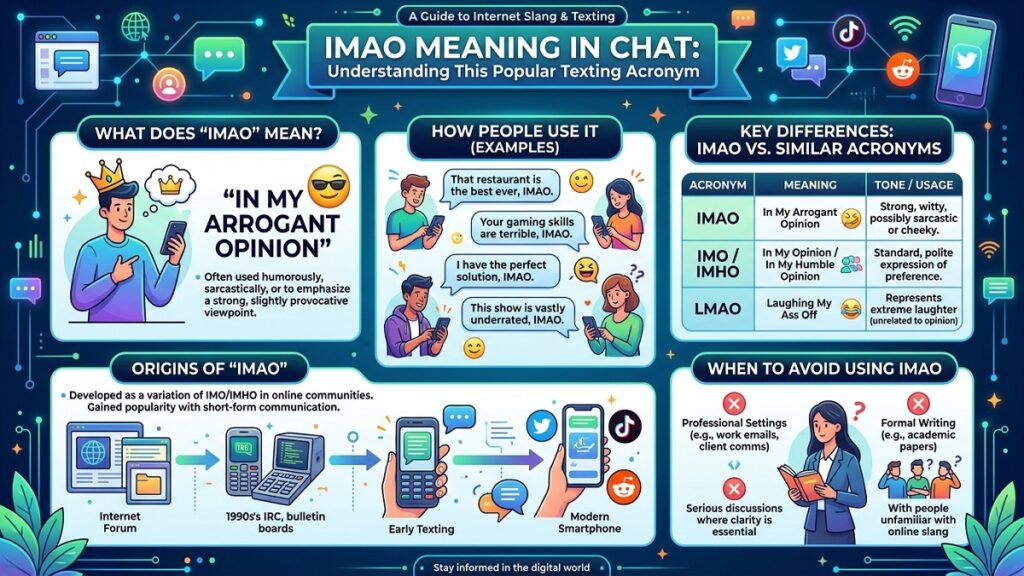
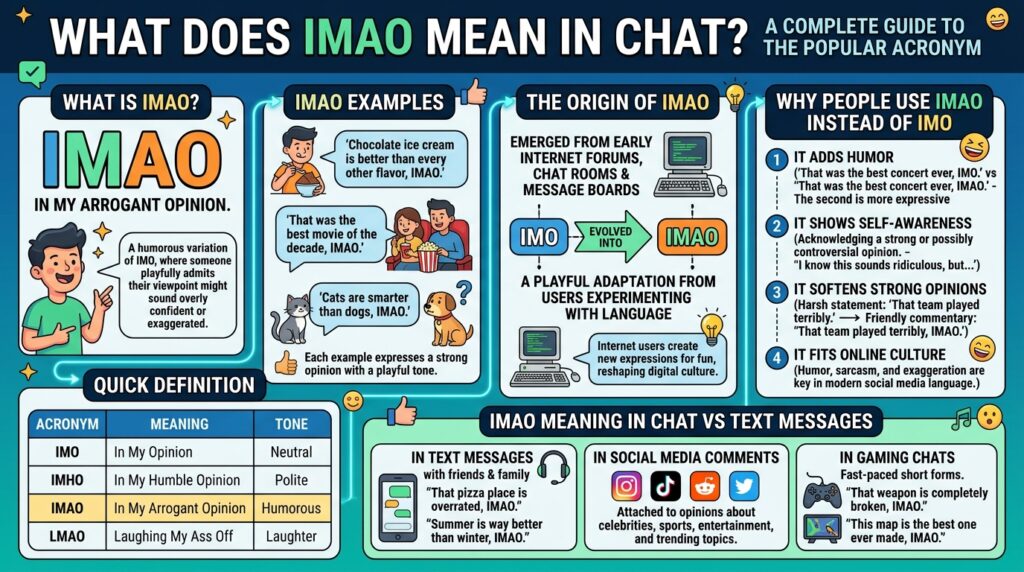
IMAO stands for “In My Arrogant Opinion.”
It is a humorous variation of the more common acronym IMO, which means “In My Opinion.”
When someone uses IMAO, they’re sharing a personal opinion while jokingly admitting that their viewpoint might sound overly confident, exaggerated, or even a little arrogant.
For example:
- “Chocolate ice cream is better than every other flavor, IMAO.”
- “That was the best movie of the decade, IMAO.”
- “Cats are smarter than dogs, IMAO.”
In each example, the speaker is expressing a strong opinion while adding a playful tone. It kind of softens the statement and makes it feel less serious.
Quick Definition
| Acronym | Meaning | Tone |
|---|---|---|
| IMO | In My Opinion | Neutral |
| IMHO | In My Humble Opinion | Polite |
| IMAO | In My Arrogant Opinion | Humorous |
| LMAO | Laughing My Ass Off | Laughter |
The Origin of IMAO
Many people know what IMAO means, but very few understand where it actually came from.
The acronym emerged from early internet forums, chat rooms, and message boards where users often experimented with language. As online communities grew, people began modifying existing abbreviations to create humorous alternatives.
The relationship is simple:
IMO → evolved into → IMAO
Instead of saying “In My Opinion,” users started jokingly saying “In My Arrogant Opinion” to make bold statements sound more entertaining.
This playful adaptation reflects how digital culture constantly reshapes language. Internet users often create new expressions not because they’re necessary, but because they’re fun.
Why People Use IMAO Instead of IMO
People don’t usually choose IMAO by accident. There’s normally a reason behind it.
It Adds Humor
A simple opinion can sound boring.
For example:
- “That was the best concert ever, IMO.”
Now compare it with:
- “That was the best concert ever, IMAO.”
The second version feels more expressive and fun.
It Shows Self-Awareness
When someone uses IMAO, they’re often acknowledging that their opinion might be controversial.
They’re basically saying:
“I know this sounds ridiculous, but I’m saying it anyway.”
It Softens Strong Opinions
Surprisingly, IMAO can make a statement sound less aggressive.
For example:
- “That team played terribly.”
Sounds harsh.
- “That team played terribly, IMAO.”
Now it sounds more like friendly commentary.
It Fits Online Culture
Modern social media language thrives on humor, sarcasm, and exaggeration. IMAO fits naturally into that environment.
IMAO Meaning in Chat vs Text Messages
The meaning stays largely the same across platforms, but usage can vary slightly.
In Text Messages
People often use IMAO when chatting with friends and family.
Examples:
- “That pizza place is overrated, IMAO.”
- “Summer is way better than winter, IMAO.”
In Social Media Comments
You’ll frequently see it in:
- Instagram comments
- TikTok captions
- Reddit discussions
- Twitter/X conversations
Users often attach it to opinions about celebrities, sports, entertainment, and trending topics.
In Gaming Chats
Gaming communities love abbreviations.
Examples include:
- “That weapon is completely broken, IMAO.”
- “This map is the best one ever made, IMAO.”
The fast-paced nature of gaming encourages shorter forms of communication.
Is IMAO the Same as LMAO?
No, and this is one of the most common misunderstandings online.
Many people confuse the two because the acronyms look very similar.
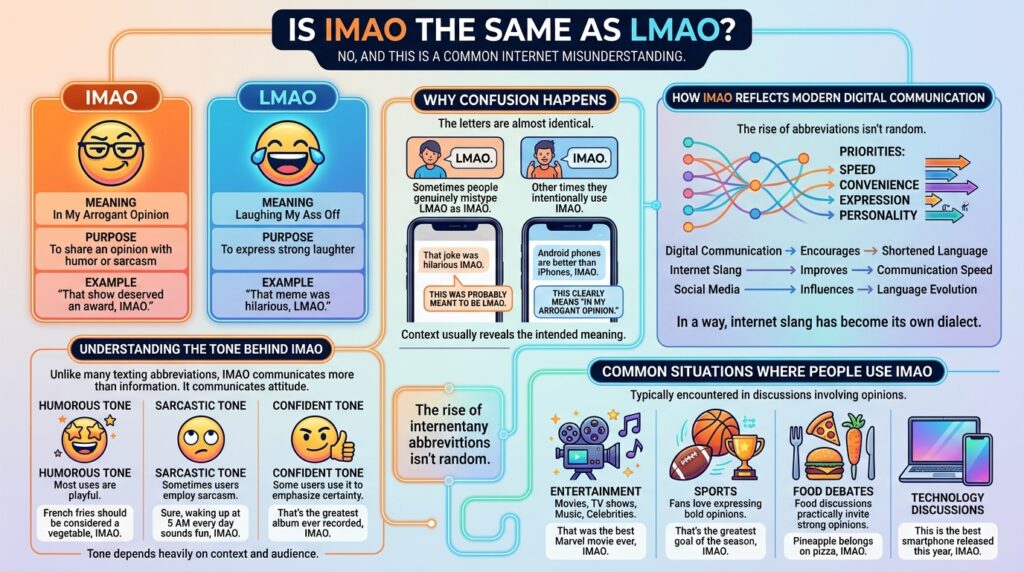
IMAO
Meaning:
In My Arrogant Opinion
Purpose:
To share an opinion with humor or sarcasm.
Example:
- “That show deserved an award, IMAO.”
LMAO
Meaning:
Laughing My Ass Off
Purpose:
To express strong laughter.
Example:
- “That meme was hilarious, LMAO.”
Why Confusion Happens
The letters are almost identical.
Sometimes people genuinely mistype LMAO as IMAO. Other times they intentionally use IMAO.
Context usually reveals the intended meaning.
For example:
- “That joke was hilarious IMAO.”
This was probably meant to be LMAO.
But:
- “Android phones are better than iPhones, IMAO.”
This clearly means “In My Arrogant Opinion.”
Understanding the Tone Behind IMAO
One reason this acronym remains interesting is its tone.
Unlike many texting abbreviations, IMAO communicates more than information. It communicates attitude.
Humorous Tone
Most uses are playful.
Example:
- “French fries should be considered a vegetable, IMAO.”
Sarcastic Tone
Sometimes users employ sarcasm.
Example:
- “Sure, waking up at 5 AM every day sounds fun, IMAO.”
Confident Tone
Some users use it to emphasize certainty.
Example:
- “That’s the greatest album ever recorded, IMAO.”
Tone depends heavily on context and audience.
How IMAO Reflects Modern Digital Communication
The rise of abbreviations isn’t random.
Modern communication prioritizes:
- Speed
- Convenience
- Expression
- Personality
Internet slang helps users communicate emotions that text alone often struggles to convey.
Digital Communication → Encourages → Shortened Language
Internet Slang → Improves → Communication Speed
Social Media → Influences → Language Evolution
These relationships explain why acronyms like IMAO continue to exist despite being relatively niche.
In a way, internet slang has become its own dialect.
Common Situations Where People Use IMAO
You’ll typically encounter IMAO in discussions involving opinions.
Entertainment
- Movies
- TV shows
- Music
- Celebrities
Example:
- “That was the best Marvel movie ever, IMAO.”
Sports
Fans love expressing bold opinions.
Example:
- “That’s the greatest goal of the season, IMAO.”
Food Debates
Food discussions practically invite strong opinions.
Example:
- “Pineapple belongs on pizza, IMAO.”
Technology Discussions
Example:
- “This is the best smartphone released this year, IMAO.”
When You Should Avoid Using IMAO
Although it’s popular in casual settings, there are situations where it doesn’t belong.
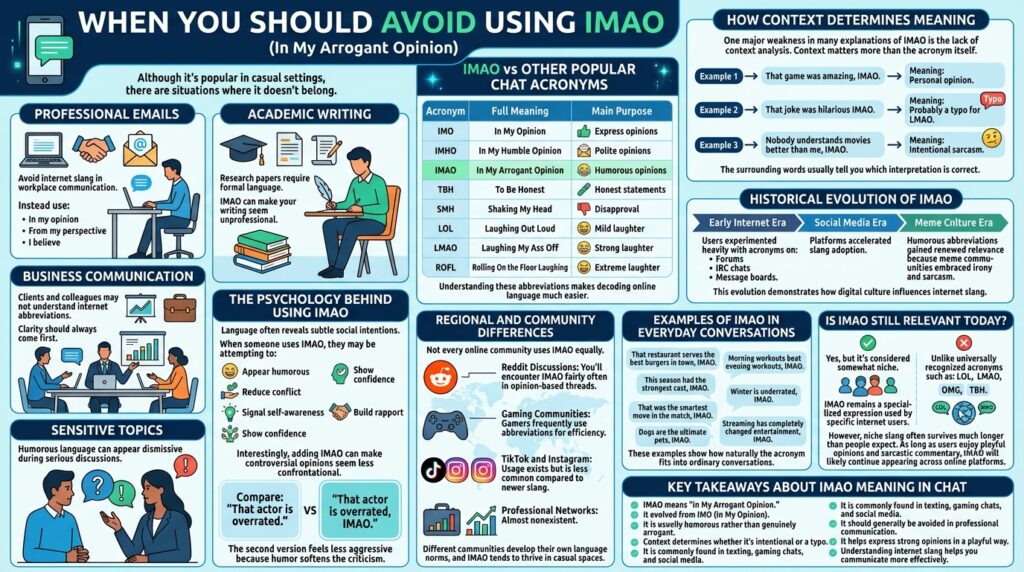
Professional Emails
Avoid internet slang in workplace communication.
Instead use:
- In my opinion
- From my perspective
- I believe
Academic Writing
Research papers require formal language.
IMAO can make your writing seem unprofessional.
Business Communication
Clients and colleagues may not understand internet abbreviations.
Clarity should always come first.
Sensitive Topics
Humorous language can appear dismissive during serious discussions.
IMAO vs Other Popular Chat Acronyms
Understanding related abbreviations can help you navigate online conversations more effectively.
| Acronym | Full Meaning | Main Purpose |
|---|---|---|
| IMO | In My Opinion | Express opinions |
| IMHO | In My Humble Opinion | Polite opinions |
| IMAO | In My Arrogant Opinion | Humorous opinions |
| TBH | To Be Honest | Honest statements |
| SMH | Shaking My Head | Disapproval |
| LOL | Laughing Out Loud | Mild laughter |
| LMAO | Laughing My Ass Off | Strong laughter |
| ROFL | Rolling On the Floor Laughing | Extreme laughter |
Knowing these abbreviations makes decoding online language much easier.
How Context Determines Meaning
One major weakness in many explanations of IMAO is the lack of context analysis.
Context matters more than the acronym itself.
Example 1
“That game was amazing, IMAO.”
Meaning:
Personal opinion.
Example 2
“That joke was hilarious IMAO.”
Meaning:
Probably a typo for LMAO.
Example 3
“Nobody understands movies better than me, IMAO.”
Meaning:
Intentional sarcasm.
The surrounding words usually tell you which interpretation is correct.
Historical Evolution of IMAO
While never as popular as LOL or LMAO, IMAO has maintained a small but dedicated presence online.
Early Internet Era
Users experimented heavily with acronyms on:
- Forums
- IRC chats
- Message boards
Social Media Era
Platforms accelerated slang adoption.
Meme Culture Era
Humorous abbreviations gained renewed relevance because meme communities embraced irony and sarcasm.
This evolution demonstrates how digital culture influences internet slang.
The Psychology Behind Using IMAO
Language often reveals subtle social intentions.
When someone uses IMAO, they may be attempting to:
- Appear humorous
- Reduce conflict
- Signal self-awareness
- Show confidence
- Build rapport
Interestingly, adding IMAO can make controversial opinions seem less confrontational.
Compare:
- “That actor is overrated.”
Versus:
- “That actor is overrated, IMAO.”
The second version feels less aggressive because humor softens the criticism.
Regional and Community Differences
Not every online community uses IMAO equally.
Reddit Discussions
You’ll encounter IMAO fairly often in opinion-based threads.
Gaming Communities
Gamers frequently use abbreviations for efficiency.
TikTok and Instagram
Usage exists but is less common compared to newer slang.
Professional Networks
Almost nonexistent.
Different communities develop their own language norms, and IMAO tends to thrive in casual spaces.
Examples of IMAO in Everyday Conversations
Here are some realistic examples:
- “That restaurant serves the best burgers in town, IMAO.”
- “Morning workouts beat evening workouts, IMAO.”
- “This season had the strongest cast, IMAO.”
- “Winter is underrated, IMAO.”
- “That was the smartest move in the match, IMAO.”
- “Dogs are the ultimate pets, IMAO.”
- “Streaming has completely changed entertainment, IMAO.”
These examples show how naturally the acronym fits into ordinary conversations.
Is IMAO Still Relevant Today?
Yes, but it’s considered somewhat niche.
Unlike universally recognized acronyms such as:
- LOL
- LMAO
- OMG
- TBH
IMAO remains a specialized expression used by specific internet users.
However, niche slang often survives much longer than people expect. As long as users enjoy playful opinions and sarcastic commentary, IMAO will likely continue appearing across online platforms.
Key Takeaways About IMAO Meaning in Chat
If you remember only a few things, remember these:
- IMAO means “In My Arrogant Opinion.”
- It evolved from IMO (In My Opinion).
- It is usually humorous rather than genuinely arrogant.
- Context determines whether it’s intentional or a typo.
- It is commonly found in texting, gaming chats, and social media.
- It should generally be avoided in professional communication.
- It helps express strong opinions in a playful way.
Understanding internet slang helps you communicate more confidently in today’s digital world, and IMAO is a perfect example of how online language keeps evolving.
Frequently Asked Questions
What is the exact IMAO meaning in chat?
IMAO stands for “In My Arrogant Opinion.” It is a humorous variation of IMO and is used to share strong personal opinions while acknowledging they may sound overly confident or exaggerated. Most people use it playfully rather than seriously.
Is IMAO the same as LMAO?
No. IMAO means “In My Arrogant Opinion,” while LMAO means “Laughing My Ass Off.” Although the acronyms look similar, they serve completely different purposes. One expresses an opinion, while the other expresses laughter.
Is IMAO considered rude?
Not usually. Most users employ IMAO humorously or sarcastically. However, depending on the conversation and tone, it can occasionally sound dismissive or arrogant. Context and audience play a major role in how it is perceived.
Should I use IMAO in professional communication?
No. IMAO is internet slang designed for casual conversations. In workplaces, academic settings, and formal emails, it’s better to use clear phrases such as “In my opinion” or “From my perspective” instead.