
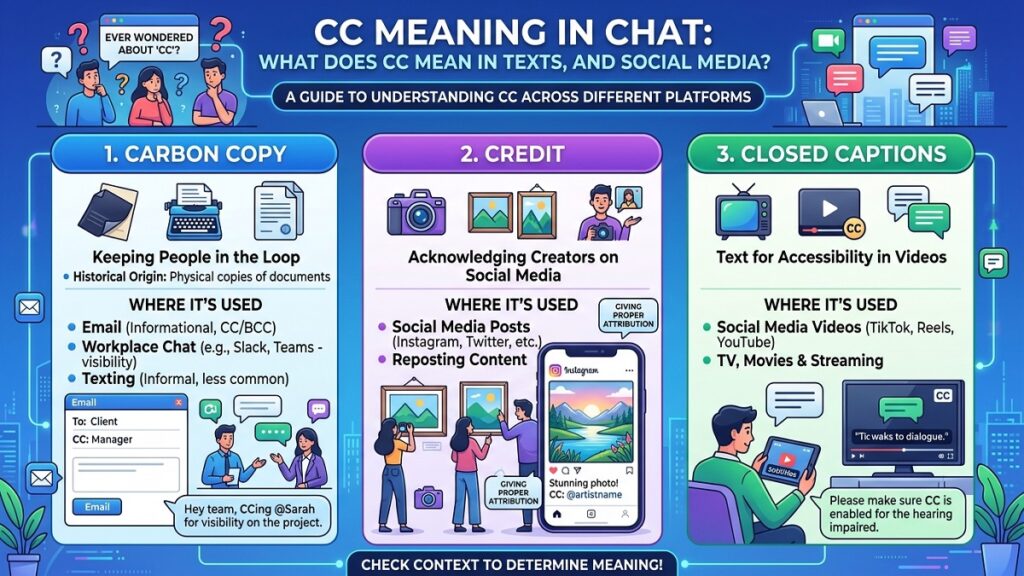

Have you ever received a message saying “CC John” or noticed “CC: @username” in a social media post and wondered what it actually means? You’re definitely not alone. The CC meaning in chat can vary depending on where you see it. In some conversations, it means Carbon Copy, while in others it refers to Credit or even Closed Captions. That little abbreviation has been around for decades, yet people still get confused by it, and honestly, that’s understandable.
In this guide, you’ll learn the different meanings of CC, where each meaning comes from, how people use it in chat apps, emails, social media, and workplace messaging, plus plenty of real-life examples. By the end, you’ll know exactly what someone means whenever they type CC.
What Does CC Mean in Chat?
CC most commonly means “Carbon Copy” in chat. It refers to including another person in a conversation or making sure they receive the same information.
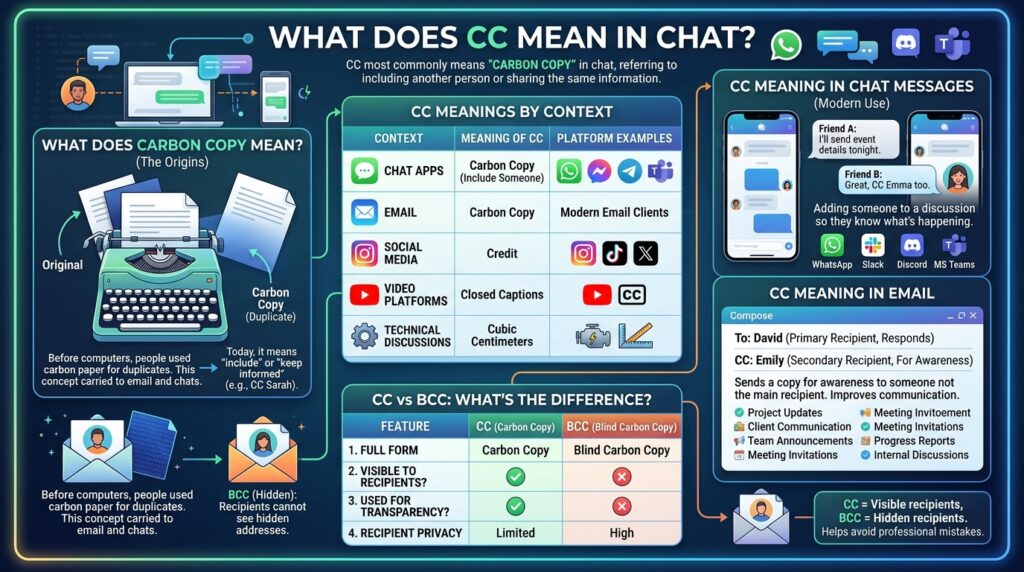
However, the meaning changes depending on the context. Here are the most common definitions:
| Context | Meaning of CC |
|---|---|
| Chat apps | Carbon Copy (include someone) |
| Carbon Copy | |
| Instagram, TikTok, X | Credit |
| YouTube and videos | Closed Captions |
| Technical discussions | Cubic Centimeters |
The surrounding conversation usually makes the intended meaning pretty obvious. Even though it looks like the same abbreviation, people use it in different ways across different platforms.
What Does Carbon Copy Mean?
Carbon Copy is the original and oldest meaning of CC.
Years ago, before computers became common, people placed carbon paper between two sheets of paper while typing letters. The carbon paper created an exact duplicate of the original document. That duplicate was called a carbon copy.
When email was invented, the same idea carried over. Instead of making a physical duplicate, you could send an identical copy of an email to another person.
Today, the concept has expanded into chats and messaging apps. Instead of forwarding a separate message, someone may simply say:
- CC Sarah.
- CC the marketing team.
- CC everyone involved.
It simply means another person should be included or kept informed.
CC Meaning in Chat Messages
In modern messaging, CC often means adding someone into a discussion so they know what’s happening.
For example:
Friend A: I’ll send the event details tonight.
Friend B: Great, CC Emma too.
Here, Emma isn’t necessarily part of the conversation yet. The speaker simply wants Emma to receive the same information.
People use CC in:
- Messenger
- Telegram
- Slack
- Discord
- Microsoft Teams
- Workplace chats
Sometimes people literally add the person to the conversation. Other times they just forward the information afterward. It kind of depends on how the chat works.
CC Meaning in Email
In email, CC stands for Carbon Copy.
The CC field allows you to send a copy of an email to someone who isn’t the primary recipient but still needs to stay informed.
For example:
To: David
CC: Emily
David is expected to respond, while Emily simply receives a copy for awareness.
Using CC correctly improves communication because everyone involved stays updated without needing separate messages.
Businesses use CC every single day for:
- Project updates
- Client communication
- Team announcements
- Meeting invitations
- Progress reports
- Internal discussions
It’s one of those features that people use almost without thinking now.
CC vs BCC: What’s the Difference?
Many people confuse CC and BCC, but they serve different purposes.
| Feature | CC | BCC |
|---|---|---|
| Full Form | Carbon Copy | Blind Carbon Copy |
| Visible to recipients | Yes | No |
| Used for transparency | Yes | No |
| Recipient privacy | Limited | High |
When you use CC, everyone can see who received the email.
When you use BCC, recipients cannot see the hidden email addresses.
A simple rule is:
- CC = Visible recipients
- BCC = Hidden recipients
Knowing this difference helps avoid embarrassing mistakes, specially in professional communication.
CC Meaning on Social Media
On social media platforms, CC usually means “Credit.”
Instead of Carbon Copy, creators use CC to acknowledge the original artist, photographer, editor, or content creator.
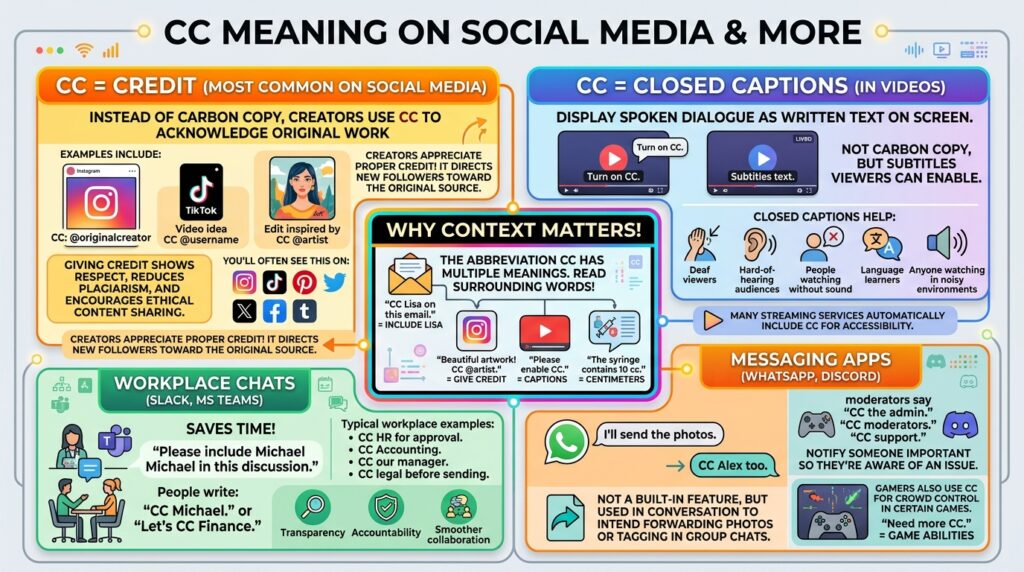
Examples include:
- CC: @originalcreator
- Video idea CC @username
- Edit inspired by CC @artist
Giving credit shows respect for someone else’s work. It also helps reduce plagiarism and encourages ethical content sharing.
You’ll often see this on:
- TikTok
- X (formerly Twitter)
- Tumblr
Many creators appreciate proper credit because it directs new followers toward the original source.
CC Meaning in Videos
Another common meaning is Closed Captions.
Closed captions display spoken dialogue as written text on the screen.
For example:
“Turn on CC.”
This has nothing to do with Carbon Copy.
Instead, it means subtitles or captions that viewers can enable.
Closed captions help:
- Deaf viewers
- Hard-of-hearing audiences
- People watching without sound
- Language learners
- Anyone watching in noisy environments
Many streaming services automatically include CC because accessibility has become much more important over the last few years.
Why Context Matters
The abbreviation CC has multiple meanings.
That’s why context matters more than the letters themselves.
Consider these examples:
“CC Lisa on this email.”
Meaning: Include Lisa.
“Beautiful artwork! CC @artist.”
Meaning: Give credit.
YouTube
“Please enable CC.”
Meaning: Turn on captions.
Medical discussion
“The syringe contains 10 cc.”
Meaning: Cubic centimeters.
Reading only the abbreviation without the surrounding words can easily lead to misunderstandings.
How People Use CC in Workplace Chats
Modern companies rely heavily on communication platforms like Slack and Microsoft Teams.
Instead of saying:
“Please include Michael in this discussion.”
Employees often write:
“CC Michael.”
Or:
“Let’s CC Finance.”
This saves time and quickly communicates that another department or employee should receive the same information.
Typical workplace examples include:
- CC HR for approval.
- CC Accounting.
- CC our manager.
- CC legal before sending.
Although it’s short, almost everyone in corporate environments understands what it means.
CC Meaning on WhatsApp
People don’t officially have a CC button on WhatsApp, but they still use the abbreviation in conversations.
For example:
“I’ll send the photos.”
“CC Alex too.”
Here, the sender intends to forward the same photos to Alex.
Sometimes users also tag another person in a group chat instead of literally copying them into another conversation.
It isn’t a built-in feature, but the phrase has become common enough that many people recognize it.
CC Meaning on Discord
Discord communities frequently use CC in a slightly different way.
Moderators may say:
- CC the admin.
- CC moderators.
- CC support.
This generally means notifying someone important so they’re aware of an issue.
Gamers also use CC differently in certain games, where CC can stand for Crowd Control. In gaming discussions, context again becomes extremely important.
If someone writes:
“Need more CC.”
They’re probably talking about game abilities rather than messaging.
CC Meaning on Slack and Microsoft Teams
Professional collaboration tools have made CC even more popular.
Rather than forwarding several messages individually, employees often type:
- CC James.
- CC Product Team.
- CC Marketing.
The goal is keeping everyone informed without repeating information multiple times.
This promotes transparency, accountability, and smoother collaboration across departments.
Common Examples of CC in Conversations
Here are some everyday examples.
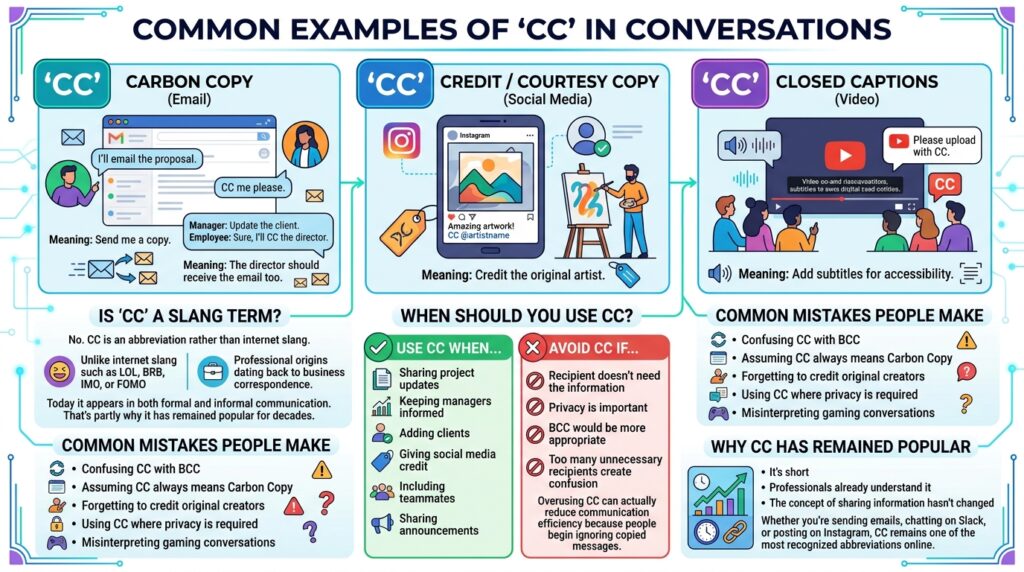
Example 1
Person A: I’ll email the proposal.
Person B: CC me please.
Meaning: Send me a copy.
Example 2
Manager: Update the client.
Employee: Sure, I’ll CC the director.
Meaning: The director should receive the email too.
Example 3
Instagram Caption:
Amazing artwork!
CC @artistname
Meaning: Credit the original artist.
Example 4
YouTube Comment:
Please upload with CC.
Meaning: Add subtitles.
Is CC a Slang Term?
No.
CC is an abbreviation rather than internet slang.
Unlike abbreviations such as LOL, BRB, IMO, or FOMO, CC has professional origins dating back to business correspondence.
Today it appears in both formal and informal communication.
That’s partly why it has remained popular for decades.
When Should You Use CC?
Using CC makes sense when another person needs visibility but isn’t the main participant.
Good situations include:
- Sharing project updates
- Keeping managers informed
- Adding clients
- Giving social media credit
- Including teammates
- Sharing announcements
Avoid using CC if:
- The recipient doesn’t need the information.
- Privacy is important.
- BCC would be more appropriate.
- Too many unnecessary recipients create confusion.
Overusing CC can actually reduce communication efficiency because people begin ignoring copied messages.
Common Mistakes People Make
Many users misunderstand CC because of its multiple meanings.
The most common mistakes include:
- Confusing CC with BCC.
- Assuming CC always means Carbon Copy.
- Forgetting to credit original creators.
- Using CC where privacy is required.
- Misinterpreting gaming conversations.
Fortunately, understanding the surrounding context usually clears up the confusion.
Why CC Has Remained Popular
Digital communication changes constantly, yet CC continues to survive.
There are several reasons for this.
First, it’s short.
Second, professionals already understand it.
Third, the concept of sharing information hasn’t changed.
Whether you’re sending emails, chatting on Slack, or posting on Instagram, people still need ways to include others or give proper credit.
Because of that, CC remains one of the most recognized abbreviations online.
Frequently Asked Questions
What does CC mean in chat?
In most chats, CC means Carbon Copy, referring to including another person in a conversation or ensuring they receive the same information. On some platforms, it may also mean Credit or Closed Captions depending on the context.
What does CC mean on Instagram?
On Instagram, CC usually means Credit. Users include CC followed by a username to acknowledge the original creator of artwork, videos, photos, edits, or creative ideas. It’s a simple way to recognize someone else’s contribution.
Is CC the same as BCC?
No. CC allows every recipient to see who else received the message, while BCC (Blind Carbon Copy) hides recipients from everyone else. BCC is commonly used when privacy is important or when emailing large groups.
Is CC considered internet slang?
No. CC is an established abbreviation rather than internet slang. It originated from business correspondence and email communication but has expanded into messaging apps, workplace chats, social media, and online collaboration tools.
Conclusion
Understanding the CC meaning in chat is much easier once you know that context determines its definition. In most messaging apps and emails, CC stands for Carbon Copy, meaning someone should receive the same message or stay informed. On social media, it usually means Credit, while on video platforms, it refers to Closed Captions.
Whether you’re chatting on WhatsApp, collaborating in Slack, sending professional emails, or posting on Instagram, recognizing these meanings helps you communicate more clearly and avoid misunderstandings. As digital communication continues to evolve, CC remains one of the most useful and widely recognized abbreviations across personal, professional, and online conversations.