
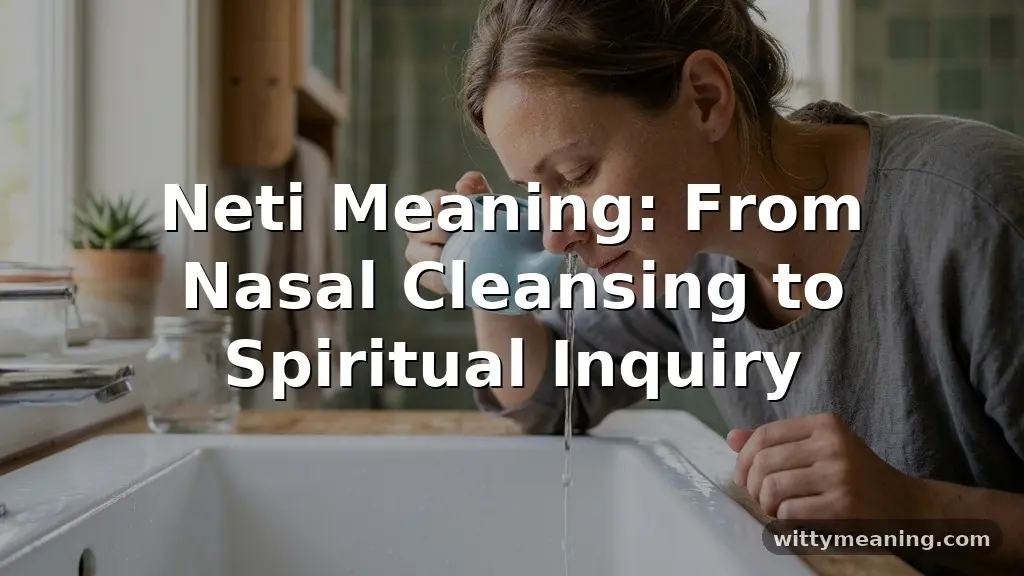

Understanding the true neti meaning requires a shift in perspective. Depending on the context, you might be looking for a physical cleansing practice or a profound philosophical concept rooted in ancient wisdom. At its most basic level, the term has two distinct applications: the physical act of flushing the sinuses and the metaphysical process of stripping away the false to reveal the truth.
Both paths lead to a form of purification, whether that involves clearing out your nasal passages or clearing away the illusions that cloud your perception of reality. By exploring both, you get a full picture of why these traditions have endured for thousands of years.
The Physical Practice of Nasal Irrigation

When people first encounter the term in a health or wellness context, they are usually referring to nasal irrigation. This cleansing technique, known as Jala Neti, is a cornerstone of Hatha Yoga hygiene.
It involves using a small vessel, often called a neti pot, to pour a gentle saline solution through one nostril and out the other. This process helps remove mucus, allergens, and environmental pollutants from the nasal passage, which significantly improves respiratory health and helps maintain clear breathing.
The practice is more than just a quick fix for a stuffy nose; it is a deliberate Kriya, or an action performed to create a specific internal state. By keeping the sinuses clear, practitioners believe they facilitate better airflow during pranayama, the yogic practice of breath control. If you have ever felt the immediate relief of a clear head after using a saline rinse, you are experiencing a small part of why this tradition remains popular in modern integrative medicine.
Sanskrit Etymology and Linguistic Roots
The Sanskrit etymology of the word provides a bridge between the physical and the philosophical. In the context of the cleansing practice, the word is often associated with the act of leading or guiding, as in guiding water through the body.
However, when we look at the phrase neti neti, we are dealing with a completely different linguistic structure. This phrase is a contraction of na iti, which translates directly to “not this, not that.”
This linguistic negation is a sophisticated tool used by sages to describe the indescribable. By systematically denying every attribute or limitation that one might project onto the ultimate reality, the practitioner is left with the only thing that cannot be negated.
It is a linguistic trap designed to exhaust the intellect so that intuition can take over. Exploring this distinction is essential for anyone trying to grasp the full scope of the term.
Jala Neti vs. Sutra Neti
In the traditional systems of Hatha Yoga, there are two primary methods for cleansing the nasal region. Jala Neti is the most accessible form, utilizing water and salt to wash the passages. It is gentle, restorative, and widely recommended for daily maintenance. In contrast, Sutra Neti is a more advanced yogic practice that involves passing a soft thread or rubber catheter through the nostril and out the mouth.
While both serve the purpose of physiological purification, they are approached with different levels of intensity. Sutra Neti is intended to provide a deeper level of stimulation and clearing, often requiring guidance from an experienced teacher to ensure safety.
Beginners should always start with the water-based method before considering more invasive techniques. The following table highlights the functional differences between these two common approaches:
| Feature | Jala Neti | Sutra Neti |
|---|---|---|
| Medium | Saline solution | Soft thread or catheter |
| Purpose | Daily hygiene | Advanced clearing |
| Complexity | Low (Beginner) | High (Requires training) |
The Philosophy of Neti Neti in Advaita Vedanta

Moving away from the physical, the phrase neti neti occupies a central place in Advaita Vedanta, a school of Hindu philosophy centered on non-dualism. Found prominently in the Brihadaranyaka Upanishad, this method of self-inquiry is designed to help the seeker identify the nature of the self. The core idea is that the true self is not the body, not the mind, not the emotions, and not the intellect.
By repeatedly asserting “neither this nor that,” the practitioner peels away the layers of the ego. This is not a nihilistic approach that seeks to destroy the world, but rather a methodology to reveal that the underlying consciousness is infinite and unchanging.
It is a rigorous mental exercise that demands constant vigilance against the habit of identifying with temporary states. When you stop defining yourself by your job, your history, or your feelings, you move closer to the realization of the Atman, or the true, eternal self.
Connecting with the Upanishads
The Upanishads are the philosophical bedrock of Vedic philosophy, and they are the primary source for these teachings on negation. These ancient texts contain dialogues between teachers and students that explore the nature of existence. When a student asks about the nature of the ultimate reality, or Brahman, the teacher often responds with “neti neti.”
This is not a refusal to answer but an invitation to experience. The logic is that any concept you can form in your mind is limited by your own perspective. If you say “God is powerful,” you are still defining God through a human lens.
By stripping away all definitions, you remove the barriers to direct experience. This ancient pedagogy continues to influence modern spiritual thinkers who seek to reconcile the finite human experience with the concept of an infinite, non-dual reality.
Physiological Purification and Modern Science
Beyond the spiritual, the physical benefits of nasal irrigation have been well-documented by medical researchers. Using a saline rinse can help reduce the symptoms of chronic sinusitis, seasonal allergies, and the common cold. The mechanical action of the water washes away irritants, while the salt helps to reduce inflammation in the mucosal lining.
The American Academy of Allergy, Asthma & Immunology provides detailed guidance on how to perform this safely. It is crucial to use distilled or boiled water to avoid introducing contaminants into the nasal cavity.
When done correctly, this practice supports the body’s natural defenses, allowing the cilia in the nose to function more efficiently. It serves as a great example of how an ancient ritual can be validated by modern clinical standards.
Self-Inquiry as a Spiritual Tool

The process of self-inquiry using the neti neti method is essentially a form of meditation. It requires the practitioner to sit with their thoughts and observe them without attachment. Whenever a thought arises—”I am tired,” “I am angry,” or “I am successful”—the practitioner silently applies the negation.
This practice is not intended to suppress emotions but to change one’s relationship to them. By recognizing that these states are transient, you create a space of stillness within yourself. Over time, this space expands, and the identification with the “small self” begins to dissolve.
It is a transformative journey that shifts your focus from the external world of objects to the internal world of pure awareness. The goal is to reach a state of spiritual liberation where the illusion of separation between the self and the universe vanishes.
The Role of Patanjali and Hatha Yoga
While the philosophical side of the term is rooted in the Upanishads, the physical side is deeply connected to the teachings of Patanjali and the broader development of Hatha Yoga. Patanjali is best known for the Yoga Sutras, which outline the eight limbs of yoga. Although the Sutras focus heavily on the mind, the later development of Hatha Yoga expanded the focus to include the body as a vehicle for spiritual growth.
The inclusion of cleansing practices like Jala Neti shows a holistic understanding of human nature. You cannot easily quiet the mind if the body is sluggish, congested, or full of toxins.
By purifying the physical vessel, the yogi prepares the ground for deeper meditation. This integration of body and mind is what makes the tradition so resilient; it recognizes that the spiritual and the physical are not separate, but two sides of the same coin.
Common Misconceptions and Clarifications
There is often confusion between the two meanings, leading to some humorous or misguided searches. Some people search for the term hoping for a quick way to “cleanse their soul” via a neti pot, while others might think it is a specific type of meditation mantra. It is important to clarify that while they share the same word, the practices are distinct.
- Jala Neti is a physical maintenance habit for your sinuses.
- Neti Neti is a mental practice for philosophical realization.
- Both require patience and consistent application to see results.
- Neither is meant to be a substitute for professional medical or psychological advice.
Understanding these distinctions prevents frustration. If you are struggling with a cold, the philosophical inquiry won’t clear your congestion.
If you are struggling with an existential crisis, a nasal rinse won’t provide the answers you seek. Use the right tool for the right situation.
Deepening Your Understanding
To truly integrate these concepts, consider how they complement each other in daily life. A clear physical body provides a stable foundation for a clear mind.
When you practice nasal irrigation, you are engaging in a moment of mindfulness, focusing on the breath and the sensation of water. This can be a gateway to the broader practice of self-inquiry.
As you go about your day, try to observe your own reactions. When you feel a strong attachment to a label or a role, remember the principle of “not this, not that.” See if you can step back and observe the thought without becoming it.
This is the essence of applying the ancient wisdom of the sages to the modern world. It is a quiet, internal work that requires no special equipment—only your own willingness to look beyond the surface.
FAQ
Is neti a word used in Scrabble?
Yes, neti is a valid word in most Scrabble dictionaries. It is recognized as a noun referring to the yogic practice of nasal irrigation. Because it is a short, vowel-heavy word, it can be a useful tool for clearing out your rack during a game.
What is the difference between neti and neeti?
Neti refers to the cleansing practices or the philosophical negation discussed in this article. Neeti, on the other hand, is a different Sanskrit term that generally translates to “policy,” “morality,” or “conduct.” They are entirely unrelated in meaning, origin, and application within Vedic texts.
Can I practice neti neti meditation without a teacher?
You can certainly begin the practice of self-inquiry on your own through reading and contemplation. However, because the process involves deconstructing deeply held beliefs about the self, many people find that working with a qualified teacher or a trusted community helps them stay on track and avoid common pitfalls.
How often should I use a neti pot?
Most practitioners use a neti pot as needed, especially during allergy season or when dealing with a cold. For general maintenance, some people use it a few times a week. Always ensure you are using sterile water and keeping your equipment clean to prevent the risk of infection.
Conclusion
Exploring the multiple layers of the neti meaning reveals a fascinating intersection of physical hygiene and profound philosophy. Whether you are using a neti pot to find relief from seasonal congestion or using the neti neti inquiry to peel back the layers of your ego, you are participating in a tradition that values clarity above all else. By keeping your body clean and your mind questioning, you create a balanced approach to living that honors both your physical existence and your deeper, non-dual nature.
Start by incorporating small, intentional practices into your routine, and remain open to the insights that naturally arise when the clutter is cleared away. If you have found this perspective helpful, consider sharing your own experiences with these timeless practices.