
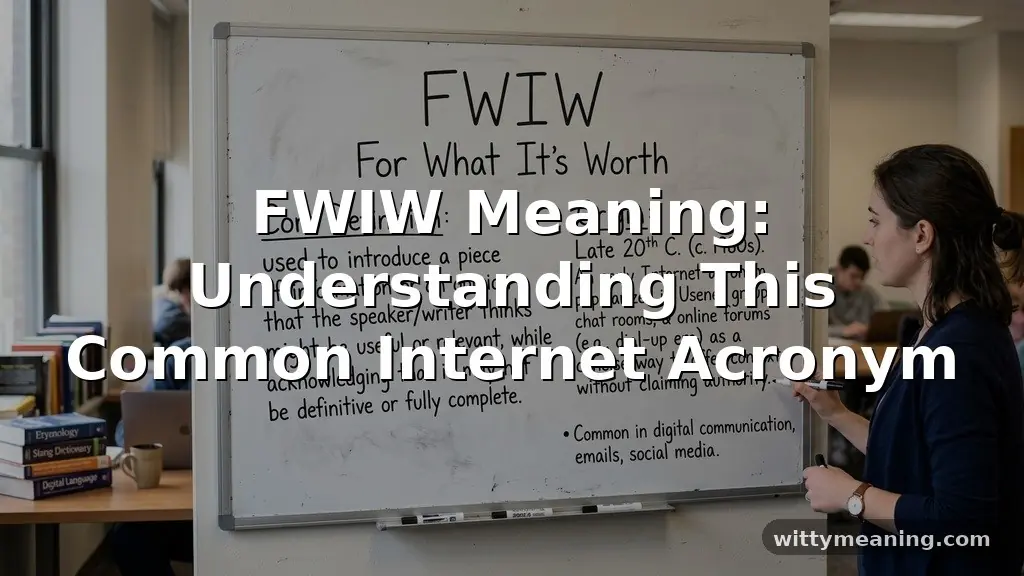

You have likely stumbled across the acronym FWIW in a heated debate on social media or a quick message from a colleague and wondered what it actually signifies. The FWIW meaning is quite straightforward, standing for the phrase “for what it’s worth.” It serves as a classic example of internet acronyms that have migrated from early chat rooms into our everyday digital communication.
Understanding how to use it properly can help you soften your tone, share an opinion without being overbearing, or simply add a bit of context to a statement. In this article, we will break down exactly how this piece of text slang functions in various professional and social environments.
The Core Definition and Origin of FWIW
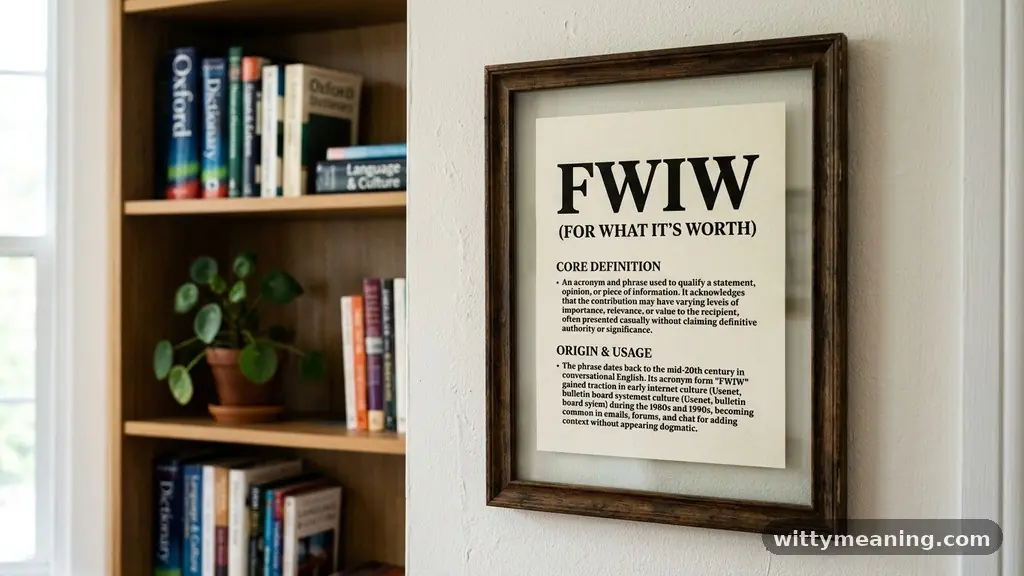
At its most basic level, the FWIW meaning is synonymous with the phrase “for what it’s worth.” People use it to introduce a piece of information or an opinion that they believe might be relevant, even if they aren’t entirely sure how much impact it will have on the ongoing conversation.
It acts as a humble qualifier. By adding these four letters to the beginning or end of a sentence, a speaker signals that they are offering their perspective without demanding that the other person accept it as absolute truth.
The term emerged during the early days of instant messaging and internet relay chat (IRC) culture. As users sought ways to communicate more quickly, long phrases were naturally compressed into short, punchy abbreviations. While it may seem like a modern invention, it has been a staple of digital communication for decades.
It reflects the evolution of language within online spaces where brevity is prized, yet the need for nuance remains high. Using such acronyms allows for a flow of ideas that mirrors the speed of thought.
How to Use FWIW in Casual Conversation
In the realm of casual text messaging and social media, FWIW is often used to introduce a counterpoint or a bit of “insider” knowledge. If your friend is complaining about a movie, you might chime in by saying, “FWIW, I actually liked the cinematography even if the plot was weak.”
Here, the acronym serves as a way to soften a disagreement. It shows that you aren’t trying to start a fight or invalidate their feelings; you are simply tossing your own take into the ring for consideration.
The beauty of this shorthand lies in its ability to manage ego and tone. Without it, a direct statement like “I liked the cinematography” might sound like a challenge to your friend’s opinion. By leading with the acronym, you create a buffer.
It acknowledges that your opinion is subjective and that you are aware the other person might not agree. This is a common pattern in internet culture, where the lack of facial expressions and vocal inflection makes it harder to convey intent.
Professional Email Etiquette and FWIW
While many internet acronyms are strictly for personal use, the FWIW meaning has crossed over into business communication with surprising success. In professional correspondence, it is frequently used to offer a suggestion or a piece of data that might have been overlooked.
For example, you might email a project lead saying, “FWIW, the last time we tried this software, it crashed during the export phase.” It is a polite way to provide a warning without sounding like you are lecturing your superior or teammate.
However, context is everything when it comes to office life. Using chat abbreviations in a formal report or a high-stakes client proposal is usually a bad idea. It can make you appear unprofessional or lazy.
Reserve its use for internal emails, Slack channels, or quick project management tool comments. When used correctly, it demonstrates that you are being helpful and proactive, providing valuable context that the team might otherwise miss.
Comparing FWIW to Other Common Acronyms
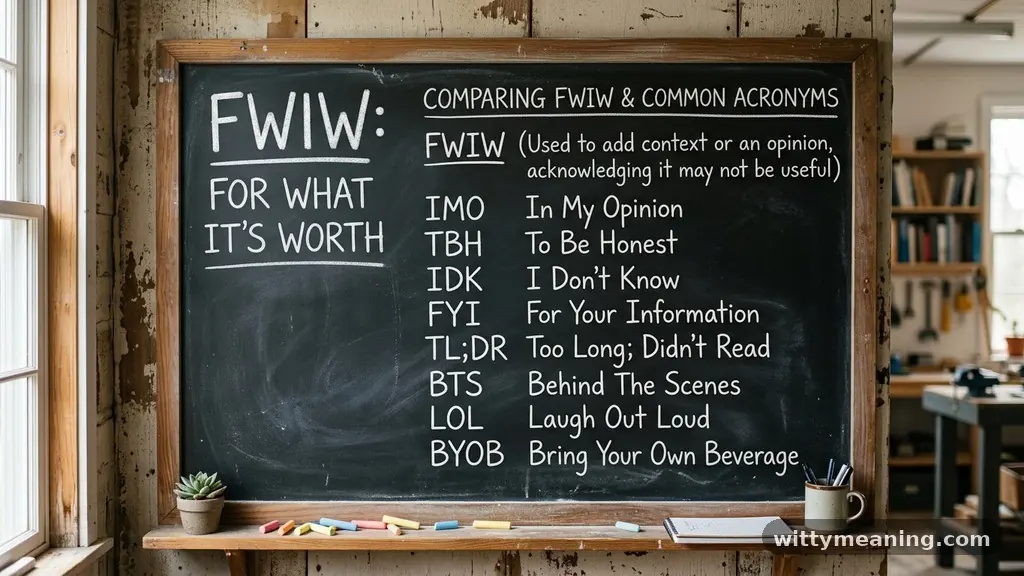
It is helpful to look at how FWIW stacks up against other common bits of shorthand. People often confuse it with FYI, but they serve very different purposes.
While FYI (for your information) is used to share objective facts or updates, FWIW is inherently tied to a subjective perspective. You aren’t just passing along a document; you are sharing a thought or a feeling that you think is relevant to the discussion.
| Acronym | Common Meaning | Primary Purpose |
|---|---|---|
| FWIW | For what it’s worth | Sharing a subjective perspective or soft opinion. |
| FYI | For your information | Sharing objective data, news, or neutral updates. |
| IMO | In my opinion | Stating a personal stance or belief clearly. |
| TBH | To be honest | Emphasizing sincerity or revealing a hidden truth. |
Understanding these distinctions helps you choose the right tool for the job. If you are sending a meeting agenda, go with FYI.
If you are discussing the merits of a specific strategy and want to offer a gentle observation, FWIW is the better choice. Mixing them up can lead to minor confusion, though most people will understand your intent based on the surrounding sentences.
The Nuance of Tone and Intent
One of the biggest challenges in digital communication is the loss of non-verbal cues. When you speak to someone in person, your tone of voice and facial expression tell them whether you are being aggressive, helpful, or sarcastic. In written text, these cues disappear.
This is where acronyms like FWIW act as a form of “conversational filler” that helps replace the missing emotional context. It signals humility and a lack of dogmatism.
Some critics argue that using such shorthand makes for sloppy writing, but it is better to view it as a linguistic adaptation. Language is designed to be efficient. If you can convey a sense of “I’m just offering this as a suggestion, take it or leave it” with four letters, you have saved yourself a long, clunky sentence.
The key is to ensure that your message remains clear. If the acronym makes the sentence hard to parse, it is usually better to write the phrase out in full.
Common Misconceptions and Urban Dictionary Influence
Because terms like FWIW originate in the wild west of early forums, there is often a belief that they are inherently “slangy” or informal to a fault. Some people browse sites like Urban Dictionary to get the “real” meaning of these terms, only to find dozens of conflicting or joke definitions. It is important to remember that these community-driven sites often prioritize humor over dictionary-standard definitions.
The reality is far more mundane. The FWIW meaning hasn’t changed significantly since it was first coined. It remains a functional, polite way to introduce a thought.
You don’t need to overthink its “street cred” or worry if it’s considered “cool” by the latest generation of social media users. It has become a standard part of the digital lexicon, understood by almost anyone who spends time on the internet or uses email for work.
When to Avoid Using Acronyms

Despite its usefulness, there are times when you should leave FWIW out of your writing entirely. If you are writing a formal letter, a legal document, or a piece of academic work, stick to full, standard English.
Acronyms can make your writing look cluttered or suggest that you are not taking the task seriously. There is a time and place for brevity, but some formats require the weight and formality of complete phrases.
Additionally, be mindful of your audience. If you are communicating with someone who is not tech-savvy or who primarily speaks English as a second language, these abbreviations might cause confusion.
They are “insider” knowledge that assumes a shared understanding of internet culture. If there is even a small chance your recipient won’t know the term, it is kinder and more professional to spell it out.
The Evolution of Digital Communication
The rise of abbreviations like FWIW is a direct response to the pace of modern life. We communicate more now than at any point in history, but we do so in shorter, more frequent bursts.
This has shifted our language toward a style that values speed and efficiency. We are essentially writing the way we speak—using filler words, short sentences, and shorthand to keep the conversation moving.
This shift isn’t inherently bad. It allows for a more democratic form of communication where ideas can be exchanged rapidly. However, it does require a certain level of social intelligence.
You have to know when to be brief and when to be thorough. The best communicators are those who can switch between these modes effortlessly, using shorthand when it helps and formal language when the situation demands it.
How FWIW Functions as a Softener
One of the most interesting aspects of the FWIW meaning is its role as a social lubricant. When we offer an opinion, we risk social friction. By front-loading a comment with FWIW, we are effectively saying, “I am not looking for a fight.”
This is a sophisticated use of language that helps maintain harmony in digital spaces. It allows us to be honest without being abrasive.
Consider these scenarios where it serves as a softener:
- When you want to share a piece of advice without sounding like a know-it-all.
- When you are offering a dissenting opinion in a group chat to avoid causing offense.
- When you are providing feedback to a colleague and want to keep the tone constructive.
- When you are adding a personal observation to a factual report.
By using the acronym, you are signaling that you recognize the boundaries of the conversation. You are acknowledging that your input is merely one of many possible perspectives, which encourages others to share their own thoughts in a similar, non-confrontational manner.
Addressing Topical Gaps and Common Questions
Many users wonder if FWIW is considered rude or aggressive. In almost every context, the answer is no. It is inherently polite.
If anything, it is the opposite of aggressive because it creates distance between the speaker and the statement. It is a way of saying, “This is just my take, feel free to ignore it.” If you find yourself worried about how a message will be received, adding FWIW is a very safe way to frame your input.
Another common question is whether it has a medical or technical meaning. Outside of the common internet acronym, it does not. If you see it in a medical chart or a highly technical manual, it is likely a typo or an internal shorthand unique to that specific organization.
Always rely on context clues. If the acronym seems out of place, look at the surrounding text to see if it makes sense as “for what it’s worth.” If not, it is probably an internal code or a mistake.
Frequently Asked Questions
Is it ever inappropriate to use FWIW in a work email?
Yes, avoid it if the email is going to senior leadership, external clients, or stakeholders who value formal communication. It is best suited for internal team communications, quick Slack messages, or informal project updates where a conversational tone is already established.
Does FWIW always have to be at the start of a sentence?
Not at all. You can place it at the end of a sentence or even set it off with commas in the middle. For example, “I think we should delay the launch, FWIW,” works just as well as starting the sentence with the acronym.
Is there a difference between FWIW and IMO?
Yes, there is a subtle difference. IMO (in my opinion) is a direct statement of your belief. FWIW (for what it’s worth) suggests that your opinion might be helpful or relevant, but you are less concerned with asserting it as a definitive stance.
Should I capitalize FWIW when writing?
It is standard practice to capitalize acronyms in text messaging and emails, but it is not strictly necessary. Using lowercase “fwiw” is perfectly acceptable in casual chat, though capitalizing it makes it slightly easier to read as a distinct unit of meaning.
Final Thoughts on Mastering Internet Acronyms
Incorporating FWIW into your digital vocabulary is a great way to add nuance and politeness to your messages. It is a versatile tool that helps you share your perspective without dominating the conversation. By understanding the FWIW meaning and when to use it, you can navigate both professional and personal digital spaces with more confidence and clarity.
Remember that the goal of any communication is to be understood, so use these shortcuts to clarify your intent rather than to obscure it. As you continue to refine your digital correspondence, keep an eye on how these small, three- or four-letter phrases can change the entire tone of your interactions. Feel free to experiment with its usage, and see how it helps you manage your daily digital conversations more effectively.