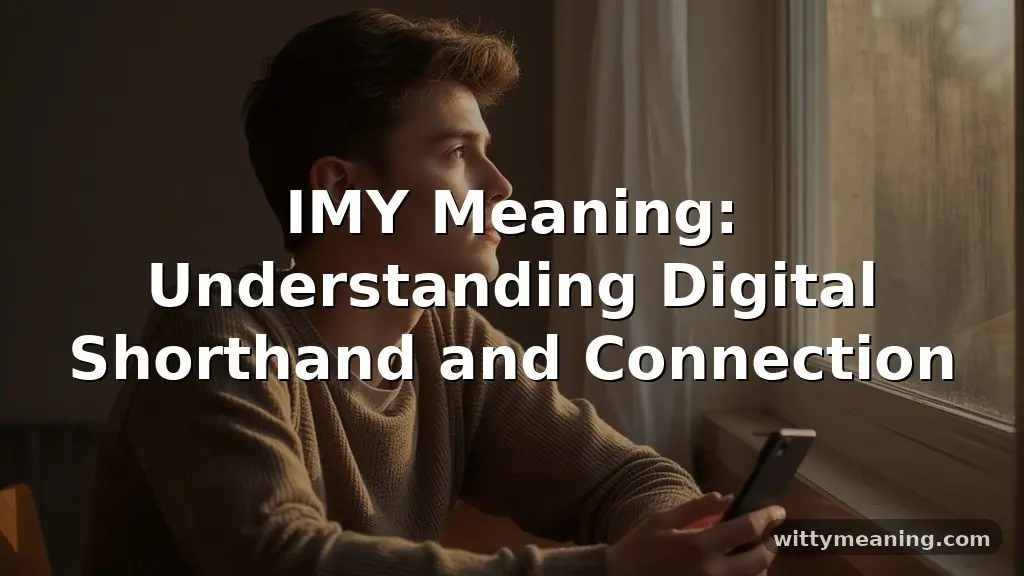

When you receive a quick message from a friend or partner that simply says “imy,” you are witnessing the evolution of modern digital communication. Understanding the imy meaning is straightforward, as it serves as a common shorthand for “I miss you,” but its usage reveals much more about how we maintain relationships in a fast-paced, screen-based world.
Whether you are navigating a new conversation on social media or checking in with a long-distance friend, this acronym acts as a bridge for emotional expression. By exploring the nuances of this term, you will gain better insight into how digital shorthand shapes our daily interactions and helps maintain intimacy across distances.
The Core Definition of IMY
At its most basic level, the acronym imy stands for “I miss you.” It is a staple of digital communication, particularly within text messaging and instant messaging platforms where brevity is often valued over formal sentence structure. By removing the spaces and replacing the full phrase with three letters, users can convey a sentiment of longing or affection without the perceived weight of a longer, more formal declaration.
This form of shorthand fits perfectly into the fast-paced nature of mobile communication. When you are on the go, typing out a complete sentence might feel cumbersome or overly dramatic for a casual check-in.
Using imy allows for a quick, low-pressure way to let someone know they are on your mind. It is an efficient tool that keeps the lines of communication open, even when a lengthy conversation isn’t possible.
Context and Usage in Modern Chat
The way people use this acronym depends heavily on the relationship dynamics between the sender and the receiver. In a romantic context, imy is often used to maintain a sense of closeness between partners who are physically separated.
It serves as a gentle reminder of affection that doesn’t require a deep, paragraph-long explanation. In platonic friendships, it functions as a casual “thinking of you” message that strengthens bonds without needing to be heavy or burdensome.
You will most often encounter this term in informal language settings. It is rarely used in professional emails or formal correspondence, as it lacks the necessary decorum for those environments.
However, on platforms like Snapchat, TikTok, and Instagram, it is ubiquitous. The informality of these spaces encourages the use of such abbreviations, making them feel like a natural part of the conversation rather than a lazy shortcut.
Social Media and Internet Linguistics
Internet linguistics has fundamentally changed how we interact, and acronyms like imy are the building blocks of this new dialect. Unlike older forms of written communication, digital messaging allows for near-instant feedback, which changes the tone of our exchanges. When you send a message, you are engaging in a real-time performance of your social connections.
Platforms like TikTok have helped standardize this language. Because these apps rely heavily on comments and direct messages, users have developed a shared vocabulary that prioritizes speed.
If you search for the term on an acronym dictionary or similar linguistic resource, you will find that it is widely recognized as a standard piece of digital jargon. It is no longer just a niche term used by a small group; it is a fundamental part of how people express sentiment online.
Variations and Related Acronyms
Just as the imy meaning is tied to “I miss you,” there are several related terms that often appear in the same context. Understanding these can help you better interpret the tone of a conversation. For example, “ily” stands for “I love you,” and it is frequently paired with imy to create a more intense emotional expression.
Other variations include:
- LMY: Less commonly used, but sometimes stands for “Love miss you” or similar variations depending on the specific group.
- IMYSM: A slightly more emphatic version, standing for “I miss you so much.”
- IMYT: Used when someone wants to say “I miss you too,” providing an immediate, symmetrical response.
- ILYSM: Stands for “I love you so much,” often used in conjunction with missing someone.
These variations allow for a spectrum of emotional intensity. While “imy” is casual, adding “sm” (so much) or pairing it with “ily” signals a deeper level of attachment. Being aware of these subtle differences in texting etiquette can prevent misunderstandings and ensure your messages land exactly as you intend.
The Role of Sentiment Analysis in Digital Communication
From a technical perspective, the prevalence of terms like imy provides fascinating data for sentiment analysis. Algorithms designed to monitor social media trends track these acronyms to gauge the emotional temperature of user interactions. Because the term is consistently linked to positive, affectionate, or longing sentiment, it is easily tagged by automated systems.
This type of linguistic data helps platforms understand how users connect with one another. When a significant portion of a user’s messages includes phrases like “I miss you” or its shorthand versions, it indicates a high level of engagement and relationship strength.
While individual users aren’t thinking about data points, the sheer frequency of these terms proves how essential they are to the digital landscape. They are not just random letters; they are data-rich indicators of human connection.
Texting Etiquette and Frequency
When it comes to texting etiquette, the frequency with which you use imy matters. Sending it occasionally can be a sweet, meaningful gesture that confirms you value the other person.
However, using it in every single text can sometimes dilute its impact. Overuse can make a sentiment feel performative or robotic rather than genuine.
Consider the rhythm of your conversations. If you are in a long-distance relationship, frequent use is often expected and appreciated as it bridges the physical gap. If you are chatting with a casual acquaintance, you might reserve the phrase for moments when you genuinely mean it.
The key is to match the intensity of the relationship with the frequency of your expressions. Authentic connection relies on balance, even in the world of digital shorthand.
Addressing Misconceptions
One common misconception is that using acronyms like imy is a sign of laziness or a lack of vocabulary. In reality, it is a sign of linguistic efficiency.
We use shorthand to adapt to the constraints of our medium—in this case, the small screens of our smartphones. Just as we use abbreviations in professional settings for industry jargon, we use them in personal settings to keep the flow of conversation moving.
Another misconception is that the meaning is always romantic. While it is certainly used in romantic contexts, it is just as common among friends and family members.
It is a flexible term that adapts to the relationship. Whether you are messaging a sibling, a best friend, or a partner, the underlying sentiment remains the same: a desire to bridge the distance created by physical separation.
Comparison of Digital Shorthand Terms
To better understand how these terms function, it is helpful to look at how they compare in terms of usage and emotional weight. The following table breaks down common digital abbreviations and their typical contexts.
| Acronym | Full Meaning | Typical Context |
|---|---|---|
| IMY | I miss you | Casual to intimate |
| ILY | I love you | Intimate/Strong affection |
| IMYT | I miss you too | Reciprocal response |
| IMYSM | I miss you so much | High emotional intensity |
This comparison illustrates that while the terms are simple, they carry distinct weights. Choosing the right one depends on the specific message you want to convey. Using “imy” is a low-stakes way to check in, whereas “imysm” requires a slightly more vulnerable emotional investment.
Topical Gaps: Nuance and Cultural Impact
Some users wonder if imy has hidden meanings or if it is always a positive expression. In most instances, the meaning is straightforward.
However, it is worth noting that in a digital age, tone is often lost. Without vocal inflection or body language, a simple “imy” could be interpreted in various ways depending on the preceding conversation.
If a conversation has been tense, a sudden “imy” might be an attempt at reconciliation or a way to soften the blow of a disagreement. Conversely, in a stable, happy relationship, it is simply a sweet, reflexive habit.
The “gap” in most discussions about this term is the lack of focus on how it acts as a “reset button” in social dynamics. It is a way to signal that despite any minor friction, the underlying bond remains intact.
Evolving Language and Future Trends
As our reliance on mobile communication continues to grow, the way we use shorthand will likely evolve. We are already seeing a shift toward more expressive digital communication, such as the use of voice notes and video snippets, which provide more context than text alone. However, acronyms like imy will likely remain because they are quick, universally understood, and serve a specific purpose.
The future of digital language is not about replacing these terms, but rather integrating them into a more diverse toolkit of expression. We are becoming more adept at using emojis, GIFs, and shorthand together to create a complex, layered message. The imy meaning will remain a cornerstone of this lexicon, serving as a reminder that even as technology changes, the human need to express longing and affection remains constant.
FAQ
Is imy considered formal or informal language?
The term imy is strictly informal. It is a product of digital shorthand and texting culture. You should avoid using it in professional emails, cover letters, or any formal documentation, as it is viewed as too casual and potentially unprofessional for those specific settings.
Does imy always mean romantic interest?
No, imy does not always indicate romantic interest. It is frequently used between close friends, family members, and siblings to express affection and longing. Its meaning is entirely dependent on the existing relationship between the sender and the recipient of the message.
Why do people use imy instead of writing it out?
People use imy primarily for efficiency and speed. In the context of instant messaging and social media, brevity is often preferred. It allows for quick communication that maintains a sense of intimacy without requiring the time and effort of typing out a full, formal sentence.
Are there regional variations for this acronym?
While imy is widely understood across English-speaking regions, it is a global term thanks to the reach of social media platforms like TikTok and Instagram. It does not have significant regional variations, as it is a standardized part of the international digital vernacular used by younger generations.
Conclusion
Understanding the imy meaning helps you navigate the complexities of modern digital relationships with greater clarity. Whether you are using it to check in with a friend or to maintain a connection with a partner, this shorthand is a powerful tool for emotional expression. It bridges the gap between physical distance and social closeness, making it an essential part of our daily communication.
As you continue to interact online, remember that while the medium is digital, the sentiments you share are very real. Use these tools to foster genuine connections, and don’t hesitate to reach out to those you care about, even if it’s just with a quick three-letter message. Keep the conversation going and stay connected with the people who matter most to you.