

If you have stumbled across the word “chooch” in a group chat or a social media thread, you might have been left scratching your head. Understanding the chooch meaning in text requires a bit of a deep dive into regional dialects and history, specifically within the United States.
While it often appears as a lighthearted jab, it carries a specific weight depending on who is saying it and where they are from. By exploring the roots of this term, you can better navigate the social context of when it is used as a playful tease versus when it is intended as a genuine insult.
The Etymological Roots of Chooch

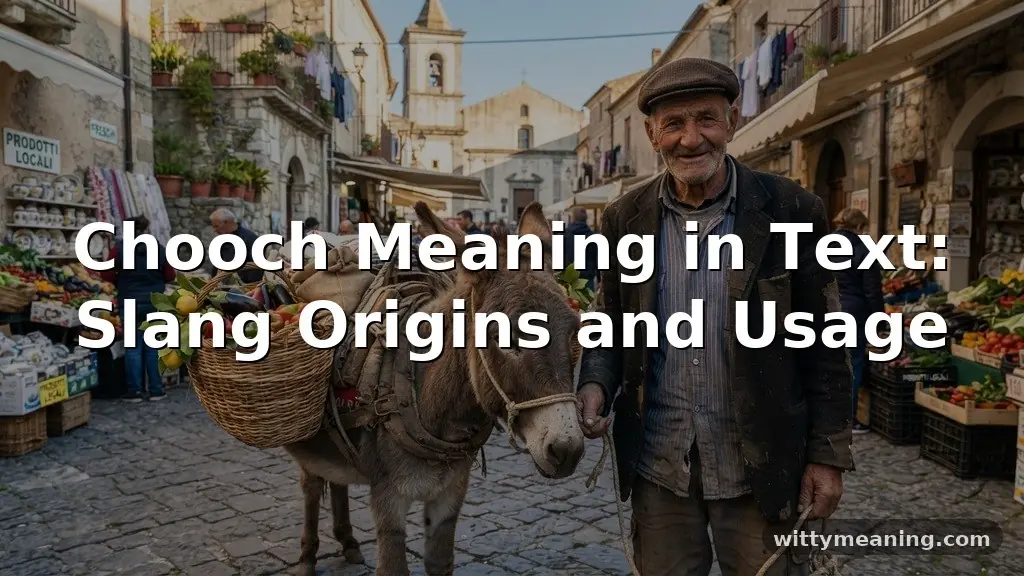
To truly grasp the term, we have to look back at its Mediterranean roots. The word is an Americanized adaptation of the Italian word “ciuccio,” which translates directly to “donkey” or “pacifier” depending on the regional dialect.
In many parts of Southern Italy, the donkey was historically viewed as a stubborn or slow-witted animal, making the term a natural choice for labeling someone as a fool or a simpleton. Over time, as waves of Italian immigrants settled in the United States, this word traveled across the Atlantic, shifting in pronunciation and usage to fit the local tongue.
The linguistic evolution of the term is a perfect example of how immigrant languages blend into the broader American tapestry. As the word moved away from its literal Italian meaning, it became a staple of the informal speech patterns found in tight-knit ethnic communities.
It is no longer about the animal itself; it is about the behavior associated with the animal. When someone calls you a chooch, they are essentially calling you a clown or a buffoon, someone who is acting in a way that lacks common sense or social awareness.
Regional Prevalence in the United States
The geographic footprint of this term is fairly specific. You are much more likely to hear it in places with deep Italian-American roots, particularly along the East Coast.
It is a hallmark of the New York dialect, often heard in the outer boroughs or among older generations who grew up in traditional enclaves. Similarly, you will find it embedded in Philadelphia slang and New Jersey culture, where it serves as a shorthand for someone who is acting like a knucklehead.
This regional vernacular acts as a social marker. If you are in a different part of the country, the word might sound completely foreign, but in the Tri-State area, it is as common as any other mild disparagement.
It is rarely used in formal settings; instead, it thrives in casual, high-energy environments like construction sites, family gatherings, or sports bars. Recognizing that this is a localized term helps you understand why it might not appear in standard dictionaries but remains a vibrant part of everyday conversation.
The Nuance of Playful Teasing
One of the most important aspects of the chooch meaning in text is that it is often used as a term of endearment. While it is technically derogatory, the intent behind the word is frequently playful.
If a close friend does something clumsy or says something particularly silly, calling them a chooch is a way to poke fun at the behavior without being genuinely malicious. It falls into the same category as “goofball” or “dingus.”
Context is everything when deciphering intent. If the person using the word is smiling or laughing, it is almost certainly meant in a lighthearted, teasing way. In these instances, the insult is softened by the strength of the relationship.
It is a way of saying, “You are being ridiculous, but you are my friend.” However, this playfulness relies heavily on the social bond between the speaker and the listener. Using the word with someone you do not know well can easily lead to misunderstandings, as the aggressive tone of the word can mask the intended humor.
When Chooch Becomes a Genuine Insult
Despite its potential for humor, it is important to acknowledge that the word can be used as a legitimate insult. When the social context shifts to one of confrontation or genuine frustration, the word takes on a sharper edge. In these cases, it is used to label someone as a moron or an idiot, implying that their actions have caused a problem or that they are fundamentally incapable of understanding a simple concept.
The weight of the word changes based on the tone of the conversation. In a heated argument, calling someone a chooch is a way to belittle their intelligence and dismiss their perspective entirely. It is a direct attack on the person’s competence.
Because of its roots in specific ethnic communities, some people might also find the term to be culturally loaded or even mildly offensive if they are not part of the community where it is commonly used. Being aware of this line is crucial, as you never want to accidentally escalate a situation by using a term that holds more weight than you intended.
Comparing Chooch to Other Slang Terms
To better understand where “chooch” sits in the hierarchy of insults, it helps to compare it to other common slang words. While it shares some DNA with terms like “idiot” or “moron,” it has a much more specific cultural flavor.
It lacks the clinical coldness of “moron” and the generic nature of “idiot.” Instead, it feels more like a character judgment, suggesting that the person is not just wrong, but acting in a way that is inherently silly or stubborn.
The following table highlights how this term compares to other common slang used to describe someone who is acting foolishly.
| Term | Intensity | Primary Connotation |
|---|---|---|
| Chooch | Mild to Moderate | Playful, stubborn, or foolish behavior |
| Idiot | Moderate | General lack of intelligence |
| Buffoon | Moderate | Comically stupid or awkward |
| Knucklehead | Mild | Good-natured, lighthearted teasing |
As seen in the table, the term occupies a unique space. It is more descriptive than a simple insult, as it implies a specific type of behavior—often a mix of stubbornness and social clumsiness—rather than just a lack of brainpower. This distinction is why it persists in regional dialects while other, more generic insults tend to fade away.
Generational Shifts and Usage Trends

Language is never static, and the way younger generations use slang often differs from their parents and grandparents. The term has seen a slight resurgence in popularity thanks to internet culture, where niche regional terms often go viral and find new life outside their original geographic borders.
However, this has led to some dilution of its original cultural nuance. Younger users might encounter the word online and use it without fully understanding its Italian heritage or its specific roots in East Coast neighborhoods.
This digital evolution means that the term is being stripped of some of its local history and repurposed as a generic, quirky insult. While this helps keep the word alive, it also changes its meaning.
For older speakers, the word feels like a piece of home; for younger speakers, it might just be another fun word to throw around in a text message. Understanding this generational gap is essential when you see the word pop up in different digital spaces, as the user’s intent might be entirely disconnected from the word’s traditional background.
Addressing Topical Gaps: Why Is It Sometimes Confused with Vaping?
One of the common questions that arises when searching for this term is whether it has anything to do with vaping. There is a frequent point of confusion here, often stemming from the similarity between “chooch” and “chug” or other slang terms used in subcultures.
To be clear: the term is not a standard slang word for vaping or e-cigarettes. If you see it used in that context, it is likely a highly localized or niche slang usage that has not entered the mainstream lexicon.
Most of the time, when people search for a connection between this word and vaping, they are encountering a misunderstanding of internet slang. It is possible that in specific online communities, members have adopted the word to describe someone who takes massive hits from a vape pen, but this is not its primary definition.
Relying on established linguistic sources, such as those provided by Online Etymology Dictionary, confirms that the word remains rooted in the concept of a donkey or a fool. Stick to the traditional usage to avoid confusion in your own texts.
The Role of Cultural Nuance in Communication
When you use a word like this, you are participating in a long line of linguistic history. Even if you are just sending a quick text, you are tapping into a culture that values expressive, colorful language.
The beauty of this term lies in its ability to paint a picture of someone who is being intentionally difficult or comically wrong. It is a tool for social signaling, showing that you are comfortable enough with the recipient to use informal, slightly edgy language.
However, the cultural nuance also dictates that you should be careful. If you are using this term in a professional setting or with someone you do not know well, you risk coming across as unprofessional or rude. The charm of the word is that it is “street-level” and informal.
It thrives in the messy, human interactions of daily life, not in the sanitized environment of a corporate email or a formal report. Keep it for your friends, your family, and the people who understand the specific flavor of your local dialect.
Common Misconceptions and Stereotypes
Because the term is tied to Italian-American identity, it is often surrounded by stereotypes. Pop culture, particularly media representations of New York or Jersey, has frequently portrayed the term as being used exclusively by loud, aggressive, or uneducated characters. This is a reductive view.
In reality, the word is used by a wide variety of people, regardless of their education or social status. It is a linguistic habit, not a character flaw.
It is helpful to separate the word from the caricature. Calling someone a chooch does not automatically make the speaker a mob-movie trope. It is simply a way of communicating frustration or affection.
By acknowledging that these stereotypes exist, you can be more mindful of how your language might be perceived by others. You might choose to use the word sparingly, or you might reclaim it as a fun, harmless part of your own personal vocabulary. The choice is yours, but awareness is the key to using it effectively.
How to Use the Term Appropriately
If you want to incorporate this word into your own vernacular, start by observing how others use it. Pay attention to the tone, the facial expressions, and the relationship between the people involved.
Is it a quick, sharp jab during a disagreement, or is it a warm, laughing comment after a mistake? Once you understand the rhythm of the word, you will know when it feels right to use it.
Here are a few guidelines for using the term in text messages or social media:
- Use it only with people who will understand the context and the joke.
- Avoid using it in professional or formal digital communications.
- Pair it with emojis if you are worried about your tone being misinterpreted.
- Be prepared to explain the meaning if the recipient is from outside your region.
- If you sense the other person is offended, apologize and clarify that it was meant as a lighthearted tease.
Following these simple rules will help you avoid social friction while still allowing you to enjoy the colorful, expressive nature of this classic piece of American slang.
FAQ Section
What is the most common meaning of chooch in a text message?
In most cases, calling someone a chooch in a text is a lighthearted way of calling them a fool or a goofball. It is usually intended as a playful tease, especially when the sender and receiver are close friends who enjoy exchanging mild, humorous insults.
Is it ever offensive to call someone a chooch?
Yes, it can be offensive depending on the context. While often used playfully, it can be a genuine insult if used during an argument to label someone as an idiot. Because of its cultural roots, some people may also find the term inappropriate if used by outsiders.
Where did the word chooch originate?
The word is an Americanized version of the Italian word ciuccio, which means donkey. In Italian dialects, it was used to describe someone who was stubborn or slow-witted. Over time, it became a staple of Italian-American slang, particularly in cities like New York and Philadelphia.
Should I use this word in a professional email?
No, you should avoid using this term in any professional or formal communication. It is considered highly informal slang and can be perceived as unprofessional or rude. It is best reserved for casual conversations with friends and family who understand your tone and the word’s background.
Conclusion
Understanding the chooch meaning in text allows you to better appreciate the rich, evolving nature of regional slang. Whether you are using it to playfully tease a friend or just trying to decode a message you received, recognizing the term’s origins as an Italian-American adaptation of “ciuccio” provides helpful context. It is a word that thrives in the nuance of human relationships, bridging the gap between a lighthearted joke and a sharp, descriptive jab.
As you continue to use and encounter this word, remember that context is always the most important factor. By staying mindful of who you are talking to and the tone of your conversation, you can use this colorful piece of language effectively.
If you have any other slang terms you are curious about, feel free to reach out and keep the conversation going. Understanding the words we use is a great way to deepen our connections and navigate the complexities of modern communication.