

The sayonara meaning is often misunderstood by non-native speakers who associate the term with a simple, everyday goodbye. While it is indeed a word for parting, its actual usage in Japanese culture is far more restricted and emotionally heavy than the casual “see ya” often heard in Western media. To use this term correctly, one must understand that it carries a sense of finality or significant distance that differentiates it from the casual salutations used between friends or colleagues on a daily basis.
Linguistic Origins and Etymology of Sayonara
The etymology of the word provides the most significant clue regarding its weight. The term is a contraction of the phrase “Sayou naraba,” which translates literally to “If it must be that way.”
This phrase is a relic of older Japanese language conventions, where speakers would acknowledge the inevitability of a situation—in this case, the necessity of parting—before proceeding to say goodbye. Over centuries, this formal, conditional clause morphed into the single word Sayounara, which is the more accurate, long-form spelling often seen in formal writing.
When written in Kanji, it is often represented as 左様ならば, though it is far more common to see it written in Hiragana (さようなら) in modern literature and signage. The evolution from a conditional phrase to a set noun demonstrates how the Japanese language prioritizes the acknowledgment of circumstances. By stating that the departure is happening because “it must be that way,” the speaker is essentially absolving themselves and the listener of the pain of the separation.
It is an acknowledgment of fate or external circumstances that dictate the end of a meeting or a phase of life. Understanding this historical background is essential for any student of the language who wishes to avoid the common Western misconception that the word is a universal equivalent to “goodbye.”
The Myth of Universal Usage
One of the most pervasive myths in global pop culture is that sayonara is the standard, go-to word for ending any conversation in Japan. In reality, native speakers rarely use the word in daily life.
If you were to walk out of a convenience store or finish a quick chat with a coworker and say “sayonara,” you would likely be met with confusion or amusement. The term is reserved for situations involving a permanent departure or a very long-term separation.
If a friend is leaving for a year-long study abroad program, or if someone is moving to a different city and you do not expect to see them for a significant amount of time, then the word becomes appropriate. It carries a gravitas that suggests, “We are parting for a long time, and I accept that this is the natural order of things.”
Using it for a simple trip to the grocery store or a quick exit from an office meeting is seen as overly dramatic, almost as if you are suggesting you might never see that person again. This socio-linguistic boundary is a critical component of Japanese etiquette, where the choice of words reflects the speaker’s assessment of the relationship and the duration of the upcoming absence.
Context-Dependent Partings in Japanese Culture
In Japanese culture, the way you end an interaction is dictated by the specific interpersonal relationships and the setting. Because the language is highly context-dependent, there are dozens of ways to say goodbye, each with its own level of politeness levels.
When you are in a professional environment, you would never use the term in question. Instead, you would use Otsukaresama, which acknowledges the shared effort of the work day.
The following table summarizes the different ways to express departure based on the social context:
| Term | Context | Intensity/Meaning |
|---|---|---|
| Sayonara | Long-term or permanent | Formal, heavy, final |
| Jya ne | Casual, friends | Light, “see ya” |
| Mata ne | Friends/Acquaintances | “See you later” |
| Otsukaresama | Professional/Workplace | “Thank you for your hard work” |
As shown in the table, the sayonara meaning stands apart as the only one that carries a heavy, long-term implication. While Jya ne and Mata ne are used in colloquial speech to maintain warmth and continuity, the formal term is designed to create a clean, respectful break. Recognizing these nuances allows a speaker to navigate social circles in Japan with much higher precision, avoiding the awkwardness of being overly dramatic or sounding inappropriately cold.
Politeness Levels and Japanese Honorifics
The use of Japanese honorifics and levels of speech is inseparable from how one chooses to say goodbye. Japanese is a language built on hierarchy and distance; therefore, the vocabulary you choose acts as a social marker.
Because sayonara is quite formal, it is rarely used in intimate relationships. If you were to say it to a close friend, it might sound like you are being sarcastic or that you are genuinely hurt and ending the friendship.
Conversely, in very formal situations, such as a speech or a formal letter, the term can be used appropriately because it maintains the necessary level of distance and respect. It is a way of saying, “I respect our time together, and I acknowledge that our paths are diverging.” This is a sophisticated aspect of nuanced communication.
The speaker is essentially using the word to manage the emotional distance between themselves and the listener. While Western languages often use the same words for both a casual departure and a final goodbye, the Japanese approach is to categorize the departure first, then select the appropriate vocabulary to match that category.
Common Western Misconceptions
Many English speakers are introduced to the term through movies, anime, or literature, where it is often used as a dramatic flair for a “cool” exit. This has led to the Western misconception that it is the standard, polite, and universal way to leave.
This misunderstanding often leads to tourists using the word incorrectly, which can be a source of mild friction. It is helpful to remember that for native speakers, the word has a specific “weight.”
When an English speaker treats it as a casual “goodbye,” they are inadvertently signaling a level of finality that they likely do not intend. For instance, if you tell your hotel receptionist “sayonara” upon checking out, you are technically telling them that you are leaving for a very long time—or potentially forever.
While the receptionist will likely understand you are a foreigner and forgive the mistake, it is a perfect example of why understanding the sayonara meaning is about more than just translation; it is about social performance. The word is not just a label for a departure; it is an active participant in defining the nature of the relationship and the future of the interaction.
Navigating Interpersonal Relationships
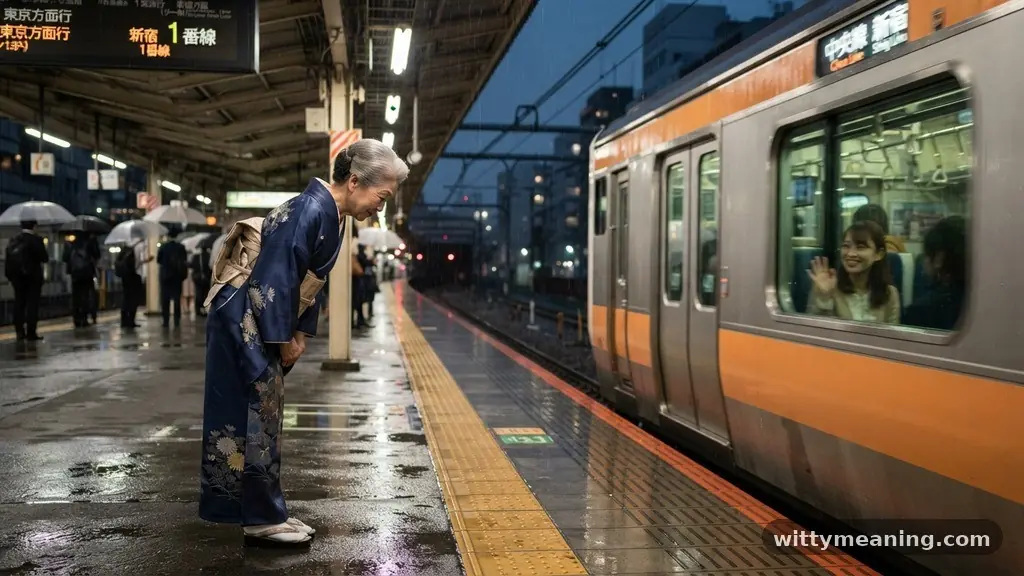
The strength of interpersonal relationships in Japan is often reinforced by how people handle transitions. Because the society places a high value on harmony, the way one exits a space or a conversation is just as important as the way one enters. Bowing is a common physical gesture that accompanies these verbal partings, and the depth or duration of the bow often mirrors the weight of the words being spoken.
If you are using the term in its proper context—perhaps saying goodbye to a host family after a month-long stay—the word carries a sense of gratitude and sadness. In this instance, it is almost always paired with a deep, respectful bow. This combination of verbal and non-verbal cues is what makes Japanese culture so deeply layered.
You are not just saying a word; you are performing an act of social closure. When you use Sayounara in this way, it is received as a sign of maturity and respect for the situation. It signals that you recognize the gravity of the parting and that you are not attempting to minimize the significance of the experience by using a casual, flippant term.
Topical Gaps: Addressing Frequent Questions
To provide a truly comprehensive view of this concept, we must address the common gaps in knowledge regarding its usage in other languages and its modern variations. Many people ask, “Is it used in Spanish?” or “What about the loanword status?”
* Loanword Status: While “sayonara” has entered the English dictionary as a recognized loanword, it has retained its “finality” connotation in English-speaking contexts, which is an interesting case of semantic drift.
* Cross-Cultural Usage: Some mistakenly believe the word has roots in Spanish or other languages due to phonetic similarities. There is no linguistic connection; it is purely Japanese in origin.
* The Role of Tone: The way the word is pronounced—the length of the vowels and the pitch—can change its meaning from a sad, respectful farewell to something that sounds like a cold, dismissive rejection.
By clarifying these points, we see that the word serves as a bridge between the linguistic structure of the Japanese language and the cultural expectations of its people. It is not merely a piece of vocabulary; it is a tool for managing social reality.
The Nuances of Japanese Etiquette
At its core, Japanese etiquette is about minimizing friction and maintaining the social order. Using the wrong farewell can cause subtle friction.
For example, if you use a very casual term with a superior, you appear disrespectful. If you use a very formal, final-sounding term with a peer, you appear distant or cold.
To master the sayonara meaning, one must practice “reading the air,” or kuuki wo yomu. This is the ability to perceive the unspoken social context of a situation. If you are in a situation where the group is feeling sentimental about a departure, then the word is a beautiful, poetic way to acknowledge that feeling.
If you are in a situation where the mood is light and people are focused on their next tasks, then using it would be a social error. The key takeaway for any learner is to observe how native speakers end their interactions. You will notice that they rarely use the word, and when they do, there is usually a significant reason behind it.
Summary of Key Takeaways
The term is a powerful, context-heavy expression that should be used sparingly. It signifies a long-term or permanent departure, making it inappropriate for daily, casual exchanges.
By understanding its etymology, its role in Japanese honorifics, and the importance of politeness levels, you can use the word effectively when the situation truly calls for it. Remember that language is a reflection of culture; the hesitation to use this word in Japan is a reflection of the deep value placed on continuity and the acknowledgement of the importance of human connections.
Frequently Asked Questions
Is sayonara considered rude in Japan?
It is not inherently rude, but it can be socially awkward or confusing if used in the wrong context. Because it implies a long-term or permanent separation, using it for a casual daily goodbye may come across as overly dramatic, cold, or unintentionally final.
What is the best way to say goodbye to a friend in Japan?
For friends, it is best to use casual phrases like “Jya ne” (see ya) or “Mata ne” (see you later). These terms are light, friendly, and appropriate for maintaining the continuity of a casual relationship without the heavy, final implications of formal vocabulary.
Why do Westerners think sayonara is the standard goodbye?
The perception largely stems from media, film, and literature where the word is used as a dramatic flourish for a character’s exit. This has created a misconception that it is the universal equivalent of “goodbye,” ignoring the nuanced, context-dependent nature of the actual Japanese language.
Can I use sayonara in a professional setting?
Generally, no. In a professional setting, you should use “Otsukaresama” (thank you for your hard work) or “Osaki ni shitsurei shimasu” (excuse me for leaving before you). These phrases are designed to maintain harmony and respect within the workplace hierarchy, whereas the former term is too final.