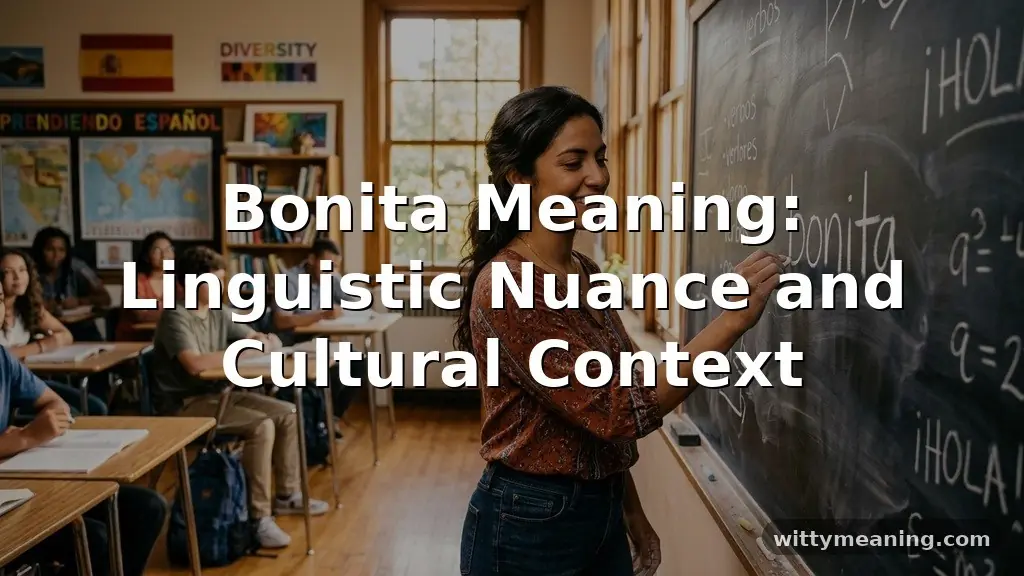

The bonita meaning centers on the core concept of beauty, acting as one of the most common Spanish adjectives used to describe a female or a feminine noun. While its direct translation into English is simply “pretty” or “beautiful,” the term carries a wealth of linguistic nuance that shifts depending on the geographic location, the relationship between speakers, and the intent behind the sentiment.
In the vast landscape of the Spanish language, understanding when to use this term is essential for anyone looking to navigate social interactions in Hispanic culture with grace and respect. Because the word is inherently gendered, it functions as a primary indicator of how Spanish speakers categorize objects and people through linguistic gender, reflecting the structural rules of the language while simultaneously serving as a bridge for genuine human connection.
The Etymological Roots and Grammatical Structure

To fully grasp the bonita meaning, one must first examine its grammatical foundation. In Spanish, adjectives must agree with the nouns they modify in both gender and number. The word “bonita” is the feminine singular form of the adjective “bonito.”
This reliance on adjective agreement is a hallmark of Latin American Spanish and Peninsular Spanish alike. Because “bonita” ends in an “a,” it is specifically reserved for feminine nouns or women.
If a speaker intends to describe a masculine noun or a man, they must switch to the masculine form bonito. This simple shift is a foundational lesson for Spanish language learners who are just beginning to understand the mechanics of the language.
The root of the word traces back to the Latin “bonus,” which translates to “good.” Over time, the evolution of the term within Romance languages shifted the focus from a general state of goodness to a specific aesthetic quality. This transition highlights how Spanish vocabulary has evolved to prioritize descriptive clarity.
When someone uses “bonita,” they are not merely stating that something is “good”; they are specifically invoking a sense of visual harmony or charm. This distinction is vital, as it separates “bonita” from other synonyms like “hermosa” (gorgeous) or “bella” (beautiful), which often carry more intense or formal connotations. By choosing “bonita,” a speaker opts for a term that feels approachable, warm, and distinctly human, making it a staple of everyday communication.
Gendered Language and the Masculine Form Bonito
The distinction between “bonito” and “bonita” is more than just a grammatical requirement; it is an exercise in gendered language that defines the rhythm of Spanish conversation. In many contexts, non-native speakers often struggle with the tendency to default to the masculine form, but in the case of “bonita,” precision is rewarded. Using the correct form demonstrates an awareness of the object’s identity within the language.
For instance, if you are describing a house (una casa), which is a feminine noun, you must use “bonita.” If you are describing a park (un parque), which is a masculine noun, you must use “bonito.”
This rule extends beyond objects to people. Calling a man “bonito” can sometimes carry a different weight than calling a woman “bonita.” While “bonita” is a standard, widely accepted compliment for women, “bonito” for a man can occasionally lean toward describing someone as “cute” or “pretty” in a way that might be perceived as less traditionally masculine than terms like “guapo” (handsome).
This sociolinguistics aspect is fascinating, as it shows how the bonita meaning is tethered to cultural expectations of gender performance. Recognizing these subtle differences allows speakers to avoid accidental gaffes and ensures that their compliments are perceived exactly as intended. It is these small, consistent applications of grammar that transform a student of the language into a fluent communicator.
Cultural Etiquette and the Use of Endearing Terms
In the context of Hispanic culture, the bonita meaning is frequently employed as a term of endearment. It is not uncommon to hear it used in public markets, between friends, or even by strangers as a way to soften a request or express friendliness. However, there is a distinct cultural etiquette involved.
While it can be a romantic compliment, it is also used in a platonic sense to describe someone’s general appearance or even their personality. This duality is what makes the word so versatile. When a grandmother calls her granddaughter “mi niña bonita,” the meaning transcends simple physical attractiveness and enters the realm of affection and familial love.
For those navigating these interactions, it is important to gauge the level of intimacy. In some regions, calling an unknown woman “bonita” might be viewed as overly familiar, while in other, more relaxed social settings, it is seen as a standard, polite acknowledgment of someone’s presence. Understanding this balance is part of mastering the linguistic context of the Spanish-speaking world.
The term functions as a social lubricant, often used to bridge the gap between people who have just met. By acknowledging someone’s beauty or charm in such a straightforward way, the speaker signals a desire for a positive, warm interaction. This is why “bonita” remains one of the most enduring words in the Spanish lexicon—it is inherently optimistic and welcoming.
Regional Variations in Latin American Spanish
While the dictionary definition remains consistent, the weight of the bonita meaning can shift as you move across different countries. In some parts of Latin American Spanish, “bonita” is used with such frequency that it loses its purely physical connotation and becomes a general descriptor for something pleasant or agreeable.
For example, a person might say “¡Qué bonita la idea!” (What a pretty idea!) or “Qué bonita tarde” (What a lovely afternoon). In these instances, the term is applied to abstract concepts or situations, demonstrating the flexibility of the language.
The following table illustrates how the term is often applied in different contexts:
| Context | Usage | Nuance |
|---|---|---|
| Romantic | “Eres muy bonita.” | Direct, intimate compliment. |
| Platonic/Friendly | “¡Qué bonita te ves hoy!” | Casual, warm, and supportive. |
| Descriptive (Object) | “Esa casa es bonita.” | Simple, aesthetic observation. |
| Abstract/Situational | “Qué bonita vida tienes.” | Expressing appreciation for a state of being. |
These regional variations highlight the importance of listening to how native speakers use the word in their specific environment. What might be considered a casual, everyday remark in one country could carry a slightly different emotional weight in another. This is why Spanish language learners are encouraged to pay attention to the tone of voice and the surrounding conversation, as these cues are just as important as the word itself.
Beauty Standards and the Sociolinguistic Impact

The bonita meaning is inextricably linked to evolving beauty standards within Spanish-speaking societies. As with any language, the words we use to describe attractiveness reflect what a culture values. Historically, “bonita” was often synonymous with a modest, classic form of beauty.
Today, however, the term is broad enough to encompass a wide variety of styles and looks. It is a democratic word; it does not necessarily demand a high-fashion or idealized standard of beauty. Instead, it captures a sense of “prettiness” that is accessible and grounded.
From a sociolinguistics perspective, the prevalence of “bonita” in music, literature, and film plays a significant role in how it is perceived. From the iconic songs of the Caribbean to the poetic verses of South American authors, the word is used to evoke a sense of longing, admiration, and grace. This constant reinforcement in media ensures that the term remains deeply embedded in the collective consciousness.
It is not just a word in a textbook; it is a cultural touchstone that helps define the aesthetics of the Spanish-speaking world. When someone is called “bonita,” they are being placed into a lineage of beauty that has been celebrated for centuries, which adds a layer of depth to the compliment that a simple English translation cannot fully capture.
Addressing Topical Gaps: Beyond the Dictionary
A common area where non-native speakers find confusion is whether the bonita meaning can be used for men or in professional settings. As established, it is almost exclusively feminine. Using it for a man is grammatically incorrect and often confusing.
Another gap in understanding is the difference between “bonita” and “linda.” While they are often used interchangeably, “linda” can sometimes carry a slightly more endearing or “cute” connotation, whereas “bonita” is more firmly rooted in the concept of “pretty.”
Furthermore, many learners wonder if “bonita” can be used in a professional environment. While it is certainly not offensive, it is generally safer to avoid using physical descriptors like “bonita” in a strictly formal business meeting, as it can be perceived as overly personal or informal. In a professional setting, Spanish speakers typically rely on other adjectives that describe competence or character, such as “excelente” (excellent) or “profesional” (professional).
Knowing when to pivot away from physical compliments is a mark of high-level social intelligence in any language. By understanding these boundaries, you can ensure that your use of the word remains appropriate and respectful in every situation you encounter.
Colloquial Expressions and Everyday Usage
Beyond its standard use, the bonita meaning appears in various colloquial expressions. For example, “hacerse la bonita” might be used to describe someone who is acting coy or trying to appear innocent in a situation where they might be at fault.
This shows the versatility of the word; it can be used to describe a personality trait or a behavioral tactic. Similarly, phrases like “bonita la cosa” can be used sarcastically to mean “a fine mess” or “a pretty situation,” proving that the term can be subverted for ironic effect.
These idiomatic uses are essential for anyone wanting to sound more natural when speaking Spanish. They demonstrate that the speaker is not just translating word-for-word, but is instead thinking in the target language. Learning these nuances requires exposure to native speech, whether through films, podcasts, or casual conversation.
When you begin to recognize these patterns, you stop translating and start communicating. The bonita meaning is not static; it is a living, breathing component of the language that adapts to the mood, the speaker, and the cultural moment.
* It is a gendered adjective requiring agreement with the noun.
* It serves as a versatile term of endearment for friends and family.
* It is distinct from “hermosa” and “bella” in its level of intensity.
* It can be used metaphorically to describe situations or ideas.
* It is rarely used for men, who are typically described as “guapo” or “bonito.”
The Role of Intonation in Romantic Compliments
When the bonita meaning is utilized as a romantic compliment, the delivery is everything. The tone of voice, the eye contact, and the timing transform the word from a simple adjective into a powerful tool of connection. In Latin American Spanish, this is often done with a sense of warmth and sincerity that is characteristic of the culture.
A quick, whispered “qué bonita” can carry more weight than a long, elaborate paragraph of praise. This is because the word itself is so evocative of classic, simple beauty.
For those in a romantic partner dynamic, the term serves as a consistent affirmation. It is a way to say, “I see you and I appreciate you,” without the need for constant grand gestures. This aligns with the broader theme of Hispanic culture, where verbal expressions of affection are a cornerstone of maintaining strong relationships.
By choosing “bonita,” the speaker opts for a word that feels genuine and grounded, reinforcing the bond between partners through simple, effective communication. The key for learners is to practice the intonation—to say the word with the confidence and warmth that it deserves, ensuring that the sentiment behind it is felt by the recipient.
Synthesizing the Meaning for Modern Communication
In summary, the bonita meaning is a multifaceted concept that goes far beyond the dictionary definition of “pretty.” It is a vital component of the Spanish language that requires an understanding of adjective agreement, linguistic gender, and cultural etiquette.
From its etymological roots in the concept of “goodness” to its modern use as a flexible term of endearment, the word serves as a primary way for Spanish speakers to express appreciation and warmth. Whether you are navigating a romantic relationship, interacting with friends in a social setting, or simply describing the world around you, “bonita” is a powerful, essential word to have in your vocabulary.
By mastering the nuances of this term, you gain more than just a new word; you gain insight into the values and communication styles of the Spanish-speaking world. You learn that language is not just about translating facts—it is about conveying emotion, acknowledging social dynamics, and participating in a shared culture.
As you continue to practice and refine your usage, remember that the most important aspect of any compliment is the sincerity behind it. When used with care and context, “bonita” becomes a bridge that connects people, fosters positivity, and adds a touch of grace to everyday life.
Frequently Asked Questions
Is it appropriate to call a girl bonita in all Spanish-speaking countries?
While “bonita” is widely understood and used, its appropriateness depends on the level of familiarity. It is generally a safe and positive term for friends and family. In some regions, using it with strangers might be seen as overly informal, so it is best to gauge the social situation first.
What is the difference between bonita and linda?
Both mean “pretty” or “beautiful” and are often used interchangeably. However, “linda” can sometimes feel a bit more “cute” or “sweet,” while “bonita” is more standard for describing physical attractiveness. The choice often comes down to regional preference and the specific nuance the speaker wants to convey.
Can I use the word bonita for a man?
No, you should avoid using “bonita” for a man because it is the feminine form of the adjective. If you want to compliment a man’s appearance, it is standard to use the masculine form “bonito” (which can mean cute) or, more commonly, the word “guapo” (handsome).
Does the meaning of bonita change in a professional setting?
Yes, the context matters significantly. While it is not inherently offensive, using physical descriptors like “bonita” can be perceived as unprofessional or overly personal in a formal business environment. It is usually better to stick to professional compliments that focus on someone’s work, skills, or character.