

The term dipsy often surfaces in casual conversation as a playful descriptor for someone acting a bit scatterbrained or silly. While many people intuitively grasp the connotation, pinning down the exact dipsy meaning requires looking at its roots in English dialects and its subsequent shift into modern slang.
Whether you have heard it used to describe a friend’s clumsy moment or encountered it in older literature, the word carries a distinct charm that separates it from harsher insults. Understanding how this term evolved helps clarify why it remains a staple in informal speech today, bridging the gap between historical regionalism and the digital-age vernacular we use now.
Etymology and Historical Context of Dipsy
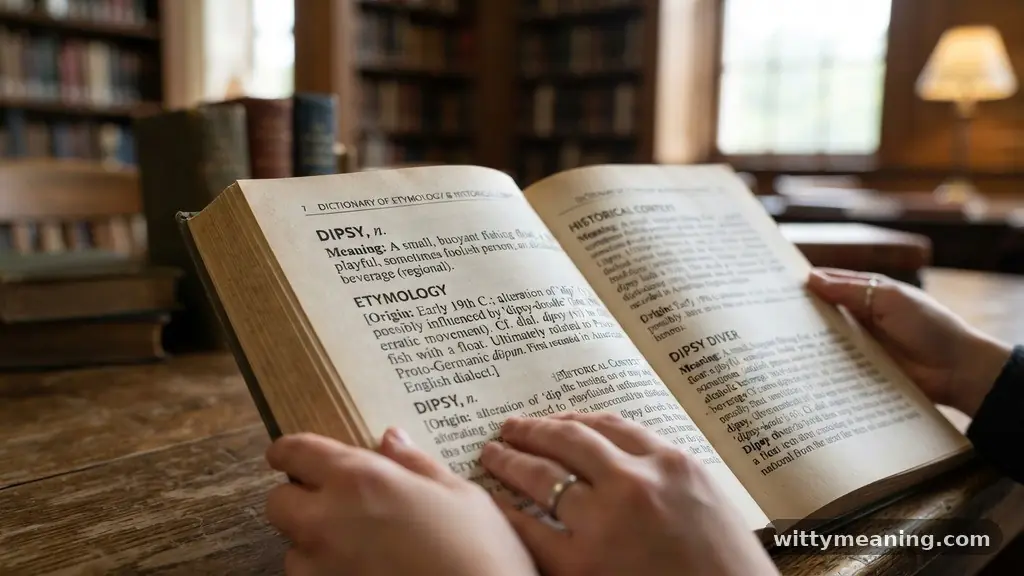
Tracing the linguistic journey of the word reveals that it didn’t just appear out of thin air. The etymology suggests a connection to older descriptors for someone who is slightly off-balance or mentally unfocused.
Historically, the word functioned as an adjective to characterize behavior that lacked serious intent or intellectual rigour. It likely emerged as a variation of other descriptive terms that highlighted a lack of conventional wisdom or stability.
When we look at its presence in historical literature, we see it often paired with descriptions of characters who are charmingly incompetent. It wasn’t intended to be a deep psychological diagnosis but rather a lighthearted observation of a person’s temperament. This historical footprint shows that the word was designed to be soft.
It lacks the biting edge of more offensive labels, which is why it persisted through generations of English speakers. Researchers often point to its phonetic similarity to words like dippy, which suggests that the “dip” sound has long been associated with the concept of being “dipped” or slightly submerged away from reality.
Regional Dialects and Linguistic Roots
The word has deep ties to various regional dialects across the British Isles and parts of North America. In many rural communities, using a word like dipsy was a common way to denote someone who was a bit “slow” in a non-malicious sense. It wasn’t about intelligence in the clinical sense, but rather a lack of common sense or a tendency to be absent-minded.
These regional variations often carried their own flavor. While some areas preferred “dippy,” others clung to the slightly more rhythmic “dipsy.” This variation highlights how language evolves through oral tradition.
People would adopt the version that felt most natural to their local cadence. Because it wasn’t a formal word found in scientific journals, it was free to mutate and drift, picking up new nuances depending on which town or valley it was spoken in. These dialects served as the laboratory where the word was refined into the version we recognize today.
Common Linguistic Confusion with Similar Terms
One of the most frequent hurdles when discussing this term is the inevitable mix-up with other words that sound remarkably similar. The most common confusion arises between dipsy, dippy, and tipsy. While they share a phonetic family, their meanings are distinct.
Tipsy, for example, is almost exclusively reserved for the state of being slightly intoxicated. If you are tipsy, you have had a drink or two. If you are dipsy, you are simply acting in a way that is eccentric or foolish.
Then there is the confusion with dimpsy. Dimpsy is a regional term, particularly associated with the West Country of England, used to describe the twilight or the time just before dark. It is a noun or an adjective related to the dimming light, whereas dipsy is an adjective describing character or behavior.
| Term | Primary Meaning | Context of Use |
|---|---|---|
| Dipsy | Foolish, eccentric, or scatterbrained | Informal, lighthearted |
| Tipsy | Slightly intoxicated | Social, specific to alcohol |
| Dimpsy | Twilight or fading light | Regional, archaic |
| Dippy | Silly or foolish | Informal, interchangeable with Dipsy |
Dipsy-Doodle and Idiomatic Usage
The term really hits its stride when paired with “doodle” to form the phrase dipsy-doodle. This idiomatic usage has a fascinating history, especially within the world of sports. In American football, a “dipsy-doodle” play refers to a series of erratic physical movements, such as a ball carrier zig-zagging to avoid defenders.
It implies a kind of controlled chaos. The term captures the idea of movement that is unpredictable, much like the personality trait of someone described as “dipsy.”
This idiomatic expansion shows that the word isn’t just about being “silly.” It is about the quality of being unconventional or non-linear.
Whether it is a player moving down the field or someone giving a rambling, incoherent answer to a simple question, the “dipsy” label applies when the expected path is abandoned for something more erratic. This usage is perhaps the most vibrant example of how the word has moved beyond its origins to describe action rather than just character.
Cultural Impact and Modern Usage
In contemporary vernacular, the word has seen a bit of a resurgence, partly due to pop culture and its inherent playfulness. It is often used in social media or casual texting to describe someone who is being endearingly awkward.
Because it is a harmless word, it fits perfectly into the low-stakes environment of modern digital communication. You might call a friend “dipsy” for forgetting their keys for the third time this week, and it lands as a joke rather than an insult.
This modern usage is far removed from the formal definitions found in the Oxford English Dictionary, which tracks the word’s development over centuries. While the dictionary provides the necessary historical anchor, the actual life of the word happens in the way people deploy it to manage social interactions. It is a tool for diffusing tension.
By labeling a behavior as “dipsy,” you characterize it as a quirk rather than a flaw. This has helped the word survive in an era where language is constantly being scrutinized for its impact on others.
The “Foolish” vs. “Eccentric” Distinction
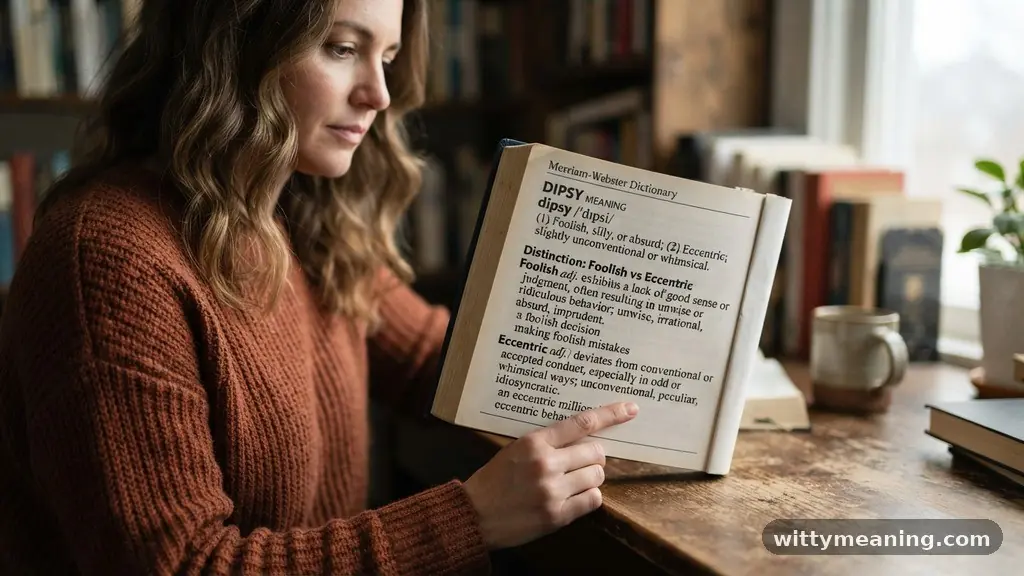
It is vital to distinguish between being foolish and being eccentric. When someone is called dipsy, the intent is usually to describe an eccentricity rather than a lack of intelligence.
An eccentric person marches to the beat of their own drum, even if that drum is a bit out of tune. A foolish person, in the traditional sense, might be seen as lacking judgment.
Dipsy occupies a middle ground. It suggests that the person is seeing the world differently, perhaps in a way that doesn’t align with standard social expectations. It is a gentle way to acknowledge that someone is acting outside the norms without implying that they are incapable of functioning.
This nuance is precisely why the word remains popular; it allows for critique without cruelty. It is a label of affection as much as it is a descriptor of behavior.
Addressing Topical Gaps in Definition
Many people searching for the term are also looking for a medical or psychological diagnosis, but it is crucial to clarify that it has no clinical standing. There is no “dipsy syndrome.” If you see the term used in a medical context, it is almost certainly a misinterpretation of a different, more technical term.
The word is entirely colloquial. It belongs to the realm of social interaction, not healthcare.
Another gap in current information is the confusion regarding its relationship to the word “dizzy.” While someone who is dizzy might act in a way that others perceive as dipsy, the two are not synonymous. Dizziness is a physical sensation of vertigo, whereas being dipsy is a behavioral observation.
Maintaining this distinction is important for anyone trying to get a clear grasp of the term’s boundaries. It is a word about character traits and personality quirks, not physical health or cognitive deficits.
The Role of Tone in Slang
The way you say the word changes everything. Because it is a colloquialism, its meaning is heavily dependent on inflection and context. If said with a laugh, it is a term of endearment.
If said with a sigh, it is a comment on frustration. This is true of many slang terms, but it is particularly pronounced with words that describe personality traits.
The flexibility of the word is what makes it so useful. It can be a noun, as in “don’t be such a dipsy,” or an adjective, as in “that was a very dipsy move.” This versatility is a hallmark of successful slang.
It allows the speaker to adjust the word to fit the sentence structure of the moment, making it feel organic and unforced. It is the kind of word that sneaks into your vocabulary because it is simply easier to say than the alternatives.
Psychological Implications of Being “Dipsy”
At a human level, why do we use labels like this? We use them to categorize the people around us to better understand their behavior. When we describe someone as dipsy, we are essentially creating a shorthand for “someone who is prone to minor, harmless mistakes.”
This helps us manage our expectations of them. We know not to rely on them for high-stakes coordination, but we appreciate their presence for its levity.
It is a form of social shorthand that simplifies complex personality traits into a single, easy-to-digest package. While this can sometimes lead to stereotyping, in the case of “dipsy,” the stereotype is generally benign. It doesn’t carry the weight of more damaging labels.
Instead, it creates a social space where being “a little off” is acceptable and even expected. It acknowledges that everyone has their moments of confusion or silliness.
Why the Term Persists in Language
Language is a living thing, and words only survive if they serve a purpose. Dipsy survives because it fills a niche that no other word occupies quite as effectively.
It is not as harsh as “stupid,” not as specific as “clumsy,” and not as clinical as “scatterbrained.” It is a Goldilocks word—it is just right for describing that specific middle-ground behavior that is neither good nor bad, just undeniably human.
As we move further into an age of digital communication, the need for words that convey tone and intent becomes even greater. Because we lose body language and tone of voice in text, we rely on words that carry their own inherent warmth. “Dipsy” does that.
It carries a sense of playfulness that helps ensure the recipient of the comment knows you aren’t being mean-spirited. This functional utility is why it will likely continue to appear in our conversations for years to come.
FAQ Section
Is being called dipsy an insult?
It is generally considered a lighthearted, informal term rather than a serious insult. While it does point out that someone is acting in a silly, scatterbrained, or eccentric way, it is usually used with a tone of affection or mild teasing among friends rather than to cause harm.
Does the word have any medical meaning?
No, it has no clinical or medical standing. It is purely a colloquialism used in everyday conversation to describe personality traits or behaviors. You will not find it used as a diagnosis in any reputable medical or psychological literature or diagnostic manual.
How does it differ from being dippy?
The two terms are essentially interchangeable. Both describe someone who is acting in a foolish, silly, or slightly confused manner. “Dippy” is perhaps slightly more common in certain regions, but they share the same linguistic roots and occupy the same space in the English language.
Can it be used to describe an object?
While it is primarily used to describe people or their behavior, it can metaphorically describe things that are erratic or confusing. For example, a “dipsy-doodle” maneuver refers to a series of zig-zagging movements, showing how the term can stretch to describe non-human actions that lack a straight path.
Conclusion
The dipsy meaning is rooted in a long history of regional dialect and informal English, serving as a gentle way to describe eccentric or scatterbrained behavior. It is a word that thrives in the space between serious criticism and total indifference, making it a valuable tool for social interaction. By understanding its origins, its relationship to similar-sounding terms, and its modern-day usage, you can better appreciate why it remains a persistent part of our vocabulary.
It is a reminder that language often evolves to capture the nuances of human personality, allowing us to describe our quirks without resorting to harshness. Next time you use the word, you will know exactly why it feels like the perfect fit for those moments of lighthearted, harmless confusion.