

When you encounter the shorthand term “parens” in a style manual or editorial note, it’s simply a colloquial way of referring to parentheses. These versatile punctuation marks are essential for providing context, adding asides, or grouping elements within a sentence.
Understanding the parens meaning in text is fundamental for anyone looking to improve their clarity in professional or academic writing. By mastering these symbols, you can effectively manage complex information without cluttering your prose, ensuring your reader stays focused on the primary narrative while still having access to necessary supplementary details.
The Linguistic Roots and Evolution of Parentheses
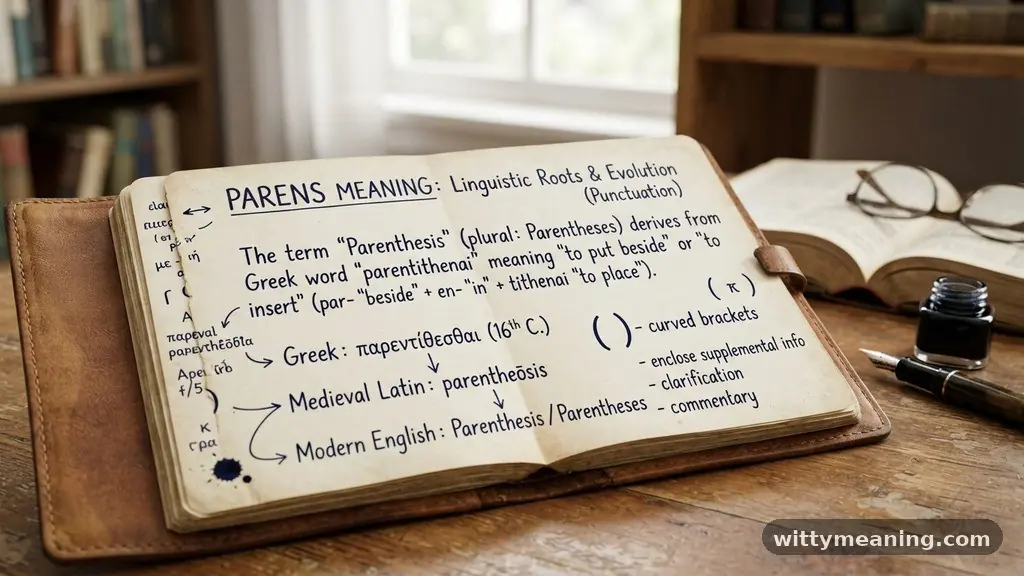
The word “parenthesis” comes from the Greek parentithenai, which literally means “to put in beside.” Historically, these marks were used to insert explanatory information into a sentence that would otherwise remain grammatically complete without it. Over time, the informal shortening to “parens” became common among editors, typesetters, and programmers who needed a quick way to describe the symbol during collaborative work.
While the term itself is informal, the function of the punctuation is strictly defined by grammatical conventions. Using them correctly involves more than just plopping text between two curves; it requires an understanding of how they influence the flow of a thought.
When you use them, you are signaling to the reader that the enclosed information is secondary or supplemental. If the sentence still holds its core meaning when you remove the content inside the marks, you have likely used them in the way they were intended.
Common Uses of Parentheses in Standard English
In everyday writing, particularly when following guidelines like APA style, these marks serve several distinct roles. They are most frequently used to introduce abbreviations, provide dates, or include citations that support your claims. For example, when you introduce a technical term followed by its acronym, you place the acronym in parentheses to provide a quick reference for the rest of the document.
Another standard use involves adding brief asides or clarifying remarks that provide flavor or necessary context without disrupting the main flow. If you find yourself needing to explain a specific word or provide a translation for a term, these marks offer a clean way to do so.
However, rely on them sparingly. If you find that your writing is riddled with parenthetical asides, it is usually a sign that your sentence structure needs a rethink or that you are trying to cram too much information into a single thought.
The Role of Parens in Mathematical Expressions
Beyond prose, the order of operations is perhaps the most famous application for these symbols. In arithmetic, they dictate the sequence in which calculations should be performed.
By grouping numbers and operators, you force the reader or the calculator to resolve the internal expression before moving on to the rest of the equation. This is a critical departure from their role in language, where they are optional; in math, they are often mandatory for the expression to be correct.
When you write mathematical expressions, you are establishing a hierarchy. Without these symbols, standard rules would force you to multiply before adding, which might lead to the wrong answer if your intent was to add first.
This structural necessity is why they are so vital in science and engineering. They essentially act as a “priority pass” for specific parts of a formula, ensuring that the logic of the calculation remains sound regardless of the complexity of the variables involved.
Programming Syntax and Logic Flow

In the world of computer science, the parens meaning in text shifts toward functional utility. Languages like Python and JavaScript rely heavily on these symbols to define functions, group conditions in if-statements, and pass arguments to methods. If you omit or misplace them in code, you will almost certainly trigger a syntax error, causing the compiler to fail or the interpreter to throw an exception.
For developers, these marks act as containers for logic. They tell the machine exactly which variables belong to a specific function and in what order they should be processed.
Unlike in English, where you might have some flexibility in how you use punctuation, the syntax of a programming language is rigid. A missing closing bracket or an extra opening one can break an entire application, highlighting just how precise these symbols must be when they transition from human language to machine code.
Legal Terminology: The Concept of Parens Patriae
While “parens” is often used as a shorthand for the punctuation mark, it also appears in the Latin legal doctrine known as Parens Patriae. This translates to “parent of the nation” and refers to the state’s inherent power to provide protection to those who cannot protect themselves, such as children or individuals with mental disabilities. This is an important distinction to make, as the word has a history that stretches back to the Roman era of jurisprudence.
In legal contexts, this doctrine allows the government to intervene in private matters to ensure the welfare of vulnerable populations. It is a fundamental concept in family law and civil litigation.
When you see this term in a legal transcript, it is not referring to the punctuation marks used to group text; rather, it is invoking a specific, historical legal authority. Distinguishing between the punctuation and the Latin doctrine is essential for clear communication in professional settings.
Best Practices for Usage in Professional Writing
Adhering to best practices for usage will keep your writing looking polished. First, ensure that punctuation outside the marks is handled correctly.
If a parenthetical statement ends a sentence, the period should go outside the closing mark unless the entire sentence is contained within them. This is a common point of confusion, but sticking to standard style guides will keep your work consistent.
Another tip is to avoid nesting. Putting one set of marks inside another makes the text difficult to read and suggests that your structure is overly complicated.
If you find yourself needing to nest, use commas or em-dashes for the outer layer, or rewrite the sentence to break the information into two separate, clearer statements. Simplicity is almost always the better choice when clarity is your primary goal.
Comparison of Parenthetical Usage Across Disciplines
The way these symbols function varies significantly depending on the field of study. To understand the parens meaning in text across different sectors, it helps to see how they are prioritized in each.
| Field | Primary Function | Strictness |
|---|---|---|
| Prose Writing | Adding asides or citations | Flexible/Stylistic |
| Mathematics | Defining order of operations | Mandatory |
| Programming | Defining functions/arguments | Strict/Required |
| Legal Studies | Invoking Latin doctrines | Context-Dependent |
As shown in the table, the level of flexibility changes based on the domain. In writing, you have the liberty to choose whether to use them to enhance flow. In coding or math, the rules are non-negotiable.
Common Mistakes and How to Avoid Them

The most frequent error is neglecting to close the set. If you open a parenthesis, you must always remember to close it.
This sounds trivial, but in long, complex sentences, it is surprisingly easy to lose track. If you are struggling to keep your sentences balanced, it is usually a sign that you need to simplify your syntax.
Another common mistake is using them to enclose entire paragraphs. While there are rare stylistic exceptions, this is generally considered poor form. If a block of text is that important, it should be part of the main narrative.
If it is not that important, it might not need to be in the document at all. Always evaluate whether the information truly serves the reader or if it is just “noise” that distracts from your primary argument.
The Impact of Punctuation on Readability
Good writing is all about managing the reader’s cognitive load. Punctuation exists to help the reader understand the relationship between ideas.
When used correctly, these marks act as a visual guide that tells the reader when to pause, what to prioritize, and what to view as additional information. When used poorly, they create friction.
Think of your reader as someone navigating a path. Every time they hit a confusing piece of punctuation, they have to stop and re-read the segment to understand the intent.
By using these marks to clarify rather than confuse, you keep the reader moving smoothly through your ideas. Always read your work aloud; if you stumble over a parenthetical phrase, it is likely that the punctuation is either misplaced or unnecessary.
Resources for Style and Grammar
For those looking to refine their use of punctuation, consulting authoritative sources is the best way to ensure accuracy. The Chicago Manual of Style is an excellent resource for understanding the nuances of professional writing, including the proper application of all punctuation marks. It provides clear examples that help writers navigate complex grammatical situations.
Developing a habit of checking style guides will make you a more confident writer. Over time, these rules will become second nature, allowing you to focus on the substance of your arguments rather than the mechanics of your sentences. Remember that language is a tool, and like any tool, it works best when you understand how its individual parts function together to create a finished product.
Frequently Asked Questions
What does parens mean in text?
“Parens” is a common shorthand or colloquial term for parentheses, the curved punctuation marks used to enclose supplementary or explanatory information. While “parens” is frequently used in editorial and programming circles to refer to the symbols themselves, it is rarely used in formal writing.
Is it parens or parentheses?
“Parentheses” is the correct, formal name for the punctuation marks. “Parens” is an informal, industry-specific shorthand used primarily by editors, copywriters, and programmers. You should use the full term in formal documents and professional correspondence to maintain a high level of clarity and linguistic precision.
How do parens affect the order of operations?
In mathematics, these symbols dictate the sequence of calculation. Anything inside them must be resolved before any operations outside of them are performed. They effectively override the standard hierarchy of arithmetic, ensuring that specific groups of numbers are processed as a single unit before the rest of the formula continues.
Why do programmers call them parens?
Programmers use the term as a quick, efficient way to refer to the symbols during code reviews or collaborative development. Because syntax often requires a high volume of these characters, shorthand terms like “parens” or “braces” are standard in technical communication to speed up verbal discussions regarding code structure and logic.
Concluding Thoughts
Mastering the parens meaning in text is a simple yet powerful way to elevate your writing. Whether you are drafting a technical manual, writing an academic paper, or simply communicating clearly in an email, understanding how these marks function—and when to use them—will make your work more readable. By balancing their use as helpful asides with the strict requirements of mathematical and programming syntax, you can ensure your message is always clear.
As you continue to refine your writing, remember that punctuation is intended to serve the reader. If you find yourself overusing these marks, take a step back and consider if your sentences could be restructured for better flow.
Practice, consistency, and a solid grasp of style guides will help you use these tools effectively. If you have any specific questions about how to apply these rules in your own work, feel free to reach out and continue the conversation.