
When you see a two-letter acronym pop up in your notifications, it is easy to feel out of the loop if you aren’t familiar with the latest trends in digital communication. Finding the correct dw meaning depends almost entirely on where you saw it and who sent it. In the fast-paced world of instant messaging, brevity is king, but this often leads to confusion when a single term carries multiple definitions.
Whether it is a reassuring phrase in a casual conversation or a technical term in a specialized field, understanding the nuances of these abbreviations helps you maintain better digital literacy. This article breaks down how to interpret these letters in any situation.
Decoding the Most Common Digital Shorthand
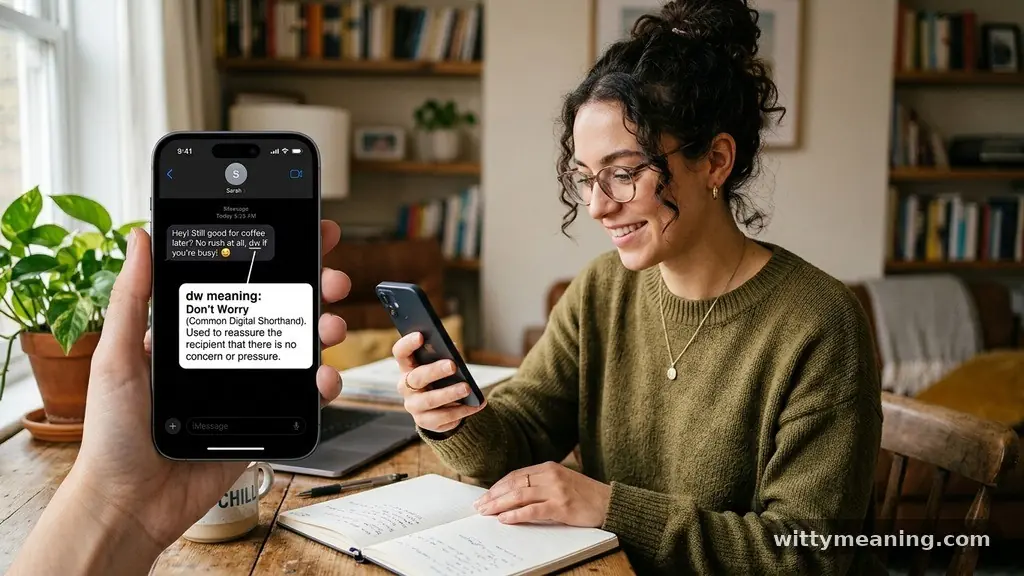
In the realm of casual text messaging slang, the most frequent way you will encounter this acronym is as a quick way to tell someone, “don’t worry.” It is a staple of Gen Z internet culture, designed to minimize typing time while keeping the tone light and supportive. When a friend sends a message like “I forgot the tickets, dw,” they are explicitly asking you not to stress about the situation.
This specific usage fits perfectly into the flow of modern direct messaging. Because people are often typing on small screens, using abbreviations allows for faster interpersonal communication without sacrificing the core sentiment of the message. It functions as a conversational bridge, signaling that the sender is aware of a potential problem but doesn’t want it to cause friction or anxiety.
Contextual Clues in WhatsApp Abbreviations
When you are analyzing WhatsApp abbreviations, the context is your best friend. Unlike formal writing, digital shorthand often lacks punctuation, which can make it hard to tell if someone is being dismissive or genuinely comforting. If you receive a message containing only those two letters, it is usually a sign of a very close, informal relationship where both parties share a shorthand dictionary.
However, if you are unsure, look at the message that preceded it. If you were expressing a concern or asking a question about a plan, the sender is using it to provide reassurance.
If the conversation was neutral, they might be using it as a placeholder for a more complex thought. Always consider the relationship you have with the person, as this determines how much emotional weight the acronym carries.
The Role of Gen Z Internet Culture
Gen Z internet culture has accelerated the adoption of social media acronyms to the point where they evolve almost monthly. The way young people use these terms often prioritizes speed and emotional efficiency over grammatical precision. By stripping away everything but the essential letters, they create a language that feels exclusive and fast.
This culture of abbreviation isn’t just about laziness; it’s about the speed of thought. When you are participating in a group chat, the ability to respond instantly with a widely understood acronym keeps the rhythm of the conversation alive. This is why you see these terms migrating from niche platforms into mainstream texting habits, becoming a standard part of our collective digital vocabulary.
Technical and Professional Interpretations

Outside of social media, the acronym can take on a completely different life. If you are reading a home renovation manual or looking at a listing for kitchen appliances, the dw meaning is almost certainly dishwasher. This is a classic example of how domain-specific knowledge changes the way we interpret text speak.
In professional environments, especially in architecture or interior design, using the abbreviation for an appliance is standard. You might see it on a floor plan or a renovation checklist.
In these cases, the context is so rigid that there is no ambiguity. It is a functional label, not a conversational filler, and it highlights how we prioritize efficiency in professional documentation as much as we do in personal chats.
Medical Abbreviations and Developmental Weight
While less common in daily text, medical abbreviations often overlap with casual slang, which can lead to significant confusion. In clinical or pediatric documentation, you might occasionally see the term used as a shorthand for developmental weight. This is a niche usage, but it illustrates why abbreviation ambiguity is a genuine concern for professionals who deal with both clinical records and patient communication.
| Context | Primary Meaning | Usage Frequency |
|---|---|---|
| Social Media | Don’t Worry | Very High |
| Home Appliances | Dishwasher | High |
| Clinical/Medical | Developmental Weight | Low |
If you happen to come across this in a medical context, it is vital not to guess. Medical terminology requires precision, and misinterpreting a note because you assumed it was social media slang could lead to errors. Always verify the source of the document before assigning a meaning to the acronym.
The Evolution of Slang Dictionary Definitions
If you search for the term on an urban dictionary or other crowdsourced slang dictionary, you will likely find dozens of niche definitions. This is the nature of language; it is fluid, constantly shifting, and heavily influenced by the platforms where it gains traction. Many of these definitions are fleeting, appearing for a few months before fading into obscurity.
The challenge for any user is keeping up with these shifts. What meant one thing in 2015 might mean something entirely different today.
This is why digital literacy is not a one-time achievement but a continuous process of observation and adaptation. You have to be willing to look at how words are used in real-time conversations rather than relying on outdated static definitions.
Strategies for Handling Abbreviation Ambiguity
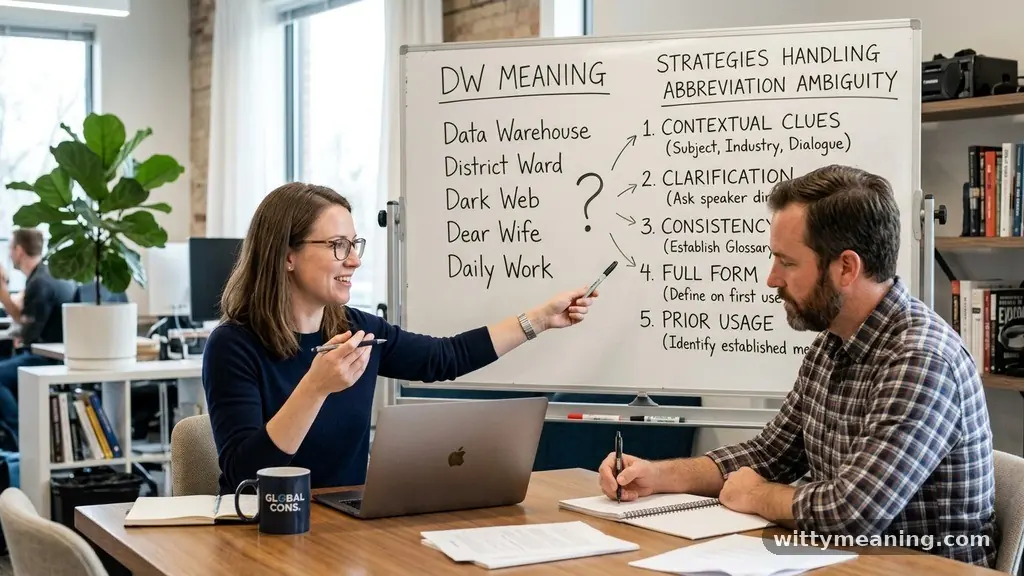
When you face a situation where the dw meaning is unclear, the best approach is to pause and look for the cues. If the text is informal, it is almost certainly a conversational filler. If the text is technical or professional, look for surrounding nouns like “kitchen,” “installation,” “pediatric,” or “growth chart.”
- Assess the sender’s typical communication style and habits.
- Identify the platform; social media favors slang, while email favors professional shorthand.
- Look for surrounding keywords that provide a technical or physical context.
- When in doubt, ask for clarification without assuming the worst.
- Check the tone of the message to see if it implies reassurance or a factual statement.
By following these steps, you can avoid the common pitfalls of misinterpretation. Most people are happy to clarify if you simply ask, “Just to be sure, are you referring to the dishwasher or the phrase ‘don’t worry’?”
The Impact of Messaging Platforms on Language
Messaging platforms have fundamentally altered how we construct sentences. We no longer write in complete thoughts; we write in bursts.
This shift has normalized the use of acronyms as a way to keep the message brief and the interaction continuous. Because these platforms are built for speed, they encourage us to drop articles, prepositions, and even full words.
This influence extends beyond the digital space. You might notice that people are beginning to use these abbreviations in spoken conversation or in informal emails.
As the lines between digital and physical communication blur, the shorthand we use to save time on our phones is becoming part of our spoken lexicon. It is a fascinating evolution of language that happens in real-time.
Addressing Topical Gaps in Digital Literacy
One major gap in existing discussions about this topic is the lack of focus on how these abbreviations affect cross-generational communication. A Gen Z user might use the term with a parent or a boss, assuming the meaning is universal, while the recipient might be left feeling confused or even disrespected. Understanding that not everyone shares the same “slang dictionary” is a key part of becoming a better digital communicator.
Furthermore, we often fail to recognize that the same acronym can have different levels of emotional intensity. Using “dw” in a serious situation might come across as dismissive, even if the sender intends it to be calming.
Learning to gauge the emotional temperature of a conversation before using shorthand is just as important as knowing the definition of the words themselves. For more insights into how language impacts our daily digital interactions, you can look at resources like the Pew Research Center’s work on digital life to see how these trends are measured and analyzed globally.
The Future of Online Communication
As we move toward more integrated digital environments, the way we use shorthand is likely to become even more streamlined. Voice-to-text technology and AI-driven predictive text are already changing how we write, often suggesting these acronyms before we even finish typing them. This suggests that the use of abbreviations is not going anywhere; instead, it is becoming baked into the infrastructure of our devices.
While it is easy to pine for the days of long-form communication, the reality is that brevity allows for a different kind of connection—one that is rapid, constant, and highly responsive. Embracing this shift while maintaining the ability to switch back to formal, clear language when the situation demands it is the hallmark of a skilled communicator in the modern age.
FAQ
Is it okay to use this acronym in a professional email?
It is generally best to avoid using this shorthand in professional emails. Stick to full, clear language to ensure your message is interpreted correctly by colleagues and clients. Save the abbreviations for informal direct messaging where the context is well-established between you and the recipient.
Why do people use this instead of just typing the full phrase?
People use it primarily for speed and to keep the flow of a conversation moving. In instant messaging, typing “don’t worry” takes more time and feels more formal than a quick two-letter acronym. It is a way to acknowledge a message without slowing down the chat’s pace.
Does the meaning change based on capitalization?
Usually, no. Whether you type it in lowercase or uppercase, the meaning remains the same. However, using all caps might inadvertently convey a sense of urgency or intensity that the sender didn’t intend, so lowercase is generally preferred for this type of casual, reassuring shorthand.
What should I do if I am still confused by the context?
If you are genuinely unsure, simply ask for clarification. It is perfectly acceptable to say, “I’m not sure I follow, could you clarify that?” in a friendly way. Most people will appreciate your desire to understand them correctly rather than guessing and responding to the wrong thing.
Final Thoughts
Mastering the dw meaning is less about memorizing a static dictionary and more about developing the sensitivity to read the room—or the screen. Whether it’s a quick message from a friend trying to put your mind at ease or a technical note about a home appliance, the context will almost always reveal the truth. By focusing on the relationship, the platform, and the surrounding words, you can navigate these digital shorthand hurdles with confidence.
As communication continues to evolve, stay curious and stay flexible. Don’t be afraid to ask questions when the shorthand gets a bit too short. Being an effective communicator in the digital age means knowing when to be brief and when to be explicit, ensuring that your message is always received exactly as you intended.