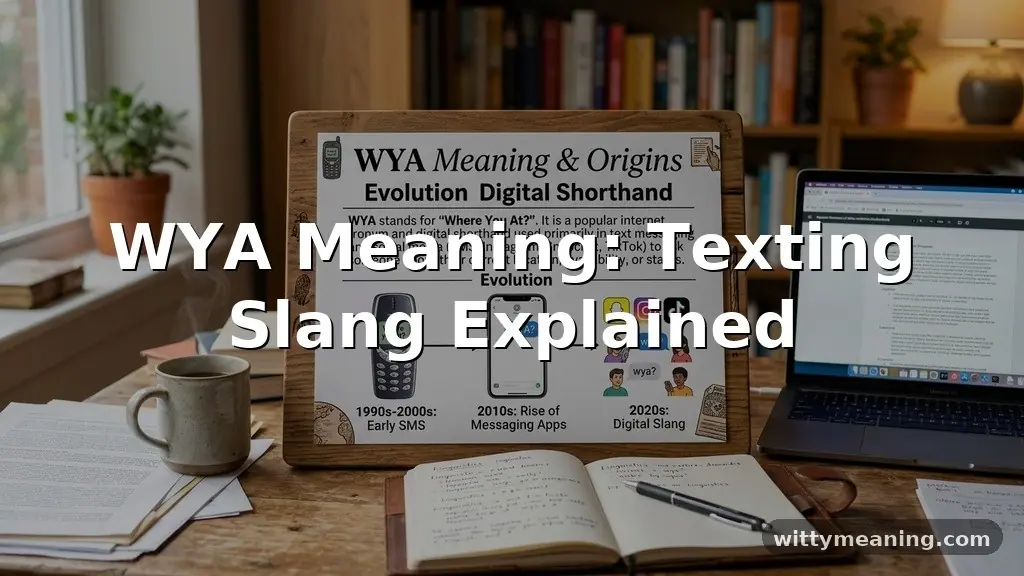

If you have ever received a short, lowercase message asking “wya,” you might have paused for a second to consider the intent behind it. This common piece of digital shorthand is a staple of modern communication, often serving as a casual way to check on someone’s location or availability. Understanding the wya meaning is fairly straightforward once you realize it is simply an abbreviation for “where you at?”
While it may seem like a simple question about geography, the nuance often lies in the relationship between the sender and the receiver. Whether it is a quick check-in from a friend or a more suggestive prompt on a dating app, knowing how to interpret this acronym helps you navigate digital conversations with ease.
Origins and Evolution of Digital Shorthand
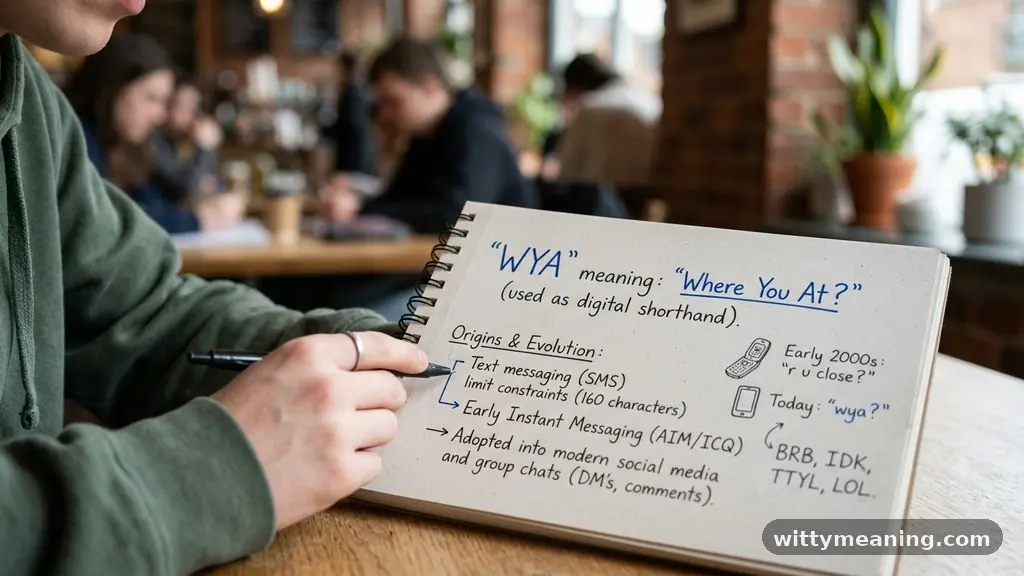
The rise of text messaging and instant messaging platforms in the early 2000s necessitated a faster way to communicate. As mobile keyboards were cumbersome and character limits were often strict, users naturally gravitated toward shortening phrases.
The wya meaning emerged from this necessity, stripping away the grammatical formality of “Where are you at?” to create a punchy, efficient query. Over time, this evolved from a practical tool into a form of social shorthand that signals a certain level of familiarity.
Because it dropped the formal structure, the term also adopted a laid-back, informal tone. It is rarely used in professional settings, and using it with someone you don’t know well can sometimes come across as overly casual or even intrusive.
The shift from full sentences to abbreviated slang reflects how our digital interactions have become more rapid and less deliberate. Today, it is firmly embedded in the lexicon of social media and messaging apps, often used without a second thought by younger generations who grew up with smartphones as their primary means of connection.
Understanding the Context of WYA
Interpreting the intent behind a message is crucial, and that is where understanding the context of WYA comes into play. Because the phrase itself is so short, the true meaning is almost entirely dependent on the relationship you have with the sender.
If a close friend sends you “wya,” they are likely looking for a spontaneous hangout or checking if you are free to grab food. It is an invitation to connect in real life, prioritizing speed and ease over formal planning.
In other scenarios, the message might carry a different weight. If you are in a committed relationship, a partner asking this might be checking in on your schedule or simply wanting to feel closer to you throughout the day.
However, when the message comes from a casual acquaintance or a match on a dating platform, the subtext can change significantly. It often serves as a low-effort way to test the waters, seeing if you are interested in a conversation or a meetup without having to commit to a full plan immediately.
How WYA Differs from WYD
While they are often used interchangeably in casual conversation, it is important to recognize how WYA differs from WYD. They serve different purposes: one is focused on your physical location, while the other is focused on your current activity.
WYD stands for “what you doing?” and is usually a broader opening for a conversation. If someone asks you “wyd,” they are inviting you to talk about your current situation, your plans for the day, or your current mood.
WYA, on the other hand, is much more specific. It pins you to a coordinate. Because of this, it can feel more demanding.
If you are not in a position to share your location or meet up, a “wya” message can feel slightly more intrusive than a “wyd.” Knowing this distinction allows you to craft a response that aligns with what the sender is actually asking. If you want to keep things vague, a response to “wyd” is often easier than a response to “wya,” which feels like a direct call to action.
Usage in Dating Apps and Online Gaming Environments

The utility of this acronym extends far beyond standard texting, especially within dating apps and online gaming environments. On platforms like Grindr, Tinder, or Hinge, the phrase is ubiquitous. It functions as a litmus test for interest.
If a match sends “wya” after only a few exchanges, they are signaling a desire for immediate gratification or a quick meetup. It cuts through the fluff of traditional “get to know you” questions, which some users find refreshing, while others find it dismissive.
In the world of online gaming, the context is strictly functional. Players use it to coordinate movements, find teammates on a map, or check if a friend is logged into the same server. In these spaces, it isn’t an intimate inquiry; it is a tactical tool.
The efficiency of the term makes it perfect for fast-paced games where typing a full sentence would take too long and potentially cost you a win. The brevity is a feature, not a bug, in these high-stakes, real-time scenarios.
Common Responses to WYA
Knowing how to handle these messages can save you a lot of social anxiety. Your response should depend entirely on your current mood or level of boredom. If you are interested in engaging, you might choose to be direct or playful.
If you are busy, you can keep your reply brief but polite. Here are a few ways to categorize your replies based on the situation:
- The Direct Approach: “Just at the gym, what’s up?” or “I’m at home, why?”
- The Playful/Vague Approach: “Somewhere you aren’t!” or “Guess where?”
- The “I’m Busy” Approach: “Just running errands, I’ll be home later,” or “Can’t talk right now, I’m tied up.”
- The Invitation: “I’m at the park, come through!“
These responses help you maintain control over the conversation. If you don’t feel like sharing your exact location, you don’t have to. You can always pivot the conversation back to the sender by asking why they wanted to know, which often clarifies their intent without you having to give up your privacy.
The Nuance of Tone and Intent
Even without voice or body language, the tone of a text message is palpable. A “wya” followed by a question mark feels like a genuine question. A “wya” with no punctuation can feel more like a demand or a lazy check-in.
This is a common point of contention in digital communication, as the lack of punctuation often leads to misunderstandings. If you are the sender, adding a question mark can soften the blow and make the message feel less like a demand for your time.
If you are on the receiving end, try not to overthink the lack of punctuation. Many people use shorthand as a default, and they aren’t necessarily trying to be rude or aggressive. They are simply communicating in the way that is most comfortable for them.
However, if the message is consistently brief and lacks effort, it may be a reflection of how they value the conversation. You can learn more about effective communication styles to better handle these subtle digital interactions.
WYA in Professional Contexts

Is it ever okay to use this term at work? Generally, the answer is a hard no. In professional environments, clarity and respect for time are paramount.
Using “wya” with a supervisor or a client can signal a lack of professionalism or an inappropriate level of informality. Even with close coworkers, it is usually better to use more descriptive language. Instead of “wya,” try “Are you at your desk?” or “Are you available for a quick call?”
There are, however, exceptions. If you work in a highly informal startup culture or with a team that has developed a very close, casual bond, you might see this type of shorthand in internal Slack or Teams channels. Even then, it should be reserved for non-urgent, casual check-ins.
If you are unsure about the culture of your workplace, it is always safer to err on the side of formality. Using full, clear sentences ensures that your intent is never misinterpreted by those who hold power over your career path.
Impact of Shorthand on Language Skills
Some linguists argue that the prevalence of acronyms like “wya” is eroding our ability to write well. Others, however, see it as a natural evolution of language. Throughout history, languages have always evolved to become more efficient.
We have moved from formal letters to emails, and now to instant, ephemeral messaging. The wya meaning is just one small data point in a larger trend toward brevity.
While it is important to maintain the ability to write formal, grammatically correct English, there is no inherent harm in using shorthand in the appropriate context. The key is code-switching—the ability to change your language style based on your audience. If you can switch between a professional email and a quick text to a friend without losing your grasp on proper grammar, you are simply mastering the nuances of modern communication.
Comparison of Common Texting Acronyms
To help you navigate the landscape of digital slang, it helps to compare “wya” against other common abbreviations. Each one carries a slightly different energy and purpose.
| Acronym | Full Phrase | Primary Purpose |
|---|---|---|
| WYA | Where you at? | Locational check-in |
| WYD | What you doing? | Activity/Interest check |
| OMW | On my way | Status update |
| RN | Right now | Temporal modifier |
This table highlights how these terms function as building blocks for quick, efficient exchanges. By understanding the specific role each one plays, you can respond more accurately and avoid the friction that comes from misinterpreting a sender’s goal.
Addressing Topical Gaps: The Privacy Perspective
A question that often goes unaddressed in simple definitions is the privacy aspect. Sharing your location via text is a common practice, but it does carry risks. When someone asks “wya,” they are effectively asking for your real-time location.
If you are not comfortable sharing that, you are under no obligation to do so. A common gap in understanding this term is the assumption that you must answer truthfully.
You can set boundaries by giving a general answer rather than a specific one. Saying “I’m out and about” or “I’m running errands” is perfectly acceptable. You don’t have to provide a GPS coordinate to be polite.
If someone persists in asking for your exact location when you are uncomfortable, that is a red flag regarding their respect for your boundaries. Always prioritize your safety and comfort over the perceived pressure to respond instantly to a digital prompt.
FAQ Section
How should I respond if I don’t want to tell someone where I am?
You can provide a vague response that satisfies the social interaction without giving away your exact location. Phrases like “I’m busy with some stuff right now” or “Just out and about” are perfectly polite ways to deflect the question while keeping the conversation moving.
Is it rude to send WYA to someone I just met?
It can be perceived as overly casual or demanding, especially if you haven’t established a rapport. It is generally better to ask a more open-ended question that allows the other person to share what they are doing at their own pace rather than pinning them down.
Does WYA mean the same thing in every country?
While the English-speaking world widely understands the abbreviation, the level of perceived informality can vary. In some cultures, direct questions about location are seen as more intrusive than in others, so it is always wise to gauge the recipient’s comfort level before using it.
Can WYA be used in a family group chat?
Yes, it is common in family settings for quick check-ins, such as asking if someone has arrived at a restaurant or if they are still at home. It is generally accepted among family members because the level of intimacy is already established, making the question feel helpful rather than intrusive.
Conclusion
Understanding the wya meaning is a simple yet effective way to improve your digital literacy. Whether you are chatting with friends, navigating a dating app, or coordinating with teammates, this shorthand is a core component of how we connect in the modern age. By recognizing the context, distinguishing it from other acronyms like “wyd,” and setting your own boundaries regarding privacy, you can use this common piece of slang with confidence.
Remember that the goal of any digital communication is to bridge the gap between people, so feel free to use these tools to make your interactions faster and more efficient. As you continue to refine your texting style, keep the focus on clarity and respect, and you will find that these small abbreviations make your daily conversations much easier to manage.