
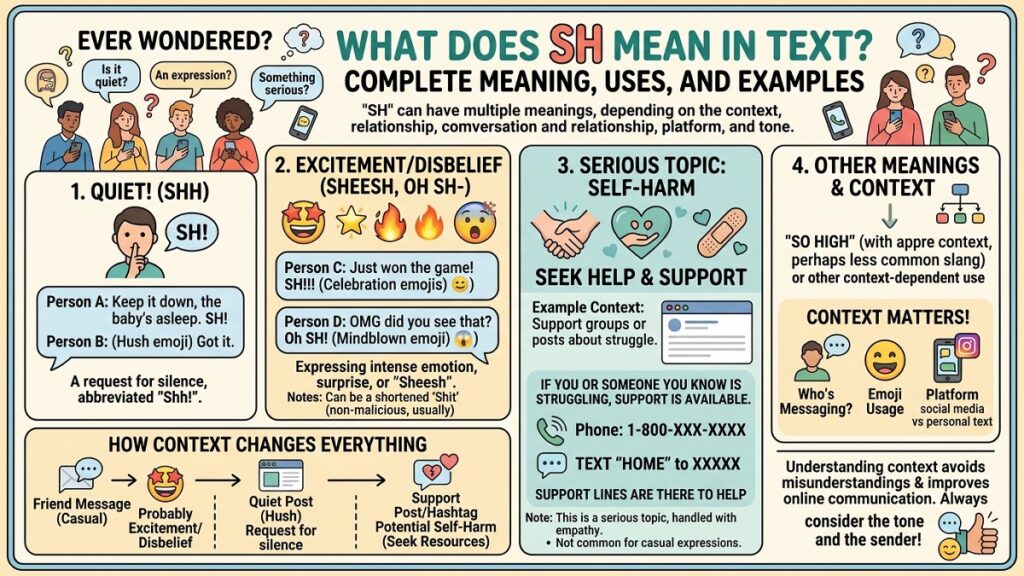

Have you ever received a message containing SH and instantly wondered, what does SH mean in text? You’re definitely not alone. Modern texting slang changes quickly, and new abbreviations seem to appear every week. Sometimes two small letters can carry multiple meanings, making it difficult to understand exactly what the sender intended.
The abbreviation SH is a perfect example. Depending on the situation, relationship, platform, and tone of the conversation, SH can mean several different things. It might express excitement, disbelief, criticism, or in some cases refer to a serious mental health topic.
Understanding the meaning behind SH helps avoid misunderstandings and improves your online communication skills. In this guide, we’ll explore every common interpretation, explain how context affects meaning, and show real-life examples from text messages, social media, and online conversations.
What Does SH Mean in Text?
SH most commonly means “Shut Up,” “So Happy,” “Shame,” or “So Harsh” in text messages and online chats. In certain mental health discussions, SH may also refer to self-harm. The intended meaning depends entirely on the conversation context.
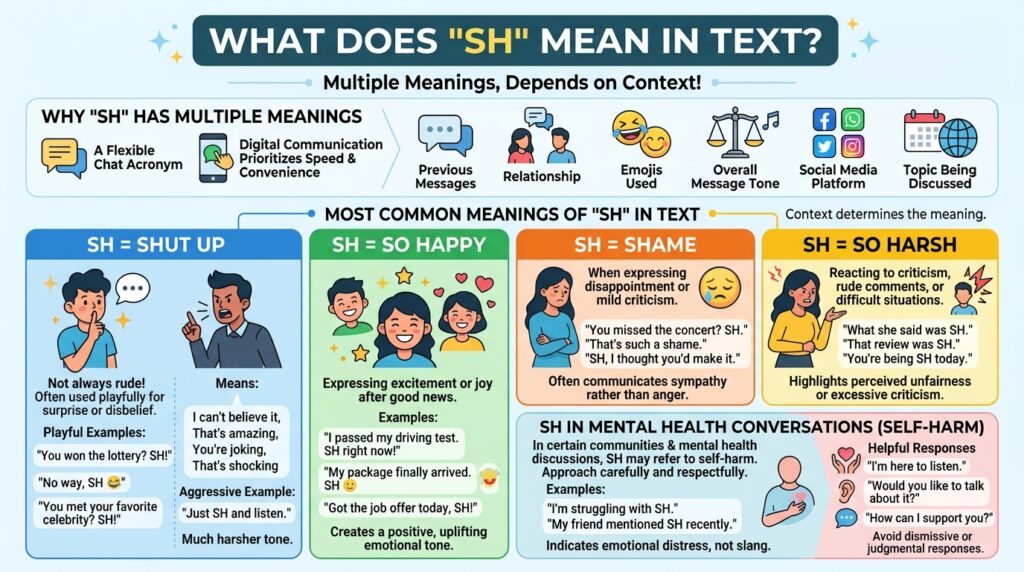
Because SH has multiple interpretations, readers should always consider the surrounding messages before assuming what someone means.
Why SH Has Multiple Meanings
Unlike many internet abbreviations that have only one definition, SH is considered a flexible chat acronym. Digital communication often prioritizes speed and convenience, so users shorten phrases whenever possible.
Several factors influence the meaning of SH:
- Previous messages in the conversation
- Relationship between the people chatting
- Emojis used alongside the abbreviation
- Overall message tone
- Social media platform
- Topic being discussed
Context determines the meaning of SH, which is why understanding the entire conversation is important.
Most Common Meanings of SH in Text
SH = Shut Up
One of the most popular meanings of SH is “Shut Up.”
However, this doesn’t always mean someone is being rude. In many casual conversations, SH is used playfully to express surprise or disbelief.
Examples:
- “You won the lottery? SH!”
- “No way, SH 😂”
- “You met your favorite celebrity? SH!”
In these situations, SH actually means:
- I can’t believe it
- That’s amazing
- You’re joking
- That’s shocking
When used aggressively, however, the meaning changes.
Example:
- “Just SH and listen.”
In this case, the abbreviation sounds much harsher.
SH = So Happy
Another common interpretation is “So Happy.”
People often use SH to express excitement or joy after receiving good news.
Examples:
- “I passed my driving test. SH right now!”
- “My package finally arrived. SH 😊”
- “Got the job offer today, SH!”
This version creates a positive and uplifting emotional tone.
SH = Shame
In some conversations, SH stands for “Shame.”
This meaning is especially common when someone expresses disappointment or mild criticism.
Examples:
- “You missed the concert? SH.”
- “That’s such a shame.”
- “SH, I thought you’d make it.”
This interpretation often communicates sympathy rather than anger.
SH = So Harsh
SH may also mean “So Harsh.”
People use it when reacting to criticism, rude comments, or difficult situations.
Examples:
- “What she said was SH.”
- “That review was SH.”
- “You’re being SH today.”
This usage highlights perceived unfairness or excessive criticism.
SH in Mental Health Conversations
In certain online communities and mental health discussions, SH may refer to self-harm.
This interpretation is significantly different from the casual slang meanings discussed above. Because of its sensitive nature, it should always be approached carefully and respectfully.
For example:
- “I’m struggling with SH.”
- “My friend mentioned SH recently.”
When SH appears in this context, it generally indicates emotional distress rather than internet slang.
Helpful responses include:
- “I’m here to listen.”
- “Would you like to talk about it?”
- “How can I support you?”
Avoid dismissive or judgmental responses, as empathy is especially important in these conversations.
How Context Changes the Meaning of SH
One of the biggest challenges with texting abbreviations is that meaning changes depending on context.
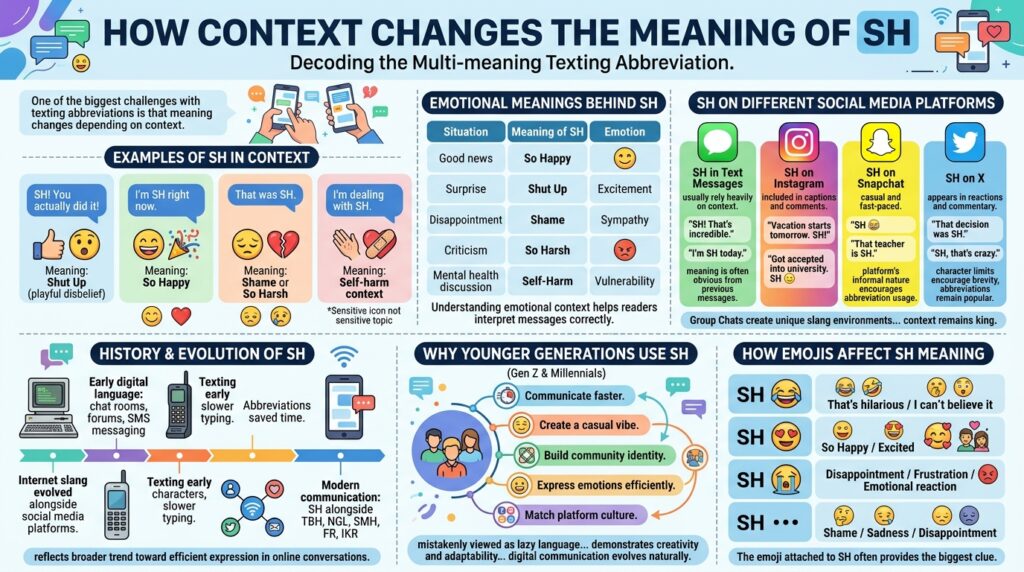
Example 1
Message:
“SH! You actually did it!”
Meaning:
Shut Up (playful disbelief)
Example 2
Message:
“I’m SH right now.”
Meaning:
So Happy
Example 3
Message:
“That was SH.”
Meaning:
Shame or So Harsh
Example 4
Message:
“I’m dealing with SH.”
Meaning:
Self-harm context
The exact same abbreviation can communicate entirely different emotions depending on surrounding words.
Emotional Meanings Behind SH
Different situations create different emotional interpretations.
| Situation | Meaning of SH | Emotion |
|---|---|---|
| Good news | So Happy | Joy |
| Surprise | Shut Up | Excitement |
| Disappointment | Shame | Sympathy |
| Criticism | So Harsh | Frustration |
| Mental health discussion | Self-Harm | Vulnerability |
Understanding emotional context helps readers interpret messages correctly.
SH on Different Social Media Platforms
SH in Text Messages
Text messages usually rely heavily on context.
Examples:
- “SH! That’s incredible.”
- “I’m SH today.”
The meaning is often obvious from previous messages.
SH on Instagram
Instagram users frequently include SH in captions and comments.
Examples:
- “Vacation starts tomorrow. SH!”
- “Got accepted into university. SH 😊”
SH on Snapchat
Snapchat conversations tend to be casual and fast-paced.
Examples:
- “SH 😂”
- “That teacher is SH.”
The platform’s informal nature encourages abbreviation usage.
SH on X (Twitter)
On X, formerly Twitter, SH often appears in reactions and commentary.
Examples:
- “That decision was SH.”
- “SH, that’s crazy.”
Because character limits encourage brevity, abbreviations remain popular.
SH in Group Chats
Group chats often create unique slang environments.
Friends who communicate regularly may use SH differently from its standard meanings.
This is why context remains king.
History and Evolution of SH
Many articles discuss SH meanings but ignore where internet abbreviations actually come from.
The rise of digital language began in early chat rooms, forums, and SMS messaging. Character limits encouraged users to shorten words and phrases.
During the early days of texting:
- Messages had limited characters
- Typing was slower
- Abbreviations saved time
Over the years, internet slang evolved alongside social media platforms.
Today, abbreviations like:
- SH
- TBH
- NGL
- SMH
- FR
- IKR
have become part of everyday communication.
The evolution of SH reflects a broader trend toward efficient expression in online conversations.
Why Younger Generations Use SH
Gen Z slang and Millennial texting habits continue shaping internet language.
Young users often prefer abbreviations because they:
- Communicate faster
- Create a casual vibe
- Build community identity
- Express emotions efficiently
- Match platform culture
Many people mistakenly view slang as lazy language. In reality, slang often demonstrates creativity and adaptability.
Digital communication evolves naturally, and SH is simply one example.
How Emojis Affect SH Meaning
Emojis can completely change interpretation.
Consider these examples:
SH 😂
Usually means:
- That’s hilarious
- I can’t believe it
SH 😍
Usually means:
- So Happy
- Excited
SH 😭
Could mean:
- Disappointment
- Frustration
- Emotional reaction
SH …
Often suggests:
- Shame
- Sadness
- Disappointment
The emoji attached to SH often provides the biggest clue.
Common Misunderstandings About SH
Many users assume SH always means one thing. That’s incorrect.
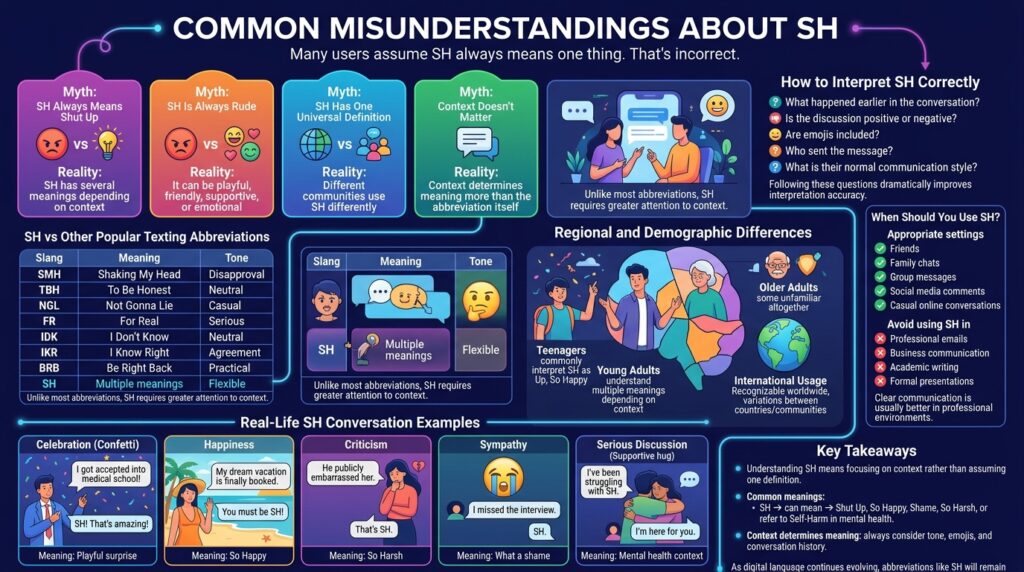
Here are some frequent misconceptions:
Myth: SH Always Means Shut Up
Reality:
SH has several meanings depending on context.
Myth: SH Is Always Rude
Reality:
It can be playful, friendly, supportive, or emotional.
Myth: SH Has One Universal Definition
Reality:
Different communities use SH differently.
Myth: Context Doesn’t Matter
Reality:
Context determines meaning more than the abbreviation itself.
SH vs Other Popular Texting Abbreviations
Understanding similar abbreviations can prevent confusion.
| Slang | Meaning | Tone |
|---|---|---|
| SH | Multiple meanings | Flexible |
| SMH | Shaking My Head | Disapproval |
| TBH | To Be Honest | Neutral |
| NGL | Not Gonna Lie | Casual |
| FR | For Real | Serious |
| IDK | I Don’t Know | Neutral |
| IKR | I Know Right | Agreement |
| BRB | Be Right Back | Practical |
Unlike most abbreviations, SH requires greater attention to context.
How to Interpret SH Correctly
Whenever you see SH in a message, ask yourself:
- What happened earlier in the conversation?
- Is the discussion positive or negative?
- Are emojis included?
- Who sent the message?
- What is their normal communication style?
Following these questions dramatically improves interpretation accuracy.
Real-Life SH Conversation Examples
Example 1: Celebration
Person A:
“I got accepted into medical school!”
Person B:
“SH! That’s amazing!”
Meaning:
Playful surprise.
Example 2: Happiness
Person A:
“My dream vacation is finally booked.”
Person B:
“You must be SH!”
Meaning:
So Happy.
Example 3: Criticism
Person A:
“He publicly embarrassed her.”
Person B:
“That’s SH.”
Meaning:
So Harsh.
Example 4: Sympathy
Person A:
“I missed the interview.”
Person B:
“SH.”
Meaning:
What a shame.
Example 5: Serious Discussion
Person A:
“I’ve been struggling with SH.”
Person B:
“I’m here for you.”
Meaning:
Mental health context.
Regional and Demographic Differences
Not everyone uses SH the same way.
Teenagers
Teen users commonly interpret SH as:
- Shut Up
- So Happy
Young Adults
Young adults often understand multiple meanings depending on context.
Older Adults
Some older users may be unfamiliar with the abbreviation altogether.
International Usage
Internet culture has made SH recognizable worldwide, although exact interpretations may vary between countries and online communities.
This variation further highlights why context matters.
When Should You Use SH?
SH works best in informal situations.
Appropriate settings include:
- Friends
- Family chats
- Group messages
- Social media comments
- Casual online conversations
Avoid using SH in:
- Professional emails
- Business communication
- Academic writing
- Formal presentations
Clear communication is usually better in professional environments.
Key Takeaways
Understanding what does SH mean in text becomes much easier when you focus on context rather than assuming a single definition.
Remember these core meanings:
- SH → can mean → Shut Up
- SH → can mean → So Happy
- SH → can mean → Shame
- SH → can mean → So Harsh
- SH → can refer to → Self-Harm in mental health discussions
Because context determines the meaning of SH, always consider tone, emojis, and conversation history before interpreting a message.
As digital language continues evolving, abbreviations like SH will remain an important part of online communication.
Frequently Asked Questions
What does SH mean in text messages?
SH most commonly means “Shut Up,” “So Happy,” “Shame,” or “So Harsh.” The correct interpretation depends on the conversation, tone, and relationship between participants. In certain mental health discussions, it may also refer to self-harm.
Is SH considered rude?
Not necessarily. SH can be playful and friendly when expressing surprise or excitement. However, it may sound rude if used aggressively during arguments or conflicts. The surrounding context usually determines whether it feels harmless or offensive.
How can I tell which meaning of SH is being used?
Look at previous messages, emojis, conversation topics, and the sender’s typical communication style. Context is the most reliable indicator. A positive conversation often suggests “So Happy,” while criticism may indicate “So Harsh” or “Shame.”
Should I use SH in professional communication?
Generally, no. SH is considered informal internet slang and may confuse readers in business settings. Professional emails and workplace communication should use complete words and clear language to avoid misunderstandings.