
Have you ever received a message saying “LCR” and wondered what the sender actually meant? You’re not alone. As digital communication continues to evolve, new abbreviations appear almost daily across texting apps, social media platforms, and online communities. One acronym that has become increasingly common is LCR.
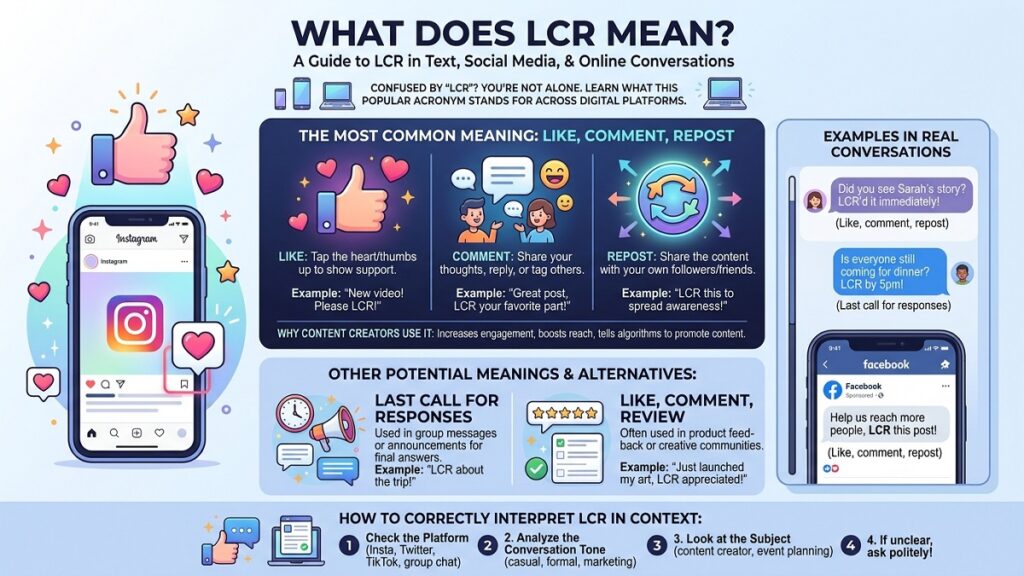
If you’re searching for what does LCR mean, the short answer is simple: LCR most commonly stands for “Like, Comment, Repost.” It is widely used on social media to encourage engagement with content. However, depending on the situation, LCR can also have other meanings that many people don’t know about.
In this complete guide, you’ll learn the meaning of LCR, how it’s used across different platforms, why content creators use it, alternative definitions, examples in real conversations, and how to correctly interpret it in any context. Let’s get into it.
What Does LCR Mean?
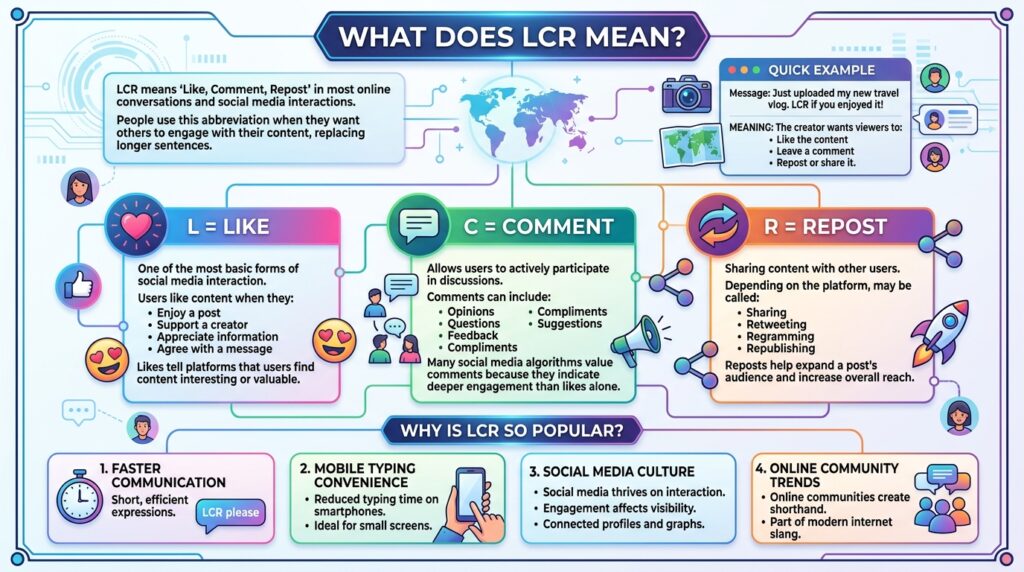
LCR means “Like, Comment, Repost” in most online conversations and social media interactions.
People use this abbreviation when they want others to engage with their content. Instead of writing a longer sentence such as “Please like my post, leave a comment, and share it,” users simply type LCR.
Quick Example
Message:
“Just uploaded my new travel vlog. LCR if you enjoyed it!”
Meaning:
The creator wants viewers to:
- Like the content
- Leave a comment
- Repost or share it
This simple abbreviation helps users communicate faster, which is why it has become popular in modern internet slang and text messaging culture.
What Does Each Letter in LCR Mean?
To fully understand the abbreviation, it’s important to break it down.
L = Like
A like is one of the most basic forms of social media interaction.
Users like content when they:
- Enjoy a post
- Support a creator
- Appreciate information
- Agree with a message
Likes tell platforms that users find content interesting or valuable.
C = Comment
A comment allows users to actively participate in discussions.
Comments can include:
- Opinions
- Questions
- Feedback
- Compliments
- Suggestions
Many social media algorithms value comments because they indicate deeper engagement than likes alone.
R = Repost
A repost means sharing content with other users.
Depending on the platform, reposting may also be called:
- Sharing
- Retweeting
- Regramming
- Republishing
Reposts help expand a post’s audience and increase overall reach.
Why Is LCR So Popular?
The popularity of LCR reflects how digital language evolution continues to shape online communication.
People increasingly prefer short, efficient expressions over long explanations.
Some major reasons include:
Faster Communication
Instead of writing:
“Please like my photo, leave a comment, and share it.”
Users simply write:
“LCR please.”
The message stays clear while requiring less effort.
Mobile Typing Convenience
Most online interactions happen on smartphones. Short abbreviations reduce typing time and improve convenience.
Social Media Culture
Social media thrives on interaction. Since engagement affects visibility, users frequently request likes, comments, and reposts.
Online Community Trends
Many online communities create their own shorthand expressions. LCR is one example of how internet culture develops new communication methods.
How LCR Helps Social Media Engagement
One reason content creators love using LCR is because engagement directly affects performance.
The relationship is quite simple:
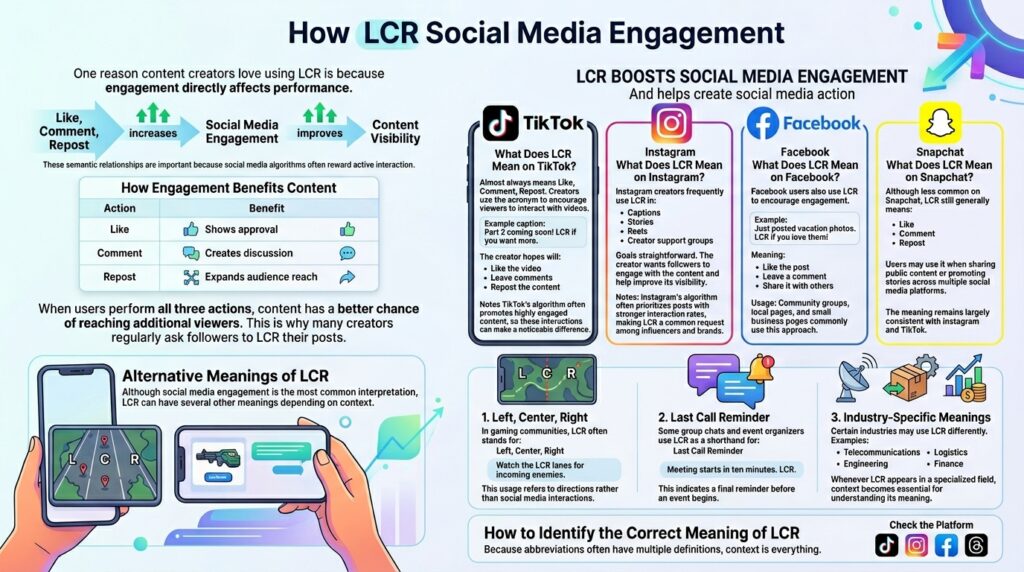
Like, Comment, Repost → increases → Social Media Engagement
Social Media Engagement → improves → Content Visibility
These semantic relationships are important because social media algorithms often reward active interaction.
How Engagement Benefits Content
| Action | Benefit |
|---|---|
| Like | Shows approval |
| Comment | Creates discussion |
| Repost | Expands audience reach |
When users perform all three actions, content has a better chance of reaching additional viewers.
This is why many creators regularly ask followers to LCR their posts.
What Does LCR Mean on TikTok?
On TikTok, LCR almost always means Like, Comment, Repost.
Creators use the acronym to encourage viewers to interact with videos.
Example
“Part 2 coming soon! LCR if you want more.”
In this case, the creator hopes users will:
- Like the video
- Leave comments
- Repost the content
TikTok’s algorithm often promotes highly engaged content, so these interactions can make a noticeable difference.
What Does LCR Mean on Instagram?
Instagram creators frequently use LCR in:
- Captions
- Stories
- Reels
- Creator support groups
Example Caption
“New photography reel is live 📸✨ LCR if you enjoyed it.”
The goal is straightforward. The creator wants followers to engage with the content and help improve its visibility.
Instagram’s algorithm often prioritizes posts with stronger interaction rates, making LCR a common request among influencers and brands.
What Does LCR Mean on Facebook?
Facebook users also use LCR to encourage engagement.
Example
“Just posted vacation photos. LCR if you love them!”
Here, the abbreviation means:
- Like the post
- Leave a comment
- Share it with others
Community groups, local pages, and small business pages commonly use this approach.
What Does LCR Mean on Snapchat?
Although less common on Snapchat, LCR still generally means:
Like, Comment, Repost
Users may use it when sharing public content or promoting stories across multiple social media platforms.
The meaning remains largely consistent with Instagram and TikTok.
Alternative Meanings of LCR
Although social media engagement is the most common interpretation, LCR can have several other meanings depending on context.
1. Left, Center, Right
In gaming communities, LCR often stands for:
Left, Center, Right
Example
“Watch the LCR lanes for incoming enemies.”
This usage refers to directions rather than social media interactions.
2. Last Call Reminder
Some group chats and event organizers use LCR as a shorthand for:
Last Call Reminder
Example
“Meeting starts in ten minutes. LCR.”
This indicates a final reminder before an event begins.
3. Industry-Specific Meanings
Certain industries may use LCR differently.
Examples include:
- Telecommunications
- Logistics
- Engineering
- Finance
Whenever LCR appears in a specialized field, context becomes essential for understanding its meaning.
How to Identify the Correct Meaning of LCR
Because abbreviations often have multiple definitions, context is everything.
Check the Platform
If the term appears on:
- TikTok
- Threads
It usually means Like, Comment, Repost.
Analyze Surrounding Words
Nearby words often provide clues.
Example:
“New reel uploaded. LCR please.”
Clearly refers to social media engagement.
Example:
“Enemies approaching from LCR positions.”
Clearly refers to directional instructions.
Consider the Conversation Topic
Ask yourself:
- Is the discussion about content creation?
- Is it related to gaming?
- Is it about an event?
The topic often reveals the intended meaning immediately.
Why Content Creators Ask People to LCR
Many content creators depend heavily on engagement metrics.
The following semantic relationship explains why:
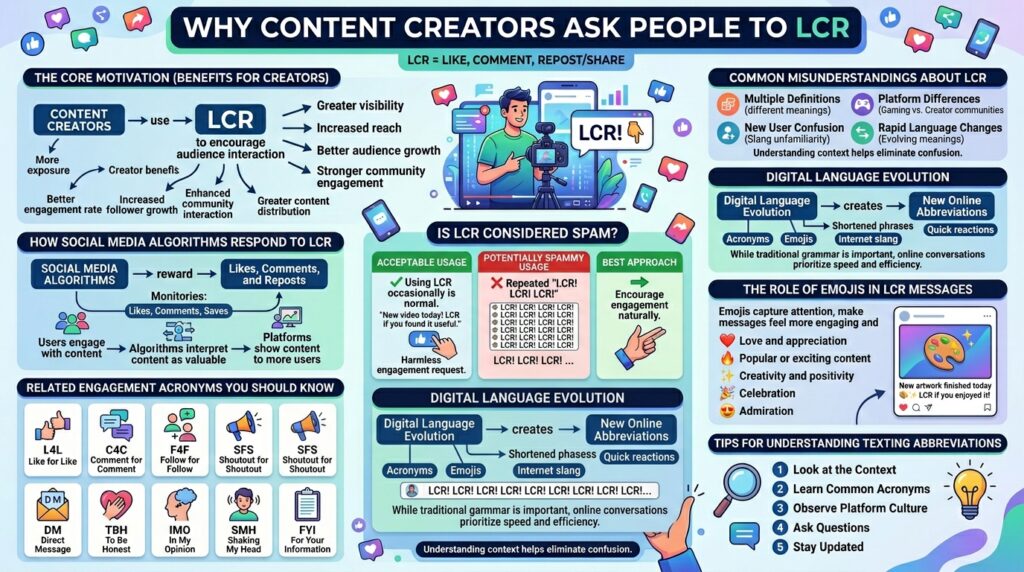
Content Creators → use → LCR to encourage audience interaction
More interaction often results in:
- Greater visibility
- Increased reach
- Better audience growth
- Stronger community engagement
For small creators, even a few additional comments and shares can significantly improve performance.
Benefits for Creators
- More exposure
- Better engagement rate
- Increased follower growth
- Enhanced community interaction
- Greater content distribution
This is why you often see creators include LCR requests at the end of captions and videos.
How Social Media Algorithms Respond to LCR
Social media algorithms constantly evaluate user behavior.
They often monitor:
- Likes
- Comments
- Shares
- Saves
- Watch time
- Click-through rates
The relationship is straightforward:
Social Media Algorithms → reward → Likes, Comments, and Reposts
When users engage with content, algorithms may interpret that content as valuable.
As a result, platforms sometimes show the content to more users.
This explains why LCR requests remain so common across social media.
Related Engagement Acronyms You Should Know
LCR isn’t the only abbreviation used in creator communities.
L4L
Like for Like
Users exchange likes to boost engagement.
C4C
Comment for Comment
Participants leave comments on each other’s posts.
F4F
Follow for Follow
Users mutually follow one another.
SFS
Shoutout for Shoutout
Creators promote each other to their audiences.
DM
Direct Message
A private conversation between users.
TBH
To Be Honest
Used when expressing honest opinions.
IMO
In My Opinion
Introduces a personal viewpoint.
SMH
Shaking My Head
Expresses disappointment or disbelief.
FYI
For Your Information
Provides useful information.
Is LCR Considered Spam?
This is a question many users ask.
The answer depends on how it’s used.
Acceptable Usage
Using LCR occasionally is generally considered normal.
Example:
“New video today! LCR if you found it useful.”
Most users view this as a harmless engagement request.
Potentially Spammy Usage
Repeatedly posting:
“LCR! LCR! LCR!”
under every piece of content may appear spammy.
The best approach is to encourage engagement naturally rather than excessively.
Common Misunderstandings About LCR
Many users misunderstand LCR because abbreviations can vary between communities.
Some common reasons include:
Multiple Definitions
LCR does not always mean the same thing.
Platform Differences
Gaming communities may use it differently than creator communities.
New User Confusion
People unfamiliar with texting slang may struggle to interpret abbreviations.
Rapid Language Changes
Digital communication evolves quickly, and meanings can shift over time.
Understanding context helps eliminate most confusion.
How Digital Language Is Changing Communication
The rise of texting and social media has transformed communication.
Today’s digital language includes:
- Acronyms
- Emojis
- Shortened phrases
- Internet slang
- Quick reactions
The semantic relationship is clear:
Digital Language Evolution → creates → New Online Abbreviations
LCR is just one example of how users adapt language for faster communication.
While traditional grammar remains important, online conversations often prioritize speed and efficiency.
That’s why abbreviations like LCR continue to grow in popularity.
The Role of Emojis in LCR Messages
Emojis often appear alongside LCR requests because they help capture attention.
Common examples include:
- ❤️ Love and appreciation
- 🔥 Popular or exciting content
- ✨ Creativity and positivity
- 🎉 Celebration
- 😍 Admiration
Example
“New artwork finished today 🎨✨ LCR if you enjoyed it!”
The emojis make the message feel more engaging and friendly, which can encourage additional interaction.
Tips for Understanding Texting Abbreviations
If you regularly encounter unfamiliar internet slang, these tips can help.
Look at the Context
The surrounding conversation usually provides valuable clues.
Learn Common Acronyms
Familiarity with internet slang improves comprehension.
Observe Platform Culture
Different platforms often develop unique language trends.
Ask Questions
When unsure, simply ask the sender what they mean.
Stay Updated
New abbreviations appear constantly, so keeping up with trends helps a lot.
Frequently Asked Questions
What does LCR mean in text messages?
LCR most commonly means Like, Comment, Repost. People use it on social media and in online conversations to encourage engagement with content. The abbreviation is popular because it saves time while clearly communicating a request for interaction.
What does LCR mean on TikTok and Instagram?
On TikTok and Instagram, LCR almost always stands for Like, Comment, Repost. Creators use it to encourage viewers and followers to interact with their content, helping improve visibility, reach, and overall engagement metrics.
Can LCR have different meanings?
Yes. Although Like, Comment, Repost is the most common meaning, LCR can also mean Left, Center, Right in gaming communities or Last Call Reminder in group chats and event planning discussions.
Is LCR formal or informal language?
LCR is considered informal internet slang. It is appropriate for social media, text messages, and casual conversations but generally should not be used in professional emails, academic writing, or official business communications.