
You spotted “STSU” in a text, Snapchat message, or TikTok comment, and now you’re staring at your screen wondering whether you just got roasted or whether it’s all part of a joke.
That’s a common reaction. Unlike some texting acronyms that have one clear definition, STSU can carry different meanings depending on who sent it, where it appeared, and the tone of the conversation. The same four letters can sound playful between friends, sarcastic in a group chat, or downright rude in an argument.
If you’re trying to understand what STSU Meaning in Text, how people use it, and whether you should be offended, you’re in the right place.
What Does STSU Meaning in Text?
Quick Definition
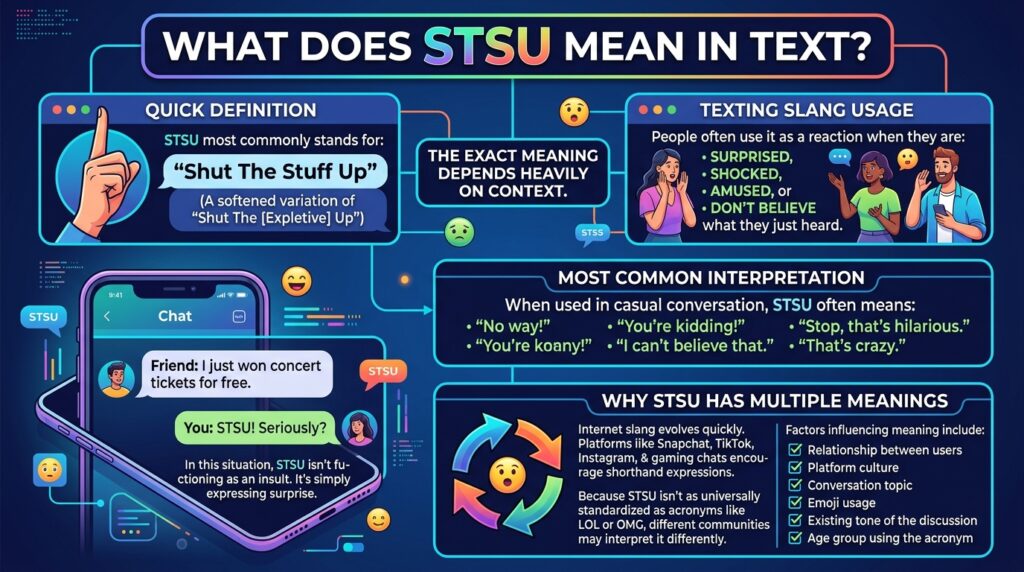
STSU most commonly stands for “Shut The Stuff Up” or a softened variation of “Shut The [Expletive] Up.”
In texting slang, people often use it as a reaction when they’re surprised, shocked, amused, or don’t believe what they just heard. The exact meaning depends heavily on context.
In many cases, STSU isn’t meant literally. Instead, it’s used as a reaction phrase expressing disbelief, excitement, or playful teasing.
Most Common Interpretation
When used in casual conversation, STSU often means:
- “No way!”
- “You’re kidding!”
- “I can’t believe that.”
- “Stop, that’s hilarious.”
- “That’s crazy.”
For example:
Friend: I just won concert tickets for free.
You: STSU! Seriously?
In this situation, STSU doesn’t function as an insult. It’s simply expressing surprise.
Why STSU Has Multiple Meanings
Internet slang evolves quickly.
Platforms like Snapchat, TikTok, Instagram, and gaming chats encourage users to create shorthand expressions that save time while conveying emotion.
Because STSU isn’t as universally standardized as acronyms like LOL or OMG, different communities may interpret it differently.
Factors influencing meaning include:
- The relationship between users
- Platform culture
- Conversation topic
- Emoji usage
- Existing tone of the discussion
- Age group using the acronym
That’s why context matters so much when trying to decode STSU.
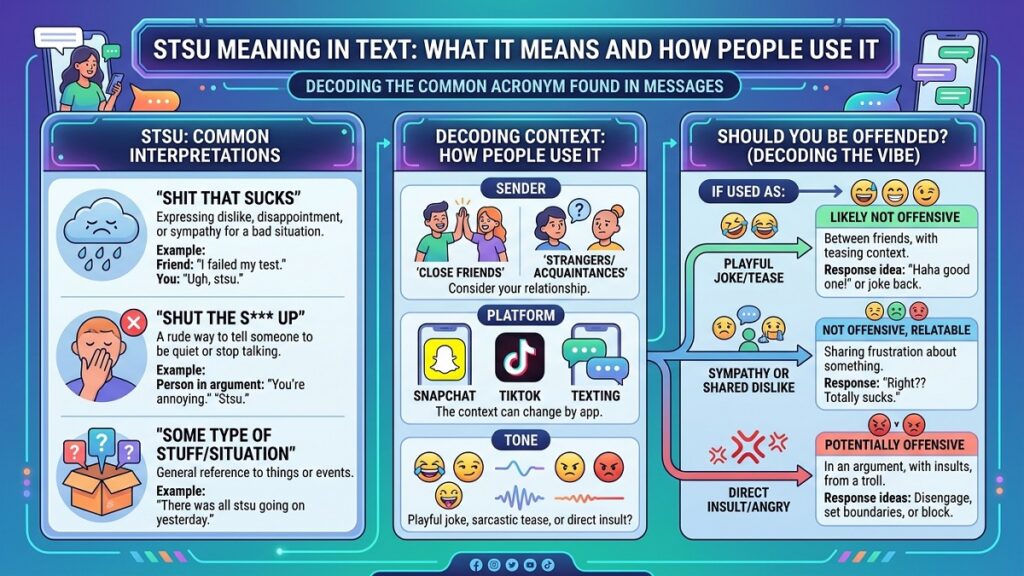
Is STSU Always Rude?
Not necessarily.
The phrase can range from friendly and humorous to aggressive and offensive.
Friendly Usage
Among close friends, STSU often appears as playful teasing.
Examples:
- “STSU, you’re making me laugh.”
- “STSU, I can’t believe you actually did that.”
- “STSU that’s the funniest thing I’ve seen all day.”
In these situations, the sender isn’t trying to hurt anyone’s feelings.
The phrase acts more like an exaggerated reaction than a command.
Sarcastic Usage
Sarcasm is deeply woven into social media slang.
Someone may use STSU as a sarcastic response when reacting to something ridiculous.
Example:
Person A: I think pineapple belongs on every pizza.
Person B: STSU.
The response is intentionally dramatic and humorous.
It’s not necessarily hostile.
Aggressive Usage
Things change when emotions are running high.
During arguments or heated online discussions, STSU can become dismissive or insulting.
Examples:
- “STSU, nobody asked.”
- “Just STSU already.”
- “STSU and leave me alone.”
In these cases, the phrase may be intended to silence or belittle someone.
Tone is everything.
Examples of STSU in Real Conversations
Understanding real-world usage makes interpretation much easier.
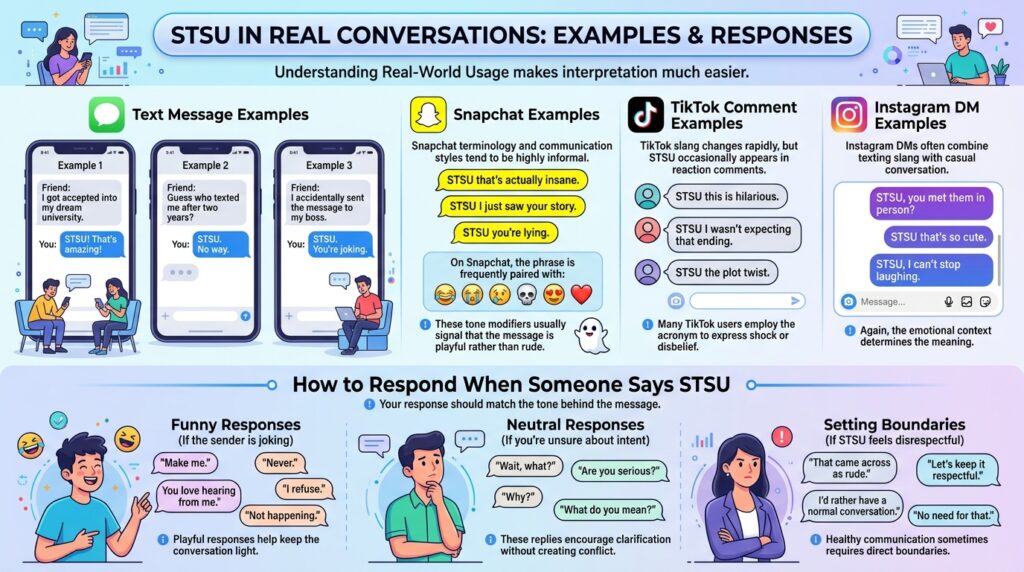
Text Message Examples
Example 1
Friend: I got accepted into my dream university.
You: STSU! That’s amazing!
Example 2
Friend: Guess who texted me after two years?
You: STSU. No way.
Example 3
Friend: I accidentally sent the message to my boss.
You: STSU. You’re joking.
Snapchat Examples
Snapchat terminology and communication styles tend to be highly informal.
Examples include:
- “STSU that’s actually insane.”
- “STSU I just saw your story.”
- “STSU you’re lying.”
On Snapchat, the phrase is frequently paired with:
- Laughing emojis
- Crying emojis
- Skull emojis
- Heart emojis
These tone modifiers usually signal that the message is playful rather than rude.
TikTok Comment Examples
TikTok slang changes rapidly, but STSU occasionally appears in reaction comments.
Examples:
- “STSU this is hilarious.”
- “STSU I wasn’t expecting that ending.”
- “STSU the plot twist.”
Many TikTok users employ the acronym to express shock or disbelief.
Instagram DM Examples
Instagram DMs often combine texting slang with casual conversation.
Examples:
- “STSU, you met them in person?”
- “STSU that’s so cute.”
- “STSU, I can’t stop laughing.”
Again, the emotional context determines the meaning.
How to Respond When Someone Says STSU
Your response should match the tone behind the message.
Funny Responses
If the sender is joking:
- “Make me.”
- “Never.”
- “You love hearing from me.”
- “I refuse.”
- “Not happening.”
Playful responses help keep the conversation light.
Neutral Responses
If you’re unsure about intent:
- “Wait, what?”
- “Are you serious?”
- “Why?”
- “What do you mean?”
These replies encourage clarification without creating conflict.
Setting Boundaries
If STSU feels disrespectful:
- “That came across as rude.”
- “Let’s keep it respectful.”
- “I’d rather have a normal conversation.”
- “No need for that.”
Healthy communication sometimes requires direct boundaries.
STSU vs Similar Slang Terms
Many people confuse STSU with other texting abbreviations.
Here’s a quick comparison.
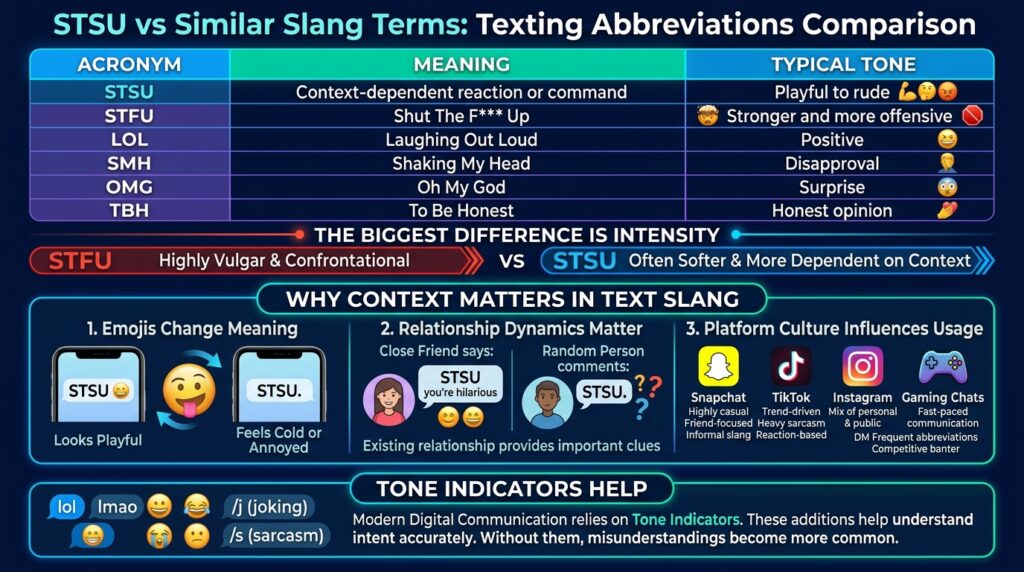
| Acronym | Meaning | Typical Tone |
|---|---|---|
| STSU | Context-dependent reaction or command | Playful to rude |
| STFU | Shut The F*** Up | Stronger and more offensive |
| LOL | Laughing Out Loud | Positive |
| SMH | Shaking My Head | Disapproval |
| OMG | Oh My God | Surprise |
| TBH | To Be Honest | Honest opinion |
The biggest difference is intensity.
STFU is widely recognized as vulgar and confrontational.
STSU often feels softer and more dependent on context.
Why Context Matters in Text Slang
One reason internet abbreviations confuse people is that text lacks vocal cues.
You can’t hear tone of voice.
You can’t see facial expressions.
You can’t always detect sarcasm.
That’s where context becomes essential.
Emojis Change Meaning
Compare these examples:
STSU 😂
Versus:
STSU.
The first looks playful.
The second can feel cold or annoyed.
A single emoji can completely transform interpretation.
Relationship Dynamics Matter
Friends communicate differently than strangers.
A close friend saying:
“STSU you’re hilarious”
Feels very different from a random person commenting:
“STSU.”
The existing relationship provides important clues.
Platform Culture Influences Usage
Different social media platforms develop their own language patterns.
Snapchat
- Highly casual
- Friend-focused
- Informal slang
TikTok
- Trend-driven
- Heavy sarcasm
- Reaction-based communication
- Mix of personal and public interactions
- DM conversations often resemble texting
Gaming Chats
- Fast-paced communication
- Frequent use of abbreviations
- Competitive banter
The platform itself can shape interpretation.
Tone Indicators Help
Modern digital communication increasingly relies on tone indicators.
Examples include:
- lol
- lmao
- 😂
- 😭
- /j (joking)
- /s (sarcasm)
These additions help users understand intent more accurately.
Without them, misunderstandings become more common.
Frequently Asked Questions
What does STSU mean in texting?
STSU usually means a variation of “Shut The Stuff Up” or a softened form of a stronger phrase. In texting slang, it’s often used to express surprise, disbelief, amusement, or playful teasing rather than a literal command.
Is STSU rude?
Sometimes.
Among friends, STSU is often harmless and humorous. During arguments or tense conversations, it can sound dismissive or offensive. The context determines whether it’s friendly or rude.
Does STSU mean the same thing on Snapchat?
Generally yes.
Snapchat users tend to use STSU in the same way it’s used in texting and online chat conversations. Because Snapchat communication is highly informal, the phrase is frequently intended as playful slang rather than an insult.
How do you respond to STSU?
You can respond based on tone:
- Joke back if it’s playful.
- Ask for clarification if you’re unsure.
- Set boundaries if it feels disrespectful.
Matching the context usually works best.
Is STSU similar to STFU?
They’re related but not identical.
STFU is usually more explicit, aggressive, and offensive. STSU often functions as a lighter, more context-dependent expression that may simply communicate disbelief or humor.
What are other popular texting acronyms?
Common internet abbreviations include:
- LOL — Laughing Out Loud
- OMG — Oh My God
- TBH — To Be Honest
- SMH — Shaking My Head
- BRB — Be Right Back
- IDK — I Don’t Know
- IMO — In My Opinion
- FWIW — For What It’s Worth
These acronyms remain popular across text messaging, social media, and digital communication platforms.
Final Thoughts
If there’s one thing to remember about STSU meaning in text, it’s this: don’t rush to judge the phrase by the letters alone.
The same acronym can signal laughter, shock, disbelief, sarcasm, teasing, or annoyance. A friend’s “STSU 😂” usually means something completely different from an angry “STSU” during an argument.
Look at the conversation. Check the emojis. Consider who sent it. Once you do that, decoding STSU becomes much easier—and you’ll know whether the sender was joking, reacting to shocking news, or actually telling someone to be quiet.