

Ever seen someone mention PDA in a text message, TikTok comment, or dating conversation and wondered what they were talking about? You’re not alone. A lot of people encounter the term for the first time online and immediately assume it’s another random internet abbreviation.
In reality, PDA is one of the most widely used relationship terms in modern communication. You’ll hear it in conversations about dating, social media, public etiquette, and even school rules.
So, what does PDA Full Form Slang, and why do people talk about it so often?
Let’s break it down.
What Does PDA Full Form Slang?
Full Form of PDA
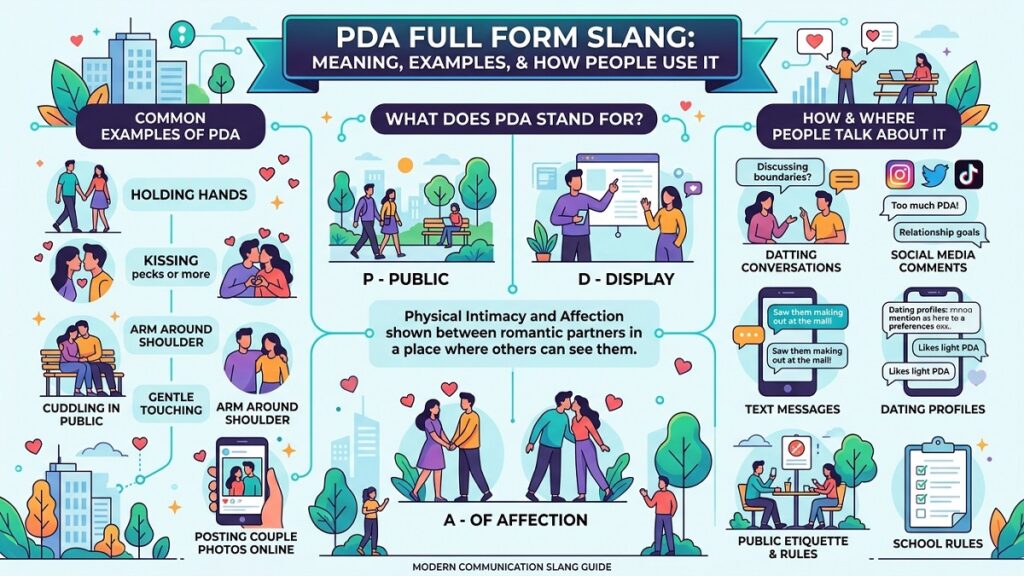
PDA stands for Public Display of Affection.
In slang and everyday conversation, PDA refers to affectionate or romantic behavior that takes place where other people can see it.
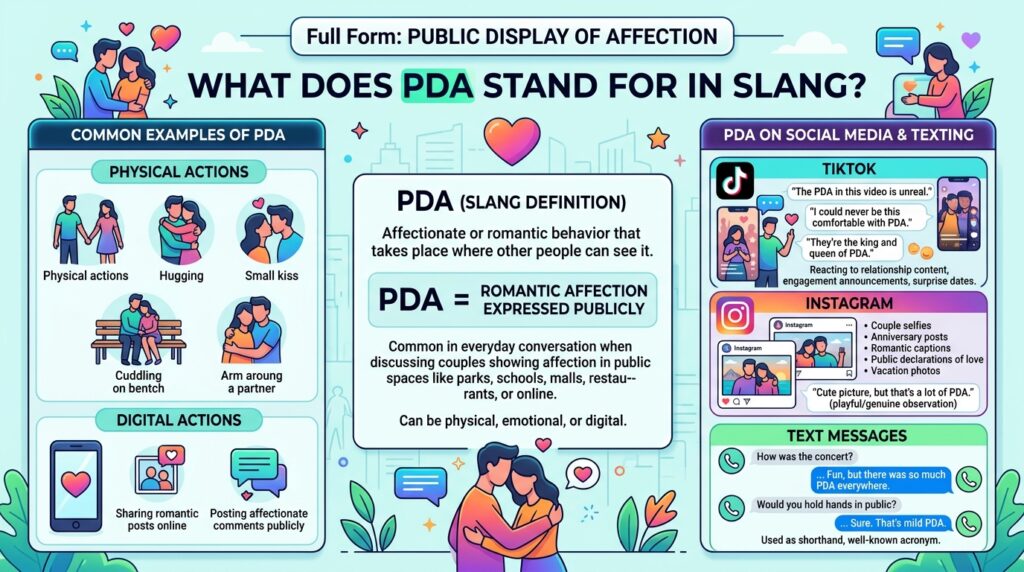
The term is commonly used when discussing couples who show affection in public spaces such as parks, schools, shopping malls, restaurants, or social media platforms.
Simple Definition
A simple way to understand PDA is this:
PDA = Romantic affection expressed publicly.
The affection can be physical, emotional, or even digital, depending on the situation.
Common examples include:
- Holding hands
- Hugging
- Kissing
- Cuddling
- Putting an arm around a partner
- Sharing romantic posts online
- Posting affectionate comments publicly
When someone says, “They’re showing a lot of PDA,” they usually mean the couple is displaying their affection where others can observe it.
What Does PDA Mean in Texting and Social Media?
When people search for PDA meaning slang, they’re often trying to understand a message, caption, or comment they saw online.
In texting and social media contexts, PDA almost always means Public Display of Affection, not anything technology-related.
PDA on TikTok
TikTok users frequently discuss PDA when reacting to relationship content.
For example:
- “The PDA in this video is unreal.”
- “I could never be this comfortable with PDA.”
- “They’re the king and queen of PDA.”
In these cases, users are commenting on visible romantic gestures between couples.
Relationship videos, engagement announcements, surprise dates, and couple challenges often attract discussions about PDA.
PDA on Instagram
Instagram has become a major platform for public relationship content.
Examples include:
- Couple selfies
- Anniversary posts
- Romantic captions
- Public declarations of love
- Vacation photos featuring couples
Someone might comment:
“Cute picture, but that’s a lot of PDA.”
The comment isn’t necessarily negative. Sometimes it’s playful. Other times, it’s a genuine observation about how openly affectionate the couple appears.
PDA in Text Messages
Text conversations often use PDA as shorthand.
Examples:
Friend 1: “How was the concert?”
Friend 2: “Fun, but there was so much PDA everywhere.”
Another example:
Person A: “Would you hold hands in public?”
Person B: “Sure. That’s mild PDA.”
Because PDA is a well-known texting acronym, most users immediately understand what it means without additional explanation.
Examples of PDA in Real Life
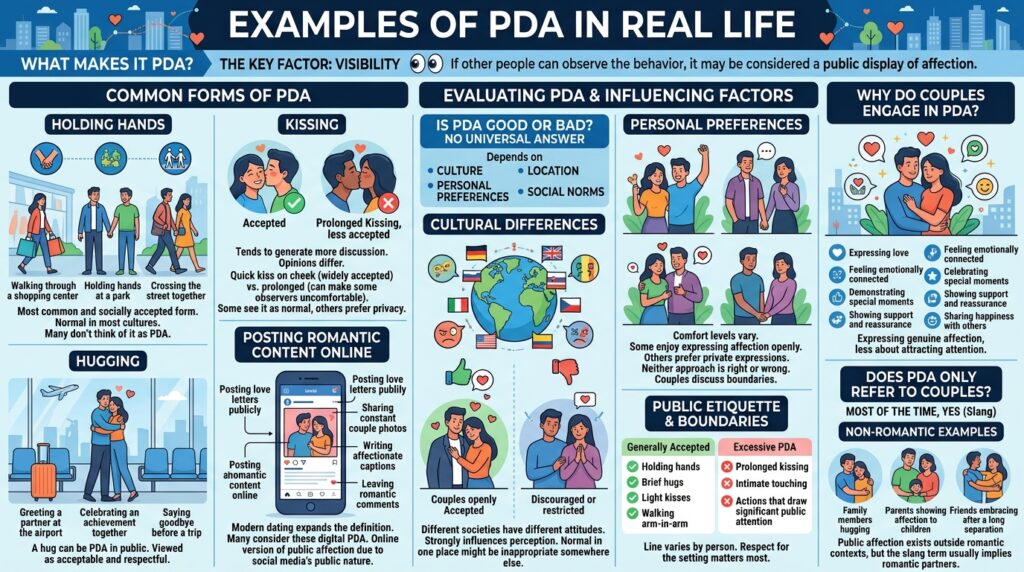
Not every affectionate action qualifies as PDA. The key factor is visibility.
If other people can observe the behavior, it may be considered a public display of affection.
Holding Hands
Holding hands is one of the most common and socially accepted forms of PDA.
Many people don’t even think of it as PDA because it is so common.
Examples:
- Walking through a shopping center
- Holding hands at a park
- Crossing the street together
In most cultures, this level of affection is considered normal.
Hugging
A hug can also be PDA when it happens in public.
Examples include:
- Greeting a partner at the airport
- Celebrating an achievement together
- Saying goodbye before a trip
Most people view hugging as an acceptable and respectful form of public affection.
Kissing
Kissing tends to generate more discussion.
A quick kiss on the cheek may be widely accepted, while prolonged kissing can make some observers uncomfortable.
This is where opinions about PDA often differ.
Some people see public kissing as perfectly normal. Others prefer romantic moments to remain private.
Posting Romantic Content Online
Modern dating culture has expanded the definition of PDA.
Today, many people consider certain online behaviors to be digital PDA.
Examples include:
- Posting love letters publicly
- Sharing constant couple photos
- Writing affectionate captions
- Leaving romantic comments under posts
Because social media is public by nature, many users view these actions as an online version of public affection.
Is PDA Good or Bad?
This question doesn’t have a universal answer.
Whether PDA is viewed positively or negatively depends on culture, location, personal preferences, and social norms.
Cultural Differences
Different societies have different attitudes toward PDA.
In some countries, couples holding hands or kissing in public is common and accepted.
In others, public intimacy may be discouraged or even restricted by local customs.
Cultural norms strongly influence how PDA is perceived.
A behavior considered normal in one place might be viewed as inappropriate somewhere else.
Personal Preferences
Not everyone feels comfortable with public affection.
Some people enjoy expressing affection openly.
Others prefer private expressions of love.
Neither approach is inherently right or wrong.
Many couples discuss boundaries and decide together what level of PDA feels comfortable.
Public Etiquette
Social etiquette often plays a role.
Generally accepted forms of PDA include:
- Holding hands
- Brief hugs
- Light kisses
- Walking arm-in-arm
Behavior sometimes considered excessive PDA may include:
- Prolonged kissing
- Intimate touching
- Actions that draw significant public attention
The line between acceptable affection and excessive PDA varies from person to person.
Respect for the setting often matters most.
Why Do Couples Engage in PDA?
People express affection publicly for many reasons.
Some simply act naturally around their partners.
Others use PDA as a way to communicate emotional closeness.
Common reasons include:
- Expressing love
- Feeling emotionally connected
- Demonstrating commitment
- Celebrating special moments
- Showing support and reassurance
- Sharing happiness with others
For many couples, PDA is less about attracting attention and more about expressing genuine affection.
Does PDA Only Refer to Couples?
Most of the time, yes.
PDA is usually associated with romantic relationships.
However, public affection can exist outside romantic contexts.
Examples include:
- Family members hugging
- Parents showing affection to children
- Friends embracing after a long separation
That said, when people use the term PDA in slang, they are almost always referring to romantic partners.
Other Meanings of PDA
Here’s where confusion sometimes happens. PDA doesn’t always mean Public Display of Affection.
Personal Digital Assistant
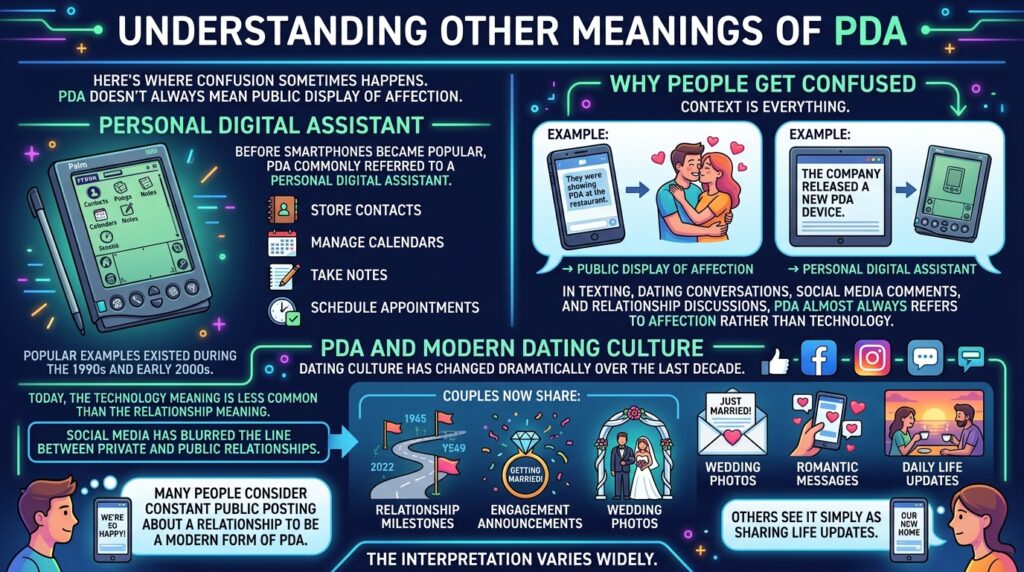
Before smartphones became popular, PDA commonly referred to a Personal Digital Assistant.
These handheld electronic devices helped users:
- Store contacts
- Manage calendars
- Take notes
- Schedule appointments
Popular examples existed during the 1990s and early 2000s.
Today, the technology meaning is less common than the relationship meaning.
Why People Get Confused
Context is everything.
Consider these examples:
- “They were showing PDA at the restaurant.” → Public Display of Affection
- “The company released a new PDA device.” → Personal Digital Assistant
In texting, dating conversations, social media comments, and relationship discussions, PDA almost always refers to affection rather than technology.
PDA and Modern Dating Culture
Dating culture has changed dramatically over the last decade.
Social media has blurred the line between private and public relationships.
Couples now share:
- Relationship milestones
- Engagement announcements
- Wedding photos
- Romantic messages
- Daily life updates
As a result, discussions about PDA now include both physical interactions and online communication.
Many people consider constant public posting about a relationship to be a modern form of PDA.
Others see it simply as sharing life updates.
The interpretation varies widely.
Frequently Asked Questions About PDA
What does PDA stand for in slang?
PDA stands for Public Display of Affection, referring to romantic gestures shown in public where others can see them.
What does PDA mean in texting?
In texting, PDA almost always means Public Display of Affection. People use it to describe affectionate behavior between couples.
Is PDA considered inappropriate?
Not necessarily. Appropriateness depends on cultural norms, personal boundaries, and the setting. Mild affection such as holding hands is often widely accepted.
What are examples of PDA?
Examples include:
- Holding hands
- Hugging
- Kissing
- Cuddling
- Walking arm-in-arm
- Posting romantic messages publicly
Why do couples engage in PDA?
Couples may use PDA to express love, show emotional connection, celebrate important moments, or simply behave naturally around each other.
Is PDA common among teenagers?
Yes. Teenagers and young adults frequently discuss PDA in schools, social media communities, and dating conversations.
Can social media posts count as PDA?
Many people believe they can. Publicly sharing romantic messages, photos, or affectionate comments is often viewed as digital PDA.
What is the difference between PDA and affection?
Affection can occur anywhere, including private settings. PDA specifically refers to affection shown where others can observe it.
Final Thoughts
If you’re searching for the PDA full form slang, the answer is simple: PDA stands for Public Display of Affection.
The term describes romantic gestures shown publicly, whether that’s holding hands, hugging, kissing, or even sharing affectionate content online. It’s one of the most common relationship terms used in texting, social media slang, dating discussions, and everyday conversations. The key thing to remember is context.
PDA isn’t automatically good or bad. Social etiquette, cultural differences, personal comfort levels, and the environment all influence how people view public affection. So the next time you see someone mention PDA on TikTok, Instagram, or in a text message, you’ll know exactly what they’re talking about.