

You saw someone type “TF” in a message, comment, or gaming chat, and now you’re wondering if you missed some secret internet code. You’re not alone. This tiny two-letter abbreviation appears everywhere—from WhatsApp conversations and Snapchat streaks to TikTok comments and Discord servers—and its meaning can be confusing if you’re not familiar with modern internet slang.
The good news? It’s actually pretty simple.
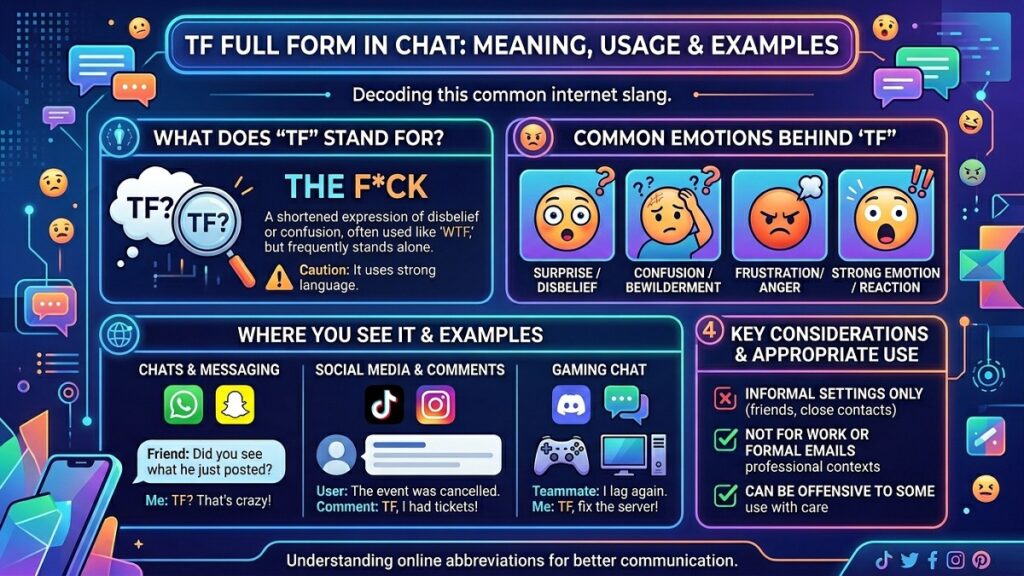
In most online conversations, TF stands for “The F*”** and is commonly used to express surprise, confusion, disbelief, frustration, or strong emotion. It’s often connected to the more familiar abbreviation “WTF” but can also appear on its own in text messages and social media posts.
Let’s break down exactly tf full form in chat, how people use it, when it’s appropriate, and what you should know before using it yourself.
What Does TF Mean in Chat?
When someone uses TF in a chat, they’re usually adding emotional emphasis to what they’re saying.
It isn’t typically used as a standalone sentence. Instead, it appears within questions, reactions, or statements to show that the speaker is surprised, confused, annoyed, or shocked.
TF Full Form Explained
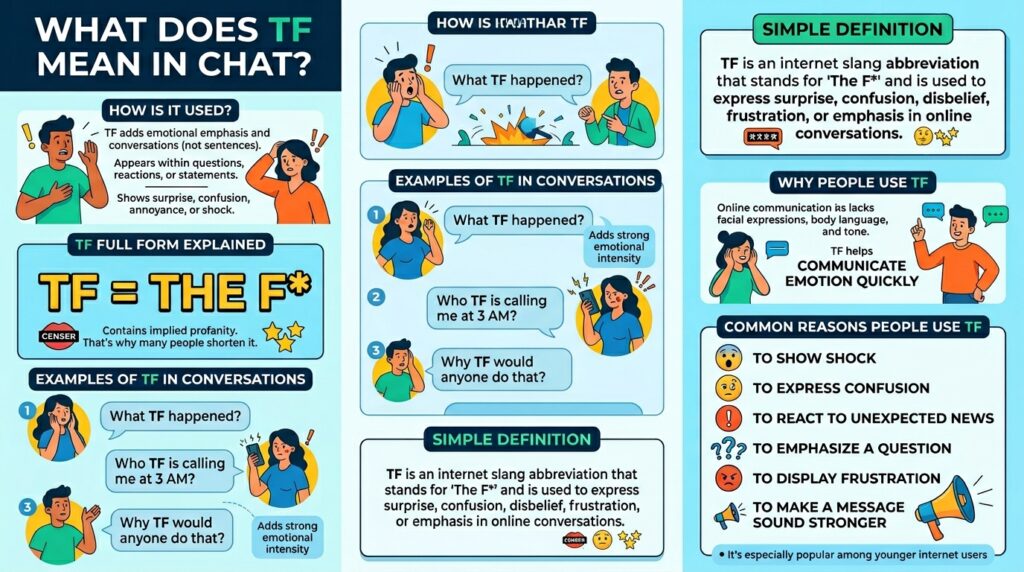
TF = The F*
The phrase contains an implied profanity. That’s why many people shorten it to “TF” instead of spelling out the full expression.
Examples include:
- “What TF happened?”
- “Who TF is calling me at 3 AM?”
- “Why TF would anyone do that?”
In each case, TF adds emotional intensity to the sentence.
Simple Definition
If you’re looking for a quick answer:
TF is an internet slang abbreviation that stands for “The F*” and is used to express surprise, confusion, disbelief, frustration, or emphasis in online conversations.**
Why People Use TF
People use TF because it helps communicate emotion quickly.
Online communication lacks facial expressions, body language, and tone of voice. Abbreviations like TF fill that gap.
Common reasons people use TF:
- To show shock
- To express confusion
- To react to unexpected news
- To emphasize a question
- To display frustration
- To make a message sound stronger
It’s especially popular among younger internet users and people active in meme culture, gaming communities, and social media platforms.
TF Meaning in Text Messages
The meaning of TF stays largely consistent across messaging apps and platforms.
Whether you’re reading a text message, social media comment, or gaming conversation, TF usually carries the same emotional tone.
TF in WhatsApp
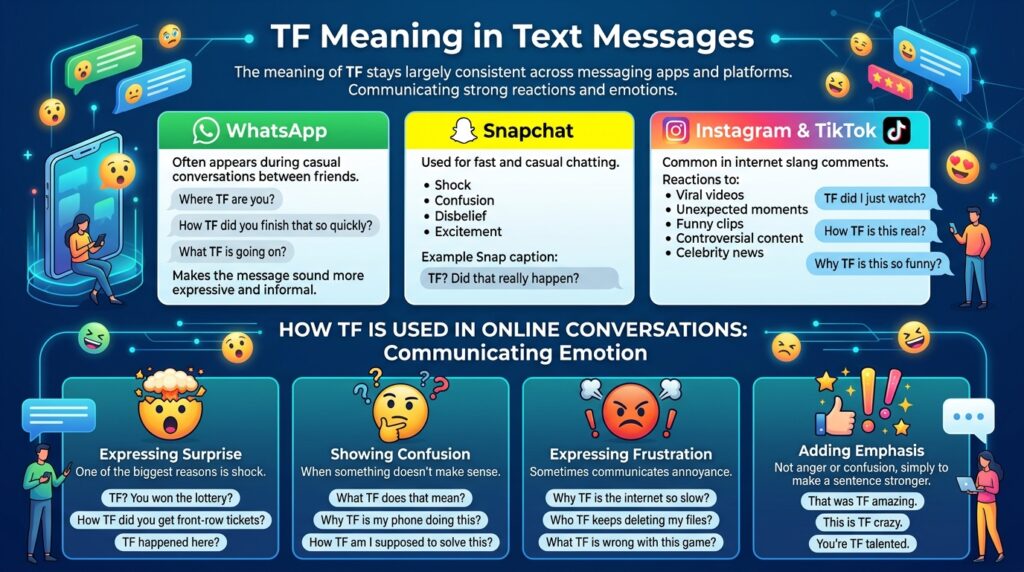
On WhatsApp, TF often appears during casual conversations between friends.
Examples:
- “Where TF are you?”
- “How TF did you finish that so quickly?”
- “What TF is going on?”
The abbreviation makes the message sound more expressive and informal.
TF on Snapchat
Snapchat users frequently rely on abbreviations and chat acronyms because conversations tend to be fast and casual.
When someone writes TF on Snapchat, they’re usually expressing:
- Shock
- Confusion
- Disbelief
- Excitement
Example:
- “TF? Did that really happen?”
The meaning remains the same as in texting.
TF on Instagram and TikTok
Instagram comments and TikTok comments are filled with internet slang.
You’ll often see TF used when people react to:
- Viral videos
- Unexpected moments
- Funny clips
- Controversial content
- Celebrity news
Examples:
- “TF did I just watch?”
- “How TF is this real?”
- “Why TF is this so funny?”
The abbreviation helps users communicate strong reactions in just a few characters.
How TF Is Used in Online Conversations
The real purpose of TF isn’t to provide information. It’s to communicate emotion.
Let’s look at the most common ways people use it.
Expressing Surprise
One of the biggest reasons people use TF is shock.
Examples:
- “TF? You won the lottery?”
- “How TF did you get front-row tickets?”
- “TF happened here?”
The abbreviation immediately signals surprise.
Showing Confusion
People also use TF when something doesn’t make sense.
Examples:
- “What TF does that mean?”
- “Why TF is my phone doing this?”
- “How TF am I supposed to solve this?”
The expression highlights confusion and curiosity.
Expressing Frustration
Sometimes TF communicates annoyance.
Examples:
- “Why TF is the internet so slow?”
- “Who TF keeps deleting my files?”
- “What TF is wrong with this game?”
In these situations, the speaker is clearly frustrated.
Adding Emphasis
Not every use of TF involves anger or confusion.
Sometimes it’s simply there to make a sentence stronger.
Examples:
- “That was TF amazing.”
- “This is TF crazy.”
- “You’re TF talented.”
Although less common, this usage exists in some online communities.
Examples of TF in Sentences
Seeing real examples makes internet slang much easier to understand.
Casual Chat Examples
Friend-to-friend conversations:
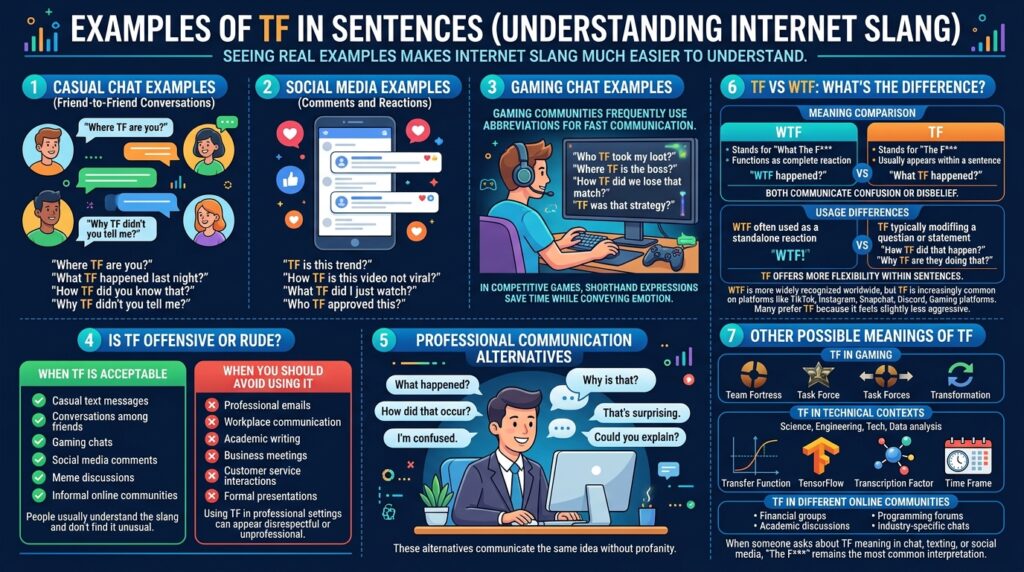
- “Where TF are you?”
- “What TF happened last night?”
- “How TF did you know that?”
- “Why TF didn’t you tell me?”
Social Media Examples
Comments and reactions:
- “TF is this trend?”
- “How TF is this video not viral?”
- “What TF did I just watch?”
- “Who TF approved this?”
Gaming Chat Examples
Gaming communities frequently use abbreviations because communication needs to be fast.
Examples:
- “Who TF took my loot?”
- “Where TF is the boss?”
- “How TF did we lose that match?”
- “TF was that strategy?”
In competitive games, shorthand expressions save time while conveying emotion.
Is TF Offensive or Rude?
This is one of the most common questions people ask.
The answer depends on context.
When TF Is Acceptable
TF is generally accepted in:
- Casual text messages
- Conversations among friends
- Gaming chats
- Social media comments
- Meme discussions
- Informal online communities
People in these environments usually understand the slang and don’t find it unusual.
When You Should Avoid Using It
Since TF contains implied profanity, it may be inappropriate in:
- Professional emails
- Workplace communication
- Academic writing
- Business meetings
- Customer service interactions
- Formal presentations
Using TF in professional settings can appear disrespectful or unprofessional.
Professional Communication Alternatives
Instead of TF, consider using:
- What happened?
- Why is that?
- How did that occur?
- That’s surprising.
- I’m confused.
- Could you explain?
These alternatives communicate the same idea without profanity.
TF vs WTF: What’s the Difference?
Many people assume TF and WTF are identical.
They’re closely related, but there are subtle differences.
Meaning Comparison
WTF
- Stands for “What The F***”
- Functions as a complete reaction
TF
- Stands for “The F***”
- Usually appears within a sentence
Examples:
- “WTF happened?”
- “What TF happened?”
Both communicate confusion or disbelief.
Usage Differences
WTF is often used as a standalone reaction.
Example:
- “WTF!”
TF typically modifies a question or statement.
Examples:
- “How TF did that happen?”
- “Why TF are they doing that?”
TF offers more flexibility within sentences.
Which Is More Common?
WTF remains more widely recognized worldwide.
However, TF has become increasingly common on:
- TikTok
- Snapchat
- Discord
- Gaming platforms
Many users prefer TF because it feels slightly less aggressive while conveying a similar emotion.
Other Possible Meanings of TF
Although “The F***” is by far the most common meaning in chat and texting, TF can represent different phrases depending on the context.
TF in Gaming
In gaming discussions, TF might occasionally refer to specific titles or terms.
Examples include:
- Team Fortress
- Task Force
- Transformation
The surrounding conversation usually makes the meaning clear.
TF in Technical Contexts
Outside social media and text messaging, TF can have specialized meanings.
Examples:
- Transfer Function
- TensorFlow
- Transcription Factor
- Time Frame
These meanings are common in science, engineering, technology, and data analysis.
TF in Different Online Communities
Different communities sometimes create unique definitions.
For example:
- Financial groups
- Programming forums
- Academic discussions
- Industry-specific chats
Still, when someone asks about TF meaning in chat, texting, or social media, “The F***” remains the most likely interpretation.
Frequently Asked Questions About TF
What does TF mean in texting?
TF usually stands for “The F***” and is used to express surprise, confusion, frustration, disbelief, or emphasis in a text message.
What does TF mean on Snapchat?
On Snapchat, TF generally has the same meaning as it does in texting. Users employ it to react to something surprising, confusing, or unexpected.
Can TF be used politely?
Not usually. Because TF contains implied profanity, it is considered informal and may be inappropriate in professional or formal conversations.
Is TF bad language?
TF is a softened abbreviation of a profanity. While it is less explicit than writing the full phrase, many people still consider it mild profanity.
What is the difference between TF and WTF?
WTF stands for “What The F***” and often functions as a complete reaction. TF stands for “The F***” and is typically inserted into a sentence for emphasis.
Final Takeaway
If you’ve been wondering about the TF full form in chat, the answer is straightforward: TF most commonly stands for “The F*.”**
People use it across text messaging, online chat platforms, social media, gaming communities, and meme culture to express:
- Surprise
- Confusion
- Disbelief
- Frustration
- Strong emotional reactions
You’ll frequently encounter TF on WhatsApp, Snapchat, Instagram, TikTok, Discord, and other messaging apps where informal communication is the norm.
Just remember one thing: while TF is widely accepted in casual conversations, it still carries implied profanity. That means it’s best reserved for friends, social media interactions, and informal online discussions—not professional communication.
Once you understand the context, spotting and interpreting TF in messages becomes easy. The next time you see someone ask, “What TF happened?” you’ll know exactly what they mean.