
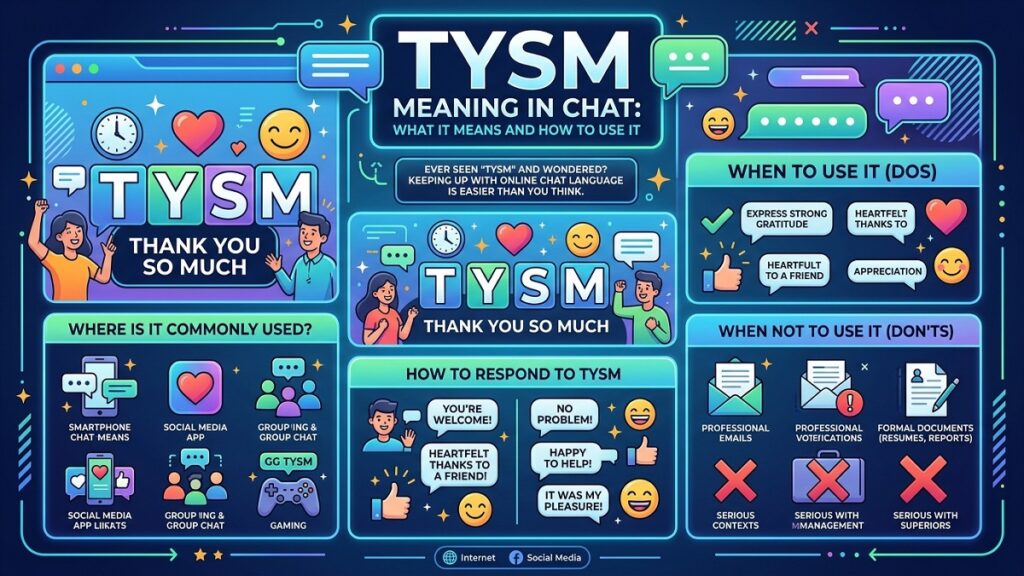

Ever opened a message, spotted “TYSM,” and wondered if you missed some new internet code everyone else seems to understand?
You’re not alone. Texting abbreviations evolve fast, and keeping up with online chat language can feel like learning a new dialect. If you’ve seen TYSM in a text message, social media comment, group chat, or gaming conversation, the good news is that its meaning is simple—and surprisingly useful.
This guide explains the TYSM meaning in chat, where it’s commonly used, how to respond to it, and when you should (and shouldn’t) use it yourself.
Quick Answer: What Does TYSM Mean?
TYSM stands for “Thank You So Much.”
It is a popular texting abbreviation used to express gratitude, appreciation, or thanks in online conversations.
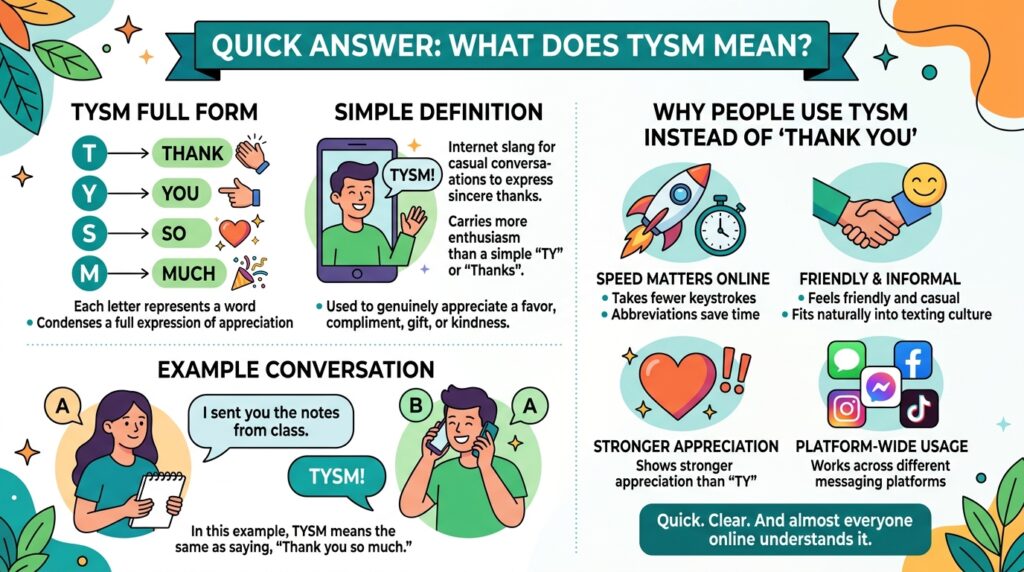
Example:
Person A: “I sent you the notes from class.”
Person B: “TYSM!”
In this example, TYSM means the same thing as saying, “Thank you so much.”
Because it is short, friendly, and easy to type, it has become a common part of digital communication across social media platforms and messaging apps.
What Does TYSM Mean?
TYSM Full Form
The full form of TYSM is:
Thank You So Much
Each letter represents a word:
- T = Thank
- Y = You
- S = So
- M = Much
The acronym condenses a full expression of appreciation into just four characters.
Simple Definition
TYSM is an internet slang abbreviation people use to express sincere thanks in a casual conversation.
It carries more enthusiasm than a simple “TY” or “Thanks.”
When someone writes TYSM, they usually want to show that they genuinely appreciate a favor, compliment, gift, piece of information, or act of kindness.
Why People Use TYSM Instead of “Thank You”
Speed matters online.
Whether you’re chatting on your phone, responding to dozens of messages, or participating in a busy group chat, abbreviations save time.
People use TYSM because it:
- Takes fewer keystrokes
- Feels friendly and informal
- Shows stronger appreciation than “TY”
- Fits naturally into texting culture
- Works across different messaging platforms
It’s quick. It’s clear. And almost everyone who spends time online understands it.
Where Is TYSM Commonly Used?
TYSM appears in many forms of digital communication.
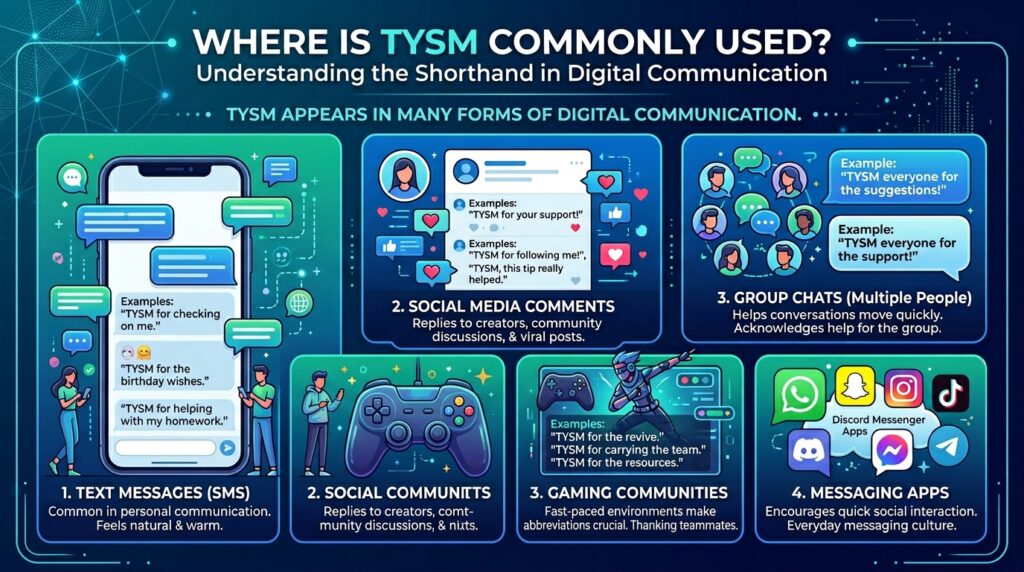
Text Messages
Text messaging remains one of the most common places to see TYSM.
Examples:
- “TYSM for checking on me.”
- “TYSM for the birthday wishes.”
- “TYSM for helping with my homework.”
In personal conversations, the abbreviation feels natural and warm.
Social Media Comments
Social media users frequently write TYSM in comment sections and replies.
Examples:
- “TYSM for your support!”
- “TYSM for following me!”
- “TYSM, this tip really helped.”
You’ll often see it under viral posts, creator content, and community discussions.
Group Chats
Group chats move quickly.
Instead of typing a full sentence, people often use TYSM to acknowledge help or thank several people at once.
Example:
“TYSM everyone for the suggestions!”
This keeps conversations moving while still expressing appreciation.
Gaming Communities
Gaming communities have embraced chat abbreviations for years.
In multiplayer games, players often thank teammates after receiving assistance.
Examples:
- “TYSM for the revive.”
- “TYSM for carrying the team.”
- “TYSM for the resources.”
Fast-paced environments make abbreviations especially useful.
Messaging Apps
TYSM appears regularly on:
- Snapchat
- TikTok
- Discord
- Facebook Messenger
- Telegram
Because these platforms encourage quick social interaction, shorthand expressions like TYSM have become part of everyday messaging culture.
Examples of TYSM in Real Conversations
Understanding context makes internet slang much easier to recognize.
TYSM Between Friends
Friend 1: “I picked up your package.”
Friend 2: “TYSM! You saved me a trip.”
Friend 1: “No problem.”
The tone is casual and friendly.
TYSM on Social Media
User: “Your tutorial helped me fix the problem.”
Creator: “Glad it worked!”
User: “TYSM!”
The user is expressing appreciation for useful content.
TYSM in Gaming Chats
Player A: “I dropped extra health packs.”
Player B: “TYSM!”
Player A: “You’re welcome.”
The exchange is brief but polite.
TYSM in School or Study Groups
Student A: “Here’s the assignment guide.”
Student B: “TYSM! I couldn’t find it.”
Student A: “Happy to help.”
This is one of the most common educational uses of the abbreviation.
How to Respond to TYSM
If someone sends you TYSM, responding is easy.
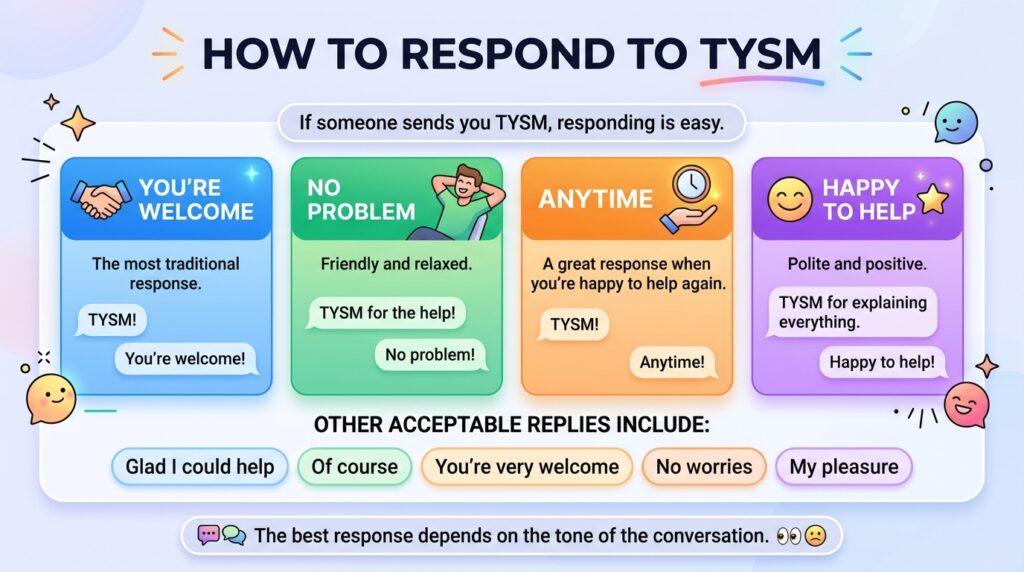
You’re Welcome
The most traditional response.
Example:
- TYSM!
- You’re welcome!
No Problem
Friendly and relaxed.
Example:
- TYSM for the help!
- No problem!
Anytime
A great response when you’re happy to help again.
Example:
- TYSM!
- Anytime!
Happy to Help
Polite and positive.
Example:
- TYSM for explaining everything.
- Happy to help!
Other acceptable replies include:
- Glad I could help
- Of course
- You’re very welcome
- No worries
- My pleasure
The best response depends on the tone of the conversation.
TYSM vs Other Popular Texting Acronyms
Many people confuse TYSM with similar chat abbreviations.
Here’s how they compare.
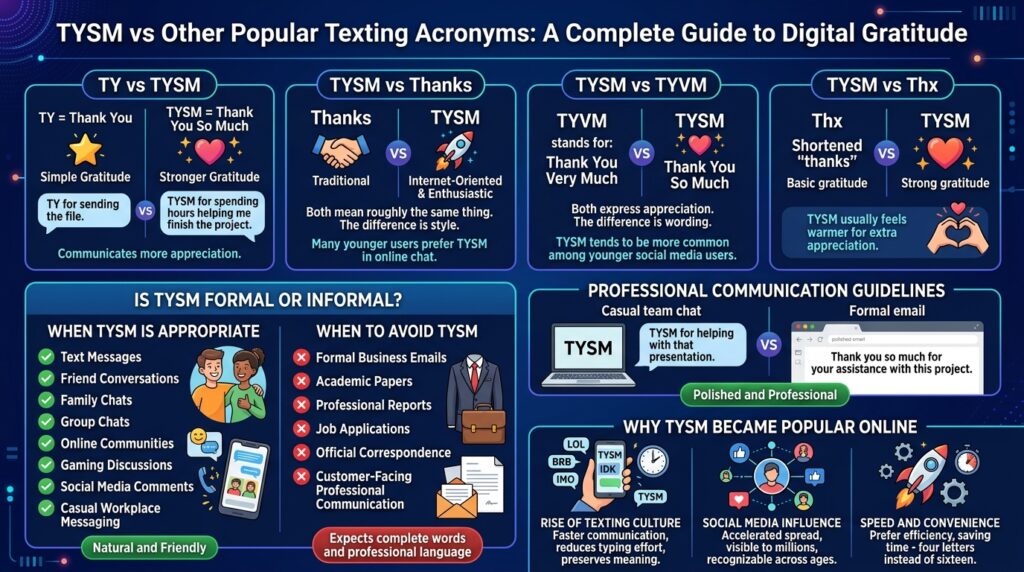
TY vs TYSM
TY = Thank You
TYSM = Thank You So Much
TY expresses gratitude.
TYSM expresses stronger gratitude.
Example:
- TY for sending the file.
- TYSM for spending hours helping me finish the project.
The second message communicates more appreciation.
TYSM vs Thanks
Both mean roughly the same thing.
The difference is style.
- Thanks feels more traditional.
- TYSM feels more internet-oriented and enthusiastic.
Many younger users prefer TYSM in online chat.
TYSM vs TYVM
TYVM stands for:
Thank You Very Much
Both express appreciation.
The difference is wording.
- TYSM = Thank You So Much
- TYVM = Thank You Very Much
TYSM tends to be more common among younger social media users.
TYSM vs Thx
Thx is simply a shortened version of “thanks.”
Comparison:
- Thx = Basic gratitude
- TYSM = Strong gratitude
If you want to show extra appreciation, TYSM usually feels warmer.
Is TYSM Formal or Informal?
This is one of the most common questions people ask.
When TYSM Is Appropriate
TYSM works well in:
- Text messages
- Friend conversations
- Family chats
- Group chats
- Online communities
- Gaming discussions
- Social media comments
- Casual workplace messaging
In these situations, it feels natural and friendly.
When to Avoid TYSM
There are situations where spelling out the full phrase is a better choice.
Avoid TYSM in:
- Formal business emails
- Academic papers
- Professional reports
- Job applications
- Official correspondence
- Customer-facing professional communication
These environments generally expect complete words and professional language.
Professional Communication Guidelines
If you’re communicating in a workplace setting, consider the audience.
Casual team chat:
- TYSM for helping with that presentation.
Formal email:
- Thank you so much for your assistance with this project.
The second version appears more polished and professional.
Why TYSM Became Popular Online
Internet slang rarely becomes widespread by accident.
Several factors contributed to TYSM’s popularity.
Rise of Texting Culture
As texting became the dominant form of communication, users naturally looked for ways to communicate faster.
Abbreviations such as:
- LOL
- BRB
- IMO
- IDK
- TYSM
helped reduce typing effort while preserving meaning.
Social Media Influence
Social media accelerated the spread of chat abbreviations.
A phrase used by a few users can suddenly become visible to millions through comments, posts, videos, and online communities.
As a result, TYSM became recognizable across different age groups and platforms.
Speed and Convenience
People prefer efficiency.
Typing four letters instead of sixteen saves time, especially when responding to multiple messages.
That convenience is a major reason TYSM remains popular today.
Frequently Asked Questions About TYSM
What does TYSM mean in text?
TYSM means “Thank You So Much.” It is a texting abbreviation used to express gratitude and appreciation.
Is TYSM polite?
Yes. TYSM is generally considered polite, friendly, and positive. It communicates sincere thanks in an informal way.
Can adults use TYSM?
Absolutely.
Although younger users helped popularize it, people of all ages use TYSM in text messages, social media, and online chat.
Is TYSM used worldwide?
Yes.
Because English internet slang spreads globally, TYSM appears in online conversations across many countries and international communities.
What should I reply to TYSM?
Common responses include:
- You’re welcome
- No problem
- Anytime
- Happy to help
- My pleasure
Any friendly acknowledgment works well.
Final Thoughts
The TYSM meaning in chat is straightforward: “Thank You So Much.” It’s a popular texting abbreviation used to express gratitude in digital communication, social media interactions, group chats, gaming communities, and messaging apps.
The acronym is informal, friendly, and widely understood. It conveys stronger appreciation than a simple “TY” while remaining quick and convenient to type.
If someone sends you TYSM, they’re simply expressing heartfelt thanks. A response like “You’re welcome,” “No problem,” or “Happy to help” is usually all that’s needed.
As texting culture continues to evolve, understanding abbreviations like TYSM helps you communicate more naturally, interpret messages correctly, and stay connected with the language people use online every day.