
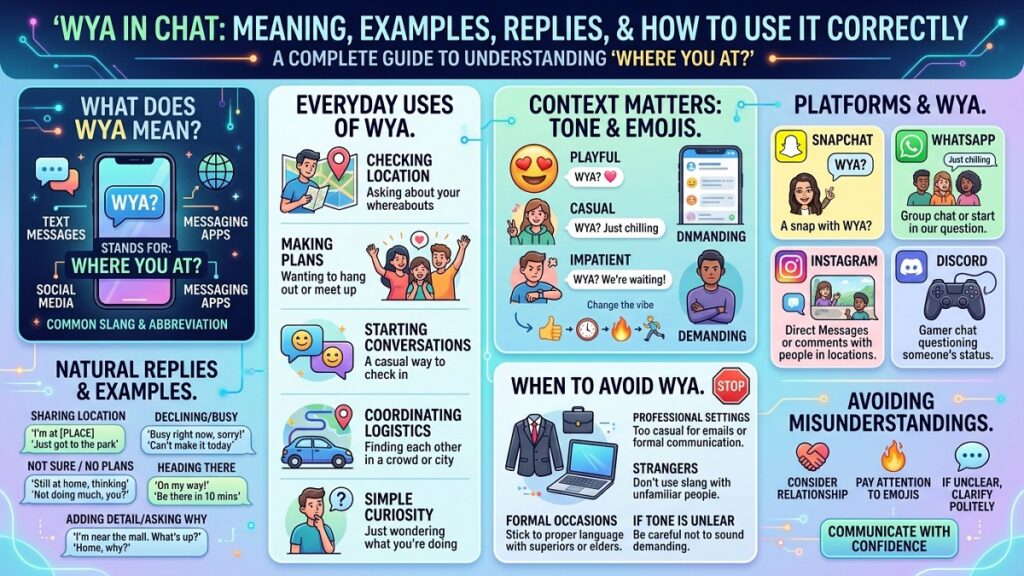

Have you ever opened a message, saw “WYA?”, and wondered what the sender actually meant? If so, you’re not alone. WYA in chat is one of the most commonly used texting abbreviations across text messages, social media, and messaging apps. While it looks simple, its meaning can change depending on the conversation context, tone, emojis, and even who sent it. That’s why people sometimes misunderstand it, honestly it happens more often than you’d think.
In this complete guide, you’ll learn the meaning of WYA, where it came from, how it’s used in everyday conversations, when you should avoid using it, and how to reply naturally. You’ll also discover how WYA differs across platforms like Snapchat, WhatsApp, Instagram, and Discord so you can communicate with confidence.
What Does WYA in Chat Mean?
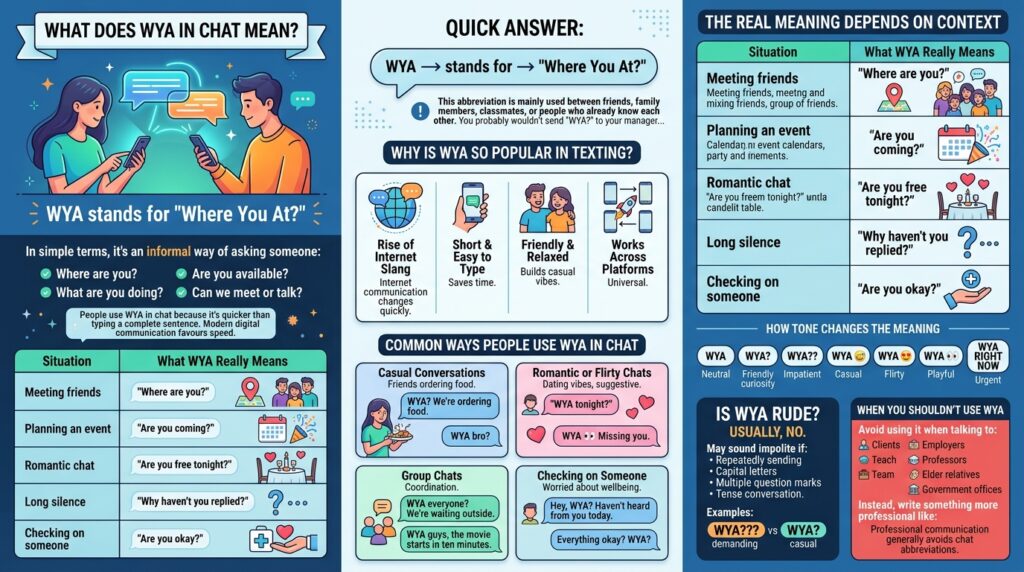
WYA stands for “Where You At?”
In simple terms, it’s an informal way of asking someone:
- Where are you?
- What are you doing?
- Are you available?
- Can we meet or talk?
People use WYA in chat because it’s quicker than typing a complete sentence. Modern digital communication favours speed, and abbreviations like WYA fit naturally into everyday conversations.
Quick Answer:
WYA → stands for → “Where You At?”
Unlike formal English, this abbreviation is mainly used between friends, family members, classmates, or people who already know each other. You probably wouldn’t send “WYA?” to your manager… well, unless your workplace is unusually casual.
Why Is WYA So Popular in Texting?
The rise of internet slang has completely changed how people communicate online. Instead of writing long messages, users now rely on short forms that save time while still expressing emotion.
Some reasons WYA became popular include:
- It’s short and easy to type.
- It feels friendly and relaxed.
- It works across almost every messaging platform.
- It helps start conversations quickly.
- It sounds natural during casual chats.
People often use WYA without even thinking about it because it’s become part of modern texting culture.
The Real Meaning Depends on Context
Although WYA always means “Where You At?”, the intention behind it changes depending on the conversation.
Conversation context → determines → the meaning and tone of WYA.
Here are a few common meanings.
| Situation | What WYA Really Means |
|---|---|
| Meeting friends | Where are you? |
| Planning an event | Are you coming? |
| Romantic chat | Are you free tonight? |
| Long silence | Why haven’t you replied? |
| Checking on someone | Are you okay? |
The wording stays the same, but the emotion behind it shifts quite a bit.
Common Ways People Use WYA in Chat
Casual Conversations
Friends send WYA every day to check each other’s location or make plans.
Examples:
- WYA? We’re ordering food.
- WYA bro?
- Everyone’s here except you.
The tone is relaxed, and nobody usually overthinks it.
Romantic or Flirty Chats
In dating conversations, WYA often carries a different meaning.
It can suggest:
- Want to hang out?
- Can I see you?
- Are you free later?
Examples:
- WYA tonight?
- WYA 👀
- Missing you. WYA?
Notice how a simple emoji changes the entire vibe.
Group Chats
Group conversations use WYA for coordination.
Examples include:
- WYA everyone?
- WYA? We’re waiting outside.
- WYA guys, the movie starts in ten minutes.
Here, the abbreviation is practical rather than emotional.
Checking on Someone
Sometimes people use WYA simply because they’re worried.
For example:
- Hey, WYA? Haven’t heard from you today.
- Everything okay? WYA?
In these situations, the question isn’t only about location. It’s also about someone’s wellbeing.
How Tone Changes the Meaning
One interesting thing about digital language is that tiny changes can create completely different meanings.
Emojis and punctuation → influence → the emotional interpretation of WYA.
Consider these examples.
| Message | Tone |
|---|---|
| WYA | Neutral |
| WYA? | Friendly curiosity |
| WYA?? | Impatient |
| WYA 😅 | Casual |
| WYA 😍 | Flirty |
| WYA 👀 | Playful |
| WYA RIGHT NOW | Urgent |
This is why reading only the abbreviation isn’t enough. You should always look at the surrounding conversation too.
Is WYA Rude?
Usually, no.
By itself, WYA isn’t considered rude. However, the way it’s used matters.
It may sound impolite if:
- Someone keeps sending it repeatedly.
- It’s written in capital letters.
- Multiple question marks are used aggressively.
- The conversation already feels tense.
For example:
“WYA???” feels more demanding than “WYA?”
Little details matter more than people realise.
When You Shouldn’t Use WYA
Even though WYA is common, there are situations where it isn’t appropriate.
Avoid using it when talking to:
- Clients
- Teachers
- Employers
- Professors
- Elder relatives
- Government offices
Instead, write something more professional like:
- Where are you at the moment?
- Are you available?
- May I ask where you are?
- Could you let me know your location?
Professional communication generally avoids chat abbreviations.
How to Reply to WYA Naturally
Many people understand the abbreviation but struggle with replies.
Here are some natural responses.
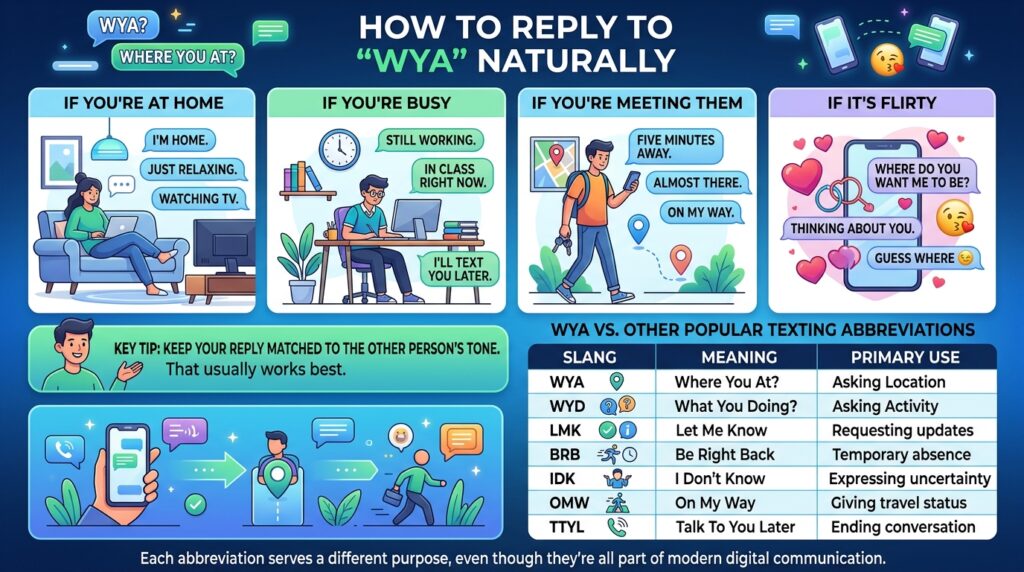
If You’re at Home
- I’m home.
- Just relaxing.
- Watching TV.
If You’re Busy
- Still working.
- In class right now.
- I’ll text you later.
If You’re Meeting Them
- Five minutes away.
- Almost there.
- On my way.
If It’s Flirty
- Where do you want me to be?
- Thinking about you.
- Guess where 😉
Keep your reply matched to the other person’s tone. That usually works best.
WYA vs Other Popular Texting Abbreviations
Many texting abbreviations appear together in online conversations.
| Slang | Meaning | Primary Use |
|---|---|---|
| WYA | Where You At? | Asking location |
| WYD | What You Doing? | Asking activity |
| LMK | Let Me Know | Requesting updates |
| BRB | Be Right Back | Temporary absence |
| IDK | I Don’t Know | Expressing uncertainty |
| OMW | On My Way | Giving travel status |
| TTYL | Talk To You Later | Ending conversation |
Each abbreviation serves a different purpose, even though they’re all part of modern online messaging.
WYA Across Different Messaging Platforms
One area many guides skip is how WYA in chat changes slightly depending on the platform.
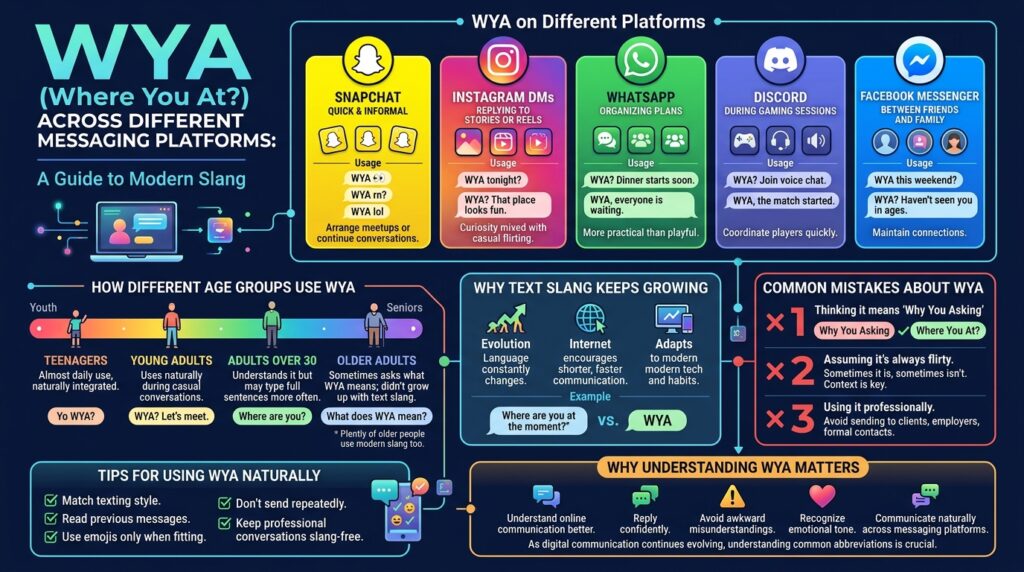
WYA on Snapchat
Snapchat conversations are quick and informal.
People usually send:
- WYA 👀
- WYA rn?
- WYA lol
It’s often used to arrange meetups or continue ongoing conversations.
WYA on Instagram DMs
Instagram messages frequently use WYA while replying to Stories or Reels.
Examples:
- WYA tonight?
- WYA? That place looks fun.
Here it often combines curiosity with casual flirting.
WYA on WhatsApp
WhatsApp users typically send WYA when organising plans.
Examples include:
- WYA? Dinner starts soon.
- WYA, everyone is waiting.
It’s more practical than playful.
WYA on Discord
Discord communities usually use WYA during gaming sessions.
Examples:
- WYA? Join voice chat.
- WYA, the match started.
The abbreviation helps coordinate players quickly.
WYA on Facebook Messenger
Messenger users often use it between friends and family.
Typical examples:
- WYA this weekend?
- WYA? Haven’t seen you in ages.
How Different Age Groups Use WYA
Age influences how frequently people use internet slang.
- Teenagers use WYA almost daily.
- Young adults use it naturally during casual conversations.
- Adults over 30 understand it but may type full sentences more often.
- Older adults sometimes ask what WYA means because they didn’t grow up with texting abbreviations.
There’s no strict rule though. Plenty of older people use modern slang too.
Why Text Slang Keeps Growing
Language constantly changes.
The internet encourages shorter, faster communication, and that’s why text slang continues expanding.
Instead of writing:
“Where are you at the moment?”
People simply write:
“WYA”
This doesn’t mean language is becoming worse. It’s adapting to modern technology and everyday habits. Communication, funny enough, has always evolved.
Common Mistakes About WYA
Many beginners misunderstand the abbreviation.
Here are the most common misconceptions.
Mistake 1: Thinking It Means “Why You Asking”
It doesn’t.
WYA → means → “Where You At?”
Mistake 2: Assuming It’s Always Flirty
Sometimes it is.
Sometimes it isn’t.
The surrounding conversation tells you which meaning applies.
Mistake 3: Using It Professionally
Avoid sending:
“WYA?”
to clients, employers, or formal contacts.
Professional settings expect complete sentences.
Tips for Using WYA Naturally
If you want your messages to sound more natural, keep these suggestions in mind.
- Match the other person’s texting style.
- Read the previous messages before replying.
- Use emojis only when they fit the conversation.
- Don’t send WYA repeatedly if someone hasn’t replied.
- Keep professional conversations free from internet slang.
These simple habits reduce misunderstandings and make conversations feel more comfortable.
Why Understanding WYA Matters
Learning WYA in chat isn’t just about memorising one abbreviation.
It helps you:
- Understand online communication better.
- Reply confidently.
- Avoid awkward misunderstandings.
- Recognise emotional tone.
- Communicate naturally across messaging platforms.
As digital communication continues evolving, understanding common abbreviations becomes increasingly useful.
Frequently Asked Questions
What does WYA mean in chat?
WYA means “Where You At?” It’s a casual texting abbreviation used to ask someone’s location, availability, or current activity. The exact meaning depends on the conversation, relationship between the people chatting, and the tone created by punctuation or emojis.
Is WYA the same as WYD?
No. WYA asks where someone is, while WYD asks what someone is doing. Although both are common internet slang abbreviations, they serve different purposes in everyday text conversations and are often used together.
Can WYA be used for flirting?
Yes. WYA can sound flirty when used in romantic conversations, especially with emojis like 👀 or ❤️. However, it isn’t automatically flirtatious. Friends also use it regularly to make plans or simply check where someone is.
Should I use WYA in professional messages?
No. WYA is designed for informal conversations. In workplaces or formal communication, it’s better to use complete sentences such as “Where are you?” or “Are you available?” to maintain professionalism and avoid sounding overly casual.