

You spotted “NTY” in a text, a gaming chat, or maybe a social media comment, and now you’re wondering whether it was a polite response or a subtle rejection. That’s usually the moment people start searching for What Does NTY Mean?
The good news? It’s simple.
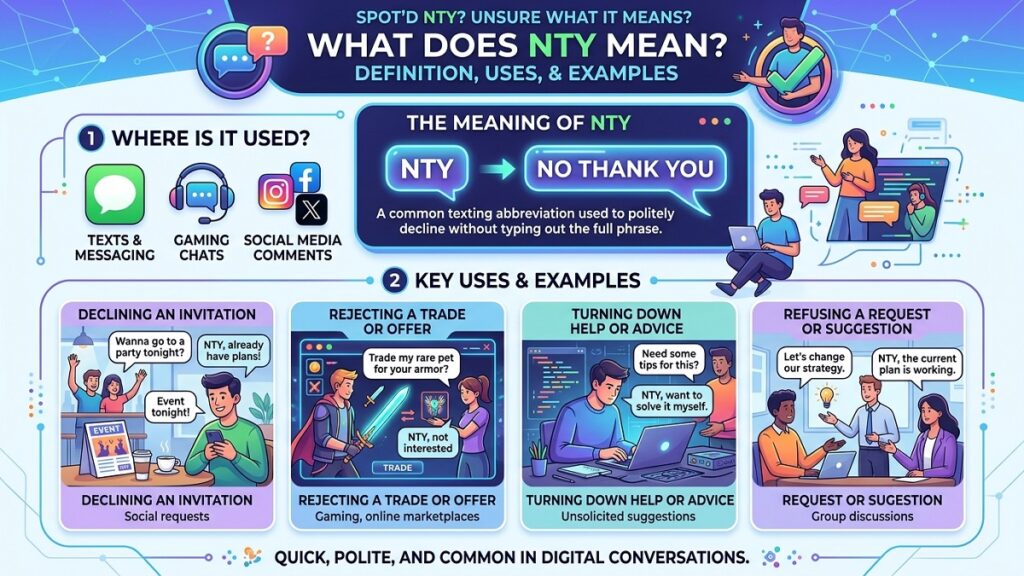
In most online conversations, NTY stands for “No Thank You.” It’s a common texting abbreviation used to politely decline an offer, invitation, suggestion, or request without typing out the full phrase.
But there’s more to it than that. Tone, context, and the platform where it’s used can all affect how NTY is interpreted. Let’s break it down.
What Does NTY Mean?
The most widely accepted NTY definition is:
NTY = No Thank You
It’s an internet acronym commonly used in text messaging, online chat rooms, social media, gaming communities, and messaging apps.
People use it as a quick way to say they’re not interested while still sounding polite.
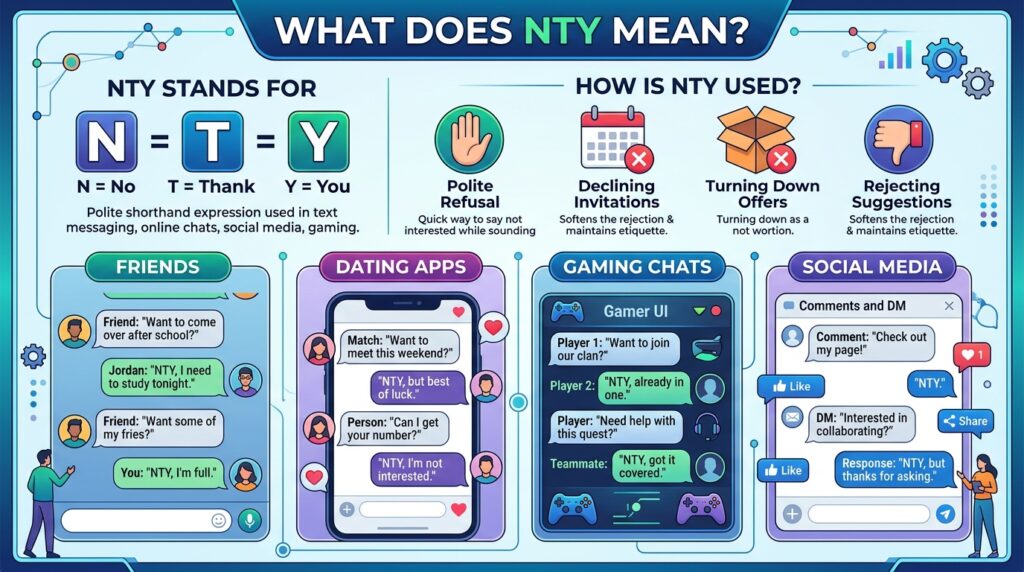
NTY Stands for “No Thank You”
The abbreviation combines the first letters of each word:
- N = No
- T = Thank
- Y = You
Instead of typing the full phrase, users shorten it to NTY to save time during digital communication.
Quick Definition
NTY means “No Thank You,” a polite shorthand expression used to decline invitations, offers, requests, or suggestions in text conversations.
For example:
Friend: Want to grab pizza tonight?
You: NTY, I already ate.
The message is clear, brief, and generally respectful.
How Is NTY Used in Text Messages?
People use NTY whenever they want to refuse something without sounding overly harsh.
The abbreviation fits naturally into casual conversation and instant messaging.
Declining Invitations
One of the most common uses of NTY is turning down invitations.
Examples:
- NTY, I have plans already.
- NTY, maybe next weekend.
- NTY, I can’t make it tonight.
Instead of writing a long explanation, users can quickly communicate their decision.
Turning Down Offers
NTY frequently appears when someone offers assistance, products, services, or opportunities.
Examples:
- NTY, I’m good.
- NTY, I already have one.
- NTY, but I appreciate the offer.
This keeps the interaction friendly while clearly communicating a refusal.
Rejecting Suggestions
People also use NTY when they don’t agree with a recommendation.
Examples:
- NTY, that’s not really my style.
- NTY, I’d rather try something else.
- NTY, maybe another time.
The phrase softens the rejection and helps maintain positive online etiquette.
Examples of NTY in Conversations
Understanding slang is easier when you see it in action.
Here are several realistic examples.
Friends
Alex: Want to come over after school?
Jordan: NTY, I need to study tonight.
Friend: Want some of my fries?
You: NTY, I’m full.
The response is short but still courteous.
Dating Apps
Dating platforms often involve quick conversations and invitation declines.
Match: Want to meet this weekend?
User: NTY, but best of luck.
Person: Can I get your number?
User: NTY, I’m not interested.
In these situations, NTY helps create a polite refusal without unnecessary back-and-forth.
Gaming Chats
Gaming communities heavily rely on chat abbreviations and shorthand expressions.
Player 1: Want to join our clan?
Player 2: NTY, already in one.
Player: Need help with this quest?
Teammate: NTY, got it covered.
Fast communication is important during gameplay, which makes acronyms especially popular.
Social Media Messages
Social media platforms are another place where NTY frequently appears.
Comment: Check out my page!
Reply: NTY.
DM: Interested in collaborating?
Response: NTY, but thanks for asking.
The meaning remains the same regardless of platform.
Is NTY Considered Rude?
This is one of the most common questions people ask after learning the NTY slang meaning.
The answer depends largely on context.
When It Sounds Polite
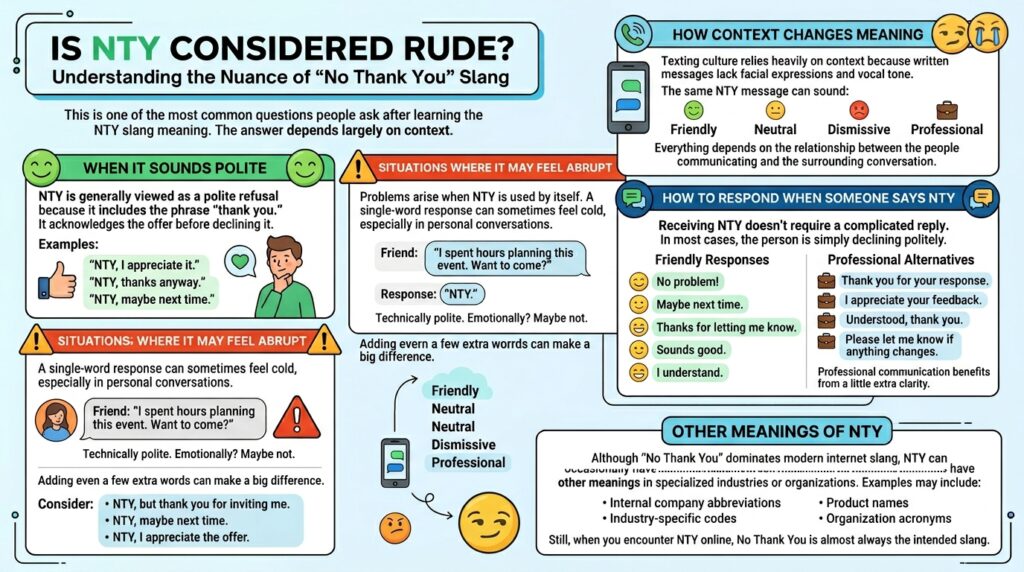
NTY is generally viewed as a polite refusal because it includes the phrase “thank you.”
It acknowledges the offer before declining it.
Examples:
- NTY, I appreciate it.
- NTY, thanks anyway.
- NTY, maybe next time.
These responses usually come across as respectful and considerate.
Situations Where It May Feel Abrupt
Problems arise when NTY is used by itself.
A single-word response can sometimes feel cold, especially in personal conversations.
For example:
Friend: I spent hours planning this event. Want to come?
Response: NTY.
Technically polite. Emotionally? Maybe not.
Adding even a few extra words can make a big difference.
Consider:
- NTY, but thank you for inviting me.
- NTY, maybe next time.
- NTY, I appreciate the offer.
How Context Changes Meaning
Texting culture relies heavily on context because written messages lack facial expressions and vocal tone.
The same NTY message can sound:
- Friendly
- Neutral
- Dismissive
- Professional
Everything depends on the relationship between the people communicating and the surrounding conversation.
How to Respond When Someone Says NTY
Receiving NTY doesn’t require a complicated reply.
In most cases, the person is simply declining politely.
Friendly Responses
Good responses include:
- No problem!
- Maybe next time.
- Thanks for letting me know.
- Sounds good.
- I understand.
These replies keep the conversation positive.
Professional Alternatives
In workplace communication, you may want a slightly more formal response.
Examples:
- Thank you for your response.
- I appreciate your feedback.
- Understood, thank you.
- Please let me know if anything changes.
Professional communication benefits from a little extra clarity.
Other Meanings of NTY
Although “No Thank You” dominates modern internet slang, NTY can occasionally have other meanings in specialized industries or organizations.
Examples may include:
- Internal company abbreviations
- Industry-specific codes
- Product names
- Organization acronyms
Still, when you encounter NTY in texting, online messaging, social media slang, or gaming chat, it almost always means No Thank You.
Similar Texting Acronyms
NTY belongs to a much larger family of texting abbreviations.
Understanding related acronyms can help you navigate online conversations more confidently.
NT
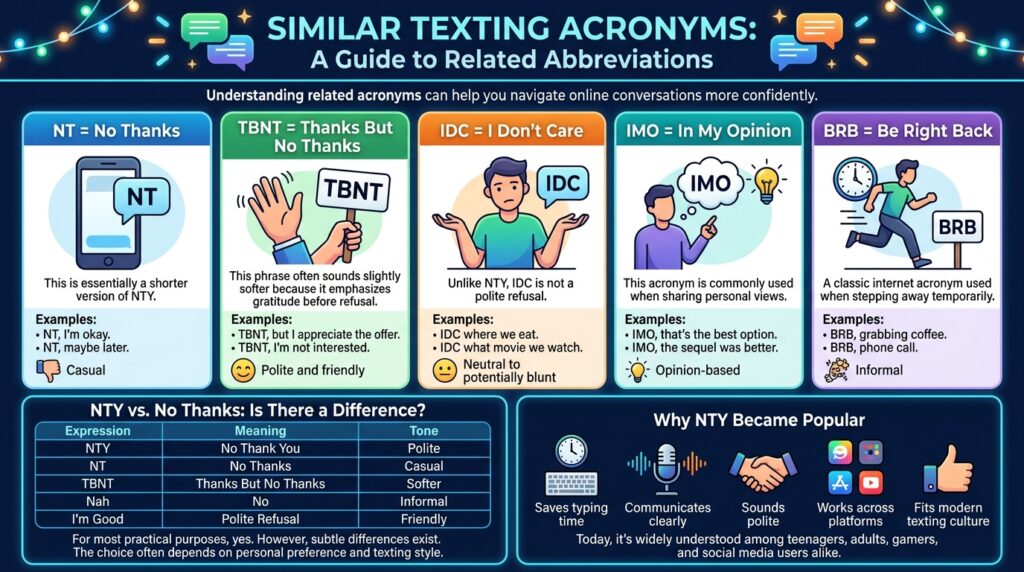
NT = No Thanks
This is essentially a shorter version of NTY.
Examples:
- NT, I’m okay.
- NT, maybe later.
Tone: Casual
TBNT
TBNT = Thanks But No Thanks
This phrase often sounds slightly softer because it emphasizes gratitude before refusal.
Examples:
- TBNT, but I appreciate the offer.
- TBNT, I’m not interested.
Tone: Polite and friendly
IDC
IDC = I Don’t Care
Unlike NTY, IDC is not a polite refusal.
Examples:
- IDC where we eat.
- IDC what movie we watch.
Tone: Neutral to potentially blunt
IMO
IMO = In My Opinion
This acronym is commonly used when sharing personal views.
Examples:
- IMO, that’s the best option.
- IMO, the sequel was better.
Tone: Opinion-based
BRB
BRB = Be Right Back
A classic internet acronym used when stepping away temporarily.
Examples:
- BRB, grabbing coffee.
- BRB, phone call.
Tone: Informal
NTY vs. No Thanks: Is There a Difference?
Many users wonder whether NTY and “No Thanks” mean the same thing.
For most practical purposes, yes.
However, subtle differences exist.
| Expression | Meaning | Tone |
|---|---|---|
| NTY | No Thank You | Polite |
| NT | No Thanks | Casual |
| TBNT | Thanks But No Thanks | Softer |
| Nah | No | Informal |
| I’m Good | Polite Refusal | Friendly |
The choice often depends on personal preference and texting style.
Why NTY Became Popular
The rise of smartphones, messaging apps, and social platforms encouraged shorter communication.
People naturally began shortening common phrases.
NTY gained popularity because it:
- Saves typing time
- Communicates clearly
- Sounds polite
- Works across platforms
- Fits modern texting culture
Today, it’s widely understood among teenagers, adults, gamers, and social media users alike.
Frequently Asked Questions
What does NTY mean in texting?
NTY means “No Thank You.” It is a texting abbreviation used to politely decline offers, invitations, suggestions, or requests.
What does NTY mean on social media?
On social media, NTY usually means No Thank You and serves as a quick way to reject offers, invitations, promotional messages, or collaboration requests.
Is NTY rude?
Not usually. NTY is generally considered polite because it includes “thank you.” However, using it alone can sometimes feel abrupt depending on the context.
Where is NTY commonly used?
You’ll often see NTY in:
- Text messaging
- Messaging apps
- Social media comments
- Direct messages
- Online chats
- Gaming communities
- Group conversations
Can adults use NTY?
Absolutely. While younger users may use it more frequently, adults commonly use NTY in casual digital communication.
Is NTY slang?
Yes. NTY is considered internet slang and a chat abbreviation used in informal online conversations.
How do you respond to NTY?
Simple responses work best:
- No problem!
- Thanks for letting me know.
- Maybe next time.
- I understand.
- Appreciate the response.
Is NTY appropriate for work messages?
Generally, no. In professional settings, writing out “No thank you” is usually more appropriate and clearer. NTY works best in casual conversations and informal messaging.
Final Thoughts
If you’ve been wondering what NTY means in text, the answer is straightforward: NTY stands for “No Thank You.” It’s a popular internet acronym used to decline offers, invitations, and suggestions in a quick yet generally polite way.
Whether you encounter it in social media slang, gaming chat, messaging apps, or everyday texting, NTY almost always signals a respectful refusal. The key is context. Add a few extra words, and it sounds warm and friendly. Use it alone, and it may come across as brief or distant.
Either way, now you’ll know exactly what the sender means the next time NTY pops up in your notifications.