
You saw “IDGAF” in a text, TikTok comment, Snapchat message, or group chat, and now you’re wondering whether it’s a joke, an insult, or something in between. That’s a common reaction because this acronym can sound casual in one conversation and surprisingly harsh in another.
The tricky part isn’t just understanding what IDGAF means. It’s figuring out the tone behind it.
Sometimes it’s used to show confidence. Sometimes frustration. Sometimes it’s a blunt way of ending a conversation. Context changes everything.
In this guide, you’ll learn the exact IDGAF meaning in chat, where it came from, how people use it across social media, and when it’s best to avoid using it altogether.
What is IDGAF Meaning in Chat?
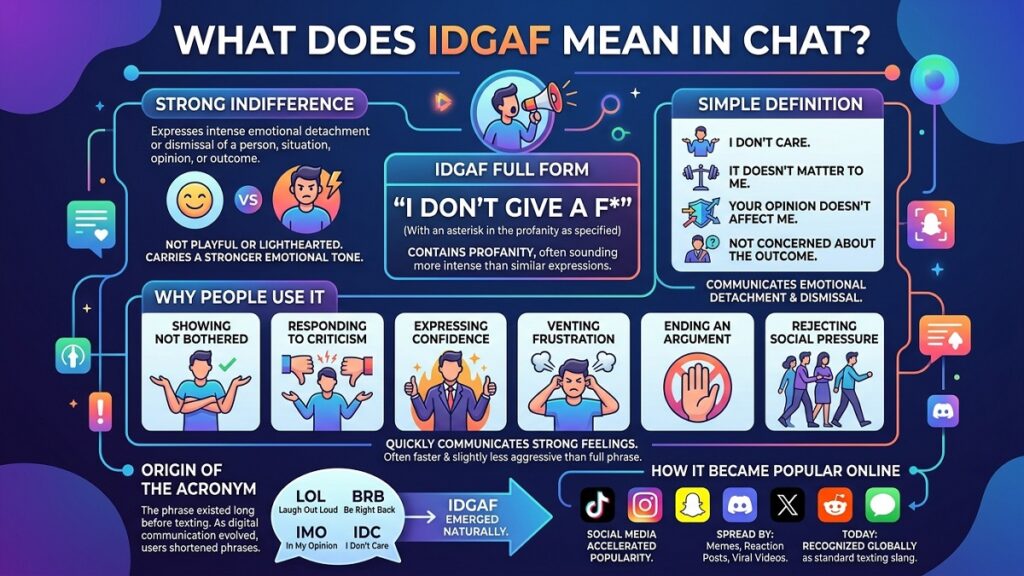
When someone uses IDGAF in a text message or online chat, they’re expressing strong indifference about a person, situation, opinion, or outcome.
Unlike many internet slang terms that are playful or lighthearted, IDGAF carries a stronger emotional tone.
IDGAF Full Form
IDGAF stands for:
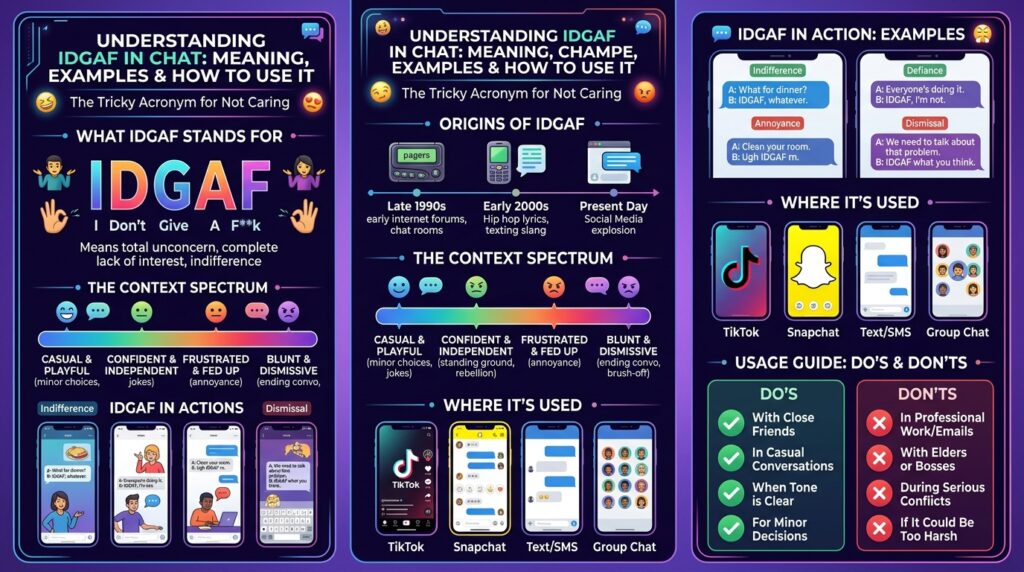
“I Don’t Give A F*.”**
The phrase contains profanity, which is why it often sounds more intense than similar expressions.
Simple Definition
In plain English, IDGAF means:
- I don’t care.
- It doesn’t matter to me.
- Your opinion doesn’t affect me.
- I’m not concerned about the outcome.
The phrase communicates a high level of emotional detachment, indifference, or dismissal.
Why People Use It
People use IDGAF because it quickly communicates strong feelings.
Common reasons include:
- Showing they aren’t bothered
- Responding to criticism
- Expressing confidence
- Venting frustration
- Ending an argument
- Rejecting social pressure
In many cases, the acronym is used instead of typing the full phrase because it feels faster and slightly less aggressive.
What Does IDGAF Stand For?
At its core, IDGAF is an internet acronym designed to shorten a longer expression.
Origin of the Acronym
The phrase “I don’t give a f***” existed long before texting slang became popular.
As digital communication evolved, users began shortening common phrases into abbreviations and acronyms. Similar examples include:
- LOL (Laugh Out Loud)
- BRB (Be Right Back)
- IMO (In My Opinion)
- IDC (I Don’t Care)
IDGAF emerged naturally from this trend.
How It Became Popular Online
Social media accelerated its popularity.
The acronym became common on:
- TikTok
- Snapchat
- Discord
- Twitter/X
- Messaging apps
Memes, reaction posts, and viral videos helped spread the term throughout internet culture.
Today, it’s recognized globally as a standard piece of texting slang.
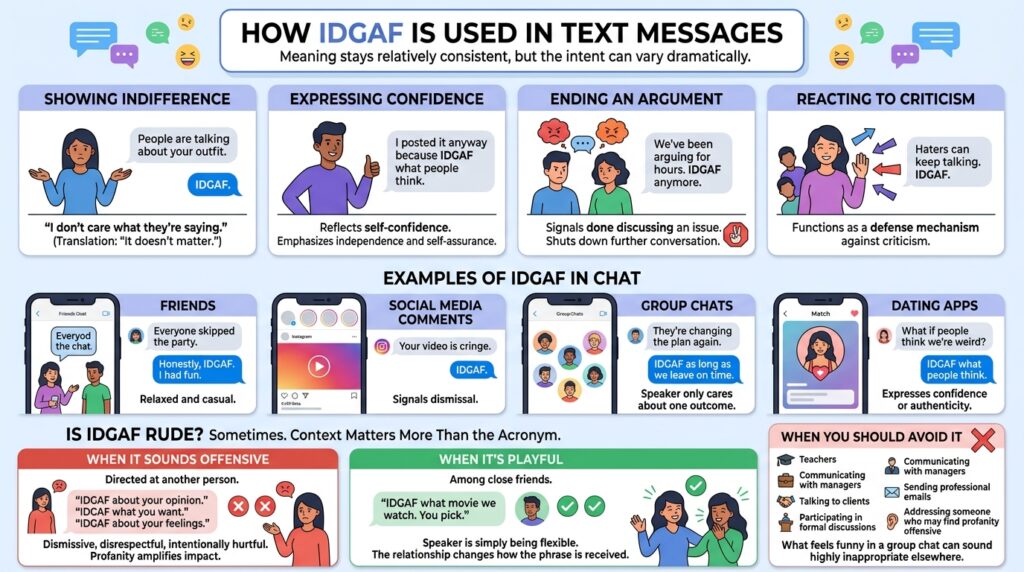
How IDGAF Is Used in Text Messages
The meaning stays relatively consistent, but the intent can vary dramatically.
Showing Indifference
One of the most common uses is simply showing that something doesn’t matter.
Example:
Friend: “People are talking about your outfit.”
Response: “IDGAF.”
Translation:
“I don’t care what they’re saying.”
Expressing Confidence
Sometimes IDGAF reflects self-confidence rather than negativity.
Example:
“I posted it anyway because IDGAF what people think.”
Here, the speaker is emphasizing independence and self-assurance.
Ending an Argument
The acronym can also signal that someone is done discussing an issue.
Example:
“We’ve been arguing for hours. IDGAF anymore.”
This usage often shuts down further conversation.
Reacting to Criticism
Many people use IDGAF when responding to negative comments.
Example:
“Haters can keep talking. IDGAF.”
In this context, it functions as a defense mechanism against criticism.
Examples of IDGAF in Chat
Seeing real examples makes the meaning easier to understand.
Friends
Friend 1: “Everyone skipped the party.”
Friend 2: “Honestly, IDGAF. I had fun.”
The tone here is relaxed and casual.
Social Media Comments
Comment: “Your video is cringe.”
Reply: “IDGAF.”
This response signals dismissal.
Group Chats
Person A: “They’re changing the plan again.”
Person B: “IDGAF as long as we leave on time.”
Here, the speaker only cares about one outcome.
Dating Apps
Match: “What if people think we’re weird?”
Reply: “IDGAF what people think.”
In dating conversations, the phrase often expresses confidence or authenticity.
Is IDGAF Rude?
This is one of the most common questions people ask.
The answer is: sometimes.
Context matters more than the acronym itself.
When It Sounds Offensive
IDGAF can sound rude when directed at another person.
Examples:
- “IDGAF about your opinion.”
- “IDGAF what you want.”
- “IDGAF about your feelings.”
These statements can come across as dismissive, disrespectful, or intentionally hurtful.
The profanity amplifies the impact.
When It’s Playful
Among close friends, the phrase may not feel offensive at all.
Example:
“IDGAF what movie we watch. You pick.”
Here, the speaker is simply being flexible.
The relationship between the people involved changes how the phrase is received.
When You Should Avoid It
Avoid using IDGAF when:
- Speaking to teachers
- Communicating with managers
- Talking to clients
- Sending professional emails
- Participating in formal discussions
- Addressing someone who may find profanity offensive
What feels funny in a group chat can sound highly inappropriate elsewhere.
IDGAF vs Other Common Chat Slang
Many people confuse IDGAF with similar abbreviations.
There are important differences.
IDC Meaning
IDC stands for:
“I Don’t Care.”
Comparison:
- IDC = Mild indifference
- IDGAF = Strong indifference
Example:
- “IDC where we eat.”
- “IDGAF where we eat.”
The second statement sounds much stronger.
IDAF Meaning
IDAF typically means:
“I Don’t Give A Flip”
or
“I Don’t Give A F*.”**
Usage varies depending on the community.
It’s generally viewed as a shortened version of IDGAF.
IGAF Meaning
IGAF stands for:
“I Give A F*.”**
This is essentially the opposite meaning.
Example:
- “People think I don’t care, but IGAF.”
The speaker is emphasizing concern rather than indifference.
DGAF Meaning
DGAF means:
“Don’t Give A F*.”**
The meaning is almost identical to IDGAF.
Examples:
- “I DGAF.”
- “I IDGAF.”
Both communicate the same basic message.
How to Respond When Someone Says IDGAF
The best response depends on the situation.
In Casual Conversations
If the tone is friendly, keep things relaxed.
Examples:
- “Fair enough.”
- “Got it.”
- “No worries.”
- “Makes sense.”
No need to escalate the conversation.
In Arguments
When someone says IDGAF during a disagreement, they’re often signaling emotional exhaustion or frustration.
Possible responses:
- “Okay, let’s leave it there.”
- “I understand your position.”
- “We can talk later.”
Pushing harder usually won’t improve the discussion.
On Social Media
If IDGAF appears in comments, it may simply be a reaction message.
Depending on the context, you can:
- Ignore it
- Clarify your point
- Respond respectfully
- End the conversation
Remember that many social media exchanges are driven by emotion rather than logic.
Can You Use IDGAF at Work or School?
Generally speaking, it’s not a good idea.
Professional Settings
Most workplaces consider IDGAF inappropriate because:
- It contains profanity
- It may appear disrespectful
- It can damage professional relationships
- It creates a negative impression
Instead of saying IDGAF, consider:
- “I don’t have a strong preference.”
- “I’m okay with either option.”
- “I’m not concerned about that issue.”
These alternatives communicate the same idea without sounding aggressive.
Academic Settings
Using IDGAF in school assignments, presentations, or communications with instructors is usually inappropriate.
Teachers may view it as:
- Unprofessional
- Disrespectful
- Immature
Formal language is generally the safer choice.
Safer Alternatives
If you want to express indifference without profanity, try:
- IDC
- No preference
- Doesn’t matter to me
- I’m okay either way
- Your choice
- I don’t mind
These phrases work in a wider range of situations.
Frequently Asked Questions About IDGAF
What does IDGAF mean?
IDGAF means “I Don’t Give A F***.” It is an internet slang acronym used to express strong indifference, dismissal, confidence, or emotional detachment.
Is IDGAF offensive?
It can be. Because the phrase contains profanity, some people view it as rude or disrespectful, especially in formal settings.
Is IDGAF slang?
Yes. IDGAF is a widely recognized piece of internet slang commonly used in texting, social media, online chat, memes, and digital communication.
What is the opposite of IDGAF?
The most common opposite is IGAF, which means “I Give A F***.” It indicates that someone cares deeply about a topic or outcome.
Can adults use IDGAF?
Absolutely. While younger users frequently use the acronym, adults also use it in casual conversations, online discussions, and social media posts. The key consideration is whether the setting is appropriate.
Final Takeaway
The IDGAF meaning in chat is simple on the surface but nuanced in practice.
It stands for “I Don’t Give A F*”** and is used to communicate strong indifference, emotional detachment, confidence, frustration, or dismissal. You’ll commonly encounter it in text messages, social media comments, group chats, TikTok discussions, Instagram captions, Snapchat messages, and other forms of online communication.
The phrase isn’t always rude, but it carries profanity and a blunt tone. That’s why context matters so much.
If you’re chatting with friends, IDGAF may sound casual or humorous. In professional, academic, or sensitive conversations, it can easily come across as disrespectful.
When in doubt, choose a softer alternative like IDC, “I don’t mind,” or “no preference.” You’ll communicate the same idea without risking misunderstandings.
Understanding internet slang isn’t just about decoding words. It’s about understanding tone, intent, and the culture behind modern communication.