
You’re texting a friend, you ask a simple question, and back comes… two letters. DC. No context, no emoji, nothing. So you sit there staring at your phone thinking, wait, what does that even mean? Did I say something wrong? Are they mad?
Honestly, most of the time it’s nothing that dramatic. DC meaning in chat is one of those tiny abbreviations that carries a surprising amount of weight in modern texting culture, and once you get it, you’ll start noticing it everywhere — group chats, gaming lobbies, even work Slack messages. This guide breaks down every version of DC you’ll actually run into, how tone changes its meaning, and how you should reply when it lands in your inbox.
What Does DC Mean in Text?
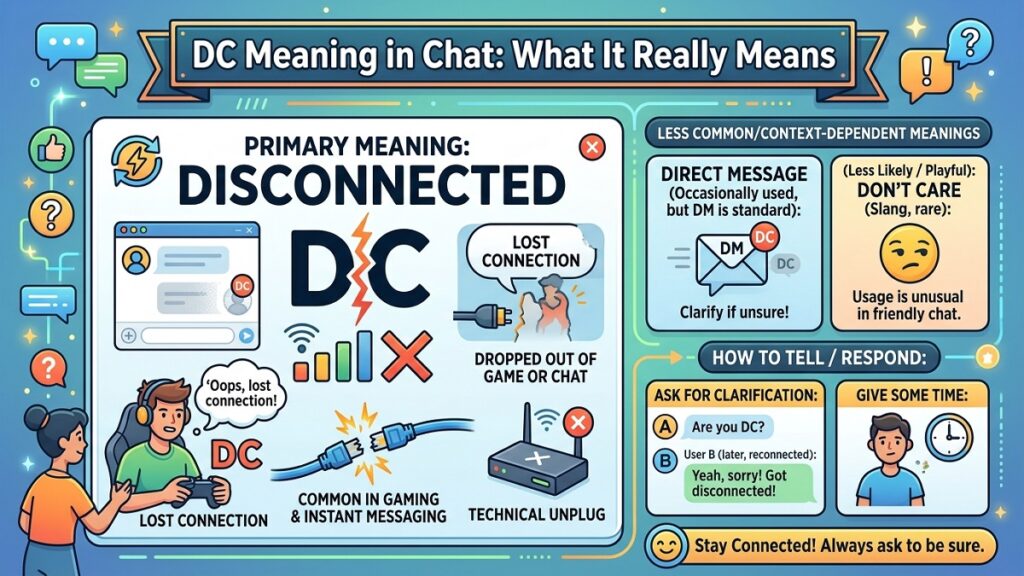
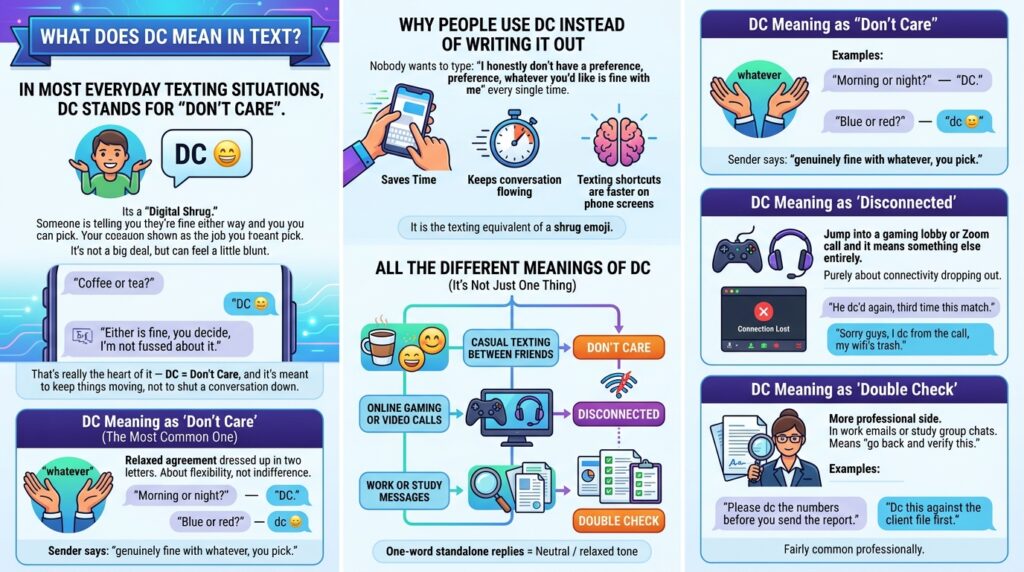
In most everyday texting situations, DC stands for “Don’t Care.”
It’s the digital shrug. Someone’s telling you they’re fine either way and you can just pick whatever works. It’s not usually a big deal, even though it can feel a little blunt if you’re not used to seeing it.
Example:
“Coffee or tea?” “DC 😄”
Translation: “Either is fine, you decide, I’m not fussed about it.”
That’s really the heart of it — DC = Don’t Care, and it’s meant to keep things moving, not to shut a conversation down.
Why People Use DC Instead of Writing It Out
Nobody wants to type “I honestly don’t have a preference, whatever you’d like is fine with me” every single time. That takes forever, and texting these days is all about speed. So instead people just fire off DC and move on with their day.
It’s kind of the texting equivalent of a shrug emoji, if you think about it. Texting abbreviations like this exist because typing full sentences on a phone screen for every single reply gets old fast, and honestly, most of us are multitasking while we chat anyway. So the shortcut saves time and keeps the conversation flowing without slowing things down.
All the Different Meanings of DC (It’s Not Just One Thing)
Here’s where a lot of people get tripped up — DC isn’t a one-meaning word. Depending on where you see it, it can mean something totally different.
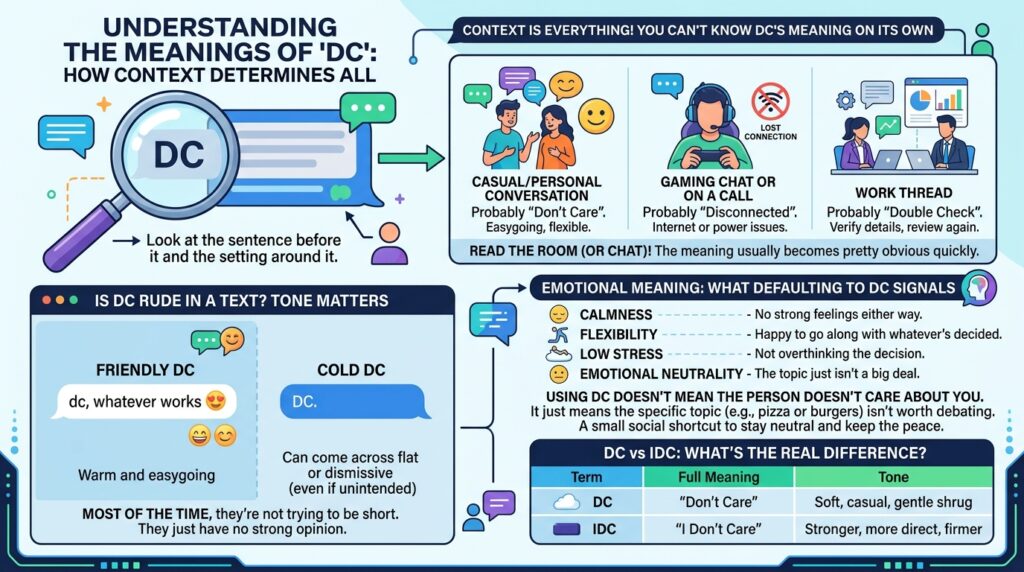
| Situation | Likely Meaning |
|---|---|
| Casual texting between friends | Don’t Care |
| Online gaming or video calls | Disconnected |
| Work or study messages | Double Check |
| One-word standalone replies | Neutral / relaxed tone |
Let’s go through each one properly.
DC Meaning as “Don’t Care” (The Most Common One)
This is the version you’ll see most in day-to-day chats, and it’s basically just relaxed agreement dressed up in two letters.
Examples:
- “Morning or night?” — “DC.”
- “Blue or red?” — “dc 😊”
Both of these are the sender saying, “genuinely fine with whatever, you pick.” DC (Don’t Care) in this context is really just about flexibility, not indifference toward the person.
DC Meaning as “Disconnected”
Jump into a gaming lobby or a Zoom call and DC suddenly means something else entirely.
Examples:
- “He dc’d again, third time this match.”
- “Sorry guys, I dc from the call, my wifi’s trash.”
Here, online gaming and video calls are the environment that flips the meaning — it’s got nothing to do with emotions, it’s purely about connectivity dropping out.
DC Meaning as “Double Check”
Then there’s the more professional side. In work emails or study group chats, DC can mean “go back and verify this.”
Examples:
- “Please dc the numbers before you send the report.”
- “Dc this against the client file first.”
This meaning shows up less often in casual texting but it’s fairly common once you’re in a workplace setting, so worth knowing if you’re job hunting or new to office group chats.
How Context Changes DC’s Meaning
The single biggest thing you need to walk away with here is this: context determines which meaning of DC applies. You genuinely cannot read DC on its own and know for sure what it means — you need the sentence before it and the setting around it.
Ask yourself:
- Is this a casual, personal conversation? Probably “Don’t Care.”
- Am I in a gaming chat or on a call? Probably “Disconnected.”
- Is this a work thread? Probably “Double Check.”
Read the room (or the chat), basically, and the meaning usually becomes pretty obvious pretty quick.
Is DC Rude in a Text?
Short answer: not really, no. But tone plays a bigger role than people realize.
- Friendly DC: “dc, whatever works 😍” — reads warm and easygoing.
- Cold DC: “DC.” — sent alone, in all caps, with a period — can come across a little flat or dismissive, even if that’s not the intent.
Most of the time though, when someone sends DC, they’re not trying to be short with you. They just genuinely don’t have a strong opinion on the topic at hand, and that’s fine.
DC and Emotional Meaning
There’s actually a bit of psychology behind why people default to DC instead of a longer reply. It usually signals:
- Calmness — no strong feelings either way.
- Flexibility — happy to go along with whatever’s decided.
- Low stress — not overthinking the decision.
- Emotional neutrality — the topic just isn’t a big deal to them right now.
Using DC doesn’t mean the person doesn’t care about you. It just means the specific topic — pizza or burgers, this time or that time — isn’t worth debating. It’s a small social shortcut that helps people avoid arguments, stay neutral, and keep the peace in day-to-day conversation.
DC vs IDC: What’s the Real Difference?
People mix these two up constantly, but they’re not quite the same in tone, even if the underlying meaning is close.
| Term | Full Meaning | Tone |
|---|---|---|
| DC | Don’t Care | Soft, casual |
| IDC | I Don’t Care | Stronger, more direct |
Basically, DC sounds relaxed, almost passive, like a gentle shrug. IDC can sound more firm, sometimes even a little dismissive depending on how it’s used. So if you’re trying to sound extra chill, DC is usually the safer pick.
DC Across Different Platforms
DC shows up basically everywhere now — it’s not tied to one specific app.
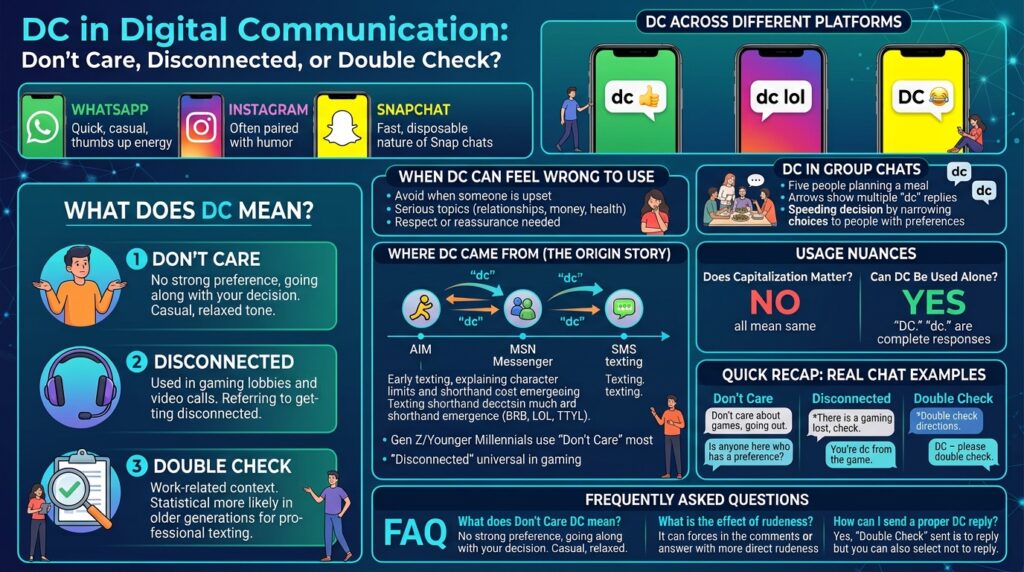
- WhatsApp: “dc 👍” — quick, casual, thumbs up energy.
- Instagram: “dc lol” — often paired with humor.
- Snapchat: “DC 😂” — fits the fast, disposable nature of Snap chats.
It fits comfortably into any casual messaging platform because, well, that’s kind of the point of the abbreviation in the first place.
DC in Group Chats
In a group setting, DC becomes a decision-making tool almost as much as an expression of preference. When five people are arguing about where to eat and three of them just reply “dc,” it genuinely speeds things up — it narrows the decision down to the people who actually do have a preference, which honestly makes group planning way less painful.
When DC Can Feel Wrong to Use
That said, DC isn’t the right move in every situation. Avoid it when:
- Someone is upset or emotional about the topic.
- The conversation is serious (relationships, money, health, etc.).
- Respect or reassurance is what’s actually needed, not a quick answer.
In those moments, a full sentence goes a long way further than two letters ever could.
Where DC Came From (The Origin Story Most Guides Skip)
Here’s something a lot of articles on this topic gloss over — where did DC actually come from, and who uses it most?
Abbreviated texting slang like DC has roots going back to early SMS and instant messaging platforms (think AIM, MSN Messenger, early flip-phone texting) where character limits and slow typing speeds pushed people toward shorthand. Terms like BRB, LOL, and TTYL all emerged from that same era, and DC followed a similar path once character-count anxiety and typing speed became a real texting habit.
In terms of who uses it — Gen Z and younger Millennials tend to use DC (as “don’t care”) the most in casual texting, largely because they grew up chatting primarily through apps rather than voice calls, so shorthand became second nature early on. Older generations, when they do use “DC,” are statistically more likely to mean it in the “double check” work-related sense, simply because their texting habits developed later in life, often inside professional contexts first.
Regionally, the term is pretty universal across English-speaking digital spaces, though the “Disconnected” meaning skews heavily toward gaming communities regardless of age or location — it’s a functional term tied to the activity, not really a generational slang marker at all.
Does Capitalization Matter?
No, not at all. DC, dc, and Dc all mean exactly the same thing. Texting culture doesn’t really care about capitalization rules the way formal writing does, so don’t overthink it if you see it written differently in different messages.
Can DC Be Used Alone?
Yes, absolutely. It’s actually one of the most common standalone replies out there.
“DC.” “dc.”
Both are complete, valid responses on their own — no extra words needed.
Quick Recap: Real Chat Examples
- “Should we leave now?” — “DC.” (Don’t care, up to you)
- “What movie tonight?” — “dc 😄” (Either one’s fine)
- “I dc from the game mid-match, sorry.” (Disconnected, not indifference)
Digital communication → relies heavily on → shared understanding of abbreviations like DC, and once you’ve got the pattern down, reading these texts becomes second nature pretty fast.
Final Thoughts
At the end of the day, DC in chat almost always boils down to one simple idea: flexibility. Whether it means “Don’t Care” in a casual text, “Disconnected” mid-game, or “Double Check” in a work thread, the abbreviation exists for one reason — speed. Texting culture and the constant push for brevity basically created DC and abbreviations just like it, and honestly, it’s not going anywhere anytime soon.
So next time DC pops up on your screen, don’t panic. Look at the context, notice the tone, and you’ll know exactly what’s being said.
Frequently Asked Questions
What does DC mean in a text message?
Most commonly, DC means “Don’t Care,” used when someone doesn’t have a strong preference and is fine going along with whatever you decide. It’s casual, relaxed, and usually not meant to sound dismissive at all.
Can DC mean disconnected?
Yes. In gaming lobbies and video calls, DC almost always refers to someone getting disconnected from the session, not indifference. Context here matters a lot — the setting basically tells you which meaning applies.
Is DC rude to send?
Generally, no. DC is considered pretty neutral in tone. It can come across as a little cold if sent completely alone without any warmth, but most people don’t mean it that way at all.
Should I reply back after someone sends DC?
Yes, ideally. Since DC usually hands the decision back to you, it’s polite to just go ahead and pick something rather than leaving the conversation hanging there awkwardly.