


Grasping the true tonearm meaning requires looking past the simple appearance of a moving lever on a record player. At its core, this component acts as the bridge between the physical grooves of a vinyl record and the electrical signals that eventually become the music you hear.
While it might look like a static piece of metal, it is a precision-engineered instrument designed to maintain a delicate balance while navigating the microscopic landscape of a record’s surface. Understanding how this piece of hardware functions will change how you view your entire audio setup and help you appreciate the complex physics involved in every spin of the platter.
The Fundamental Anatomy of a Tonearm
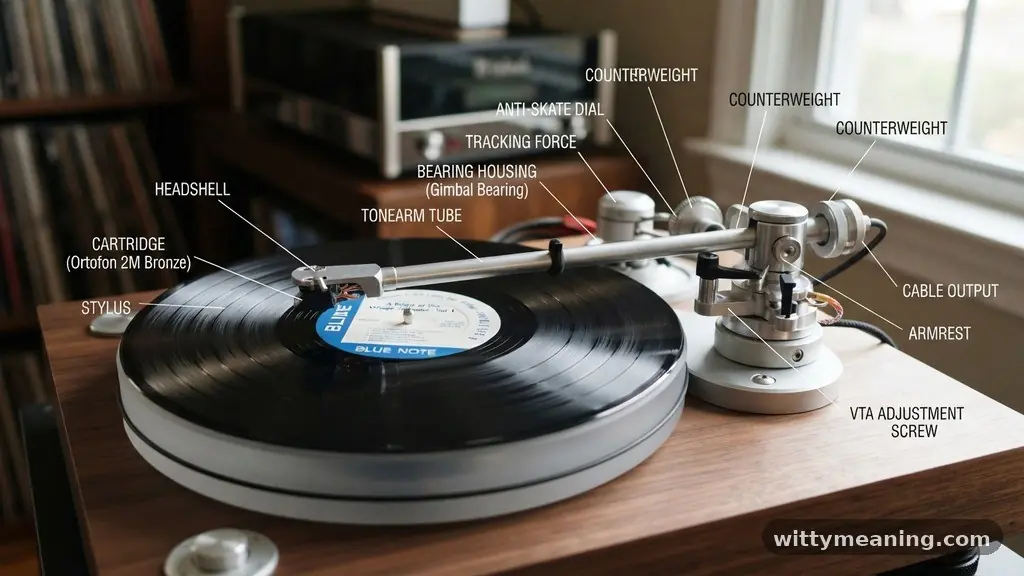
When you examine the tonearm meaning in a technical sense, you are essentially looking at a mechanical suspension system. Its primary job is to hold the cartridge and stylus at the correct position over the record, allowing the needle to trace the groove modulation with minimal friction. The structure begins at the pivot point, which serves as the anchor for the entire assembly, allowing it to move both horizontally across the record and vertically to handle warps or uneven surfaces.
The tonearm tube, which is the long, slender body of the arm, must be rigid enough to resist bending yet light enough to respond to the slightest groove deviations. At the front end, you find the headshell, which provides a mounting platform for the cartridge. This connection is critical, as it defines the spatial relationship between the stylus and the record.
The counterweight at the rear of the arm is arguably the most important adjustment point, as it dictates the vertical tracking force applied to the stylus. Balancing this weight correctly ensures that the needle stays in the groove without causing excessive wear to your precious vinyl collection.
Understanding Tonearm Geometry and Alignment
The geometry of the arm is not arbitrary; it is governed by strict mathematical principles designed to minimize distortion. Because a record is cut by a lathe moving in a straight line toward the center, but a pivoted tonearm moves in an arc, the stylus will naturally deviate from a perfect tangent to the groove.
This phenomenon is known as tracking error. To combat this, engineers design arms with specific offsets and overhang distances.
Proper tonearm alignment ensures that the stylus maintains the best possible contact angle throughout the entire playback process. If the alignment is off, the stylus will favor one side of the groove wall, leading to uneven channel balance and increased harmonic distortion.
Many enthusiasts use alignment protractors to fine-tune the position of the cartridge within the headshell slots. By ensuring the stylus is perfectly aligned at two specific null points across the record surface, you can achieve significantly higher playback fidelity.
The Role of Bearing Systems in Playback
The movement of the arm depends entirely on the quality of its bearings. A gimbal bearing system is common in many consumer and mid-tier hi-fi components, offering stable movement across both horizontal and vertical axes. These bearings must be virtually frictionless; any resistance here will cause the arm to drag, which places uneven pressure on the stylus and degrades the sound quality.
High-end models often employ unipivot designs, where the arm rests on a single point, like a needle sitting in a cup. This design is favored for its simplicity and the reduction of potential bearing chatter, though it requires a steady hand to set up.
Regardless of the type, the goal is always the same: to allow the arm to follow the groove with zero resistance. If the arm feels stiff or “sticky” when you move it, your audio quality will suffer, and you risk damaging your records during playback.
Managing Tracking Force and Anti-Skate
Setting the correct vertical tracking force is the most frequent adjustment an owner will make. This force is the downward pressure exerted by the stylus tip into the groove. If the force is too light, the stylus will bounce or mistrack, causing harsh, distorted audio.
If it is too heavy, you risk scraping the delicate lacquer of the record and potentially bottoming out the cantilever. You can learn more about these mechanical interactions by visiting the Library of Congress archive on sound recording history for deeper context on early phonograph designs.
Anti-skate is the secondary adjustment that often confuses new listeners. As the record spins, the friction between the stylus and the groove creates an inward force that pulls the arm toward the center of the platter. This force causes the stylus to press harder against the inner groove wall than the outer one.
Anti-skate mechanisms, often using springs or hanging weights, apply a counteracting outward force to balance the pressure. Proper calibration here is vital for maintaining a centered soundstage and preventing premature wear on the inner wall of the record groove.
The Impact of Tonearm Mass and Resonance
Tonearm mass is a frequently overlooked factor that significantly influences the compatibility between the arm and your chosen cartridge. The effective mass of the assembly, combined with the compliance of the stylus cantilever, creates a resonant frequency. If this frequency falls within the audible range or too close to the low-frequency vibrations of the turntable motor, it can cause muddy bass or even audible feedback loops.
Low-mass arms are generally better suited for high-compliance cartridges, while high-mass arms pair better with stiff, low-compliance moving coil cartridges. Achieving a harmonious match between these components is the hallmark of a well-designed hi-fi system. If you notice your playback sounds “thick” or lacks detail in the low end, it is often a sign that your arm mass and cartridge compliance are mismatched, resulting in poor resonance control.
Comparing Common Tonearm Types
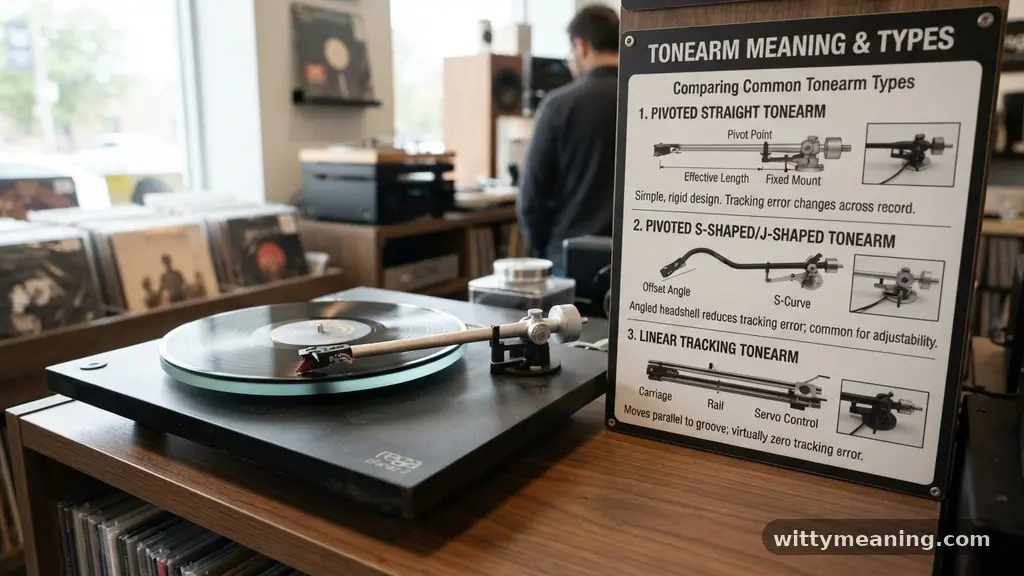
Different designs offer various performance characteristics, catering to different needs and budgets. The following table highlights the primary differences between common configurations found in modern and vintage players.
| Feature | Gimbal Bearing | Unipivot | Linear Tracking |
|---|---|---|---|
| Stability | High | Moderate | Very High |
| Maintenance | Low | Medium | High |
| Complexity | Moderate | Low | |
| Tracking Error | Minimal | Minimal | Near Zero |
Linear tracking arms are a unique category where the arm moves in a straight line across the record, effectively eliminating the tracking error associated with pivoted designs. While they offer superior geometric performance, they are mechanically complex and often difficult to repair. Most audiophiles stick with pivoted designs because they are easier to maintain and offer a more tactile, engaging experience when cueing up a side.
Essential Accessories for Tonearm Maintenance
To keep your setup performing at its peak, you need a few specialized tools. Regular maintenance is not just about cleanliness; it is about ensuring the mechanical tolerances remain within factory specifications. Most users will find the following items essential for daily operation:
- Digital stylus force gauge for precision tracking adjustments.
- Alignment protractor to verify the correct overhang and offset angle.
- Spirit level to ensure the entire turntable chassis is perfectly flat.
- Anti-static brush for removing dust from the stylus tip before playback.
- Headshell leads or wire kits for replacing oxidized signal connections.
Using a digital scale is far more accurate than relying on the dial on the counterweight alone. Over time, counterweight springs can lose their tension, making the manual markings unreliable. Investing in a simple digital gauge ensures that every record you play is treated with the exact tracking force recommended by the manufacturer.
The Influence of Materials on Sound Quality
The material used to construct the tonearm tube is a major point of debate among enthusiasts. Materials like carbon fiber, aluminum, and titanium all possess different stiffness-to-weight ratios and internal damping characteristics. A rigid, low-resonance material helps prevent the arm from absorbing energy from the cartridge, which would otherwise color the sound.
Carbon fiber is particularly popular because it is incredibly light and stiff, allowing the arm to remain neutral during playback. Some manufacturers use multi-layered wood or exotic alloys to achieve specific sonic signatures.
While these differences might seem subtle, they contribute to the overall clarity and transient response of the system. A well-damped arm will sound cleaner, with better separation between instruments, because it doesn’t introduce its own sympathetic vibrations into the signal chain.
Addressing Common Topical Gaps
A common question that often goes unanswered relates to the “tonearm lift” mechanism and its potential impact on audio. The lift is a hydraulic device that allows you to raise and lower the arm safely.
Some argue that because it is a mechanical attachment, it might interfere with the arm’s natural resonance. However, for most listeners, the convenience of a slow-lowering lift far outweighs the theoretical sonic benefit of removing it.
Another often overlooked aspect is the internal wiring. The signal from the cartridge travels through tiny, fragile wires hidden inside the tube. If these wires become damaged or oxidized, you will experience channel dropouts or persistent hum.
Replacing these wires is a delicate surgery, but it can revitalize an older, high-quality arm that seems to have lost its sparkle. Understanding that the arm is not just a tube, but a conduit for delicate electrical signals, is key to diagnosing mysterious audio issues.
Troubleshooting Performance Issues
If you find that your audio is skipping or failing to track correctly, start by checking the basics. Often, the issue is not the arm itself, but a build-up of dust on the stylus tip. A dirty stylus will skip over even the cleanest records because it cannot maintain proper contact with the groove.
If the stylus is clean, check your tracking force. It is possible that the counterweight has slipped over time due to vibrations or accidental bumps.
If the problem persists, look at the anti-skate setting. An improperly set anti-skate can pull the arm too hard in one direction, causing the stylus to jump out of the groove during loud passages. Finally, inspect the tonearm alignment.
If you have recently changed your cartridge, it is possible that the alignment is slightly off, causing the stylus to be stressed at certain points on the record. Taking the time to re-calibrate these variables usually solves the vast majority of tracking issues.
FAQ
What is the primary function of a tonearm?
The tonearm’s main role is to hold the cartridge and stylus at a precise, consistent angle over the vinyl record. It allows the stylus to trace the microscopic grooves of the record while applying the correct amount of downward pressure to ensure accurate signal extraction.
How do I know if my tracking force is correct?
You should consult the owner’s manual for your specific cartridge to find the recommended tracking force range. Use a digital stylus force gauge to verify the actual weight being applied to the record, as the markings on the counterweight dial can become inaccurate over time.
Does the material of the tonearm really matter?
Yes, the material affects the arm’s stiffness, weight, and resonance damping. These factors directly influence how the arm interacts with the cartridge, affecting the clarity, bass response, and overall tonal neutrality of your playback. A rigid, well-damped arm generally provides a cleaner audio signal.
Can a damaged tonearm be repaired?
Many issues, such as broken headshell leads or misaligned bearings, can be repaired by a professional or a skilled enthusiast. However, if the tonearm tube itself is bent or the internal geometry is permanently compromised, it is often more cost-effective to replace the entire assembly.
Conclusion
Understanding the tonearm meaning is essential for anyone interested in the nuance of analog audio. By viewing it as a precision mechanical instrument rather than just a simple lever, you gain the ability to troubleshoot, calibrate, and upgrade your system effectively. From the importance of proper alignment to the physics of tracking force and resonance, every adjustment you make has a direct impact on the music you hear.
Whether you are using a vintage turntable or a modern hi-fi component, taking the time to master your setup will pay off in years of superior listening experiences. If you have questions about your specific model or need advice on fine-tuning your current configuration, feel free to share your thoughts or reach out to local audio experts to continue the conversation.