


When people encounter the name Moneypenny, they often think of sharp suits, cold martinis, and the high-stakes world of British espionage. While the character is synonymous with the James Bond franchise, the actual Moneypenny meaning extends far beyond a simple job title.
She represents a unique intersection of office hierarchy, unrequited romantic tension, and the shifting social norms of the 20th century. By diving into the origins of this iconic figure, we gain a better understanding of how fictional characters reflect the changing attitudes toward women in the workplace and the broader evolution of the spy genre itself.
The Literary Origins Created by Ian Fleming
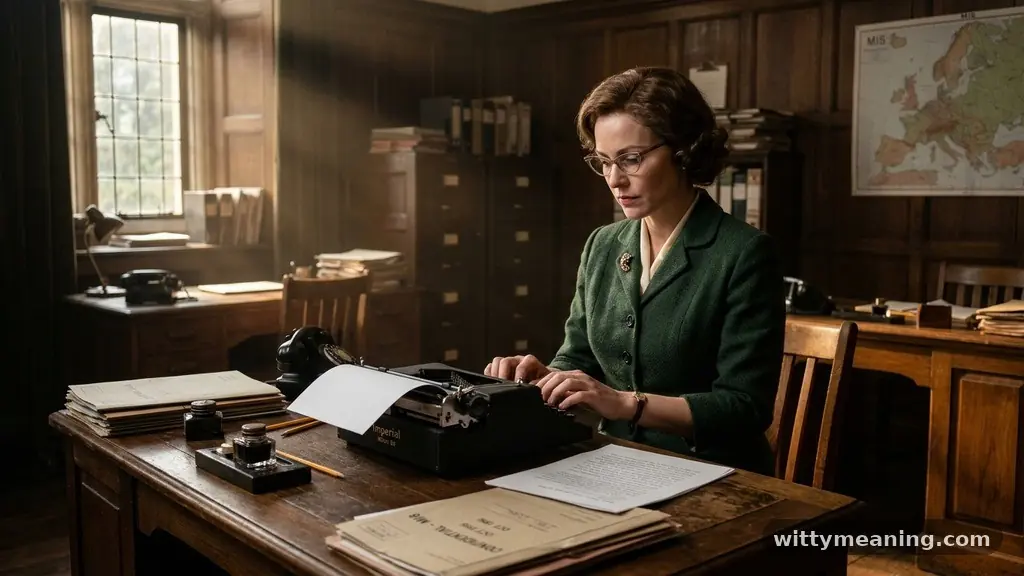
The character first appeared in the novels of Ian Fleming, the British author who gave life to 007. Fleming was a former intelligence officer who knew the inner workings of the Secret Intelligence Service, now commonly known as MI6.
When he introduced the secretary to M in the 1953 novel Casino Royale, he wasn’t just creating a background prop. He was establishing a specific dynamic that would define the office culture of his literary world.
Fleming chose the name carefully. In the mid-20th century, surnames often carried connotations of status or personality.
The name Moneypenny carries a rhythmic, slightly whimsical quality, yet it feels grounded in the stuffy, bureaucratic atmosphere of the British civil service. It suggests someone who handles the details, the logistics, and the “money” of the operation, even if her actual duties were far more complex than simple accounting.
The character served as a tether for Bond. In the novels, James Bond is often portrayed as a man operating on the fringes of morality and society. Moneypenny represented a stable, grounding force within the office.
She was the one constant in his professional life, providing a link between the cold, calculated directives of M and the human element of the agency. This duality—being an essential cog in the machine while remaining an outsider to the field work—is the core of her literary function.
Evolving Dynamics: From Secretary to Field Operative
Over the decades, the role of this character has shifted significantly. In the early films, the focus was primarily on her unrequited love for Bond and the lighthearted, often flirtatious banter that took place in M’s office. This dynamic was a staple of the cinematic experience, providing a brief moment of levity before the tension of a mission took over.
However, modern interpretations have stripped away the purely administrative constraints. In recent films, we see a shift toward a more capable, active participant in the narrative.
This evolution mirrors the real-world changes in gender roles in literature and film. No longer defined solely by her desk or her devotion to her boss, she has become a character with her own agency and professional expertise.
This transition hasn’t been without its critics, who argue that the original charm was tied to the specific “will-they-won’t-they” tension. Yet, for many audiences, the modern version offers a more satisfying narrative arc.
The character now possesses a backstory that informs her decisions, making her more than just a sounding board for the protagonist. She is a bridge between the old guard of the agency and the high-tech, fast-paced reality of modern intelligence gathering.
The Linguistic Symbolism of the Name
Fictional nomenclature plays a massive role in how we perceive characters. The name Moneypenny sounds distinctly British, perhaps slightly upper-middle-class, and carries a hint of Victorian formality. It contrasts sharply with the more aggressive or exotic names often found in espionage fiction.
There is a subtle irony in the name. While she is not a wealthy heiress, the name implies a preoccupation with value, currency, and the transactional nature of the intelligence business.
In the world of MI6, information is the only currency that matters, and she is the gatekeeper of that information. She manages the flow of secrets, ensuring that only the right people have access to the right data.
When we look at the character development through the lens of her name, we see a deliberate choice by Fleming to create a persona that feels both approachable and slightly distant. She is “Penny,” a nickname that suggests intimacy, but her surname reminds us of her professional standing.
This balance is crucial to the character’s longevity. It allows her to be both a colleague and a confidant, a professional and a friend, without ever crossing the line into total accessibility.
The Actress Legacy: Defining the Role

The history of the character is inextricably linked to the women who have portrayed her. Each actress brought a different flavor to the part, influencing the audience’s perception of the Moneypenny meaning for generations.
- Lois Maxwell: The original cinematic icon who defined the role for over two decades, establishing the flirtatious, witty banter with Connery and Moore.
- Samantha Bond: Stepped into the role during the Pierce Brosnan era, bringing a sharper, more modern edge to the character’s interactions with the office.
- Naomie Harris: Revolutionized the part in the Daniel Craig era by moving from the desk to the field, providing a more balanced partnership with Bond.
Lois Maxwell’s portrayal set the bar. She was the quintessential secretary who knew more than she let on.
She was the keeper of the secrets, the one who knew exactly when Bond was lying or when he was in trouble. Her performance was a masterclass in subtlety, using only a few lines of dialogue to convey a lifetime of unspoken longing and professional respect.
When Samantha Bond took over, the character became more assertive. The office environment in the 1990s was changing, and the films reflected that.
She was no longer just waiting for Bond to return; she was actively managing the chaotic reality of post-Cold War espionage. This shift paved the way for the more radical reinvention we saw with Naomie Harris.
Gender Roles in 20th Century Fiction
The character has often been cited as a prime example of the “Bond girl” trope, yet she stands apart from the typical romantic interests who appear and disappear within a single film. While she is certainly a fixture in the franchise, her role is more akin to a colleague than a conquest.
Historically, her presence was used to reinforce the traditional gender roles of the 1950s and 60s. The office was a place of order, dominated by the masculine figure of M and the chaotic energy of Bond.
She was the tempering influence, the “softer” presence that made the agency feel human. However, this interpretation ignores the power she actually held.
By controlling the access to the head of the agency, she held a form of gatekeeping power that was rarely acknowledged by the male characters. She knew who was calling, who was waiting, and what was urgent.
In many ways, she was the true administrator of the office. Analyzing her through this lens reveals a character who was far more essential to the function of MI6 than the casual viewer might assume.
Cinematic Tropes and the Office Dynamic
The scenes in M’s office are some of the most recognizable in cinema. They serve a vital structural purpose: they provide exposition, set the stakes, and establish the relationship between the key players. The interaction between Bond and his secretary is a classic example of workplace banter that serves to humanize the protagonist.
This dynamic is a double entendre in itself. The flirtation is clearly performative, a game that both parties understand and enjoy.
It provides a release of tension before the film descends into the violence and danger of the field. Without these scenes, the film would be unrelentingly grim.
Many critics have noted that these scenes are where we see the most “human” version of James Bond. Outside of the office, he is a weapon; inside the office, he is a man who can be teased, challenged, and even occasionally corrected.
This is the true value of the character. She is the only person who can treat Bond as a peer rather than a superior or a subordinate, and that is a position of significant influence.
Table: Comparing the Eras of the Character
| Era | Focus | Key Trait |
|---|---|---|
| Classic (1960s-70s) | Unrequited Romance | Witty, flirtatious, office-bound |
| Transition (1990s) | Professional Competence | Sharp, modern, efficient |
| Modern (2010s-Present) | Field Partnership | Active, resilient, equal partner |
This table highlights how the character’s focus has shifted from a romanticized trope to a functional, active role within the intelligence community. Each era reflects the societal expectations of the time, moving from the secretary-as-ornament to the secretary-as-expert.
The Impact of Skyfall on Character Development

The 2012 film Skyfall marked a massive turning point. It provided an origin story for the character, revealing her past as a field agent who had a disastrous mission with Bond. This revelation fundamentally changed the Moneypenny meaning for a new generation.
She was no longer just the person who sat behind the desk; she was someone who had been in the trenches and had the scars to prove it. This backstory allowed for a deeper, more nuanced relationship between her and Bond. It acknowledged the danger of their profession and the shared trauma that comes with it.
This change was received with largely positive reviews from both fans and critics. It gave the character a sense of history and gravitas that was missing in earlier iterations. By grounding her in the reality of field work, the producers made her a much more compelling part of the overall narrative architecture of the franchise.
Topical Gaps: Addressing Common Misconceptions
Many readers ask if the character’s name has a deeper, secret meaning. While some have suggested that it refers to her salary or her status, there is no evidence to support this. The name is primarily a product of Fleming’s penchant for names that sound slightly eccentric yet distinctly British.
Another common gap is the confusion between the character’s role and the actual functions of an MI6 administrative assistant. It is important to remember that this is a work of fiction.
The Secret Intelligence Service (MI6) is a real organization, but it bears little resemblance to the glamorous, high-action version presented in the films. The character is a creation of genre fiction, intended to serve the needs of the story rather than to provide a realistic depiction of government bureaucracy.
Furthermore, people often confuse the character’s devotion to Bond with a lack of professional ambition. This is a misreading of the text.
Her dedication to her job and her loyalty to her colleagues are signs of her professionalism, not a lack of depth. She is a woman who thrives in a high-pressure environment, regardless of her title.
The Legacy of the Character in Popular Culture
The name has become a shorthand for any administrative assistant who is smarter than their boss. It has entered the cultural lexicon as a term for someone who is indispensable, witty, and slightly cynical about the chaos unfolding around them.
The influence of the character can be seen in countless other spy films and television shows. From the quirky sidekicks in sitcoms to the highly competent analysts in modern thrillers, the archetype of the “capable assistant” owes a debt to the way this character was written and performed over the decades.
She represents a standard of excellence in a support role. In a world where the heroes get all the glory, she reminds us that the success of any mission—fictional or otherwise—depends on the people who keep the gears turning in the background. Her legacy is one of competence, loyalty, and quiet strength.
FAQ Section
What is the primary role of Moneypenny?
The character serves as the secretary to M, the head of the British Secret Intelligence Service. Her primary function is to manage the office, handle sensitive information, and act as a liaison between M and the field agents, most notably James Bond, throughout the film franchise.
Why did Ian Fleming choose that specific name?
Fleming chose the name for its rhythmic, quintessentially British quality. It conveys a sense of formality and tradition while remaining slightly whimsical. It fits the atmosphere of the civil service while distinguishing the character from the more exotic or aggressive names assigned to other figures in his novels.
Is the character based on a real person?
While Fleming drew inspiration from various people he encountered during his time in intelligence, there is no single individual who served as the definitive template for the character. She is a composite creation, designed to ground the fantastical world of international espionage in a recognizable office reality.
How has the character changed over time?
The character has evolved from a primarily romantic, office-bound support figure in the 1960s to a more complex, active participant in the modern era. Recent films have given her a backstory as a former field agent, reflecting a shift toward greater agency and professional equality in modern storytelling.
Future Perspectives
As the franchise continues to evolve, the role of this character will undoubtedly shift again. We may see her take on even more responsibility or perhaps move into a leadership position within the agency. Whatever the future holds, the character will likely remain a pillar of the series, providing a human connection to the high-stakes world of espionage.
Her journey from the secretary’s desk to the heart of the action is a testament to the enduring power of well-written characters to adapt and thrive. By understanding the true Moneypenny meaning, we can better appreciate the depth and complexity that she brings to the table in every single film. If you have a favorite iteration of the character or want to discuss how her role might change in the next chapter of the series, feel free to join the conversation.