
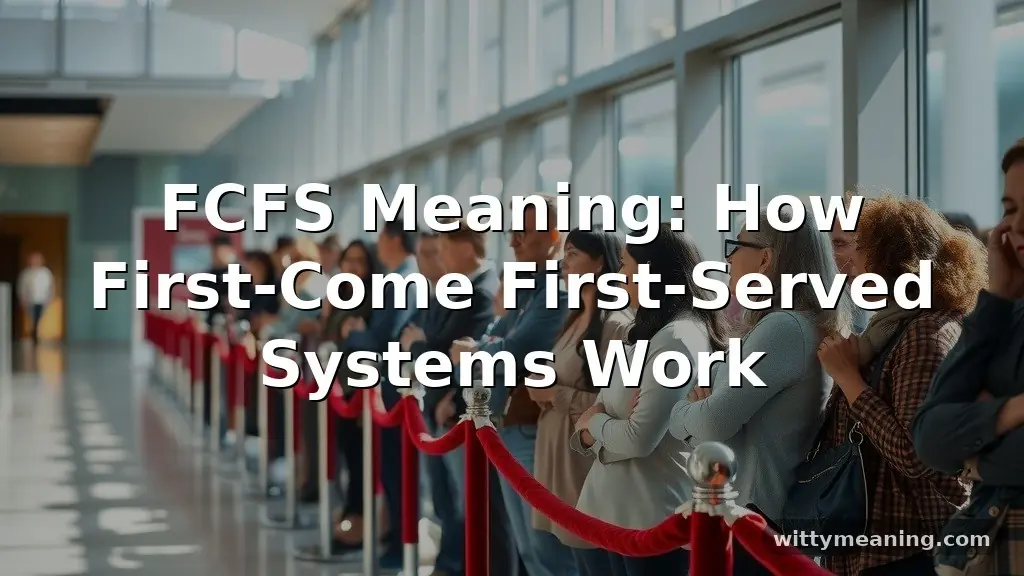

Understanding the fcfs meaning is essential for anyone trying to navigate simple queue systems or complex technical environments. At its core, the acronym stands for “first-come, first-served,” a principle that dictates that the person or request arriving first is the one served first.
While this sounds straightforward, it influences everything from how your computer handles background tasks to how you secure a limited item on a digital marketplace. Grasping this concept helps you anticipate wait times and understand the logic behind how resources are distributed in both physical and digital spaces.
The Basic Mechanics of First-Come First-Served Logic

The fundamental idea behind the first-come, first-served model is transactional fairness. In a linear world, the person at the front of the line should logically be the next one to receive service.
This prevents favoritism and ensures that there is a transparent, predictable method for handling demand. When you apply this to queue management, you are essentially establishing a sequence where the arrival time is the sole determinant of priority.
In most everyday scenarios, this system is intuitive. Think of a coffee shop or a grocery store checkout lane. You arrive, you stand in line, and you wait your turn.
The business doesn’t need to know who you are or what your specific needs are to process your request; they simply need to know that you arrived before the person behind you. This simplicity is why the model remains the gold standard for high-volume, low-complexity transactions. However, as systems become more complex, the limitations of this “blind” approach to service start to emerge.
Operating Systems and CPU Scheduling
When you shift the focus to operating systems, the fcfs meaning takes on a more technical dimension. In the world of computing, the processor—or CPU—needs to manage a variety of tasks, or processes, simultaneously.
A scheduling algorithm based on this principle treats every process as a job that must be completed in the exact order it was requested. The CPU acts as the server, and the incoming tasks act as the customers waiting in line.
This method is highly efficient in terms of overhead. Because the system doesn’t have to calculate priorities, determine urgency, or perform complex sorting, it can simply execute tasks as they arrive. This is often referred to as FIFO (First-In, First-Out).
While it is easy to implement, it can lead to performance bottlenecks if a long, resource-heavy task arrives before a series of quick, simple ones. The shorter tasks are forced to sit in the queue, waiting for the massive task to finish, which can lead to noticeable system lag.
The Convoy Effect in Computing
One of the most significant drawbacks of using this model in CPU scheduling is something known as the convoy effect. This happens when one process that requires a large amount of time to complete gets to the front of the line first.
Every other process, even those that would only take a millisecond to finish, gets trapped behind it. It is much like a slow-moving truck on a single-lane highway, causing a massive backup of faster cars that are unable to pass.
When this occurs, the overall system efficiency drops because the processor isn’t being utilized in a way that minimizes wait times for the majority of users. Developers often look for ways to mitigate this by implementing preemptive scheduling or multi-level queues.
Despite these modern advancements, understanding the base logic of how these systems function is a prerequisite for learning more advanced resource allocation strategies. For a deeper look at how modern OS kernels handle these processes, you can review the official Linux kernel documentation to see how real-world scheduling logic evolves.
Applications in Facebook Marketplace and Online Retail

If you spend any time browsing Facebook Marketplace or community resale groups, you have likely encountered the phrase “FCFS” used by sellers. In this context, the fcfs meaning is a way to manage buyer interest efficiently. Rather than dealing with a flood of messages and trying to decide who “deserves” the item, the seller establishes that the first person to commit to a pickup time or payment is the one who gets the deal.
This approach saves the seller significant time. It eliminates the need for back-and-forth negotiations about who reached out first or who is offering a better price. For the buyer, it creates a sense of urgency.
When you see an item listed as “FCFS,” you know that waiting to message the seller might cost you the purchase. It is a form of inventory management where the “resource” being allocated is a physical product, and the “queue” is the stream of incoming direct messages.
Logistics and Supply Chain Management
Beyond personal transactions, logistics professionals rely on this model to keep goods moving. In a warehouse, shipments often arrive at loading docks in a specific order.
To maintain a smooth flow, the facility must prioritize requests based on arrival times. If a truck arrives at 8:00 AM, it is typically processed before a truck that arrives at 9:00 AM, provided that the loading docks are occupied by the earlier arrival.
This ensures that the warehouse maintains a steady throughput. If managers were to constantly shuffle the order based on other factors, it would lead to chaos at the dock and potentially cause traffic jams in the shipping yard. While certain high-priority orders might occasionally jump the queue, the default process execution remains firmly rooted in the first-come, first-served methodology to keep the supply chain predictable.
Comparing Service Models
It is helpful to contrast this model with others to see why it is used in some situations and avoided in others.
| Model | Primary Logic | Best Use Case |
|---|---|---|
| FCFS / FIFO | Arrival order | High-volume, standard service |
| Priority-Based | Urgency/Importance | Emergency services, high-stakes tasks |
| Shortest Job First | Task duration | Optimizing system speed |
As shown in the table, the choice of model depends on what you are trying to optimize. If you are trying to optimize for fairness, the first-come approach is almost impossible to beat. If you are trying to optimize for speed or the survival of critical systems, you might need to move away from a simple queue toward something more nuanced.
Challenges in Implementing Fair Queuing
Key Considerations for Implementation involve deciding how to handle “arrival” in a digital space. In a physical store, the person standing at the counter is clearly the next in line.
In a digital environment, milliseconds matter. If two requests hit a server at almost the exact same time, the system must have a robust way to time-stamp these requests to determine which one technically arrived first.
This is why managing complex computing systems requires high-precision internal clocks. Without them, the system cannot guarantee that it is being truly fair. Furthermore, you have to account for network latency.
If one user has a faster internet connection than another, their request might reach the server first even if they technically clicked the button a split-second later. These technical nuances are what make system architecture so challenging.
Common Applications of FCFS in Healthcare and Services
In the medical field, scheduling appointments often follows a hybrid model. While urgent care clinics might operate on a triage basis (where the sickest patient goes first), many general practice clinics or walk-in service centers use a first-come, first-served system for daily slots. This provides a level of certainty for patients who need to be seen but don’t have a life-threatening emergency.
Beyond event ticketing or walk-in clinics, this logic is used in administrative workflows. For example, when a government office processes permit applications, they often handle them in the order they are received.
This prevents accusations of bias and ensures that every citizen is treated with the same level of bureaucratic consistency. It is a way to ensure that the system is not only fair but also seen to be fair by the public.
The Role of Fairness in Resource Allocation
When discussing resource allocation, we must differentiate between efficiency and equity. A system that is perfectly efficient might ignore the needs of individuals, while a system that is perfectly equitable might be slow.
FCFS occupies a middle ground. It is highly equitable because it treats everyone the same, but it is not always efficient because it doesn’t account for the nature of the request itself.
Consider a bank teller. If the person at the front of the line needs a simple balance check, it takes ten seconds. If the person behind them needs to initiate a complex international wire transfer, that takes ten minutes.
If the bank strictly follows the first-come rule, the person with the wire transfer must wait, which is fair. However, if the bank allowed the person with the quick balance check to jump ahead, the total average wait time for everyone in the lobby would drop. This trade-off is the central struggle of all queuing theory.
Addressing Topical Gaps and Misconceptions
A common misconception is that “first-come, first-served” is always the best way to handle a queue. Many people assume that because it is fair, it must be the most efficient. This is rarely the case in high-performance environments.
Another gap in understanding is that FCFS is only for physical lines. In reality, it is a digital backbone. Every time you send a packet of data across the internet, you are relying on routers that are likely using some form of queue management to ensure your data arrives in the correct order.
Furthermore, people often confuse FCFS with “first-come, first-paid.” While often used interchangeably in marketplaces, the distinction matters.
In a business context, “first-come” might just mean the first person to express interest, whereas “first-paid” is the definitive point of transaction. Understanding these nuances prevents frustration when you are trying to secure a limited-time offer or a scarce resource online.
FAQ Section
What does FCFS mean in a professional setting?
In a professional or business environment, it means that requests, orders, or tasks are handled in the exact order they were received. It is a standard method for maintaining transparency and ensuring that no single client or task is unfairly prioritized over others.
Is FCFS the same as FIFO?
Yes, they are essentially the same concept. FCFS is typically used when discussing people or service-oriented queues, while FIFO (First-In, First-Out) is the technical term more commonly used in computer science, inventory management, and logistics to describe data or physical goods movement.
Why do businesses use FCFS for limited items?
Businesses use this method to avoid the administrative burden of selecting winners or dealing with complex priority systems. It provides a clear, objective rule that prevents disputes among customers and simplifies the sales process by rewarding the fastest responders.
Can FCFS be unfair to some users?
It can be inefficient if a long, slow request blocks several fast, simple requests. While it is fair in terms of arrival time, it does not account for the “cost” or duration of the task, which can lead to longer overall wait times for the entire group.
Conclusion
Grasping the fcfs meaning is more than just knowing what an acronym stands for; it is about understanding the underlying logic that powers our digital and physical worlds. From the way your operating system manages background processes to how you secure a purchase on a marketplace, this principle dictates the flow of resources and information. By recognizing when this model is being used, you can better predict wait times and understand the rules of engagement in any queue-based system.
Whether you are optimizing a technical workflow or simply trying to get to the front of a digital line, keeping these fundamentals in mind will serve you well. If you have questions about how these systems apply to your specific projects, feel free to share your thoughts or reach out for more detailed insights.