
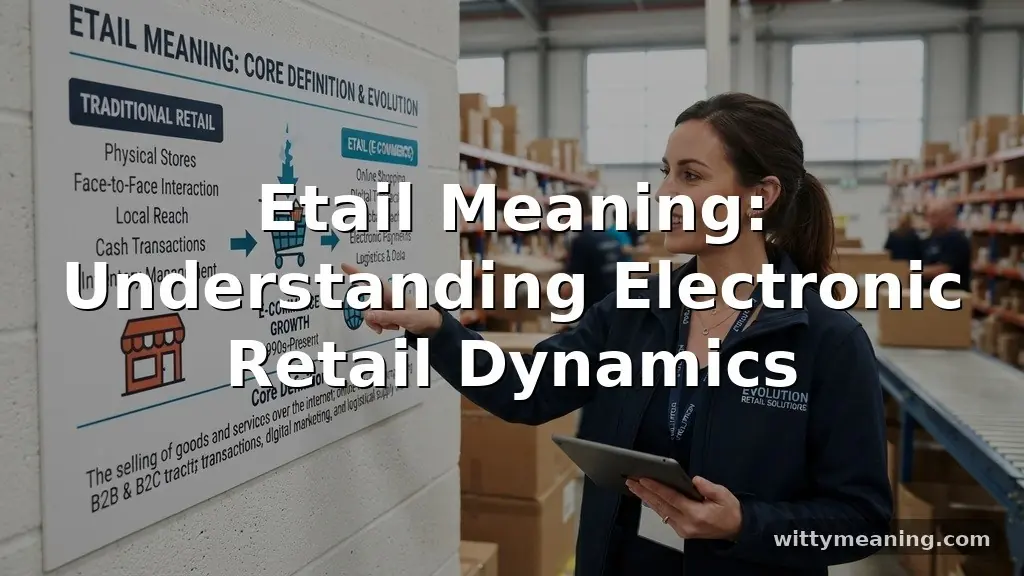

When you strip away the buzzwords, the etail meaning is quite straightforward: it is a contraction of electronic retail, referring to the process of selling goods or services directly to consumers through digital channels. While many people use the term interchangeably with ecommerce, it specifically emphasizes the retail aspect—the movement of products from a digital storefront to the end user’s doorstep.
Grasping this distinction helps business owners and consumers alike understand how modern marketplaces function. By looking at the core infrastructure, logistics, and data strategies behind these transactions, you gain a clearer picture of why your online shopping habits look the way they do today.
The Core Definition and Evolution of Etail

At its heart, the etail meaning centers on the transition of traditional retail activities into a purely digital environment. Unlike broader ecommerce, which can encompass B2B transactions, wholesale exchanges, and complex supply chain interactions, etail focuses on the direct-to-consumer relationship.
It is the evolution of the catalog shopping model, supercharged by the internet and sophisticated software. Every time you browse a website, add an item to a cart, and complete a purchase, you are participating in an etail operation.
The shift toward this model began with simple web pages but has matured into a complex ecosystem. Today, it involves more than just a website; it includes mobile applications, social media storefronts, and integrated marketplaces.
This evolution has moved the power balance toward the consumer, who now demands speed, transparency, and personalization. Understanding that etail is fundamentally about the customer-facing side of digital business allows companies to focus on the elements that actually drive revenue: site performance, product presentation, and trust.
Core Components of Etail Operations
Successful digital retail requires a robust foundation that spans far beyond a pretty user interface. The backend of these operations must be airtight to ensure that when a customer clicks “buy,” the entire machinery of the business springs into action. This includes everything from inventory management systems that track stock in real-time to the digital storefront itself, which acts as the digital equivalent of a physical shop window.
The integration of these systems is what separates thriving brands from those that struggle with technical debt. When inventory management is synced with the website, you avoid the dreaded “out-of-stock” notification after a transaction has already occurred. This level of synchronization is essential for maintaining consumer trust.
Furthermore, the ability to manage returns, handle customer inquiries, and update product information globally is a hallmark of a mature etail strategy. Without these core components, the front-end experience quickly collapses under the weight of operational inefficiencies.
Payment Processing and Financial Security
The financial backbone of any electronic retail setup is the payment gateway, a service that authorizes payments for online retailers. This component must be both secure and frictionless to keep conversion rates high.
Modern shoppers expect a variety of payment options, including credit cards, digital wallets, and “buy now, pay later” services. Each of these requires a secure handshake between the customer’s device, the retailer’s site, and the financial institution.
Security remains the primary hurdle in this space. Retailers must comply with global standards like PCI-DSS to ensure that sensitive data remains encrypted during transit. The goal is to make the payment process so invisible that the customer doesn’t even have to think about the security measures happening in the background.
If a checkout page is cluttered or requires too many steps, the likelihood of a sale drops significantly. Providing a clean, fast, and secure payment experience is a non-negotiable requirement for anyone serious about digital retail.
Logistics and the Last Mile Delivery Challenges
Logistics and the last mile delivery represent the most tangible part of the etail meaning. Once the transaction is complete, the digital promise must be fulfilled in the physical world.
This involves coordinating with couriers, managing shipping costs, and ensuring that the package arrives on time. The “last mile” is notoriously the most expensive and complex stage of the supply chain management process, as it involves the final journey from a local distribution hub to the customer’s front door.
Many retailers are now experimenting with hybrid models to offset these costs and improve speed. For example, offering pick up in-store (BOPIS) options allows companies to leverage their physical locations as mini-warehouses. This not only saves on shipping fees but also drives foot traffic into the store, where customers might make additional impulse purchases.
Mastering these logistics is vital because, in the eyes of the consumer, the quality of the delivery experience is just as important as the quality of the product itself. If the item arrives damaged or late, the brand’s reputation suffers regardless of how good the website was.
The Role of Data-Driven Customer Engagement
In the modern digital economy, data is the currency that fuels growth. Retailers are no longer just selling products; they are curating experiences based on user behavior.
By analyzing metrics like bounce rates and average order value, companies can identify exactly where their sales funnel is leaking. This data-driven customer engagement allows for hyper-personalized marketing, where shoppers see recommendations based on their past browsing history rather than generic advertisements.
Machine learning plays a massive role in this optimization process. Algorithms can predict which products a user is likely to buy, determine the best time to send an email promotion, and even adjust pricing dynamically based on demand.
This level of sophistication means that a small business can compete with industry giants by focusing on niche segments and high-value customer interactions. The key is not just to collect data, but to act on it in ways that provide genuine value to the user, making them feel understood rather than just targeted.
Conversion Rate Optimization and User Experience

Conversion rate optimization is the systematic process of increasing the percentage of visitors who take a desired action on your site. In the context of etail, this usually means completing a purchase, though it can also involve signing up for a newsletter or creating an account.
The user experience is the primary lever in this process. A site that is difficult to navigate, slow to load, or confusing to look at will almost always result in a high bounce rate.
To improve these metrics, retailers often conduct A/B testing on their landing pages, checkout flows, and product descriptions. Small changes, such as moving a “buy” button or simplifying a form, can lead to significant increases in revenue. It is about removing friction at every single touchpoint.
When a customer knows exactly what to do next, their cognitive load decreases, which makes the act of spending money feel much more natural. You can learn more about these standards by reviewing the Web Accessibility Initiative guidelines, which help ensure that digital experiences are usable by everyone.
Omnichannel Retail and Unified Brand Presence
Omnichannel retail is the strategy of providing a consistent shopping experience across all platforms, whether the customer is on a desktop, a mobile application, or walking through a physical store. The etail meaning is evolving to include these interconnected touchpoints.
A customer might start their journey by looking at a product on Instagram, research it further on their laptop, and eventually buy it using a mobile app. If the brand does not recognize the user across these devices, the customer experience becomes fragmented and frustrating.
Achieving a truly omnichannel presence requires a centralized data system where inventory, customer profiles, and order history are updated in real-time. This integration ensures that if an item is sold out in the physical store, the website reflects that immediately.
It also allows for sophisticated loyalty programs where rewards earned online can be redeemed offline. While this is technically difficult to implement, it creates a moat around your business, as customers are far less likely to switch to a competitor if your brand is woven into every part of their daily digital and physical life.
Supply Chain Management and Inventory Accuracy
Inventory management is the unsung hero of successful electronic retail. If you cannot accurately track your stock, you cannot scale your operations.
This goes beyond simple counting; it involves forecasting demand based on seasonal trends, marketing campaigns, and macroeconomic shifts. When supply chain management is optimized, retailers can maintain leaner inventory levels, which reduces storage costs and minimizes the risk of carrying obsolete products.
Advanced software now allows for automated reordering, where the system triggers a purchase order to the supplier once stock levels hit a certain threshold. This reduces human error and ensures that the most popular items are always available for purchase.
Furthermore, having a bird’s-eye view of your entire supply chain allows you to pivot quickly when disruptions occur. Whether it is a global shipping delay or a sudden surge in demand for a specific item, the ability to respond proactively is what separates resilient retailers from those that fold under pressure.
Mobile Commerce and the Rise of the App
The shift toward mobile-first shopping has fundamentally changed how we define the digital storefront. Today, a mobile application is often the primary way high-frequency shoppers interact with a brand.
These apps offer a level of intimacy and control that a standard web browser simply cannot match. Push notifications, biometric login, and saved payment details make the checkout process incredibly fast, which directly drives higher conversion rates.
Retailers who prioritize their mobile experience are winning the battle for attention. Because mobile screens are limited in size, the design must be intentional and minimalist. Every pixel counts.
This constraint actually helps developers focus on the essentials: high-quality imagery, clear calls to action, and fast-loading content. As mobile hardware continues to improve, we can expect to see more integration with augmented reality, allowing users to “try on” clothes or visualize furniture in their homes before making a purchase. This is the next frontier of the etail experience.
Comparing Traditional and Digital Retail Models
The differences between traditional brick-and-mortar retail and the digital-only model are stark, yet they are increasingly converging. The following table highlights some of the key operational differences that businesses must manage when transitioning to or expanding into electronic retail.
| Feature | Traditional Retail | Electronic Retail |
|---|---|---|
| Reach | Limited by geographic location | Global, 24/7 availability |
| Overhead | High (rent, utilities, staff) | Variable (hosting, logistics, ads) |
| Customer Data | Hard to capture and analyze | Granular, real-time analytics |
| Inventory | Physical shelf space limits | Scalable via virtual catalog |
Understanding these differences helps business leaders allocate their resources more effectively. While digital retail offers immense scale, it also requires a different set of skills, specifically in areas like digital marketing, platform security, and data analysis. The goal is to leverage the strengths of each model to create a hybrid approach that maximizes profit while minimizing risk.
Frequently Asked Questions
What is the primary difference between ecommerce and etail?
Ecommerce is the broad umbrella term for any commercial transaction conducted online, including business-to-business and wholesale. Etail, or electronic retail, is a specific subset focused on the retail sale of goods directly to individual consumers through digital platforms like websites and mobile applications.
Why is last-mile delivery so important in electronic retail?
The last mile is the final, often most expensive, leg of the shipping process where the package travels to the customer. A poor last-mile experience, such as a late delivery or a damaged package, directly ruins the customer’s perception of the brand regardless of the website quality.
How do bounce rates affect etail success?
Bounce rates measure the percentage of visitors who leave a site after viewing only one page. A high bounce rate typically indicates that the site is slow, difficult to use, or irrelevant to the user’s intent, which directly prevents sales and hurts overall conversion rate optimization.
Can small businesses compete in the etail space?
Yes, small businesses can compete by using data-driven customer engagement to target specific niches. By utilizing off-the-shelf ecommerce platforms and focusing on high-quality user experience and personalized marketing, smaller brands can effectively challenge larger retailers in specialized markets and build loyal customer bases.
Conclusion
The etail meaning is ultimately about the seamless connection between a digital storefront and the physical delivery of value to a customer. Whether you are a business owner looking to optimize your conversion rate or a consumer wondering how your favorite brands operate, understanding the components of this system—from payment gateways to last-mile logistics—provides valuable insight. As technology continues to advance, the line between digital and physical shopping will only blur further, making it essential to stay informed about the tools and strategies that define the modern marketplace.
By focusing on user experience, data integrity, and operational efficiency, you can build a sustainable model that adapts to the shifting habits of today’s digital-first shoppers. Start by auditing your current digital touchpoints to see where you can reduce friction and improve the customer journey.