

You’ve likely seen the letters attached to the end of a name on business cards, formal correspondence, or official documents and wondered about the esq meaning. While it often signals that someone is a member of the legal profession, the nuances of its use are frequently misunderstood.
Understanding how and when to use this suffix is a matter of professional etiquette that helps maintain clarity in formal communication. Whether you are a legal practitioner yourself or simply someone trying to address a professional correctly, knowing the historical origins and current standards surrounding this title is essential for navigating modern business interactions.
The Historical Roots of Esquire

The term Esquire has a long and storied history that predates the modern American legal system by centuries. In medieval England, the title was a rank of social distinction, sitting just below a knight.
It was a status indicator for men who held specific roles in the nobility or the military. Over time, the term became more fluid, eventually being used as a generic sign of respect for men of high social standing or professional status.
During the colonial era, the term migrated to the American colonies, where it retained some of its British connotations. It was often applied to government officials, magistrates, and those who held positions of authority in the community.
Over generations, the association between the title and the legal profession began to solidify. Because many of the individuals serving in official capacities were also trained in the law, the public began to equate the suffix with legal expertise.
This evolution is a classic example of how language shifts to reflect societal changes. While the original British definition focused on social class, the American interpretation transformed it into a functional professional designation. By the 19th century, the shift was largely complete, and the public began to recognize the abbreviation as a hallmark of someone licensed to provide legal counsel.
Defining the Modern Legal Suffix
In contemporary American practice, the suffix is almost exclusively used by licensed attorneys. When you see someone using the term, they are generally signaling that they have graduated from law school and passed their state’s bar examination. It serves as a brief, shorthand way to identify their role without needing to write out “Attorney at Law” every time.
However, the usage is not uniform across all contexts. In most professional circles, it is used on letterheads and email signatures to establish credibility immediately.
When a client receives a letter from a firm, seeing the suffix helps clarify that the sender is a qualified lawyer. It distinguishes them from paralegals, legal assistants, or administrative staff who might be working on the same case.
Despite its ubiquity, there is no federal law mandating its use. It is a social and professional convention rather than a strict legal requirement.
Some lawyers choose to use it in every piece of correspondence, while others prefer to keep their signatures cleaner and more minimalist. It remains a personal branding choice that reflects the tone of an individual’s specific legal practice.
Common Misconceptions Regarding the Title
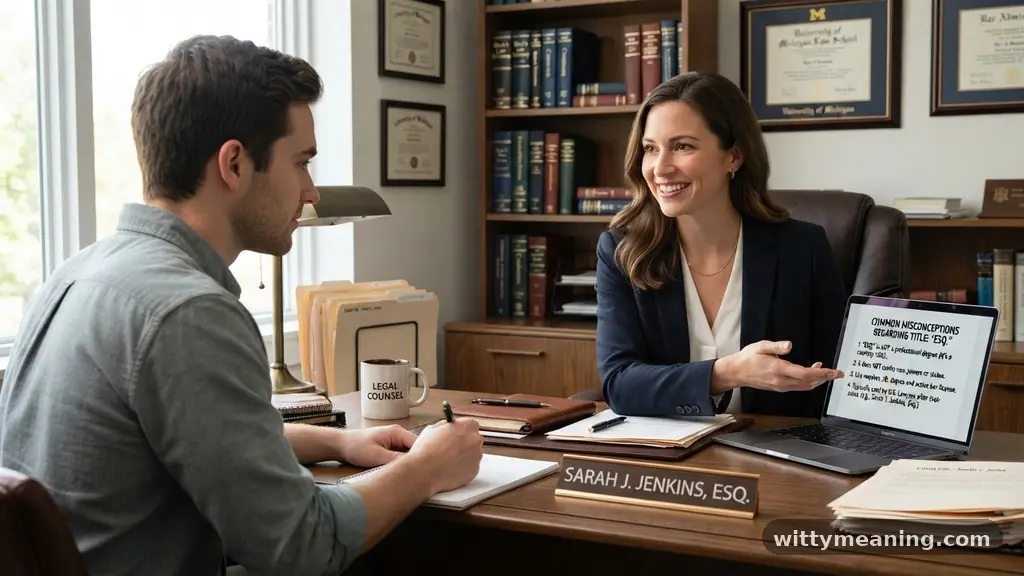
One of the most persistent myths is that the title carries some sort of inherent legal power or exclusive status that elevates the holder above other professionals. In reality, it is simply a professional designation.
Many people assume that if someone has the letters after their name, they must be a high-ranking litigator, but that is not necessarily true. It applies equally to transactional attorneys, in-house counsel, and retired lawyers who maintain their active status.
Another common misconception involves gender. Historically, the term was exclusively masculine, often reserved for men in the legal field.
Today, the usage has become gender-neutral, and female attorneys use it just as frequently as their male counterparts. There is no linguistic or professional barrier preventing its use by anyone who has met the requirements for licensure.
Finally, some people mistakenly believe that the title is required for a lawyer to be recognized as legitimate. This is false.
A lawyer who does not use the suffix is still an attorney in every sense of the word. The decision to include it is entirely optional and often depends on the culture of the firm or the specific region where the lawyer practices.
Proper Professional Protocol and Formatting
When you are addressing a letter or an envelope, knowing where to place the suffix is crucial for maintaining a polished appearance. The standard rule is that you should never use both a prefix and a suffix that signify the same thing.
For example, writing “Mr. John Smith, Esq.” is considered redundant and technically incorrect in formal style guides.
The reason for this is simple: “Mr.” is a title of address, and “Esq.” is a professional suffix. By using both, you are effectively calling someone “Mister” and “Esquire” simultaneously.
The preferred format is to simply write “John Smith, Esq.” without the “Mr.” or “Ms.” prefix. This creates a clean, professional look that adheres to traditional etiquette.
Formatting Guidelines for Correspondence
* Use the suffix after the full name: John Doe, Esq.
* Avoid redundant titles like Mr. or Ms. when using the suffix.
* Ensure the comma placement is consistent with your regional style guide.
* In some regions, the suffix is used typically without a preceding comma, though styles vary by region.
Consistency is key when you are preparing professional documents. If you are drafting a list of attorneys for a website, ensure that all names follow the same formatting rules. Mixing styles—using the suffix for some but not others—can look sloppy and unprofessional.
Ethical and Legal Restrictions
The use of the title is subject to strict Ethical and Legal Restrictions. Because it implies that an individual is a licensed lawyer, using it when you have not passed the bar exam can be considered the unauthorized practice of law.
Each state has its own bar association that regulates how lawyers represent themselves to the public. If a non-lawyer uses the title to deceive clients or solicit legal business, they can face severe civil and criminal penalties.
The American Bar Association provides guidance on professional conduct, though specific rules regarding titles are usually enforced at the state level. These bodies are tasked with protecting the public from fraud. If you are ever in doubt about whether someone is a licensed attorney, you can usually check the official registry of the state’s bar association.
It is important to remember that the title is a privilege of licensure, not a personal preference. If your license is suspended or revoked, you must immediately cease using the designation in all professional materials. Failing to do so can result in disciplinary action from the bar and further complicate your standing within the legal community.
Regional Differences in Usage
While the term is widely recognized across the United States, there are subtle regional variations in how it is applied. In some parts of the country, particularly in the Northeast, it is common to see the title used quite frequently in social correspondence. In other regions, it is reserved strictly for formal business documents and is considered pretentious if used elsewhere.
Some firms have internal policies that dictate how their lawyers should present their names. A large corporate firm might require all partners to use the suffix on their business cards to maintain a uniform brand identity. Conversely, a boutique firm might take a more relaxed approach, allowing individual lawyers to decide whether they want to include it.
You can refer to resources provided by the American Bar Association for more information on professional standards. These organizations often publish manuals on legal writing and correspondence that address these regional nuances. Understanding the local culture of your legal market will help you decide whether to adopt the title in your own professional life.
Distinguishing Between Degrees and Titles
It is vital to distinguish between a degree and a professional title. A Juris Doctor (J.D.) is an academic degree earned upon graduation from law school.
While it signifies that you have completed the necessary education, it does not automatically grant you the right to practice law or use the suffix. You must still pass the bar exam and be sworn in by the appropriate authorities.
Many people confuse the degree with the professional designation. You might see someone list their credentials as “John Smith, J.D.” on a resume. This is an academic claim, not a professional practice claim.
Using “Esq.” implies that you are currently authorized to represent clients. This distinction is important for potential clients who are looking for someone to provide legal advice.
If you are just starting your career, you might be tempted to use the suffix as soon as you receive your diploma. However, you should wait until you have officially been admitted to the bar. Using the title prematurely can lead to questions about your ethics and may violate the rules set by your state’s regulatory body.
The Role of the Title in Business Development

For many lawyers, the title serves as a marketing tool. It signals competence and professional experience to potential clients.
In a crowded marketplace, having the suffix on your business card or website can provide a level of immediate trust. It tells the reader that you have met the rigorous standards required to enter the profession.
However, relying solely on the title for business development is rarely enough. Clients are generally more interested in your track record, your areas of expertise, and your communication style.
The suffix should be viewed as a baseline requirement for credibility rather than a competitive advantage. It is a starting point for a conversation about your value as an attorney.
When you are networking, it is often more effective to introduce yourself by your name and your area of practice. If someone sees the suffix on your card, they will understand your professional status without you needing to emphasize it. Over-emphasizing your title can sometimes come across as arrogant, which can be a turn-off for potential clients.
Comparison of Legal Professional Titles
To clarify the differences between various ways of addressing legal professionals, the following table summarizes common designations and their appropriate contexts.
| Title / Suffix | Context | Requirement |
|---|---|---|
| Esq. | Formal correspondence | Licensed to practice law |
| Attorney | Professional introductions | Licensed to practice law |
| J.D. | Academic bios | Graduation from law school |
| Counsel | Firm roles / Titles | Specific employment status |
Understanding these distinctions ensures that you are always using the correct terminology in the correct setting. Misusing these terms can lead to confusion and may undermine your professional reputation.
Addressing Topical Gaps in Legal Etiquette
One gap that often confuses people is the use of the title in digital communications. Is it appropriate to include the suffix in an email signature? Yes, it is common practice, but it should be done tastefully.
Your email signature should be clean and easy to read. Adding the suffix is a standard way to maintain a professional appearance in your daily correspondence with clients and colleagues.
Another frequent question concerns the use of the title for justices of the peace or other quasi-legal roles. Generally, these individuals do not use the suffix unless they are also licensed attorneys. If you are a justice of the peace, it is usually better to use your official title (e.g., “Justice of the Peace”) rather than attempting to co-opt the lawyer’s suffix.
Finally, what about international contexts? In many countries, the term “Esquire” does not have the same legal meaning as it does in the United States.
If you are communicating with international partners, be aware that they might find the suffix confusing or unnecessary. In such cases, it is often better to stick to standard professional titles like “Mr.” or “Ms.” to avoid any cultural misunderstandings.
FAQ
Is Esq only for lawyers?
Yes, in the United States, it is primarily used by licensed attorneys. While it historically had broader social applications, using it today without being a member of the bar can be considered the unauthorized practice of law in many jurisdictions.
What does the abbreviation Esq. mean after a name?
It stands for Esquire. In the American legal system, it functions as a professional suffix that indicates the individual has graduated from law school and has been admitted to practice law by their state’s bar association.
Is it illegal to use Esquire if you are not a lawyer?
While not always a specific crime in every jurisdiction, using it to deceive the public or hold yourself out as a lawyer when you are not licensed is generally considered the unauthorized practice of law, which carries significant legal and professional risks.
What is the highest title for a lawyer?
There is no single “highest” title, as the profession is horizontal. However, titles like “Senior Partner,” “Managing Partner,” or “General Counsel” denote higher levels of authority and responsibility within a law firm or corporate environment compared to a standard associate.
Conclusion
Understanding the esq meaning is more than just learning a trivia fact; it is about mastering the subtle codes of professional communication. By recognizing that this suffix is a badge of licensure rather than a social status, you can ensure that you are using it appropriately in your own career or when addressing your legal counsel. Remember that professional etiquette is built on clarity, consistency, and respect for the regulations that govern the legal industry.
Whether you are drafting a formal letter or updating your digital presence, keep your formatting clean and your usage accurate. If you have further questions about your specific state’s rules, the best next step is always to consult the guidelines provided by your local bar association. Staying informed helps you project the professionalism that is expected of those in the legal field.