
When you encounter the word “dote” in a digital conversation, it usually signals a high level of warmth. Understanding the dote meaning in text requires looking beyond the dictionary definition to see how people use it to express deep, often unreserved, affection.
Whether you are reading a heartfelt message or trying to decode a specific regional slang usage, grasping the nuances of this word helps you better interpret the emotional tone behind a sender’s words. It is a term that bridges the gap between simple care and profound, visible devotion.
Defining the Core Concept of Doting

At its simplest, the dote definition centers on the act of showing excessive fondness or love toward someone. When someone says they dote on another person, they are describing a state of being where their attention and care are focused almost entirely on that individual. In modern text communication, this often manifests as consistent praise, frequent check-ins, or the expression of deep emotional devotion that goes above and beyond standard friendliness.
The verb usage of the word is almost always followed by the preposition “on.” You don’t just “dote”; you dote on a specific subject. This grammatical requirement reinforces the idea that the action is directed and intentional.
It implies a conscious choice to prioritize someone’s happiness or well-being. By using this specific verb, a person in a text message is signaling that their feelings are not merely casual but are rooted in a sense of protective, warm-hearted attachment.
The Nuances of Irish Slang and Regional Variation
If you have stumbled upon the term while speaking with someone from Ireland, you might have noticed a slight shift in how it is applied. In Irish slang, being called “a dote” is a common term of endearment.
Unlike the standard verb form, which describes an action, this noun usage describes a person’s character. If a friend tells you that someone is “a total dote,” they are describing that person as sweet, charming, or incredibly lovable.
This regional usage transforms the word from an active expression of love into a descriptor of personality. It is high praise, often reserved for someone who is kind-hearted or helpful.
Understanding this distinction is vital because it prevents confusion when the word appears as a noun rather than a verb. In this specific linguistic context, it functions similarly to calling someone a “dear” or a “sweetheart,” highlighting a doting personality that naturally draws others in.
Tracing the Linguistic Roots and Historical Context
The history of the word is surprisingly deep, tracing back through Middle English and even touching upon the French origin doté. The French word doté means “endowed with,” often referring to a dowry or a specific gift. Over time, the English evolution of the word drifted toward the emotional landscape, moving from the idea of being “endowed” with qualities to the act of showering those qualities—or one’s entire focus—upon someone else.
This etymological journey explains why we still associate the word with a sense of generosity. When you dote on someone, you are essentially “endowing” them with your time, your patience, and your affection.
It is a form of emotional investment. Recognizing this historical connection adds a layer of depth to how we use the term today; it isn’t just about being nice, but about a deliberate, sustained gift of oneself to another person.
Dote vs Love: Distinguishing the Intensity
While the two terms are frequently used interchangeably in casual conversation, there is a subtle difference in how they function. Love is a broad, foundational state of being, whereas dote describes the active, visible manifestation of that love.
You can love someone from a distance, but the specific behavior associated with doting requires proximity and engagement. It is the visible, outward expression of a sentimental attachment.
Consider the following table to help clarify the distinctions between these two closely related emotional concepts:
| Feature | Love | Dote |
|---|---|---|
| Primary Focus | Internal feeling or state | External, observable behavior |
| Consistency | Can be static or long-term | Usually implies frequent, active expression |
| Direction | Often reciprocal | Often one-sided or focused on a dependent |
| Context | Broad, applies to many relationships | Specific, focused on pampering or deep care |
The Role of Excessive Fondness in Relationships
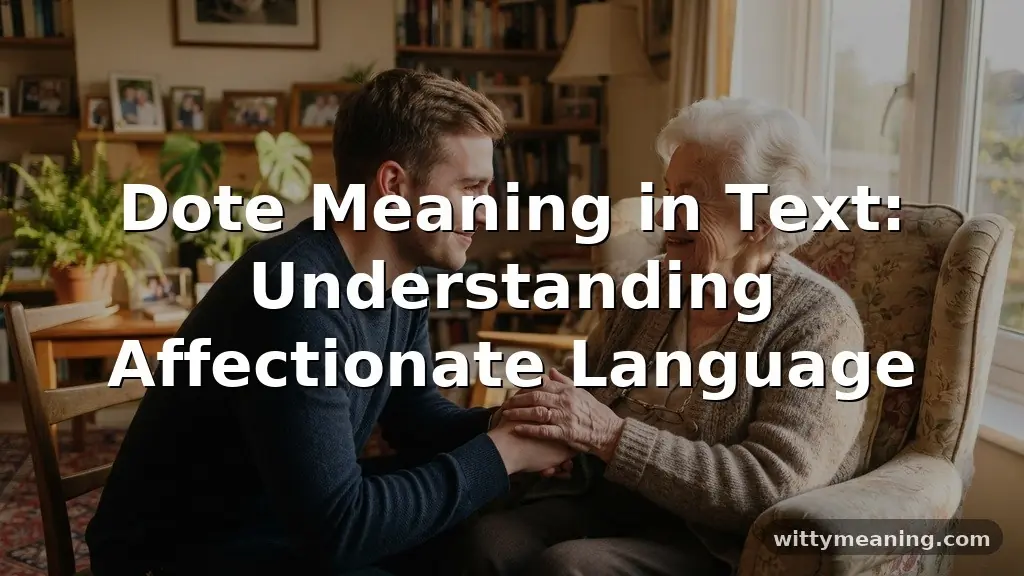
In a romantic or familial context, the act of doting often serves as a primary language of affection. A doting parent, for example, is someone who provides constant, attentive care to their children, often prioritizing the child’s needs above their own.
This is a classic example of unconditional love in practice. In text messages, this might look like a parent sending constant updates, emojis of love, or messages expressing how much they miss or adore their child.
Romantic doting follows a similar path but with a different intensity. It involves a partner who goes out of their way to make the other feel special, valued, and cherished.
When someone writes that they are “doting on” their partner, they are highlighting their commitment to keeping the spark alive through small, deliberate acts of kindness. It is a way to affirm that the relationship remains a central priority, even during the mundane moments of daily life.
Identifying Doting Behavior in Digital Communication

Because text messages lack tone and body language, we rely on specific vocabulary to convey depth. Using the word “dote” allows a sender to add a layer of emotional weight that a simple “I love you” might lack.
It suggests a level of care that is attentive and perhaps a little indulgent. If you see this word in a message, pay attention to the context; it is almost always used to describe a positive, nurturing dynamic.
You can often spot this behavior in the following ways within a chat:
- Frequent usage of terms of endearment alongside the word.
- Descriptions of small, thoughtful gestures performed for the other person.
- Language that emphasizes a constant, watchful, and protective presence.
- Expressions of pride or joy regarding the other person’s achievements.
Psychological Attachment and the Need for Validation
At a deeper level, the impulse to dote on someone is rooted in our basic human need for social connection and psychological attachment. When we focus our attention on someone else, we are reinforcing the bond between us.
This behavior creates a sense of security for the recipient and a sense of purpose for the giver. It is a reciprocal cycle of emotional validation that stabilizes relationships.
However, it is worth noting that this behavior is often most visible when there is an imbalance in power or age, such as in the relationship between a doting grandparent and a grandchild. This isn’t a negative dynamic; rather, it is a specialized form of care where the “doter” finds immense pleasure in the happiness of the “dotee.” In text-based communication, this often translates to messages that are purely supportive, celebratory, and filled with warmth, as the sender seeks to provide a constant stream of positive reinforcement.
Addressing Topical Gaps: Common Misconceptions
A common point of confusion is whether the word carries a negative connotation. Some people mistakenly believe that to “dote” is to be foolish or blinded by love.
While it is true that one can be “doting to a fault”—meaning they might ignore a loved one’s flaws—the word itself is not inherently pejorative. It is a descriptive term for a specific type of affectionate behavior that is generally viewed as a positive, nurturing trait.
Another gap in understanding involves the assumption that the word is only for romantic partners. As established, the term is highly flexible. It is just as applicable to friends, family members, or even pets.
When a person says they dote on their dog, they are simply using the word to describe their intense, affectionate focus on their pet’s well-being. The core meaning remains constant regardless of the recipient: it is about the devotion of time, energy, and love.
Linguistic Nuances and Synonyms
To better understand the word, it helps to look at its synonyms and how they compare. Words like “adore,” “cherish,” or “treasure” are often used in similar contexts, but they lack the active, “doing” quality of doting.
To adore is an internal feeling; to dote is to put that adoration into practice. This is why the word is so effective in text messages—it describes an active, ongoing effort to maintain a bond.
For more information on how language shapes our perception of relationships, you can consult the Merriam-Webster dictionary entry for dote to see the full range of historical and contemporary applications. This resource provides a clear look at how the word has shifted from its older definitions, which sometimes implied a loss of mental clarity, toward its modern usage, which celebrates focused, positive attention. Understanding these nuances allows you to use the word with more precision in your own communication.
The Importance of Context in Modern Messaging
The meaning of any word in a text message is heavily dependent on the relationship between the sender and the receiver. If you receive a message saying, “I’m just doting on you today,” it is a clear expression of affection.
If you see it in a more observational context, such as, “She really dotes on her new kitten,” it is a factual description of an affectionate personality. The key is to look at the surrounding words.
Because digital communication is often brief, we use words like this to pack a lot of meaning into a small space. By choosing to use this specific verb, the sender is making a statement about the nature of their feelings.
They are telling you that their attention is yours, and that they are finding joy in the act of caring for you. It is a powerful way to build intimacy in a medium that can sometimes feel cold or impersonal.
Frequently Asked Questions
Is it ever an insult to be called a dote?
In most cases, no. While calling someone “a dote” in Irish slang is a compliment, using the verb “to dote” is almost always positive. However, if someone says you are “doting on” someone who doesn’t deserve it, they might be implying that your affection is misplaced or excessive.
How does dote differ from being obsessed?
The primary difference is the intent and the health of the relationship. Doting is generally considered a healthy, intentional, and affectionate form of care. Obsession, by contrast, is typically viewed as unhealthy, intrusive, and lacking in the mutual respect or emotional safety that characterizes true doting.
Can you dote on yourself?
While the word is traditionally used to describe affection toward others, the concept of self-care is evolving. You can certainly engage in behavior that involves “doting on yourself,” such as treating yourself to a spa day or taking extra care of your own needs, though this is a less common usage.
Does the word imply a lack of intelligence?
Historically, the word did have archaic meanings relating to being “doltish” or mentally weak. However, in modern English, that definition is effectively obsolete. Today, it is almost exclusively used to describe intense affection, and it does not carry any implication of reduced intelligence or capability.
Conclusion
Understanding the nuances of how people communicate helps us build stronger, more empathetic connections. When you see this term in a digital conversation, recognize it for what it is: a sincere expression of emotional devotion.
It highlights a person who is willing to focus their energy and care on someone else, whether that takes the form of a doting parent, a supportive friend, or a romantic partner. By paying attention to these small linguistic choices, you gain a clearer window into the feelings of the people you interact with every day.
Next time you come across this word, consider the warmth behind it. It is an invitation to acknowledge the love and effort that goes into maintaining our closest relationships.
If you feel inclined to express your own deep appreciation for someone, do not hesitate to use the word yourself—it carries a weight of sincerity that few other verbs can match. Let your messages reflect the depth of your own connections by embracing the language of genuine, active affection.