
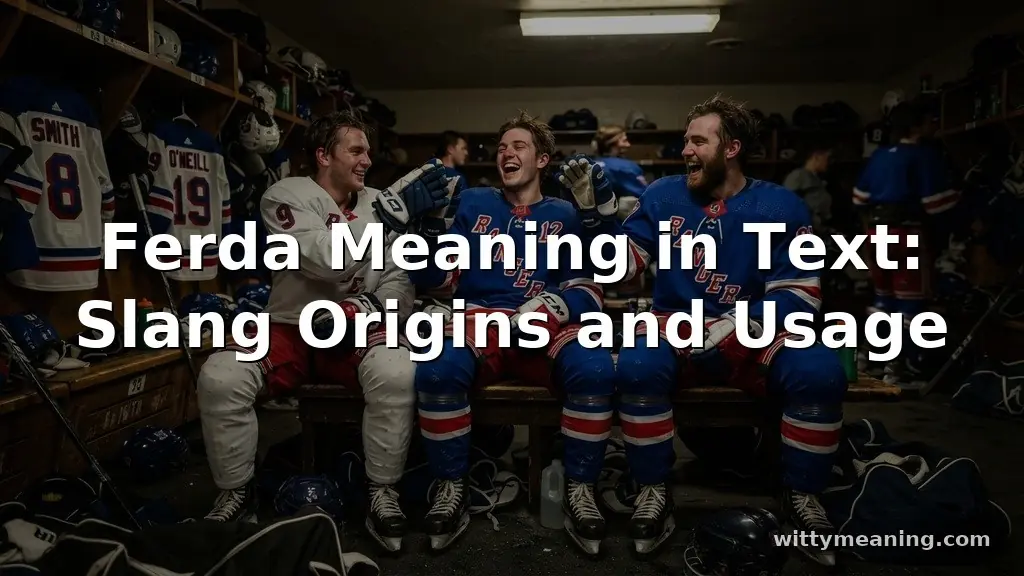

If you have stumbled across the term “ferda” while scrolling through social media or reading text messages, you are certainly not alone. It is one of those words that seems to have appeared out of nowhere, yet it carries a very specific, high-energy vibe that resonates with certain groups.
Understanding the ferda meaning in text requires a look at how language evolves within tight-knit subcultures, particularly those centered around sports and close-knit friend groups. By the time you finish this article, you will have a clear grasp of how to use this term authentically without coming across as someone trying too hard to stay current.
The Origins of Ferda in Hockey Culture

The term is rooted firmly in the world of hockey slang. Long before it hit the mainstream, it was used in locker rooms to describe actions taken for the sake of the team. It is essentially a contraction of the phrase “for the boys.”
In the fast-paced, high-intensity environment of a hockey team, players are constantly looking for ways to boost morale or celebrate a collective win. This linguistic shorthand allowed players to communicate a sense of selflessness and shared purpose quickly.
Because hockey culture values grit, hard work, and loyalty, the word naturally evolved to encompass those traits. When a player does something that benefits the team, even if it is a thankless task like blocking a shot or clearing the zone, it is described as being “ferda.”
It is a badge of honor that signifies you are putting the group before your own personal glory. This team-first mentality is the backbone of the term’s identity and explains why it feels so inherently positive to those who use it regularly.
Influence of Letterkenny on Mainstream Popularity
While the term had a long life in regional hockey circles, it exploded into the public consciousness through the hit Canadian show Letterkenny. The series leaned heavily into the specific vernacular of rural Canadian life, featuring characters who used “ferda” constantly as a way to punctuate their loyalty to one another. The show’s writers captured the specific cadence of the slang, making it feel organic rather than forced.
Beyond its television origins, the show helped translate the term for audiences who had never set foot in a hockey rink. Fans of the show began adopting it into their own speech patterns, often using it to describe any situation where they were hanging out with friends or supporting their social circle. The show effectively turned a niche hockey term into a recognizable piece of internet slang, proving how quickly media can accelerate the adoption of regional colloquialisms into global digital culture.
Deciphering the Core Meaning
At its heart, the word serves as a rallying cry. It represents enthusiasm or a sense of camaraderie that is best experienced in a group setting.
When someone uses it in a text, they are almost always signaling that they are doing something for the collective benefit of their friends. It is rarely used to describe solitary actions; it almost exclusively applies to group dynamics where the individual is willing to sacrifice a little for the sake of the many.
If you encounter “ferda” online, look at the context of the surrounding message. If a friend sends a text saying they are grabbing food for the whole group, they might add “ferda” to emphasize that they are happy to do the work because they value the group.
It changes the tone of a message from a simple statement of fact to an expression of loyalty and commitment. This nuance is what separates it from other generic slang terms that might just mean “cool” or “fun.”
Usage in Social Media Captions
Social media captions are perhaps the most common place to see this term in the wild. You will often see it attached to photos of guys on a road trip, at a concert, or participating in a sporting event.
It acts as a hashtag or a short sign-off that tells followers that the event was all about the bonds of friendship. It essentially says, “We are here together, and we are looking out for each other.”
Using the term on platforms like Instagram or Twitter allows users to quickly signal their tribal affiliation. It says, “I am part of this group, and I am proud of it.” However, because it is so heavily associated with specific subcultures, it is important to understand that it does carry a certain “frat culture” connotation.
Using it in a professional setting or in a serious, somber context would likely come across as confusing or inappropriate. It is a word meant for leisure, laughter, and high-energy social interactions.
Distinguishing Nuance and Tone
While “ferda” is generally positive, it can sometimes be used ironically. In some friend groups, it is used to mock the intensity of the “team-first” mentality.
For example, if someone does something trivial, like buying a round of cheap drinks, a friend might jokingly say “ferda” to tease them for acting like they just won a championship game. This ironic usage is common in the evolution of digital slang, where words are often repurposed to poke fun at their own origins.
To use the term effectively, you need to gauge the room. If your friends are the type to use heavy slang, it will fit right in. If you are in a more formal or mixed social setting, it might be better to stick to standard English.
The charm of the word lies in its casual, unpolished nature. It is not meant to be a precise linguistic tool, but rather a vibe-check word that reinforces the emotional state of a group.
The Role of Frat Culture and Group Dynamics

Beyond the hockey rink, the term has found a significant home in college fraternities and similar social organizations. Frat culture often mirrors the high-intensity, team-oriented structure of sports teams, making “ferda” a natural fit for their internal lexicon.
In these settings, it is used to justify all sorts of activities, from late-night study sessions to weekend parties. It serves as a glue that binds the group together through shared experiences.
The term thrives in environments where there is a clear distinction between the “in-group” and the “out-group.” By using a word that only those in the know fully understand, users create a sense of exclusivity.
This is a classic hallmark of internet slang, where the barrier to entry for understanding the word is part of the appeal. Once you know what it means, you feel like you are part of the club.
Table: Common Contexts for Ferda
| Context | Meaning | Typical Sentiment |
|---|---|---|
| Sports Team | Sacrifice for the team | High commitment |
| Social Outing | Doing something for the group | Fun and inclusive |
| Online Gaming | Helping teammates win | Competitive spirit |
| Ironic Use | Mocking extreme team loyalty | Humorous or sarcastic |
Evolution of Digital Slang
The way we talk online is constantly shifting, and “ferda” is a perfect example of how language moves from the margins to the mainstream. Initially, it was just a localized way of saying “for the boys.” Over time, as it traveled across social platforms, the definition softened and broadened.
It no longer requires a hockey stick or a locker room to be valid. Today, it is simply a shorthand for group solidarity.
This evolution is typical of how the internet handles new vocabulary. Once a term hits social media, its original context is often stripped away, leaving only the “vibe” behind.
This can be frustrating for people who were there at the beginning, but it is the reality of how language works in a connected world. The term is now a permanent fixture in the lexicon of anyone who spends significant time in online spaces, regardless of their actual connection to hockey.
Common Mistakes When Using the Term
One of the biggest mistakes people make is using the term in a way that sounds forced. Because it is so heavily colloquial, it needs to be dropped into a conversation naturally.
If you are trying to force it into a sentence where it does not belong, it will stand out for all the wrong reasons. It is not a universal synonym for “for” or “because,” and using it that way will make it clear that you do not understand its origins.
Another mistake is assuming that everyone knows what it means. Even though it has gained popularity, there are still plenty of people—even active social media users—who have never heard it.
If you use it in a conversation with someone outside of your immediate circle, be prepared to explain it. If you have to explain the joke, it usually loses its impact, so use it judiciously with people who share your specific social context.
Topical Gaps and Clarifications
Many people ask if the term can be used by women or in non-male-dominated spaces. While the original phrase “for the boys” clearly implies a male-centric origin, language is fluid.
Many women in sports and social groups have adopted the term as a gender-neutral way to express group loyalty. It is no longer strictly tied to “the boys” in a literal sense; it is tied to “the team” or “the squad.”
Another gap in the common understanding is whether the word can be used as a standalone descriptor. Can you just say “That’s ferda”? Yes, that is actually one of the most common ways to use it.
It functions as an adjective or a descriptor of an event or action. If something is “ferda,” it is inherently good for the group. It encapsulates a whole sentiment in just two syllables, which is why it has become so popular in the age of short-form communication.
FAQ Section
What does ferda actually mean in a text message?
It is a slang term meaning “for the boys” or, more broadly, “for the group.” When someone uses it, they are indicating that an action is being performed out of loyalty or to benefit their friends, emphasizing a team-first, communal mentality.
Is it okay to use ferda if I don’t play hockey?
Yes, the term has evolved far beyond its hockey origins. It is now used by many people to describe group activities, parties, or any situation where there is a strong sense of camaraderie. You do not need to be an athlete to use it.
How can I use ferda correctly in a sentence?
Use it to describe an action that benefits your friends. For example, if you are bringing pizza to a study session, your friend might say, “Thanks for the food, that’s so ferda.” It is best used in casual, high-energy, or humorous contexts with friends.
Does ferda have a negative connotation?
Generally, no. It is almost always a positive term meant to foster unity. However, because it is associated with “frat culture” and masculine social circles, some people might view it as immature or exclusionary depending on the setting and the tone of the conversation.
Conclusion
Understanding the ferda meaning in text opens a window into how digital slang shapes our modern conversations. It is more than just a contraction of “for the boys”; it is a shorthand for loyalty, sacrifice, and the joy of being part of a group. Whether you are a hockey fan, a fan of the show that brought it to the masses, or simply someone who enjoys the evolution of language, the term serves as a fun, high-energy way to signal your connection to others.
Next time you see it in a group chat, you will know exactly what it represents. Feel free to use it when the moment calls for a bit of team spirit and camaraderie among your own circle of friends.