
The term “elope” has traveled a long distance from its historical roots, shifting from a clandestine act of rebellion to a modern, celebrated lifestyle choice. When you encounter the elope meaning in text, the interpretation depends almost entirely on the social context of the conversation.
In one thread, it might refer to a romantic, intimate wedding, while in another, it could describe a serious medical or behavioral situation. Understanding this linguistic duality is essential for clear communication, as the word carries significant weight in both personal relationships and clinical settings.
The Romantic Evolution: From Secret Marriage to Intentional Choice

Historically, the elope meaning was synonymous with a secret marriage—a couple running away to wed without parental consent. In the past, this was often a high-stakes decision driven by societal pressure, family disapproval, or legal barriers.
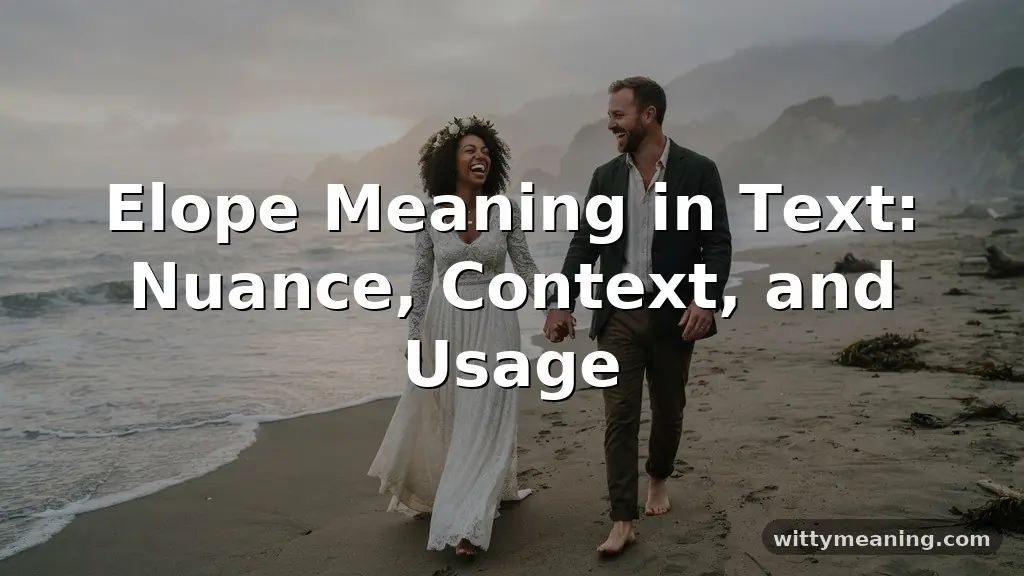
Today, however, the connotation has shifted toward a quick wedding that prioritizes the couple’s desires over traditional expectations. Modern couples often choose to elope not because they are hiding, but because they want an intentional departure from the stress, financial burden, and performance-heavy nature of a large, traditional wedding ceremony.
When a partner sends a text suggesting, “Let’s just elope,” they are typically proposing an impulsive marriage or a simplified, intimate ceremony. This usage reflects a shift in cultural values where the experience of the union is placed above the spectacle of the event.
It is no longer about escaping authority; it is about reclaiming the sanctity of the moment. This change in vocabulary nuance is a hallmark of modern romantic communication, where the focus has moved from “running away from” to “running toward” a shared experience that is personal, affordable, and deeply meaningful.
Behavioral Context: Elopement in Neurodivergence
In a vastly different domain, the term takes on a critical, non-romantic definition. When discussing wandering behavior or wandering autism, the term refers to the act of a person—often an eloping child or an individual with specific cognitive differences—leaving a safe environment without permission or awareness of the consequences.
This is a recognized safety risk that requires careful management and understanding. In this context, the elopement definition is stripped of any romantic flair and is instead categorized as a serious behavioral event that triggers specific elopement protocols.
For parents, caregivers, and educators, the term describes a form of runaway behavior that is not motivated by defiance but by sensory processing, internal distress, or a lack of situational awareness. Understanding this is vital because using the term interchangeably with “running away” can lead to misunderstandings.
While “running away” often implies a conscious choice to flee, elopement in the context of neurodivergence often implies an involuntary or impulsive exit. Recognizing this distinction is a fundamental part of providing proper support and ensuring the safety of vulnerable individuals.
The Role of Digital Slang and Urban Dictionary
Digital communication platforms have further complicated the elope meaning in text. If you search for the urban dictionary slang definition, you will find a blend of traditional usage, humorous takes, and modern slang that suggests “eloping” can simply mean leaving a boring social situation or a bad date.
This is an example of linguistic drift, where a specific, high-stakes word is repurposed for informal communication to describe a low-stakes exit. When a friend texts, “I’m going to elope from this party,” they are using the word as a synonym for escape.
This usage highlights how language evolves through social media and messaging apps. While it might seem trivial, this shift can be confusing for those who are accustomed to the clinical or traditional definitions. It is a reminder that the social context of a text message is the primary driver of meaning.
In a group chat, the hyperbole of “eloping” from a meeting is clearly understood as a joke, but in a professional or medical email, the same word would be interpreted with gravity. Navigating these layers requires a keen sense of the audience and the medium through which the information is being shared.
Safety and Crisis Intervention Protocols
When professionals discuss elopement prevention, they are operating within the framework of behavioral psychology. Whether in a school, hospital, or residential care facility, the goal is to mitigate the safety risk associated with individuals who may exit a secure area.
This involves creating a structured environment where the triggers for fleeing are identified and managed. A formal elopement protocol often includes environmental modifications, such as secure exits or monitoring systems, as well as personalized behavioral plans designed to address the underlying causes of the departure.
Crisis intervention in these cases is not just about physical containment; it is about understanding the “why” behind the act. For an individual who is prone to wandering, the environment may be overstimulating, or they may be seeking a specific sensory input that they cannot find within the designated area.
By viewing the behavior through a clinical lens rather than a disciplinary one, caregivers can create a safer, more supportive space. This professional usage of the term serves as a stark contrast to the romantic getaway connotation, proving that a single word can hold vastly different weights depending on the profession and the person involved.
Comparing Definitions Across Different Fields

To better understand how the term is utilized, it is helpful to look at how it functions across different sectors. The table below outlines the primary ways the word is interpreted depending on the environment in which it is used.
| Context | Primary Meaning | Key Implication |
|---|---|---|
| Romantic/Social | Intimate, secret, or quick wedding | Personal choice, minimalism |
| Clinical/Medical | Unsupervised leaving of a facility | Safety concern, risk management |
| Behavioral/Developmental | Wandering due to neurodivergence | Sensory need, lack of awareness |
| Casual/Slang | Leaving a situation suddenly | Humor, social relief |
This comparison illustrates that the term is far from monolithic. In the romantic sphere, it is a positive, proactive choice.
In the medical and developmental spheres, it is a reactive event that necessitates oversight. By understanding these distinctions, one can avoid the pitfalls of miscommunication.
Nuances in Legal and Social Implications
The legal implications of the term are perhaps most pronounced when we look at the runaway teenager versus the legal adult. While the term “elope” is rarely used in modern legal statutes to describe a child running away—”runaway” is the standard legal term—the word still carries historical weight regarding marriage laws.
In many jurisdictions, the ability to marry without parental consent at a certain age effectively ended the “need” to elope in the traditional sense. However, the concept persists in the public imagination as a way to circumvent familial expectations.
Socially, the act of eloping has become a form of protest against the commodification of marriage. The destination elopement industry has exploded, offering packages that allow couples to marry in exotic locations with minimal fuss. This represents a complete reversal of the term’s original, shameful connotation.
Where once it was a scandal, it is now an aesthetic. This evolution demonstrates how social attitudes toward autonomy and privacy have changed, allowing individuals to define their own milestones without the pressure of public performance.
Identifying Topical Gaps in Common Understanding
Many people struggle to bridge the gap between the medical definition and the romantic one, leading to awkward moments or misunderstandings. A common gap in public knowledge is the distinction between “wandering” and “eloping” in a clinical sense.
While they are often used interchangeably, experts sometimes use “eloping” to describe a more targeted attempt to leave a specific space, whereas “wandering” may be more aimless. Clarifying this in your own communication can prevent unnecessary panic or confusion when discussing the safety of an individual.
Another gap lies in the assumption that “eloping” always implies a negative or “sneaky” intent. As we have discussed, the word has been reclaimed by couples who view it as a high-quality, low-stress alternative to traditional weddings.
By acknowledging the positive evolution of the term, we can avoid judging those who choose this path. Furthermore, recognizing that the term is a synonym for escape in casual slang allows us to interpret texts more accurately, ensuring we don’t overreact to a friend’s casual use of the word in a non-serious, high-stress situation like a boring party.
Strategies for Clear Communication
When using the word “elope,” the best strategy is to provide sufficient context. If you are discussing a wedding, clarify your intent by using phrases like “we are planning an intimate ceremony” or “we’ve decided to elope to the coast.”
By providing these details, you remove the ambiguity that the word might otherwise carry. Conversely, if you are working in a caregiving role, ensure that you use the term within the established elopement protocol of your organization to avoid any confusion with romantic usage.
The following list provides best practices for ensuring your use of the term is understood correctly:
- Always identify the setting (e.g., “in our relationship,” “at the care facility”).
- Use modifiers if the context is unclear (e.g., “we are eloping to get married” vs. “the patient is prone to elopement“).
- Be aware of your audience; avoid slang versions of the word in formal or professional writing.
- If you are the sender of a text, consider if the recipient might misinterpret your meaning based on their background.
- When in doubt, use a more specific word like “run away,” “leave,” or “get married” to ensure absolute clarity.
By following these simple steps, you can harness the flexibility of the English language without falling into the trap of misinterpretation. Language is a tool, and like any tool, its effectiveness depends on the precision with which it is used.
The Future of the Term in a Digital Age
As we look toward the future, it is likely that the divergent meanings of “elope” will continue to coexist, perhaps even drifting further apart. The romantic definition will likely continue to evolve as social norms around marriage change, potentially becoming the default for many who wish to avoid the industrial complex of modern weddings. Meanwhile, in the fields of behavioral psychology and medicine, the term will remain a fixed, clinical descriptor of a specific type of risk.
The intersection of these two worlds—the romantic and the clinical—is where we must remain vigilant. As digital communication continues to favor brevity, words like “elope” will be used more frequently in shorthand. Maintaining a clear understanding of the elope meaning in text is not just about grammar; it is about empathy and safety.
Whether we are celebrating a union or ensuring the well-being of a loved one, the precision of our language reflects our care for the people involved. By remaining mindful of the nuances, we can continue to use this versatile word to describe the diverse experiences of the human condition, from our most intimate joys to our most pressing safety concerns.
Frequently Asked Questions
What does it mean when a partner says they want to elope?
In a romantic context, this usually means they want to skip a traditional, large-scale wedding. They are proposing a simplified, private ceremony that focuses on the couple’s relationship rather than the social expectations of a big event, prioritizing intimacy and often reducing costs and stress.
Is eloping considered a safety risk in medical settings?
Yes, in clinical or care settings, elopement refers to a patient or child leaving a supervised area without authorization. This is a recognized safety risk that requires specific intervention protocols, such as increased supervision or environmental modifications, to prevent the individual from wandering into dangerous situations.
Can the term elope be used to describe leaving a boring social event?
Yes, in casual, informal communication or digital slang, people often use the word hyperbolically to mean “escaping” from a dull or uncomfortable situation. While this is a non-standard usage, it is common in text messages and social media, serving as a humorous synonym for leaving quickly.
How do I clarify if I’m using the word elope in a text?
The best way to clarify is to add context words that define the situation. Instead of saying “I’m going to elope,” you could say “I’m going to elope to get married” for romance, or “I’m going to elope from this meeting” to signal you are using the word in a joking, slang-like manner.
In summary, the elope meaning in text is entirely dependent on the context of the conversation. Whether you are using it to describe a modern, intimate wedding or a critical safety protocol, the word carries distinct layers of meaning that reflect our social, professional, and personal lives. By understanding these nuances, you can communicate more effectively, avoid potential misunderstandings, and ensure that your message is conveyed with the appropriate tone and gravity.
The evolution of this word from a secret escape to a celebrated choice—and its parallel use as a clinical safety term—serves as a fascinating example of how language adapts to meet the changing needs of society. Always consider your audience, define your intent, and use the word with clarity to ensure your meaning is never lost in translation.