

The term “titmouse” often triggers confusion because it sits at the intersection of serious ornithology and lighthearted, sometimes misunderstood, linguistic play. While the average birdwatcher immediately visualizes a small, crested gray bird flitting through the trees, someone encountering the word in a digital text message or an urban dictionary entry might find themselves scratching their head.
Understanding the titmouse meaning in text requires navigating two distinct paths: the literal, biological reality of the creature and the secondary, slang-heavy associations that have emerged through the quirks of the English language. This article peels back the layers of this word, exploring its roots in the Paridae family, its place in avian symbolism, and how it has evolved into a term that carries surprisingly diverse weight depending on the context in which it appears.
Biological Foundations and Ornithological Classification

To grasp the full scope of the word, one must first look at the biological entity itself. The titmouse is a member of the Paridae family, a group of small, hardy, and highly intelligent birds that reside primarily in the Northern Hemisphere. These birds are classified under the order Passeriformes, which includes the majority of the world’s songbirds.
Within this group, the most recognizable species in North America is the Tufted titmouse. Ornithologists study these birds for their complex songbird behavior, which involves a variety of calls used to communicate territorial boundaries, alarm signals, and mating intentions.
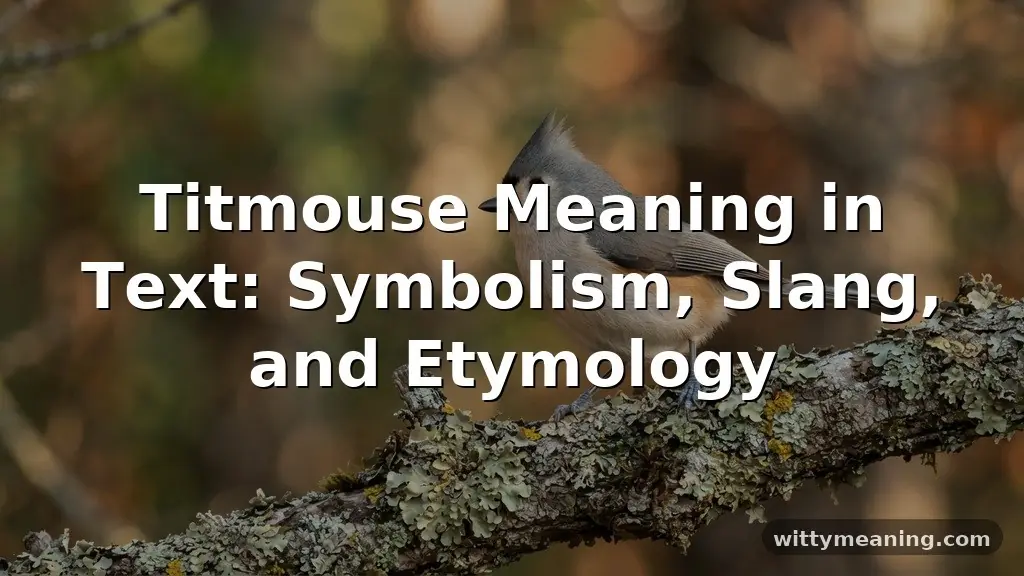
When the word appears in a scientific or nature-focused text, it is referring to a creature known for its curiosity and agility. The Tufted titmouse, specifically, is a staple of North American backyard birds. It is characterized by its soft, grey plumage, a distinctive crest of feathers atop its head, and a black patch just above its beak.
Because they are frequent visitors to feeders, they are a primary subject for those interested in bird watching. Their behavior is often described as bold; they are known to investigate humans, display high levels of intelligence, and exhibit social structures that rely on intricate communication. Understanding this biological baseline is essential because the later, more metaphorical uses of the word often draw upon the bird’s perceived characteristics: smallness, tenacity, and a chirpy, persistent nature.
Etymology and the Linguistic Evolution of the Name
The history of the word “titmouse” is a fascinating lesson in etymology and the way language shifts over centuries. Contrary to what many might assume, the word has absolutely nothing to do with the rodent commonly known as a mouse. The term is a linguistic fossil.
The first part, “tit,” comes from an Old Norse word, tittr, which meant “small” or “tiny.” The second part, “mose,” is derived from the Old English mase, which was a general term used for various small birds. Over time, tittr and mase fused, and as the English language underwent a linguistic shift, the word mase was phonetically assimilated into the word “mouse.”
This process is a classic example of folk etymology, where speakers of a language change an unfamiliar word to sound like a word they already know. Because the bird was small and quick, it was already associated with the idea of a “mouse” in the minds of early English speakers. This linguistic evolution demonstrates how human perception shapes vocabulary.
We didn’t just name the bird; we molded the word to fit our mental categorization of “small things.” When you see a titmouse mentioned in a text, you are witnessing a word that has traveled through centuries of human conversation, picking up layers of meaning and eventually settling into a form that is both biologically accurate—in its origin—and misleadingly mammalian to the modern ear.
The Tough Titmouse Idiom and Colloquial Usage
One of the most common reasons someone searches for the meaning of this term in a digital context is the tough titmouse idiom. In certain regional dialects, particularly within older generations of North American English, describing someone as a “tough titmouse” is a way of acknowledging resilience, pluck, or an unexpected strength despite a small stature.
This expression plays on the contrast between the bird’s diminutive size and its surprisingly feisty, songbird behavior. These birds are known to be aggressive when protecting their territory or their food sources, often standing their ground against larger species.
This slang usage has occasionally leaked into modern digital communication, though it is often used with a degree of irony. When someone uses the term in text, they are frequently invoking the image of the underdog. Much like the bird itself, which can be seen diving at larger crows or jays at a feeder, a person described as a “titmouse” in this context is someone who refuses to be intimidated.
It is important to note that this is not a mainstream slang term, and its usage is often highly localized or situational. If you encounter it in a chat, it is almost certainly a reference to this perceived tenacity—a compliment disguised as a quirky, animal-based metaphor.
Avian Symbolism and Spiritual Significance
Beyond biology and linguistics, the titmouse carries significant weight in the realm of avian symbolism. In various traditions, the bird is often viewed as a spiritual messenger. Because they are active, vocal, and frequently appear in backyards, they are often associated with the idea of community, joy, and the importance of being observant.
In many cultures, the appearance of a small, active bird like the titmouse is interpreted as a sign to pay attention to the details of one’s life. They represent the idea that even the smallest actions, when performed with persistence, can have a significant impact.
In a totem animal context, the titmouse is often linked to the traits of courage and adaptability. Because they survive harsh winters by caching food and maintaining social bonds, they are seen as symbols of resourcefulness.
When people write about these birds in a spiritual or metaphorical sense, they are tapping into a long tradition of nature interpretation where animals serve as mirrors for human virtues. If you find the word used in a poem, a blog post about mindfulness, or a spiritual text, it is likely being used to evoke the spirit of the bird: quick-witted, cheerful, and resilient.
The Titmouse Animation Studio Connection

A major source of confusion regarding the term in modern digital search results is the existence of Titmouse Inc., a prominent animation studio. Known for their work on high-profile adult animation and unique visual storytelling, the studio has become a brand name that frequently appears in online discussions.
Because the name is so distinct, many people searching for “titmouse” are actually looking for information about the company rather than the bird. This represents a significant topical gap in how search engines categorize the term.
The studio has embraced the name for its quirky, memorable nature, which aligns with the creative and often irreverent tone of their work. This is a clear example of how a biological term can be co-opted by corporate branding. When you see “Titmouse” capitalized in a text, especially in the context of television, film, or digital art, it is almost certainly referring to the animation studio.
This creates a bifurcated usage: the lowercase “titmouse” almost always refers to the bird or the slang, while the capitalized “Titmouse” refers to the production company. Recognizing this distinction is vital for anyone trying to interpret the intent behind a search query or a social media mention.
Comparing Contexts: How to Interpret the Term
To effectively navigate the different meanings of the word, it helps to categorize how it appears in various environments. The following table provides a breakdown of how the word is typically used across different sectors of communication.
| Context | Primary Meaning | Typical Tone |
|---|---|---|
| Ornithology | Small, crested bird of the Paridae family | Scientific, descriptive |
| Slang/Colloquial | A person who is small but unexpectedly tough | Informal, metaphorical |
| Pop Culture | Reference to the Titmouse animation studio | Professional, industry-focused |
| Spirituality | Symbol of resilience and observation | Reflective, symbolic |
By looking at the surrounding words in a sentence, you can almost always deduce the meaning. If the text mentions “feeders,” “feathers,” or “species,” you are looking at biology. If it mentions “production,” “artists,” or “TV shows,” you are looking at the studio.
If the text is personal, conversational, or uses the term to describe a person’s behavior, you are likely looking at the idiomatic usage. This analytical approach simplifies the otherwise confusing titmouse meaning in text.
Urban Dictionary and the Modern Digital Landscape
The urban dictionary entries for “titmouse” often reflect the more humorous and sometimes vulgar side of the English language. Because the word contains “tit” and “mouse,” it is frequently a target for juvenile wordplay.
This is a common phenomenon in linguistic evolution where words that sound like other, more provocative terms become the subject of internet humor. While these definitions exist, they generally lack cultural staying power and are rarely used in serious conversation.
However, it is important to acknowledge that the digital footprint of the word is heavily influenced by these entries. For a content strategist or an analyst, recognizing that these “slang” definitions exist is important, even if they are not the primary meaning in most professional or literary contexts. These definitions are often ephemeral, changing with the trends of the internet, whereas the biological and symbolic meanings have remained relatively stable for centuries.
When you encounter the word online, it is best to weigh the source. If it is a casual social media thread, the intent might be playful or crude; if it is a nature blog or a media article, the intent is likely rooted in the bird or the animation company.
Addressing Topical Gaps: Why the Confusion Persists
One might ask why the titmouse meaning in text remains so elusive. The answer lies in the lack of a singular, dominant definition. Unlike a word such as “apple,” which is universally understood as a fruit (or a tech company), “titmouse” sits at a crossroads.
It is a biological term, a historical linguistic accident, a source of potential humor, and a modern corporate name. This creates a “perfect storm” of ambiguity.
Furthermore, many people are unaware that the bird is a legitimate, widely distributed species in North American backyards. Because the name sounds so unusual to the modern ear, people assume it must be a slang term, leading them to search for “what does titmouse mean” when they see it in a nature documentary or a bird-watching guide. The confusion is not just about the word; it is about the disconnect between our modern, urbanized existence and the natural world.
Reconnecting with the ornithology of the bird is the most effective way to clear up the confusion. By understanding the bird’s actual presence in the ecosystem, the word loses its “weirdness” and regains its status as a descriptive, historical term for a fascinating creature.
Essential Points for Discerning Meaning
When you are trying to interpret the usage of this term, keep the following checklist in mind to ensure you are capturing the correct nuance:
- Context is everything: Look for surrounding keywords like “feeder,” “animation,” “tough,” or “bird.”
- Capitalization matters: “Titmouse” with a capital T usually refers to the animation studio, while lowercase refers to the bird or the slang.
- Consider the source: A nature blog will treat the word with scientific respect, while social media may lean into slang or humor.
- Check the geographical context: If the text is from a North American source, it is almost certainly referring to the Tufted titmouse.
- Avoid over-interpreting: Sometimes a bird is just a bird. Don’t look for deep metaphorical meaning in a simple observation of a backyard visitor.
By applying these filters, you can move past the initial confusion and identify the intended meaning with accuracy. The word is not inherently complex, but its varied applications in modern media make it a case study in how language adapts to serve different cultural needs—from the scientific labeling of a songbird to the branding of a creative studio and the playful use of regional idioms.
FAQ
What is the primary biological meaning of titmouse?
The term primarily refers to a small, active songbird belonging to the Paridae family. These birds are known for their intelligence, crested heads, and presence in North American backyard ecosystems. They are classified within the order Passeriformes and are frequently observed by birdwatchers for their curious and bold behavior.
Is “titmouse” a common slang term?
It is not a mainstream slang term. However, it is occasionally used in regional dialects as a way to describe someone small but feisty or resilient. Because the word contains “tit” and “mouse,” it is also subject to juvenile wordplay on the internet, though this is not its standard linguistic definition.
Why do I see Titmouse associated with animation?
Titmouse Inc. is a well-known, award-winning animation studio that produces adult-oriented cartoons and series. The company chose the name for its distinctiveness and quirkiness. In digital spaces, this brand name often appears alongside the bird name, which can lead to confusion if the context is not clear.
What does the “tough titmouse” idiom imply?
The “tough titmouse” idiom refers to the idea of a person who is physically small or unassuming but possesses great mental or emotional strength. It draws a direct parallel to the bird, which, despite its tiny size, is known for being aggressive and persistent when defending its territory or food.
Conclusion
The titmouse meaning in text is a multifaceted subject that requires a degree of contextual awareness to navigate. By moving from the biological reality of the Paridae family to the creative branding of Titmouse Inc. and the regional nuances of the tough titmouse idiom, we can see how a single word can occupy such diverse spaces in our vocabulary. Whether you are a birdwatcher admiring the Tufted titmouse in your backyard, a fan of modern animation, or someone trying to decode a peculiar turn of phrase, the word serves as a reminder of how language evolves.
It bridges the gap between the natural world and human culture, proving that even a name as seemingly strange as “titmouse” holds a rich history and a variety of functional uses. By understanding these layers, you can interpret the term accurately, regardless of the context in which it appears.