
The term “hoe” occupies a complex space in the English language, functioning simultaneously as a staple of agricultural history and a heavily loaded piece of contemporary slang. Understanding the hoe meaning requires a multi-layered approach that bridges the gap between physical labor and sociolinguistic evolution. While most people immediately associate the word with its modern, often controversial usage, its roots are deeply embedded in the history of human cultivation.
To truly grasp how a simple tool used for weeding and soil aeration became a lightning rod for discussions on gender, power, and identity, one must examine the intersection of linguistics, culture, and the shifting tides of social norms. This article explores the transition of the term from the garden to the streets, examining how it has been weaponized, redefined, and ultimately reclaimed across different spheres of influence.
The Agricultural Origins and Historical Etymology
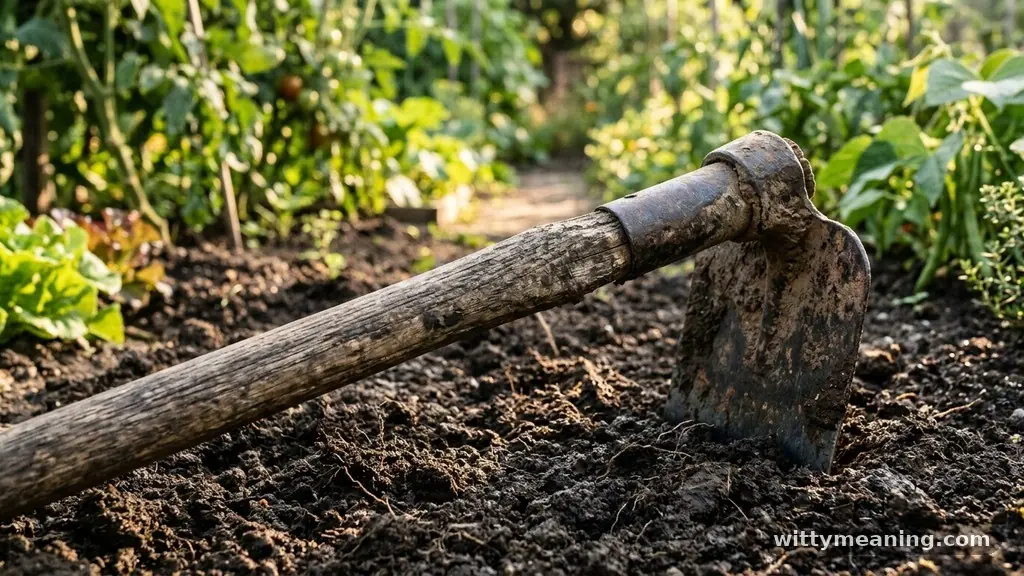
At its most literal level, a hoe is an agricultural implement used for centuries to shape soil, remove weeds, clear soil, and harvest root crops. The word itself has a long lineage, tracing back through Middle English as howe and further into Old English or Germanic roots.
Historically, the tool has been essential to human survival, representing the foundational labor of agrarian societies. Because the tool was so ubiquitous in daily life, its name became a common noun in almost every dialect of the English language.
The physical design of the hoe—a long handle with a flat blade—has remained remarkably consistent over thousands of years. This consistency allowed the word to remain stable in the lexicon for centuries. When linguists study the etymology of the word, they note that its evolution was purely utilitarian for the vast majority of its existence.
It was not until the mid-20th century, and more aggressively toward the end of it, that the term began to drift from the garden shed into the realm of social commentary. This shift is a classic example of linguistic drift, where a word’s phonetic proximity to other, more taboo terms triggers a semantic slide. The phonetic similarity between the tool and the word “whore” (often pronounced with a silent ‘w’ in various dialects) provided the perfect substrate for a new, derogatory meaning to take root.
The Emergence of Derogatory Slang
The transition from a gardening tool to a derogatory slang term is a study in how language reflects the prejudices of its speakers. The slang meaning of the word gained significant traction in the latter half of the 20th century, particularly within urban centers in the United States.
As the term migrated from casual speech into mainstream media, it became inextricably linked to sexual promiscuity. In this context, the term is used to diminish individuals—almost exclusively women—by reducing their humanity to a perceived lack of sexual restraint.
This usage is a prime example of misogynistic language that functions to police female behavior. By labeling a person with this term, the speaker is attempting to exert social control, enforcing a standard of purity that is often unevenly applied across gender lines. The word acts as a social marker, intended to shame and marginalize.
When analyzed through the lens of sociolinguistics, we see that the term serves as a weapon of sexual objectification. It strips the subject of their agency and focuses exclusively on their sexual history or reputation. This process of labeling is rarely neutral; it is a deliberate act of power, designed to maintain a hierarchical structure where certain behaviors are deemed acceptable for some and reprehensible for others.
Linguistic Evolution and AAVE
It is impossible to discuss the modern usage of this term without acknowledging the influence of AAVE (African American Vernacular English) and hip-hop culture. Many slang terms that permeate global youth culture today originated within Black communities, often as a result of linguistic creativity, rhythmic speech, and the necessity of coded communication.
In these contexts, the word was often used in a way that was both expressive and informal. However, when these terms are adopted by the broader, white-dominated media landscape, they are frequently stripped of their nuanced, community-specific meanings and flattened into purely pejorative labels.
The relationship between hip-hop culture and the proliferation of this slang is undeniable. Throughout the 1990s and early 2000s, the term appeared frequently in rap lyrics, music videos, and film. While some artists argued that they were merely reflecting the reality of their surroundings or using the word as a term of endearment within a specific, closed social circle, the mainstream consumption of these cultural products led to a widespread normalization of the word as a gender-based slur.
This creates a tension between the intent of the speaker within a subculture and the impact of the word when it is broadcast to millions of listeners who may not share that cultural context. The semantics of the word, therefore, are not fixed; they shift depending on who is speaking, who is listening, and the power dynamic between the two.
The Politics of Misogynoir and Gendered Labels

When analyzing the term, one must address the concept of misogynoir, a term coined by scholar Moya Bailey to describe the specific intersection of racism and sexism faced by Black women. The use of this particular slur is often disproportionately directed at Black women, reinforcing harmful stereotypes that hyper-sexualize them. This is not merely a matter of “bad words”; it is a systemic issue of how language is used to uphold patriarchal language structures that prioritize the subjugation of women of color.
The gender politics involved here are stark. While the male equivalent (often a derivative of the same root or entirely different terms) might imply a “player” or someone successful in their romantic pursuits, the female version is designed to evoke shame. This double standard is a hallmark of the structural inequality embedded in our language.
When we look at how the word is defined in a slang dictionary or an urban dictionary, we often see a reflection of this bias. These platforms, while useful for tracking the rapid change of vernacular, often lack the critical analysis necessary to understand why these terms exist or the harm they cause. They record the “what” without explaining the “how” or the “who” of the structural oppression.
Reclaiming Language and Agency
In recent years, there has been a significant movement toward the reclaiming language of historically disparaging terms. This process, often referred to as “reclamation,” involves a group taking a slur that has been used against them and stripping it of its power by adopting it as a badge of honor or a neutral descriptor.
We see this with many terms across various identity groups. In the case of the word in question, some women are choosing to use it to describe their own sexual autonomy, effectively saying, “If you want to call me this for having a healthy sex life, I will own the term and remove your ability to hurt me with it.”
This act of reclamation is highly contested. Some argue that it is a powerful way to neutralize a pejorative term, while others feel that the word is too deeply stained by its history of violence and objectification to ever be truly “clean.” This debate is at the heart of modern identity politics.
It raises the question: can a word ever be fully separated from its origins? Or is the history of the word permanently etched into its current usage, regardless of the speaker’s intent? This is a fundamental challenge for anyone interested in how language shapes our reality.
Comparing the Tool and the Slang: A Data Overview
To better understand the bifurcation of the word, it is helpful to look at how the two distinct meanings function in modern discourse. The following table contrasts the traditional agricultural usage with the contemporary slang usage to highlight the extreme divergence in their semantic fields.
| Feature | Agricultural Implement | Slang Term |
|---|---|---|
| Origin | Old/Middle English | Mid-20th Century Slang |
| Primary Domain | Farming and Gardening | Social/Interpersonal Relations |
| Connotation | Neutral, Utilitarian | Pejorative, Sexualized |
| Function | Soil cultivation | Social shaming/Objectification |
| Cultural Context | Agrarian history | Pop culture and social media |
This comparison illustrates that the word has essentially split into two different entities that happen to share the same spelling. In academic circles, this is known as a homonym, but the social weight of the second usage makes it a unique case study in how cultural shifts can hijack a word from its original, innocent purpose.
Common Phrases and Cultural Manifestations
The term frequently appears in pop culture, specifically in phrases like “hoes over bros” or “hoes over boys,” which are often interpreted as a commentary on female solidarity. However, these phrases are themselves contradictory. While they are meant to prioritize female friendships, they do so by using a term that inherently devalues women.
This creates a cognitive dissonance that is difficult to resolve. It suggests that even when attempting to create positive spaces, the language we inherit—which is often built on patriarchal language—can limit our ability to express ourselves without resorting to the very tools of oppression we are trying to escape.
Furthermore, the influence of social media has accelerated the use of such terms. On platforms like TikTok or Twitter, the hoe meaning is often debated, mocked, or performed. Trends that encourage women to “embrace” the label are often met with backlash from traditionalist factions, highlighting the ongoing culture war over female sexuality.
This is not just about a word; it is about who gets to define what “appropriate” behavior looks like for women in the 21st century. The speed at which these linguistic trends move online means that the word is constantly being redefined, making it a volatile element in contemporary discourse.
Addressing Topical Gaps: Why the Confusion Persists
One of the main reasons for the persistent confusion regarding the hoe meaning is the lack of a singular, authoritative source that bridges the gap between agricultural history and modern slang. Most dictionaries provide definitions for both, but they often fail to explain the process of how the word transitioned.
There is a gap in public understanding regarding how phonetic shifts (the “whore” connection) actually happen in a language. Many people assume the slang term is a direct evolution of the tool, whereas it is actually a linguistic “accident” caused by sound similarity.
Another gap is the lack of nuance in discussing the intent behind the use of the word. When people use the term, are they being malicious, or are they participating in a cultural vernacular that has stripped the word of its sting? By failing to distinguish between these contexts, we lose the ability to have productive conversations about language.
We need to move beyond simple “good” or “bad” classifications and start looking at how the term functions within specific social groups. Understanding that the word can mean “a garden tool” in one sentence and a “sexually active woman” in the next, without the speaker being confused, is a testament to the complexity of human cognition and the flexibility of our language.
Strategic Takeaways on Linguistic Change
The journey of this word is a definitive example of how language is never static. It is a living, breathing entity that responds to the needs, fears, and biases of the society that uses it.
As we move forward, it is likely that the hoe meaning will continue to evolve. Perhaps it will be fully reclaimed and stripped of its pejorative power, or perhaps it will fall out of fashion as new generations create their own vocabulary.
For those navigating these linguistic waters, the key is awareness. Recognizing the history of the words we use allows us to be more intentional in our speech.
Whether we are discussing the importance of an agricultural implement in maintaining food security or analyzing the impact of gender-based slurs on modern discourse, our choice of words matters. By understanding the roots and the impact of the term, we can engage in more thoughtful, inclusive communication that acknowledges the power we hold every time we open our mouths.
Frequently Asked Questions
When did the word start being used as a slang term?
The slang usage began to gain significant traction in the United States during the late 20th century, particularly within urban and hip-hop subcultures. It evolved through a phonetic association with the word “whore,” moving from a tool-based noun into a pejorative label for women.
Is the term always considered offensive?
Context is everything. While the word is widely recognized as a derogatory slur, some groups have attempted to reclaim it as a term of empowerment. However, in most professional or polite settings, it remains highly offensive and is generally considered inappropriate to use due to its misogynistic roots.
What is the difference between “hoe” and “ho”?
While they are often used interchangeably in casual speech, “ho” is frequently identified as a specific spelling variation used to emphasize the pronunciation found in certain dialects of AAVE. Both spellings carry the same derogatory weight and are used in the same context to describe sexual promiscuity.
Why is the term specifically linked to misogyny?
The term is linked to misogyny because it is overwhelmingly used to police and shame women’s sexual behavior. It functions as a tool of social control, reinforcing a double standard where female sexual expression is treated as a moral failing, while similar male behavior is often ignored or celebrated.
Conclusion
The hoe meaning is a testament to the power of language to transform, evolve, and reflect the deepest tensions within a culture. What began as a simple agricultural implement has become a complex signifier of gender politics, sexual objectification, and the ongoing battle for autonomy. By tracing its etymology from Old English to the present day, we gain insight into how words are weaponized and how, in some cases, they are reclaimed by those they were meant to hurt.
Ultimately, the way we use and interpret such terms says as much about our current societal values as it does about the history of the language itself. As we continue to navigate a world where communication is faster and more global than ever, remaining conscious of the history, impact, and shifting nature of our vocabulary remains an essential task for any informed participant in modern discourse. Whether used in the garden or in the heat of a social debate, the term remains a powerful reminder that words are never just empty sounds; they are the vessels of our history and the architects of our future social realities.