

Deciphering the pt meaning in a conversation or a document depends almost entirely on the environment in which you encounter it. Because this two-letter sequence is so common, it serves as a versatile shorthand across drastically different fields, ranging from high-stakes medical settings to casual digital messaging.
Understanding which definition applies requires looking at the surrounding cues, as the term shifts its identity based on whether you are at the gym, in a doctor’s office, or checking the clock. By identifying these distinct categories, you can quickly cut through the confusion and grasp the intended message without misinterpreting the context.
Medical and Healthcare Contexts
In the clinical world, the letters hold significant weight and are usually tied to professional credentials or specific patient care scenarios. A physical therapist is perhaps the most common professional title associated with this acronym.
These healthcare experts focus on helping individuals improve their movement, manage pain, and recover from injuries. When you see a referral for a PT, it implies a structured plan aimed at restoring function to the musculoskeletal system.
Beyond the practitioner, the term often appears in a medical record to denote a patient. Documentation in hospitals is notoriously fast-paced, and staff often rely on abbreviations to keep charting efficient.
Similarly, in fields related to recovery, you might encounter the term in discussions regarding occupational therapy, where the focus remains on rehabilitation and long-term wellness. If you see this in a chart, it is almost certainly a direct reference to the individual receiving care or the specific type of therapy being prescribed to aid their recovery.
Fitness and Athletics
If you spend any time in the fitness industry, the letters take on a much more active, sweat-inducing connotation. A personal trainer is the primary entity here, acting as a coach who designs a custom workout routine for a client.
They provide the expertise required to ensure movements are performed safely, reducing the risk of injury while maximizing physical results. Many people hire a trainer to bridge the gap between knowing they need to exercise and actually knowing how to train effectively.
Physical training is another variation of this, often used in sports or group settings to describe the act of conditioning the body. Whether it involves high-intensity interval training or strength building, the objective remains the same: physical improvement.
You will often hear gym-goers discuss their schedule by mentioning they have a session with their PT. It signifies a commitment to a goal, emphasizing that the abbreviation here is synonymous with accountability and professional guidance in a health-focused environment.
Time Zones and Global Scheduling
When you are coordinating a meeting across different states or countries, the pt meaning shifts to a geographical indicator. Pacific Time represents the time zone used along the West Coast of North America, including major hubs like Los Angeles, San Francisco, and Vancouver.
This is a critical distinction for anyone working in a remote or distributed team. If a deadline is set for 5:00 PM PT, it serves as a rigid anchor, ensuring everyone is aligned regardless of their local clock.
This usage is standard across business jargon and digital communication. It helps avoid the chaos of overlapping time zones by providing a clear, widely recognized reference point.
When checking international flight schedules or live broadcast events, you will frequently see it paired with other zones like Eastern Time or Coordinated Universal Time. Recognizing this usage is essential for effective scheduling and avoiding the common pitfall of missing a meeting because you were operating on the wrong local time.
Digital Communication and Texting Slang

In the realm of casual texting slang, the interpretation becomes much more fluid and informal. Much like other forms of shorthand communication, people use these letters to save time while typing on mobile devices.
Depending on the conversation, it can be a quick way to say “part-time,” especially when someone is discussing their job status or their availability for a project. It is a classic example of how digital habits bleed into our daily speech patterns.
The beauty of such abbreviations is their reliance on context-dependent interpretation. If you are talking to a friend about your class schedule or a side hustle, and they ask if you are full-time or PT, the intent is immediately clear.
While it lacks the formal structure of medical or military jargon, this casual usage remains one of the most common ways people encounter the term in their daily digital lives. It is all about speed and convenience when you are trying to get a point across quickly.
Military and Organizational Usage
Military terminology often utilizes the letters to designate specific roles or types of drill. Physical training in the armed forces is a foundational element of daily life, aimed at maintaining the combat readiness of service members.
It is not just about exercise; it is about discipline, endurance, and unit cohesion. In this context, the term carries a more rigorous tone compared to its use in a commercial gym setting.
Beyond physical conditioning, the abbreviation might appear in administrative documents to signify specific operational statuses or internal codes. Organizations often create their own shorthand to streamline internal communications, and these codes can be confusing to outsiders.
If you encounter the term within an official manual or a structured corporate environment, it is best to look for a glossary of terms. This ensures you are not confusing a military-specific designation with the more common time zone or healthcare definitions.
Comparing Common Definitions
Because the term is so heavily overloaded, it helps to see how the definitions stack up against one another. The following table provides a quick reference to help you identify which usage is likely at play based on the setting.
| Context | Primary Meaning | Common Usage |
|---|---|---|
| Healthcare | Physical Therapist / Patient | Clinical notes, referrals |
| Fitness | Personal Trainer | Workout planning, coaching |
| Business | Pacific Time | Scheduling, deadlines |
| Casual | Part-time | Employment status, availability |
Addressing Common Misconceptions
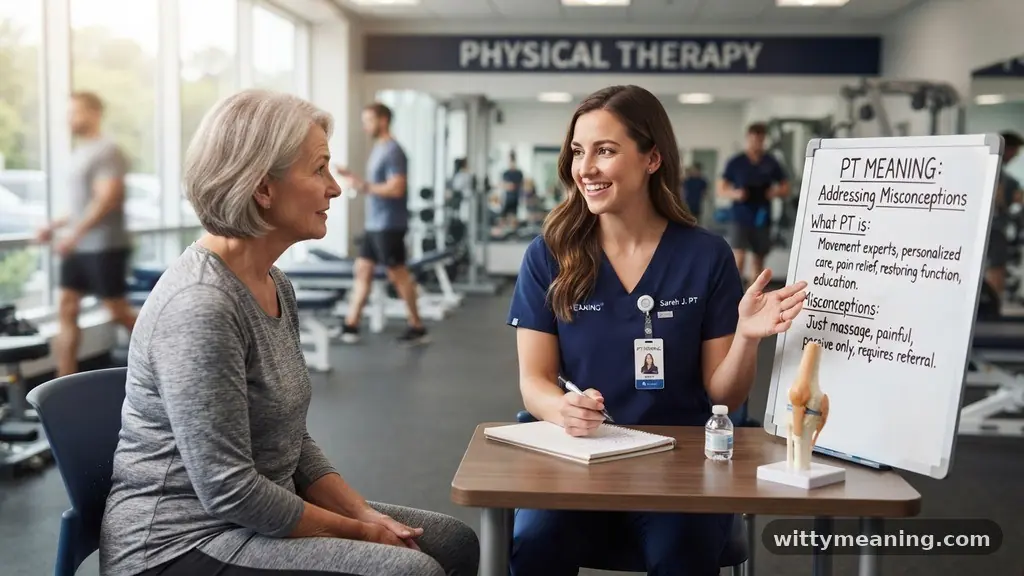
A major source of confusion stems from assuming that every instance of an acronym has a singular, universal definition. People often search for the one true answer, failing to realize that language is inherently flexible.
For instance, a patient reading a medical record might be alarmed to see an abbreviation they associate with “part-time” work, leading to unnecessary stress. It is vital to remember that the professional environment dictates the definition.
Another common gap involves the conflation of professional titles. A physical therapist is a licensed medical professional with a doctoral or master’s degree, whereas a personal trainer is a fitness professional certified by various organizations. Mixing these up can lead to poor decision-making regarding health and safety.
Always verify the credentials of the person you are dealing with if you are seeking advice on injury rehabilitation or musculoskeletal health. You can find more information about the clinical side of these professions through the American Physical Therapy Association.
The Role of Context in Interpretation
Mastering the art of reading between the lines is the most effective way to handle ambiguous abbreviations. When you encounter a term like this, look for the surrounding words. If you see “session,” “reps,” or “gym,” you are clearly in the fitness domain.
If you see “appointment,” “diagnosis,” or “recovery,” you are firmly in the medical arena. If you see “meeting,” “call,” or “deadline,” you are dealing with time zones.
This mental filtering process becomes automatic with practice. By categorizing the environment, you remove the guesswork. Never hesitate to ask for clarification if the stakes are high.
In a medical or legal document, assuming the wrong meaning can have real-world consequences, whereas in a text message, it might just lead to a lighthearted correction. Prioritizing clarity over speed is always the smarter move when you are unsure.
Evolution of Shorthand Communication
Shorthand has existed for centuries, but the digital age has accelerated its adoption across all sectors of society. We have moved from using acronyms in telegrams and shorthand notes to using them in instant messaging and global business platforms.
The term we are discussing is a prime example of how a simple two-letter code can adapt to the needs of different industries. It reflects our collective desire for efficiency.
As our communication methods continue to evolve, expect these abbreviations to remain a permanent feature of our language. They act as linguistic shortcuts, allowing us to transmit complex ideas with minimal characters.
While this creates occasional ambiguity, it also fosters a sense of community among those who share the same professional or social context. You learn the code because you are part of the group, and that shared understanding is a powerful tool for connection.
Impact of Abbreviations on Professionalism
While using shorthand is efficient, it is important to know when to use it and when to spell things out. In professional emails or formal reports, overusing abbreviations can make your writing appear lazy or overly casual. If you are writing to a client in a different time zone, using “PT” is generally acceptable, but if you are writing a formal contract, it is safer to specify “Pacific Time” to avoid any legal ambiguity.
The key is to balance efficiency with clarity. Consider your audience and their level of familiarity with the specific jargon you are using. If you are communicating with someone outside your field, spell out the term the first time it appears.
This shows respect for the reader’s time and prevents any confusion. Being a clear communicator is far more valuable than being the fastest person to type a message.
FAQ Section
What does PT mean in a medical record?
In a medical record, it most commonly refers to a physical therapist or the patient being treated. Sometimes, it may signify physical therapy as a service. Always check the surrounding notes or the provider’s credentials to confirm which specific definition is being used in that context.
How do I know if PT refers to a time zone?
If the abbreviation appears alongside a time (e.g., 2:00 PM PT) or in the context of scheduling a meeting, it almost certainly refers to Pacific Time. This is standard practice for coordinating events across different regions to ensure all participants are aligned on the exact time of the event.
Is PT always short for physical therapist?
No, it is highly context-dependent. While it is a common abbreviation for physical therapist in the healthcare industry, it is equally common for personal trainer in the fitness industry or part-time in employment contexts. You must look at the setting to determine the correct meaning.
Can PT mean something different in a military context?
Yes, in the military, it typically stands for physical training. This refers to the structured exercise and conditioning programs that service members must complete to maintain their operational readiness and fitness standards. It is a core part of the daily routine in most military branches worldwide.
Final Thoughts
Understanding the nuances of common abbreviations is a subtle but powerful way to improve your communication and situational awareness. Whether you are navigating a medical diagnosis, hiring a fitness coach, or scheduling a cross-country conference call, the meaning of these two letters will change to fit the situation. By paying attention to the context, you can avoid misunderstandings and ensure that you are always on the same page as the person you are speaking with.
Next time you encounter this term, pause for a second to assess your surroundings. Are you in a gym, an office, or a clinic? Once you identify the environment, the intended definition will usually reveal itself instantly.
If you still find yourself unsure, a quick request for clarification is always better than acting on an assumption. Keep observing these patterns, and you will find that deciphering shorthand becomes second nature in no time.