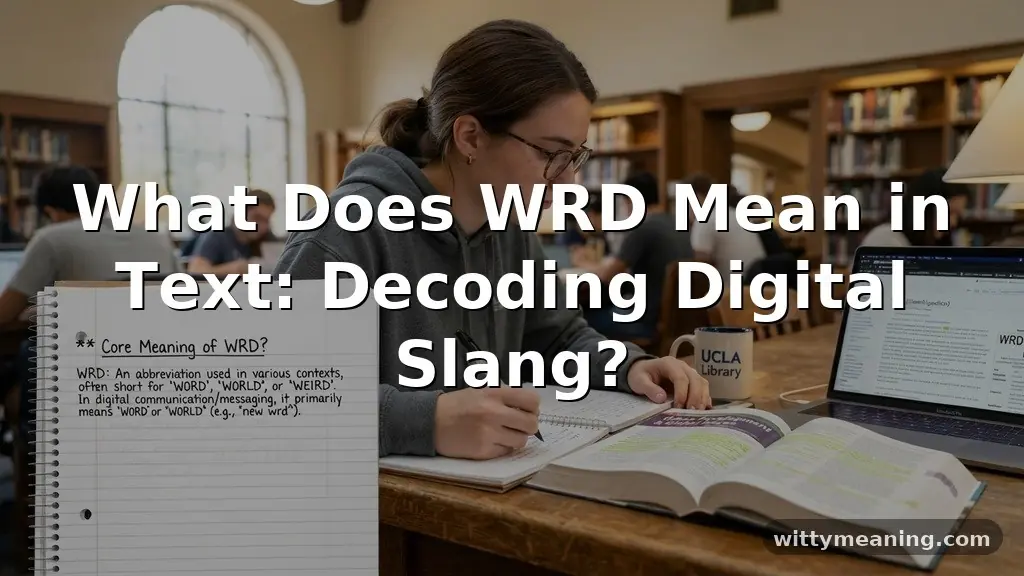

If you have ever stared at your phone screen trying to decipher a short, cryptic message, you have likely encountered the term “wrd.” It is a common piece of digital shorthand that shows up frequently in casual chats, leaving many people wondering exactly what does wrd mean in text. At its core, this abbreviation is a stripped-down version of the standard English noun “word.”
In the fast-paced environment of digital communication, where speed and brevity often take priority over formal grammar, people rely on these contractions to keep conversations flowing naturally. Understanding this term helps bridge the gap between traditional writing and the fluid, ever-changing nature of modern internet slang.
The Core Meaning of WRD

When someone sends you “wrd” in a message, they are almost always using it as an affirmation. It functions as a synonym for “word,” but in a specific, slang-heavy context, it carries the weight of “word up,” “word is bond,” or simply “I agree.”
Think of it as a low-effort, high-impact way to signal that you heard what the other person said and you are on the same page. It is a classic example of how linguistic evolution reshapes our daily interactions by turning simple nouns into functional conversational tools.
This abbreviation is rarely used to refer to an actual dictionary definition of a word. Instead, it acts as a social token. By stripping away the vowels, the sender creates a sense of casual intimacy.
It signals that the conversation is informal and that both participants are comfortable enough to skip the formalities of complete, punctuated sentences. If you respond with “wrd,” you are effectively saying, “I hear you,” “that’s true,” or “I agree with your sentiment.”
Historical Roots in Hip-Hop Culture
To truly grasp the nuance of this term, you have to look at its origins in African American Vernacular English and hip-hop culture. For decades, the phrase “word” was used as an exclamation of truth or agreement.
It was an assertion that what was just said was factual or deeply felt. Over time, as this vernacular moved from street-level conversation into broader pop culture, it became a staple of informal communication across the United States.
When the digital age hit, this verbal affirmation was perfectly primed for the constraints of early mobile messaging. Early SMS services were limited by character counts, which encouraged people to adopt texting abbreviations to save space.
“Wrd” survived because it was already a punchy, two-syllable word that lost nothing in its abbreviated state. It moved from being an oral exclamation to a text-based signal, marking one of the many ways that youth culture has influenced how we structure our digital language today.
Usage in Messaging Contexts
The way you use “wrd” depends entirely on the messaging context. It is extremely versatile, which is why it remains popular on platforms like Instagram, Snapchat, and TikTok.
You will typically see it used in one-on-one private messages rather than formal emails or professional correspondence. If you are chatting with a close friend about plans for the weekend, a quick “wrd” confirms the plan without requiring a lengthy sentence.
However, the tone of “wrd” can shift based on the surrounding text. If used in response to a serious statement, it shows empathy or agreement. If used in a playful, banter-filled chat, it acts as a casual “got it.”
Because it is so brief, it can occasionally be misinterpreted as dismissive if the recipient is not familiar with the sender’s typical texting style. It is best reserved for people you know well, as it thrives in an environment of established texting etiquette.
Comparison with Other Affirmations
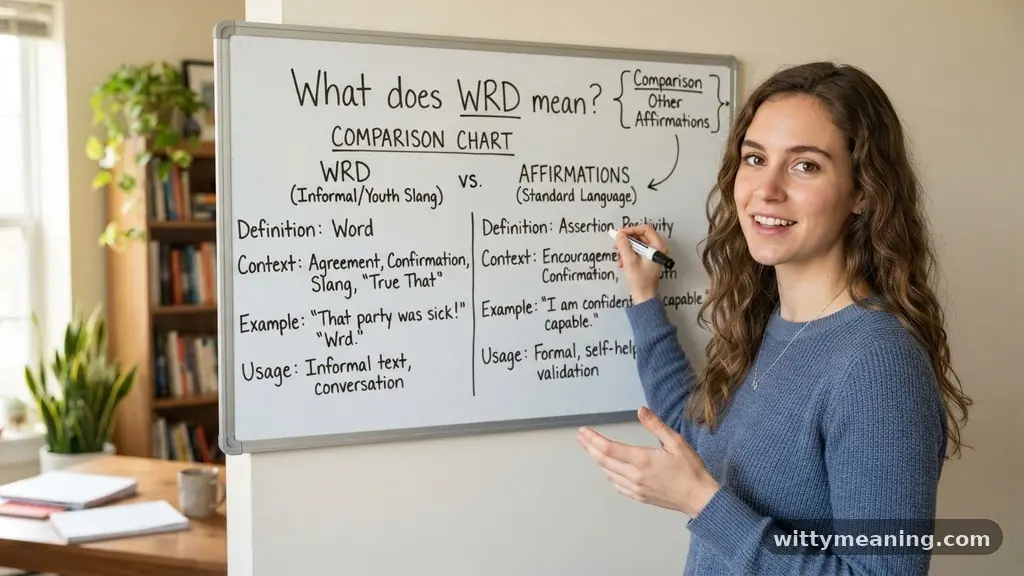
It is helpful to compare “wrd” with other common digital affirmations to understand where it fits on the spectrum of formality. While “okay,” “sure,” and “agreed” are standard, they lack the specific cultural weight that comes with “wrd.”
| Term | Formality Level | Primary Sentiment |
|---|---|---|
| Wrd | Very Informal | Agreement / Acknowledgement |
| Okay | Neutral | Acceptance / Compliance |
| Bet | Very Informal | Commitment / Agreement |
| Indeed | Formal | Confirmation |
As seen in the table, “wrd” sits firmly in the “very informal” category alongside terms like “bet.” It is not meant for the boardroom; it is meant for the group chat. Choosing between these options depends on how much enthusiasm or casualness you want to convey in your digital communication.
The Role of Social Media Platforms
Platforms like Instagram, Snapchat, and TikTok have accelerated the spread of this term. On these sites, the conversational tone is paramount.
Users are constantly trying to balance brevity with personality. When you comment “wrd” on a friend’s post, you are participating in a shared social ritual that signals you are part of the “in-group” that understands current internet slang.
On Snapchat, where messages often disappear, the speed of interaction is even higher. Users do not want to spend time typing out “I agree with that statement.” They want to react instantly.
“Wrd” serves this need perfectly. Similarly, on TikTok, the comments section is a chaotic stream of consciousness. Using “wrd” allows users to voice their support for a creator’s point of view without cluttering the screen, keeping the interaction fast, authentic, and focused on the content.
Common Misconceptions and Variations
One of the biggest misconceptions about “wrd” is that it is a typo. When someone who isn’t familiar with internet slang sees it, they might assume the sender accidentally hit the wrong keys.
This leads to confusion, especially across different generations. It is important to remember that this isn’t a mistake—it is a deliberate word contraction.
There are also variations to be aware of. You might see “wrdd” or “wrd2.” These aren’t necessarily standard, but they are common evolutions of the base term.
“Wrd2” often stems from “word to,” which is a shortened version of “word to your mother” or “word to the wise,” implying a deeper oath or validation of the truth. These variations show how language keeps evolving, with users constantly tweaking existing slang to add their own personal flair or emphasis.
Linguistic Evolution and Digital Shorthand
The rise of “wrd” is a case study in how the internet is changing our relationship with the English language. We have moved from a culture that values complete, grammatical sentences to one that prioritizes efficiency and tone.
This is not necessarily a degradation of language; rather, it is a transformation. We are using new tools to convey meaning, and linguistic evolution is a natural consequence of these new tools.
When we use internet slang, we are essentially creating a new dialect that is highly dependent on context. “Wrd” is just one piece of a much larger puzzle.
As we continue to interact primarily through screens, we will likely see more words shrink, morph, and take on new, specialized meanings. Embracing this shift allows us to communicate more effectively within the digital spaces we inhabit every day.
Addressing Topical Gaps
Many people ask if “wrd” has a medical or professional meaning. Outside of the world of text messaging, “WRD” can sometimes be an acronym for “Word” in computing or database management, but this is entirely different from the slang term. In medical contexts, it is sometimes used as a shorthand for “ward” in hospital notes, though this is discouraged in modern electronic health records due to the risk of confusion.
It is also worth noting that “wrd” is not universally understood. While common among younger demographics and those deeply integrated into social media culture, it can be completely opaque to others.
If you find yourself in a situation where you aren’t sure if the recipient will understand, it is always safer to stick to standard English. The goal of communication is clarity, and while slang is great for building rapport, it can be a barrier if the other person doesn’t share your linguistic frame of reference.
The Importance of Contextual Awareness
The most successful communicators are those who can switch between registers effortlessly. You might use “wrd” in a casual text to your best friend, but you would never use it in an email to a potential employer. Recognizing the appropriate time and place for slang is a key part of digital literacy.
If you are just starting to incorporate these types of abbreviations into your own vocabulary, observe how others use them first. Look at the tone of the conversation. If the other person is using emojis, abbreviations, and informal phrasing, you are likely in a safe space to do the same.
If the conversation is stiff and formal, keep your language standard. Being aware of these social cues ensures that your use of “wrd” comes across as natural and authentic rather than forced or confusing.
Future Trends in Digital Language
As we look toward the future, it is clear that digital shorthand will continue to adapt. We are already seeing a move toward more visual forms of communication, such as reaction gifs and custom stickers, which serve the same purpose as “wrd.” Yet, text-based abbreviations remain essential because they are fast and require no additional media to load.
What does the future hold for “wrd”? It will likely remain a staple of informal chat for years to come, but it may eventually be eclipsed by even shorter, more efficient ways of expressing agreement. Language is never static.
It is a living, breathing entity that reflects the society that uses it. By staying curious about terms like “wrd,” we stay connected to the pulse of modern interaction, ensuring that we can keep up with the ever-changing landscape of human expression.
Frequently Asked Questions
Is it considered rude to use WRD in a text?
No, it is not inherently rude, but it depends on the relationship. It is perfectly acceptable between friends or peers. However, using it with someone you don’t know well, or in a professional setting, might come across as overly casual or dismissive of the conversation.
Can WRD be used in a professional email?
You should avoid using it in professional emails. Professional communication generally requires standard grammar and spelling to convey respect and clarity. Using slang like “wrd” can make you appear unprofessional or unprepared, so it is best to stick to formal language in those environments.
How is WRD different from other slang like LOL or BRB?
While all are abbreviations, “wrd” is specifically an affirmation or a sign of agreement. In contrast, “LOL” expresses amusement, and “BRB” indicates a temporary absence. “Wrd” functions more like a verbal nod or a “yes,” making it a tool for maintaining conversational flow rather than conveying a specific emotion.
Does WRD have a different meaning on TikTok?
On TikTok, “wrd” is used exactly the same way as in text messaging—as an expression of agreement or acknowledgement. Because TikTok is a highly social platform, you will often see it used in comments to show support for a creator’s opinion or to validate a funny observation made in a video.
Conclusion
Understanding what does wrd mean in text is a great way to better navigate the nuances of modern digital communication. At its simplest, it is a way to say “I agree” or “I hear you” without needing to type out a full sentence. By recognizing that this term is rooted in cultural history and used primarily to maintain a casual, conversational tone, you can better interpret the messages you receive and use it effectively yourself.
The key to mastering internet slang is knowing when to lean into the informality and when to keep things standard. Whether you are chatting on Instagram, Snapchat, or just sending a quick text, using language that fits the situation is a skill that helps you build stronger connections. Now that you have a clearer picture of how this term fits into the broader landscape of digital language, feel free to use it naturally in your own conversations.