

You’ve likely encountered the term in a text message or a social media comment section and wondered about the ight meaning. It is a common piece of slang that has permeated digital communication, acting as a quick, informal way to convey agreement or acknowledgment. Understanding this shorthand helps you stay in the loop with modern linguistic trends, which often favor speed and phonetic efficiency.
Whether you see it on Snapchat or in a casual DM, recognizing how to interpret this word is essential for navigating today’s informal language landscape. By the end of this article, you will have a firm grasp of how to use it appropriately and what nuance it brings to your daily interactions.
The Linguistic Origins of Ight
At its core, the ight meaning is derived from a clipped version of the word “alright.” In linguistics, this process is known as aphaeresis, where the unstressed initial syllable of a word is dropped.
Over time, as speakers sought to communicate more efficiently in rapid-fire settings, “alright” became “aight,” which eventually shortened further to “ight.” This evolution is a classic example of how spoken language naturally drifts toward economy.
Phonetic spelling is a massive driver in the creation of modern slang. When people type on mobile devices, they often prioritize speed over traditional orthography.
Because “ight” captures the essential vowel and consonant structure of the original word while removing unnecessary characters, it became a staple of text speak. It reflects a shift where the sound of the word takes precedence over its dictionary-standard representation.
Ight as an Affirmative Response
When someone uses this term as an affirmative response, they are essentially saying “yes,” “okay,” or “I understand.” It functions as a low-effort way to signal that a message has been received and processed. Unlike a formal “yes,” which can sound stiff or overly rigid in a casual context, using this term keeps the flow of the conversation relaxed and friendly.
If a friend asks, “Do you want to grab coffee later?” and you respond with “Ight,” you are providing a clear, concise confirmation. It carries a sense of nonchalance that suggests you are easygoing.
This level of brevity is particularly useful in high-volume chat environments where long, drawn-out sentences can feel cumbersome or unnecessary. It keeps the momentum of the digital conversation moving forward without requiring extra effort from either party.
The Role of Nonchalance and Tone
One of the most interesting aspects of the ight meaning is how it conveys a specific attitude. Depending on the context, it can signal a sense of calm or even a slightly detached agreement. If you are discussing plans and the other person replies with just the word, it indicates they are comfortable with the arrangement and don’t need further clarification.
However, tone in text is notoriously difficult to read. Sometimes, a single-word response can be misinterpreted as passive-aggressive or dismissive.
If the conversation was previously heated, a short response might signal that the person is done talking or is choosing to disengage. It is important to look at the preceding messages to gauge whether the speaker is being genuinely agreeable or simply trying to end the dialogue.
Ight vs. Aight in Digital Communication
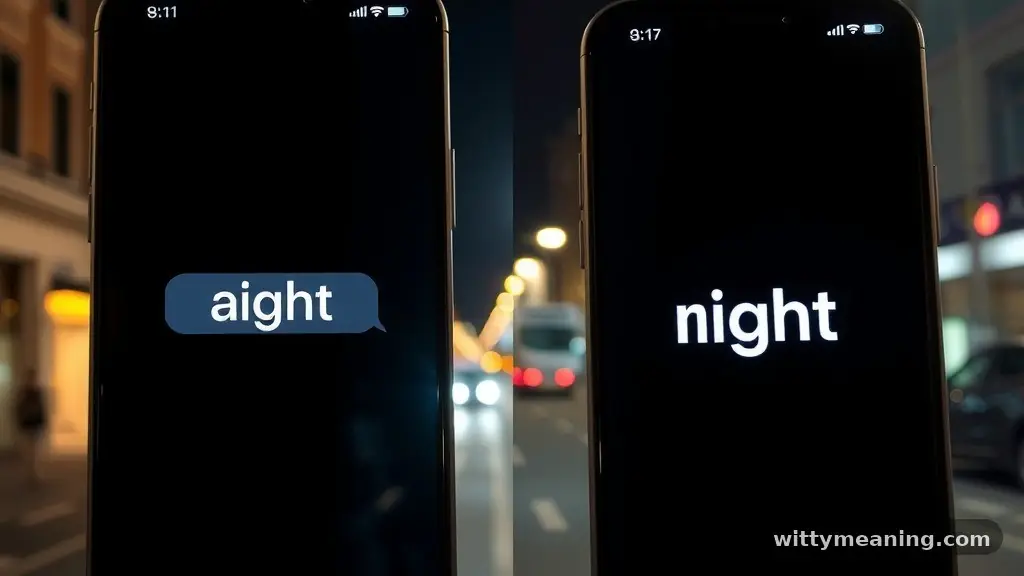
You might notice that some people use “aight” while others prefer the shorter version. While they share the same fundamental meaning, “aight” feels slightly closer to the phonetic roots of the word. It often carries a bit more weight or enthusiasm than the stripped-down version.
To help visualize the subtle differences in how these terms are used across platforms, consider this breakdown:
| Term | Primary Connotation | Best Used For |
|---|---|---|
| Aight | Casual, slightly more emphatic | Friendly, low-stakes agreement |
| Ight | Extremely brief, efficient | Fast-paced text messaging |
| Alright | Standard, formal, or serious | Professional or explicit confirmation |
Using “aight” can sometimes feel like a middle ground between the full word and the shorthand. It remains firmly in the realm of slang, but it doesn’t feel as abrupt as the four-letter version. Choosing between them often comes down to personal style and how much effort you want to put into your typing.
Usage in Social Media and Messaging Apps
Platforms like Snapchat and Instagram have accelerated the adoption of these terms. Because these apps rely heavily on visual content and quick reactions, the need for short, punchy text is high. On these channels, the ight meaning is rarely questioned; it is accepted as a standard element of the user interface culture.
In a Snapchat conversation, for example, brevity is often the goal. Users are frequently on the move, and typing out full sentences can be difficult. This is where shorthand becomes a functional necessity.
If you are sending a quick update to a friend, using this term allows you to acknowledge their previous message while keeping the focus on your next visual update. It acts as a bridge between thoughts, ensuring the conversation feels continuous.
Is Ight a Form of Consent?
In many scenarios, this term is used to provide consent or agreement to a proposal. Whether it is agreeing to a meeting time or confirming a plan, it acts as a digital stamp of approval. Because it is so casual, it is best reserved for informal settings.
If you are dealing with a formal agreement—such as a legal contract or a serious work-related decision—avoid using this slang. In those instances, clarity is paramount, and standard English is the only way to ensure there is no ambiguity.
Relying on slang in a professional setting can undermine your credibility. Always assess your audience before deciding to use informal language to ensure your message is received as intended.
The Evolution of Slang in Modern Language
Language is a living entity, and the ight meaning is a prime example of how it shifts to accommodate new technologies. As we spend more time interacting through screens, our vocabulary naturally reflects the constraints and culture of those platforms. This is not a degradation of language, but rather an adaptation to the environment.
You can trace the history of similar terms back to the early days of internet forums and SMS technology. The definition of slang often involves words that emerge from subcultures and eventually make their way into the mainstream. This particular term has successfully transitioned from niche urban vernacular to a household word used by millions across the globe, proving that its utility is what keeps it relevant in our daily lives.
Common Variations and Misinterpretations
Because it is a phonetic spelling, you may see variations like “ite” or “ight.” These are usually just stylistic choices by the sender.
Regardless of the spelling, the intent remains consistent. The main risk of using such informal language is the potential for misinterpretation by those who are not familiar with current trends.
If you are communicating with an older generation or someone who is not tech-savvy, they might be confused by the spelling. They could mistake it for a typo or a lack of literacy.
It is always wise to adapt your communication style to fit the person on the other end of the screen. If you are unsure if they will understand, it is better to stick to standard English to avoid confusion.
Expanding Your Vocabulary Beyond Basic Shorthand
While knowing the ight meaning is helpful, it is also important to maintain a diverse vocabulary. Over-reliance on any single piece of slang can make your writing feel repetitive. Mix in other ways to express agreement, such as “sounds good,” “definitely,” or “I agree,” to keep your communication fresh and engaging.
Using a variety of expressions allows you to better convey nuance. “Ight” is perfect for a quick acknowledgement, but it doesn’t convey excitement or deep commitment.
If you are truly enthusiastic about a plan, using a more descriptive phrase is a better way to show your genuine interest. Balance is key in effective digital communication, and knowing when to use shorthand versus when to use full sentences is a valuable skill.
Addressing Topical Gaps: Is it Always Appropriate?
One common question is whether the use of this term is ever considered rude. Generally, it is seen as casual rather than offensive.
However, there are times when it might come across as dismissive. If you are responding to someone who has shared a long, emotional, or detailed message, a one-word reply can feel like you are brushing them off.
In those situations, the brevity that makes the word so useful can become its biggest weakness. If the person you are talking to is opening up to you, they likely want a more thoughtful response.
In these cases, even if you agree with what they are saying, taking the time to write a slightly longer, more supportive sentence is the better choice. It shows that you are present and actually listening to what they have to say.
FAQ Section
What does ight mean in a text message?
In a text, it is a shortened version of “alright.” It functions as an informal way to say okay, yes, or to acknowledge that you have received a message. It is widely used in casual conversations to keep communication fast and efficient between friends or peers.
Is it better to use ight or aight?
It comes down to personal preference. “Aight” often feels slightly more conversational and closer to the original phonetic sound, while “ight” is the most extreme form of abbreviation. Both are perfectly acceptable in casual digital settings, but neither should be used in formal or professional writing.
What is the origin of the term ight?
The term originated as a slang version of “alright.” Through a linguistic process called aphaeresis, speakers dropped the first unstressed syllable. Over time, it became a staple of urban vernacular and eventually spread to mainstream digital communication through social media platforms and mobile text messaging.
Can using ight be considered rude?
It is usually not rude, but it can be perceived as dismissive if used in the wrong context. If someone is sharing something significant or emotional, a one-word response like this may seem like you are not paying attention or do not care about the content of their message.
Closing Thoughts
Navigating the nuances of digital slang like the ight meaning is all about context and intent. While it serves as a highly efficient tool for quick, casual agreement, it shouldn’t replace thoughtful communication in every situation. Knowing when to rely on these shortcuts and when to use full, expressive language is what separates a skilled communicator from someone who just follows trends.
Next time you find yourself typing a quick reply, consider whether the situation calls for that specific brand of brevity or if a slightly more detailed response would better serve the connection you are building. Language is a tool meant to bridge gaps between people, so use it in a way that feels authentic to you. Feel free to experiment with your own style and see how it fits into your daily digital interactions.