
If you’ve recently received a message saying “IMA call you later” or spotted someone writing “IMA post a video tonight” on social media, you may have wondered: what does IMA mean in text?
You’re not alone. The world of text messaging, online chat, and social media slang changes rapidly, and new abbreviations appear almost every day. Some are easy to understand, while others can leave people scratching their heads a little.
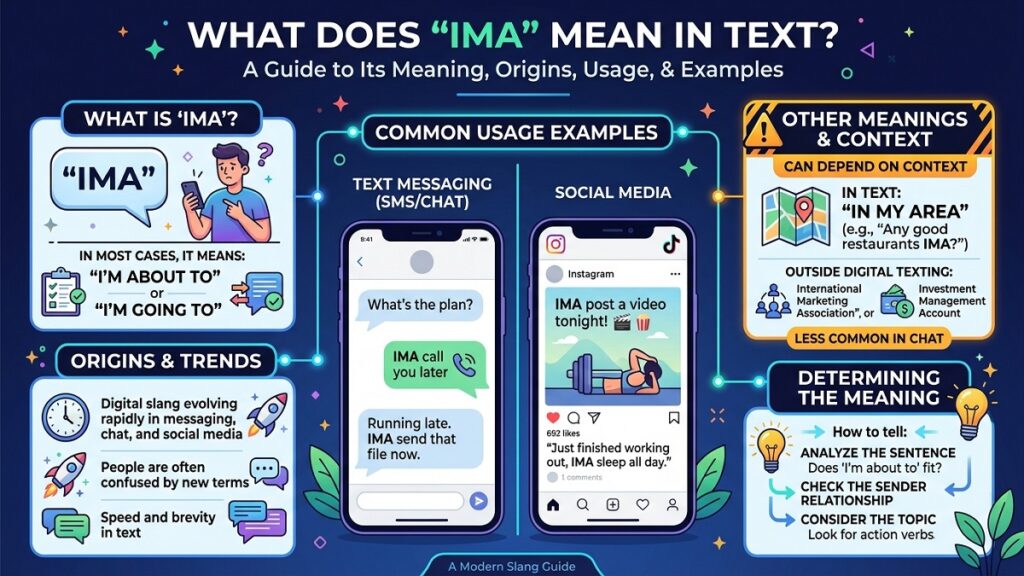
The abbreviation IMA is one of those terms that often creates confusion because it can have multiple meanings depending on the context. In most cases, it means “I’m about to” or “I’m going to.” However, in certain situations, it can also mean “In My Area” or even refer to organizations and professional terms outside digital communication.
This comprehensive guide explains everything you need to know about IMA meaning in text, including its origins, examples, social media usage, texting trends, alternate meanings, and how to determine the correct interpretation every time.
What Does IMA Mean in Text?
IMA most commonly means “I’m about to” or “I’m going to” in text messages and online conversations.
People use it as a form of text shorthand to communicate quickly without typing a complete sentence.
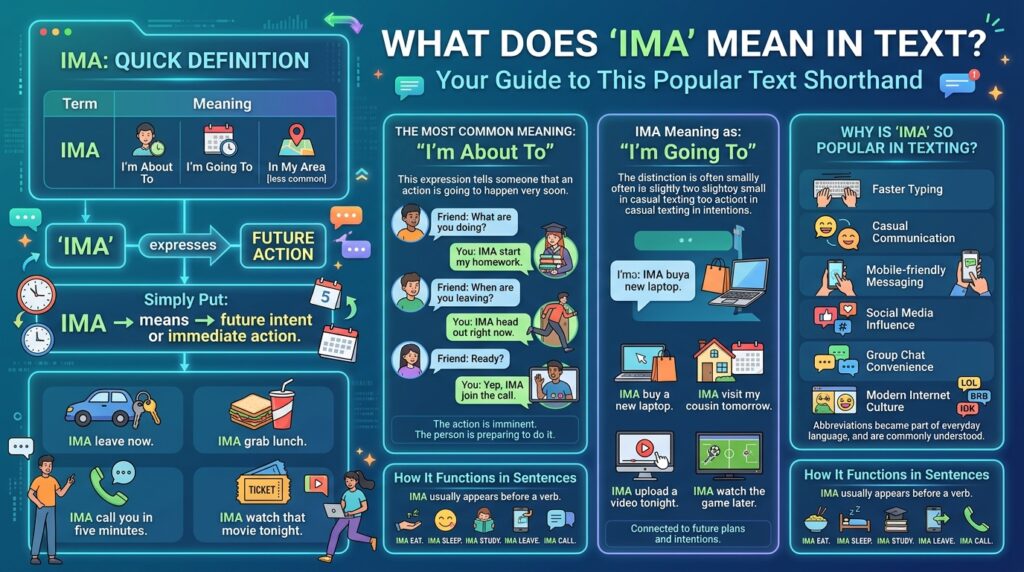
Quick Definition
| Term | Meaning |
|---|---|
| IMA | I’m About To |
| IMA | I’m Going To |
| IMA | In My Area (less common) |
For example:
- IMA leave now.
- IMA grab lunch.
- IMA call you in five minutes.
- IMA watch that movie tonight.
In each example, the person is expressing an upcoming action.
Simply put, IMA → means → future intent or immediate action.
Why Is IMA So Popular in Texting?
The rise of digital communication has encouraged people to shorten words and phrases. Nobody wants to type long sentences when a few characters can communicate the same thing.
Several reasons explain why IMA became popular:
- Faster typing
- Casual communication
- Mobile-friendly messaging
- Social media influence
- Group chat convenience
- Modern internet culture
As texting evolved, abbreviations became part of everyday language. Today, terms like LOL, BRB, IDK, and IMA are commonly understood by millions of users.
The Most Common Meaning: “I’m About To”
The primary meaning of IMA is “I’m about to.”
This expression tells someone that an action is going to happen very soon.
Examples
Friend: What are you doing?
You: IMA start my homework.
Friend: When are you leaving?
You: IMA head out right now.
Friend: Ready?
You: Yep, IMA join the call.
In these examples, the action is imminent. The person isn’t just thinking about doing something—they’re preparing to do it.
How It Functions in Sentences
IMA usually appears before a verb:
- IMA eat.
- IMA sleep.
- IMA study.
- IMA leave.
- IMA call.
This pattern makes it easy to recognize.
IMA Meaning as “I’m Going To”
Many users also use IMA to mean “I’m going to.”
The distinction between “I’m about to” and “I’m going to” is often very small in casual texting.
Examples
- IMA buy a new laptop.
- IMA visit my cousin tomorrow.
- IMA upload a video tonight.
- IMA watch the game later.
In these situations, the action may happen later rather than immediately.
Even so, the meaning remains connected to future plans and intentions.
Semantic Relationship
IMA → expresses → future action
This is one of the most important relationships search engines associate with the term.
What Does IMA Mean on Social Media?
On platforms such as Instagram, TikTok, Snapchat, and Facebook, IMA is widely used to keep communication short and engaging.
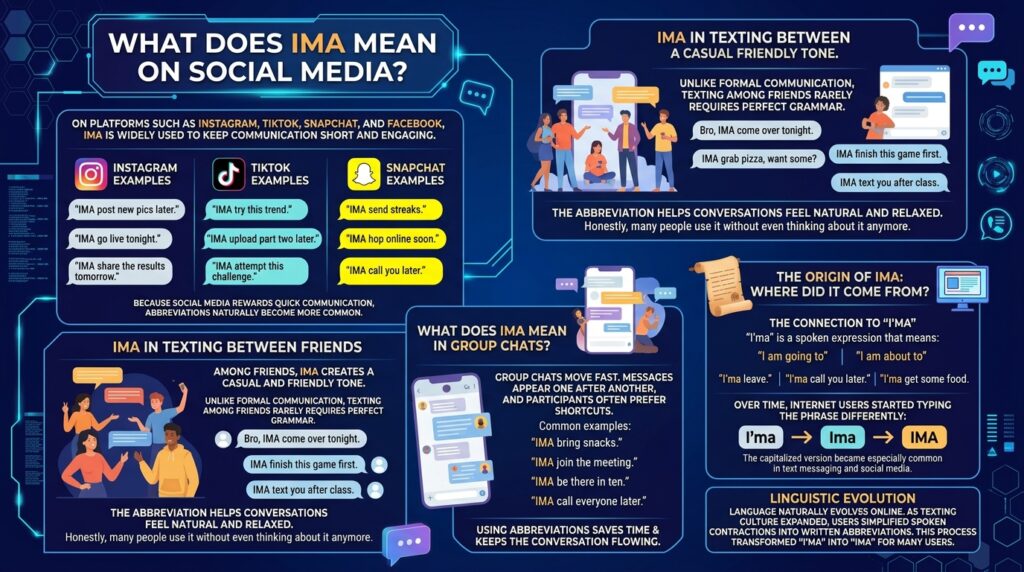
Instagram Examples
- IMA post new pics later.
- IMA go live tonight.
- IMA share the results tomorrow.
TikTok Examples
- IMA try this trend.
- IMA upload part two later.
- IMA attempt this challenge.
Snapchat Examples
- IMA send streaks.
- IMA hop online soon.
- IMA call you later.
Because social media rewards quick communication, abbreviations naturally become more common.
Semantic Triple
Social media users → use → IMA for faster communication.
IMA in Texting Between Friends
Among friends, IMA creates a casual and friendly tone.
Unlike formal communication, texting among friends rarely requires perfect grammar.
Examples
- Bro, IMA come over tonight.
- IMA grab pizza, want some?
- IMA finish this game first.
- IMA text you after class.
The abbreviation helps conversations feel natural and relaxed.
Honestly, many people use it without even thinking about it anymore.
What Does IMA Mean in Group Chats?
Group chats move fast. Messages appear one after another, and participants often prefer shortcuts.
Common examples include:
- IMA bring snacks.
- IMA join the meeting.
- IMA be there in ten.
- IMA call everyone later.
Using abbreviations saves time and keeps the conversation flowing.
Semantic Triple
Text abbreviations → support → quick digital communication.
The Origin of IMA: Where Did It Come From?
Many articles explain what IMA means but never discuss its origin. That’s a huge gap because understanding where a term comes from often makes its meaning easier to remember.
The Connection to “I’ma”
IMA is strongly connected to the contraction “I’ma.”
“I’ma” is a spoken expression that means:
- I am going to
- I am about to
Examples:
- I’ma leave.
- I’ma call you later.
- I’ma get some food.
Over time, internet users started typing the phrase differently:
- I’ma
- Ima
- IMA
The capitalized version became especially common in text messaging and social media.
Linguistic Evolution
Language naturally evolves online.
As texting culture expanded, users simplified spoken contractions into written abbreviations.
This process transformed “I’ma” into “IMA” for many users.
Is IMA Slang or an Abbreviation?
The answer is actually both.
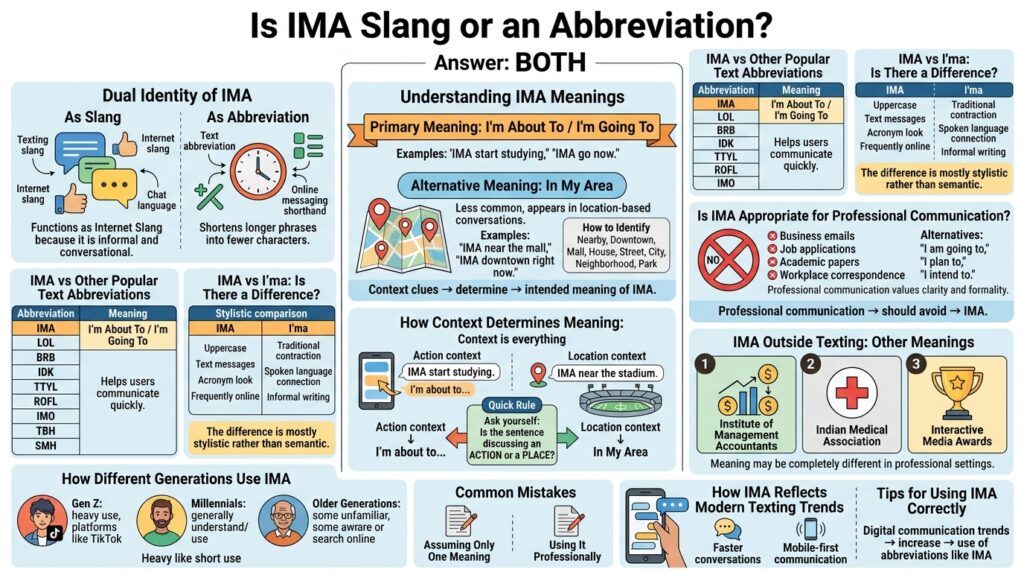
As Slang
IMA functions as internet slang because it is informal and conversational.
As an Abbreviation
IMA shortens longer phrases into fewer characters.
Because it serves both purposes, you’ll often hear it described as:
- Texting slang
- Internet slang
- Chat language
- Text abbreviation
- Online messaging shorthand
IMA Meaning: In My Area
Although less common, IMA can also mean “In My Area.”
This interpretation appears primarily in location-based conversations.
Examples
- IMA near the mall.
- Anyone IMA interested in basketball?
- IMA downtown right now.
- IMA near your neighborhood.
In these examples, the conversation focuses on location rather than actions.
How to Identify This Meaning
Look for location-related words such as:
- Nearby
- Downtown
- Mall
- House
- Street
- City
- Neighborhood
- Park
When these clues appear, IMA may refer to location.
Semantic Triple
Context clues → determine → intended meaning of IMA.
How Context Determines the Meaning of IMA
Context is everything.
The same abbreviation can mean different things depending on surrounding words.
Action-Based Context
Message: IMA start studying.
Meaning:
“I’m about to start studying.”
Location-Based Context
Message: IMA near the stadium.
Meaning:
“In My Area” or nearby location.
Social Context
Message: IMA post a new video.
Meaning:
“I’m going to post a new video.”
Quick Rule
Ask yourself:
Is the sentence discussing an action or a place?
If it’s an action, IMA usually means:
I’m about to or I’m going to
If it’s discussing location, it may mean:
In My Area
IMA vs Other Popular Text Abbreviations
Texting culture contains thousands of abbreviations, but some appear more frequently than others.
| Abbreviation | Meaning |
|---|---|
| IMA | I’m About To / I’m Going To |
| LOL | Laugh Out Loud |
| BRB | Be Right Back |
| IDK | I Don’t Know |
| TTYL | Talk To You Later |
| ROFL | Rolling On The Floor Laughing |
| IMO | In My Opinion |
| WYO | What You On |
| TBH | To Be Honest |
| SMH | Shaking My Head |
These abbreviations help users communicate quickly while maintaining conversational flow.
IMA vs I’ma: Is There a Difference?
This is one of the most misunderstood aspects of the term.
IMA
- Often written in uppercase
- Common in text messages
- Looks like an acronym
- Frequently used online
I’ma
- Traditional contraction
- More connected to spoken language
- Appears in informal writing
Examples
- I’ma call you later.
- IMA call you later.
Both versions generally mean the same thing.
The difference is mostly stylistic rather than semantic.
Is IMA Appropriate for Professional Communication?
No.
IMA belongs in casual communication environments.
Avoid using it in:
- Business emails
- Job applications
- Academic papers
- Professional reports
- Workplace correspondence
Instead use:
- I am going to
- I am about to
- I plan to
- I intend to
Professional communication values clarity and formality.
Semantic Triple
Professional communication → should avoid → IMA.
Other Meanings of IMA Outside Texting
One major weakness of many articles is that they ignore alternative meanings.
Outside texting, IMA can refer to several organizations and institutions.
1. Institute of Management Accountants
A professional association for accountants and financial professionals.
2. Indian Medical Association
One of the largest medical associations in India.
3. Interactive Media Awards
Recognizes excellence in website and digital media design.
Why This Matters
If someone encounters IMA in a business, accounting, healthcare, or professional setting, the meaning may be completely different from texting slang.
How Different Generations Use IMA
Gen Z
Gen Z uses internet slang heavily.
Platforms such as TikTok and Snapchat contribute to widespread adoption.
Millennials
Millennials generally understand IMA and often use similar abbreviations.
Older Generations
Some older users may be unfamiliar with the abbreviation and search for its meaning after encountering it.
This generational difference explains why questions about IMA continue to grow online.
Common Mistakes People Make When Using IMA
Assuming Only One Meaning
Not every use of IMA means “I’m about to.”
Always examine the surrounding context.
Using It Professionally
Many people accidentally transfer texting habits into workplace communication.
That’s usually not a great idea.
Ignoring Context Clues
Location words and action verbs provide valuable hints.
Overusing Slang
Too much slang can make conversations difficult to understand.
Balance is important.
How IMA Reflects Modern Texting Trends
Texting abbreviations continue to shape modern communication.
Several trends support their growth:
- Faster conversations
- Mobile-first communication
- Character efficiency
- Informal messaging styles
- Social media influence
Semantic Triple
Digital communication trends → increase → use of abbreviations like IMA.
As long as people value speed and convenience, abbreviations will likely remain popular.
Tips for Using IMA Correctly
If you want to use IMA naturally, follow these guidelines:
- Use it with friends and family.
- Use it in casual chats.
- Avoid professional settings.
- Follow it with a clear action or location.
- Consider whether the recipient understands texting slang.
Examples:
- IMA leave now.
- IMA call later.
- IMA near downtown.
These are clear, simple, and easy to understand.
Frequently Asked Questions
What does IMA mean in text messages?
IMA usually means “I’m about to” or “I’m going to.” People use it in texting, social media, and online chats to describe an upcoming action. The abbreviation helps users communicate quickly and naturally in casual digital conversations.
Does IMA always mean “I’m about to”?
No. While “I’m about to” is the most common meaning, IMA can also mean “In My Area” in location-based conversations. The surrounding words and context determine which interpretation is correct.
Is IMA the same as I’ma?
Yes, in most situations they have the same meaning. Both express future intent or an upcoming action. The main difference is that “I’ma” is a contraction, while “IMA” is commonly written as a texting abbreviation.
Can I use IMA in professional emails?
No. IMA is considered informal internet slang. Professional communication should use complete phrases such as “I am going to,” “I am about to,” or “I intend to” for better clarity and professionalism.